
Affluent Seller Pipeline Guide for Luxury Agents
What if a stronger luxury listing pipeline came from fewer, better-prepared conversations rather than a longer contact list? Affluent seller pipeline generation works when homeowners are qualified, understand your expertise, and are ready to discuss a move. More names alone won’t solve inconsistent access, unproductive follow-up, or the challenge of earning credibility with high-value prospects.
Trust matters in luxury real estate. Build it before the appointment so your time goes to meaningful listing conversations instead of chasing low-intent leads. This guide explains how to find and qualify seller opportunities, assess appointment readiness, and use a consistent process to move conversations toward a listing.
We’ll cover the pipeline from identifying affluent homeowners to preparing for the first meeting. LuxeScale helps agents identify and qualify affluent homeowners who are ready to sell, then schedules listing appointments. Its coaching, training, and live video education help agents prepare to convert those opportunities.
Key Takeaways
- Strong affluent seller pipeline generation prioritizes homeowners with genuine motivation, a plausible timeframe, and interest in discussing a sale, not simply high-net-worth contact data.
- Use a repeatable path from identifying and engaging prospects to qualifying, pre-framing, and scheduling listing conversations.
- Evaluate lead programs by qualification standards, appointment readiness, compensation structure, territory terms, and agent support.
- Track qualified and held appointments alongside listing agreements and closed transactions to identify where your process needs attention.
- LuxeScale identifies and qualifies affluent homeowners and schedules listing appointments. Its referral model charges a 20% fee at closing, with no monthly or recurring out-of-pocket charges.
What affluent seller pipeline generation means for luxury agents
Affluent seller pipeline generation is the repeatable process of identifying, qualifying, and scheduling affluent homeowners who have a genuine reason and readiness to discuss selling. It is more than a database of high-net-worth contacts. Financial capacity or an expensive property may indicate potential, but neither confirms intent, timing, or willingness to consider representation.
A useful pipeline tracks progress from first contact to a meaningful listing conversation. That aligns with the broader idea of a sales pipeline: prospects move through defined stages instead of sitting in an undifferentiated list. For luxury agents, the key questions are whether the homeowner has a reason to consider selling, a timeframe worth following, a property that fits the agent’s business, and openness to discussing representation.
How an affluent seller opportunity differs from a general real estate lead
A seller opportunity has context. An owner may be preparing for a relocation, reassessing a property, or considering a change in their portfolio. These signals do not guarantee a listing, but they give you a relevant reason to ask about timing and needs. Qualification also clarifies whether the property fits your expertise and whether the owner is willing to discuss selling and representation.
Affluence alone proves none of this. Ask what prompted the homeowner to consider a change, when they might act, and what they need to know before deciding. An early-stage prospect may need useful, low-pressure follow-up; someone with a defined timeline may be ready for a focused listing discussion. Distinguishing between the two helps you prioritize your time and keep outreach relevant.
Why a luxury listing pipeline needs a defined process
Without consistent prospecting and qualification, listing conversations can depend too heavily on referrals arriving at the right moment. A defined process gives you a disciplined way to identify potential sellers, understand their priorities, and move suitable prospects toward an appointment. It also makes it easier to review activity and decide what follow-up belongs next.
Credibility should start before the meeting. Communicate your relevant experience and approach in a way that speaks to the homeowner’s priorities. Before the appointment, review what you already know so you can avoid generic questions and make the conversation useful from the start. Explore the practical side of that conversation in this guide to luxury real estate listing appointments.
Affluent seller pipeline generation is about appointment readiness, not contact volume. Build a consistent path from prospect identification to a prepared meeting, and use qualification to decide when to advance, nurture, or pause follow-up.
Building an Affluent Seller Pipeline: Prospect to Meeting
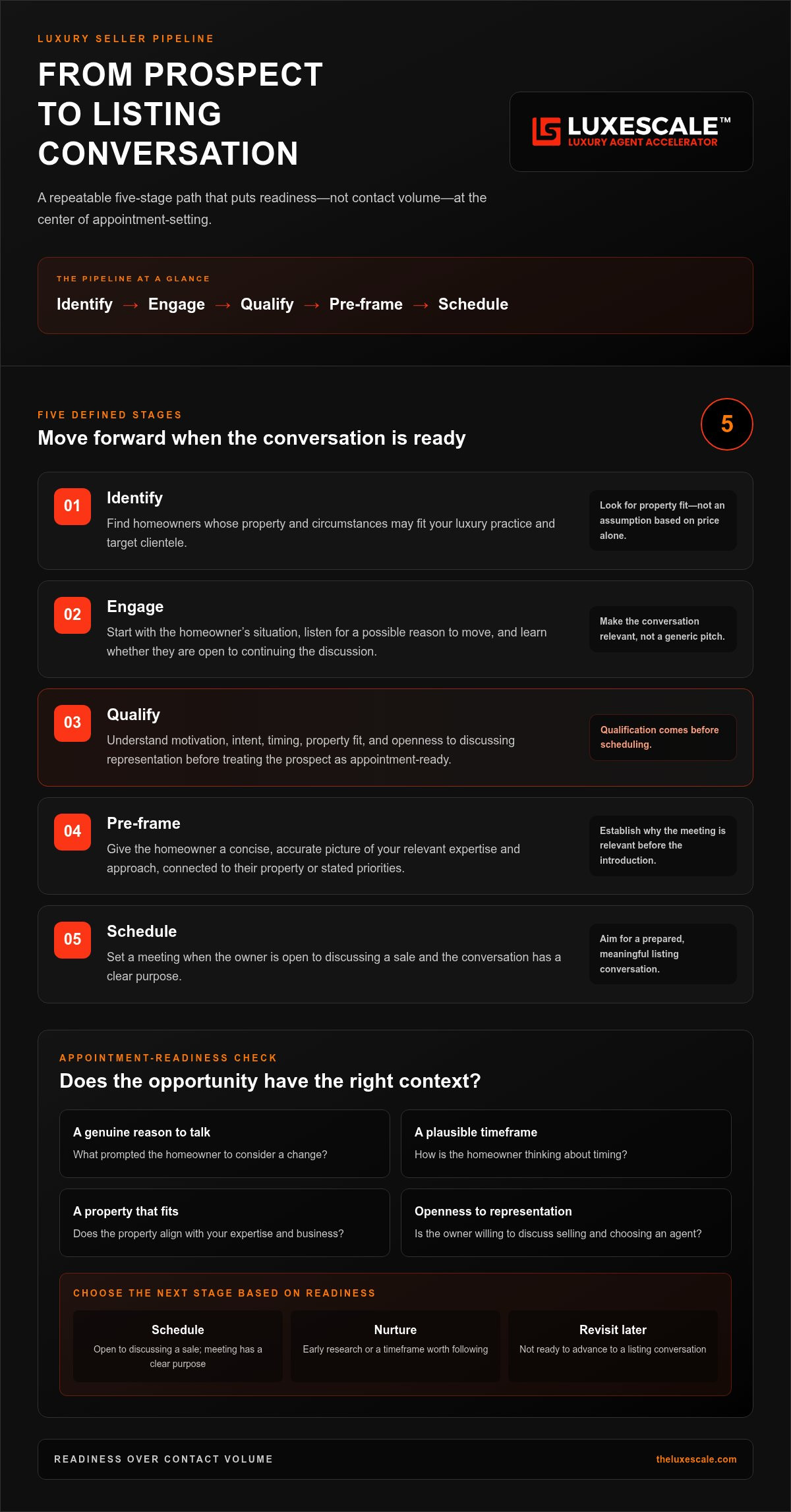
A disciplined pipeline moves each potential seller through five stages: identify, engage, qualify, pre-frame, and schedule. At each stage, define what you need to learn before advancing a prospect. This keeps appointment-setting tied to readiness rather than contact volume.
- Identify: Find homeowners whose property and circumstances may fit your luxury practice. The luxury real estate market is not defined by one assumption about price. Consider whether the property fits your expertise and target clientele.
- Engage: Open a relevant conversation about the homeowner’s situation instead of leading with a generic pitch. Listen for a possible reason to move and whether they are open to continuing the discussion.
- Qualify: Establish motivation, intent, timing, property fit, and openness to discussing representation before treating the prospect as ready for an appointment.
- Pre-frame: Explain why your experience and approach relate to the homeowner’s needs before making an introduction.
- Schedule: Set a meeting when the owner is open to discussing a sale and the conversation has a clear purpose.
Qualify seller motivation, timing, and fit
Qualification should come before scheduling. An appointment is most useful when the homeowner has a relevant reason to talk, a plausible timeframe, and a property that fits the agent’s expertise. Distinguish immediate intent from early research or general curiosity. Ask what has prompted the homeowner to consider a change, how they are thinking about timing, and what they hope to understand before making a decision.
Clarify whether the owner is prepared to discuss the practical considerations of a sale, without assuming that affluence alone signals readiness. Find out whether they are open to representation and what matters most when choosing an agent. No single answer guarantees a listing. Taken together, the details help you decide whether to schedule, nurture, or revisit the conversation later.
Pre-frame the agent before the listing conversation
Before an introduction, give the homeowner a concise, accurate picture of your relevant expertise and value. Tie that positioning to the property or the seller’s stated priorities instead of relying on broad claims. The homeowner can then see why the meeting is relevant, and you can begin with a more focused conversation. Explore the role of pre-framing and credibility building in high-end sales.
LuxeScale’s affluent seller opportunities connect prospecting and qualification with scheduled listing conversations. Agents receive context and preparation support so they can focus on a relevant, well-framed meeting.
How to evaluate affluent seller pipeline services and referral terms
Evaluate the process behind an appointment, not just the number of names or meetings. A sound affluent seller pipeline generation model should explain how prospects are qualified, what context you receive before an appointment, and what you pay. Use a consistent framework to assess fit:
| Evaluation area | What to assess |
|---|---|
| Qualification standards | Does the process establish seller motivation, intent, timing, property fit, and openness to discussing representation? |
| Appointment readiness | Will you know what prompted the conversation and what the homeowner expects from the meeting, or are you receiving a contact with little context? |
| Compensation | Is payment a recurring subscription charge, or a referral fee tied to a closing? Clarify when payment applies and how the agreement defines it. |
| Territory | Understand how territory limits affect access to opportunities and potential overlap with other agents. |
| Support | Does the relationship end at appointment delivery, or include training, coaching, and systems to help you prepare and convert? |
Assess appointment quality and referral economics
Appointment quality depends on useful qualification detail. A homeowner casually exploring options is different from someone with a clear reason to discuss selling, even if neither is certain to list. Assess how the service distinguishes early interest from a timely conversation and what information you receive before the meeting.
A recurring subscription charge is paid on a schedule, whether or not a transaction closes. A closing-based referral arrangement ties the fee to a completed transaction under the agreement’s terms. That structure connects payment to a realized outcome, but it does not mean every referral will become a listing or sale. Review the written terms, including how the fee is calculated, when it becomes payable, and any applicable referral obligations.
Evaluate exclusivity, coaching, and operational support
Territory terms shape how opportunities are allocated and whether agents may have overlapping access. Review how boundaries and exclusivity are defined, then weigh appointment delivery against support that helps you prepare, position your expertise, and manage the listing conversation.
LuxeScale’s performance-based referral model has a 20% fee at closing, with no monthly or recurring out-of-pocket charges. The service also includes training, coaching, systems, and support. Evaluate the written referral terms alongside the support and your own conversion process. For a deeper evaluation framework, read choosing a luxury real estate referral partner.
How to turn affluent seller appointments into a measurable listing pipeline
An appointment is a pipeline milestone, not the final outcome. To understand whether your process is working, track what happens from referral through closing. Separate the actions you control from results that depend on the seller’s decisions and transaction details. That makes affluent seller pipeline generation easier to assess without treating every meeting as a likely listing.
Track the stages that reveal pipeline health
Use consistent stage definitions so you can see where opportunities stall. Record each referral or prospect as it moves through qualification, appointment scheduling, the meeting, follow-up, a listing agreement, and, when applicable, a closed transaction.
- Activity measures: referrals received, qualification details captured, appointments scheduled, and follow-up completed.
- Progress measures: qualified appointments, appointments held, next steps agreed, and listing agreements signed.
- Outcome measures: transactions closed.
Review the measures together. If scheduled appointments are often not held, revisit readiness, scheduling expectations, and pre-meeting communication. If meetings take place but rarely lead to an agreed next step, consider whether you uncovered the seller’s priorities and explained your value clearly. If follow-up is inconsistent, set a cadence based on what the homeowner requested and the timing they shared.
Look for patterns across opportunities rather than reacting to one outcome. A seller may change plans, delay a decision, or choose another direction for reasons outside your control. Use measurement to identify process improvements, not to assume a particular conversion rate or closing.
Prepare for the first affluent seller conversation
Before the appointment, review the homeowner’s stated goals and the context already gathered. Prepare focused questions about their priorities, timing, and what they need to decide. Then listen closely. A discussion grounded in the seller’s answers is more useful than a presentation built around generic claims.
Bring relevant market expertise to the conversation and explain how your approach addresses the homeowner’s specific concerns. Close by confirming the next step and agreeing on follow-up that reflects their preferences. For additional preparation guidance, see this luxury listing presentation guide.
Coaching can help agents sharpen appointment preparation, discovery questions, value positioning, and follow-through. Explore LuxeScale’s affluent seller opportunities and agent support to learn how qualified appointments and conversion-focused training fit into your pipeline process.
How LuxeScale supports affluent seller pipeline generation
LuxeScale connects prospecting with agent readiness through four stages: attract, qualify, position, and schedule. The focus is not simply on supplying names. LuxeScale identifies and qualifies affluent homeowners who are ready to sell, prepares them to understand the agent’s expertise, and schedules listing appointments so agents can focus on the seller conversation.
What agents can expect from the LuxeScale process
Attract and qualify focus on finding potential sellers and assessing whether a conversation is relevant. Position introduces the agent’s expertise and value before the meeting, giving the homeowner useful context. Schedule moves a suitable opportunity toward a listing appointment. Together, these steps address qualification, appointment readiness, credibility, and a defined next action. An appointment is an opportunity, not a guaranteed listing or closed transaction.
LuxeScale uses a performance-based referral model: the referral fee is 20% at closing, with no monthly or recurring out-of-pocket charges. Unlike a subscription structure, this model does not involve recurring charges regardless of whether a transaction closes. Review the written agreement to understand the fee calculation and how the terms fit your business economics.
Support extends beyond appointment delivery. LuxeScale provides coaching, training, live video education, and systems to help agents prepare and strengthen their conversion process. LuxeScale also limits the number of agents allowed in any one territory. The agent remains responsible for the listing conversation, follow-up, and conversion.
Decide whether the model fits your growth strategy
This model may suit agents who want qualified affluent seller opportunities without monthly recurring charges and are prepared to invest their expertise in appointment preparation and follow-through. Consider whether the opportunities match your target clients, whether the support complements your strengths, and how the referral terms fit your business priorities. A well-qualified appointment creates an opportunity, not a guaranteed outcome.
If you want to focus more of your time on luxury listing conversations, explore LuxeScale’s luxury listing appointment service and how its prospecting, qualification, and agent support fit your growth plan.
Build a More Dependable Luxury Listing Pipeline
A stronger pipeline depends on readiness, not a larger list of affluent contacts. Qualify homeowners before scheduling, then track appointments, follow-up, listing agreements, and closings to see where your process can improve. Prepare for each conversation with relevant questions and a clear understanding of the seller’s priorities.
LuxeScale supports this approach with a four-stage process: attract, qualify, position, and schedule. Agents also receive complementary training, coaching, live video education, systems, and support to help them prepare for and convert listing conversations. The referral model has a 20% fee at closing, with no monthly or recurring out-of-pocket charges.
Effective affluent seller pipeline generation still depends on your preparation, judgment, and follow-through. If you’re ready to explore qualified affluent seller opportunities and luxury listing appointments, explore LuxeScale’s affluent seller pipeline and luxury listing appointments.
Frequently Asked Questions
What is affluent seller pipeline generation?
Affluent seller pipeline generation is the repeatable process of identifying, qualifying, and scheduling affluent homeowners who are open to discussing a sale. It goes beyond collecting contact details or targeting owners based only on property value. A useful pipeline tracks motivation, intent, timing, property fit, and readiness for a listing conversation, then guides follow-up. The aim is to create relevant appointments and a clear path from first contact to a potential listing.
How do real estate agents find affluent homeowners who are ready to sell?
Agents can build access through consistent prospecting, professional relationships, relevant market content, and qualified seller lead programs. Look for a reason to start a timely conversation, then ask respectful questions about the homeowner’s plans and priorities. A high-value property or affluent profile alone does not show that its owner is ready to sell. Confirm interest and timing before treating a contact as an appointment opportunity.
What makes an affluent seller lead qualified?
A qualified affluent seller lead is more than a homeowner with financial means or a high-value property. Qualification should clarify motivation, intent, likely timing, property fit, readiness to consider a sale, and willingness to discuss representation. These details help you prepare a relevant conversation and decide whether to schedule now or follow up later. No single signal guarantees a listing, so assess the full context.
How can agents measure an affluent seller pipeline?
Track opportunities through clear stages: referrals received, qualified appointments, appointments scheduled and held, follow-up completed, listing agreements signed, and transactions closed. Separate activity, such as completing follow-up, from outcomes, such as securing an agreement or closing. Reviewing both helps identify where the process may be weakening. For example, scheduled meetings that are not held may call for better readiness checks or clearer appointment expectations. Look for patterns rather than drawing conclusions from one prospect.
Are pay-at-closing real estate referrals worth considering?
They may suit agents who prefer referral compensation tied to a completed transaction rather than recurring subscription charges. Payment at closing does not mean every referral will become a listing or sale. Compare the referral terms with the qualification, appointment preparation, and support provided. Review the written agreement to understand when a fee applies, how it is calculated, and any referral obligations before deciding whether the arrangement fits your business.
What should agents look for in a luxury seller lead generation partner?
Assess how the partner identifies and qualifies sellers, what context you receive before an appointment, and how the homeowner is prepared for your introduction. Also consider compensation terms, territory provisions, and whether support includes coaching, training, and conversion systems. Appointment volume alone will not tell you whether opportunities fit your practice. Look for a clear process and evaluate it against your target clients, capacity, and ability to prepare for and follow up after meetings.
How does LuxeScale help agents generate affluent seller appointments?
LuxeScale uses a four-stage process: attract affluent homeowners, qualify potential sellers, position agents as credible luxury experts, and schedule listing appointments. This connects prospecting and preparation so agents can focus on seller conversations. LuxeScale also provides training, coaching, live video education, systems, and support to help agents improve conversion. Its performance-based referral model charges a 20% fee at closing and has no monthly or recurring out-of-pocket charges. An appointment creates an opportunity, not a guaranteed listing.

Article by
Mark Coppens
Mark Coppens is the Founder and Chairman of LuxeScale and Co-Team Lead of Living Vogue | eXp Luxury. He is an active elite-level luxury agent and the author of the upcoming book, POWER POSITIONING: From Missiles to Mansions – Why People Really Buy, and is a nationally recognized speaker on luxury real estate, consumer psychology, marketing, and business growth.
A U.S. Army veteran with an MBA in Marketing, Mark has generated more than $1 billion in career sales and now leads one of the nation's fastest-growing luxury referral platforms, referring more than $2 billion in luxury real estate opportunities each month to partner agents across the United States. He specializes in helping real estate agents generate more listings, break into the luxury market, and build scalable businesses through qualified referrals, award-winning training, coaching, and proven systems. His practical, psychology-driven approach has helped agents across the country increase their income while attracting more affluent clients and building lasting, referral-driven businesses.