
Breaking Into High-End Real Estate With No Experience: A 2026 Roadmap
You don’t need a luxury sales record to start building a credible path into the high-end market. Breaking into high-end real estate with no experience is possible, but confidence alone won’t earn a client’s trust. You’ll need strong fundamentals, polished communication, and a clear understanding of the market you want to serve.
If you’re concerned affluent clients will dismiss you without a luxury track record, focus on what you can demonstrate instead. These clients expect discretion, sound judgment, and capable guidance. Don’t exaggerate your experience. Build relevant skills, learn from established professionals, and show your value through consistent preparation and follow-through.
This roadmap explains what to develop before pursuing luxury clients, how to gain practical exposure honestly, and how to position yourself for qualified opportunities. Coaching and training can help you prepare, while scheduled listing appointments with qualified affluent homeowners can give you access to seller conversations. Neither replaces licensing, brokerage supervision, or the competence you must earn. The goal is a measured route from foundation to readiness, with credibility at every step.
Key Takeaways
- Breaking into high-end real estate with no experience starts with separating a missing luxury sales record from the professional skills and foundations you can build.
- Review your licensing requirements with your state regulator, then strengthen the market knowledge and service habits affluent clients expect.
- Compare mentorship, professional networks, education, and appointment access by what each can help you develop, and choose a specific next action.
- Use a practical progression from licensing review to market immersion, measuring readiness through demonstrated skills rather than arbitrary deadlines.
- Qualified homeowner appointments and coaching can expand your opportunities and preparation, but they don’t replace licensing, brokerage supervision, or client-service competence.
Breaking Into High-End Real Estate With No Experience: What the Path Really Requires
High-end real estate is a service segment, not a shortcut to larger commissions. Clients may be making complex, high-value decisions, so they need an agent who prepares carefully, communicates clearly, and follows through reliably. A useful Understanding the Real Estate Industry resource can help put residential sales in context, but luxury readiness comes from applying your knowledge to clients and transactions.
Having no luxury sales record doesn’t mean you have no relevant experience. It does mean you should be precise about what you’ve done and what you’re still learning. Licensing and brokerage requirements vary by state, so check current rules with the relevant state real estate regulator and follow your brokerage’s supervision requirements. Credibility grows through preparation, service, market knowledge, and results, not through a luxury label alone.
What counts as experience when you have not sold luxury homes?
Transferable experience can give you a practical starting point. Negotiation may help you manage competing priorities; hospitality can sharpen your attention to detail; finance can build comfort with numbers; and business development can help you initiate professional conversations. These abilities are relevant, but they aren’t proof of luxury transaction history. Describe the distinction plainly: explain the skills you bring, identify the experience you have earned, and don’t imply that you’ve represented luxury buyers or sellers if you haven’t.
That honesty is strategic. Accurate positioning helps clients and colleagues understand your strengths and where you’ll need guidance. For example, you can describe your experience handling client relationships in hospitality while making clear that you’re developing your real estate transaction expertise.
What luxury clients need from an agent
Affluent clients still need the fundamentals: accurate advice, dependable execution, and clear communication. Discretion matters, as does responsiveness that sets realistic expectations and follows through. Before a conversation, understand the property, the client’s priorities, and which questions you can answer. If you don’t know something, say so, then identify how you’ll find a reliable answer within your brokerage’s processes.
Trust is earned in specific moments: arriving prepared, protecting sensitive information, explaining options without pressure, and keeping commitments. Expensive personal branding or an appearance of wealth can’t replace those behaviors. For agents focused on breaking into high-end real estate with no experience, the standard is straightforward: demonstrate sound judgment consistently, and let your conduct support your claims.
Build the Licensing, Market Knowledge, and Service Foundations Luxury Work Demands
Separate eligibility from readiness. Licensing and brokerage requirements determine what you’re permitted to do; they don’t automatically prepare you to advise high-end clients. Check current rules with the real estate regulator in your state. For example, the Real Estate Broker Licensing Requirements page explains Oregon’s requirements, but it shouldn’t be treated as guidance for other states.
Luxury-market readiness means combining professional competence, accurate market guidance, and dependable client service. Build fluency in the market where you intend to work. Track active and recently sold properties, compare features and condition, and learn how inventory and buyer demand shape pricing conversations. Rather than memorizing figures, practice explaining what the available information means for a client’s decisions.
Which technical and transaction skills should you develop first?
Start with pricing analysis, contract fluency, negotiation, and transaction coordination. A comparative market analysis (CMA) brings relevant property data together so you can discuss a reasoned pricing range, explain which comparisons are useful, and identify factors that may affect value. It informs the conversation, but doesn’t replace professional judgment or a careful review of the property and market.
Learn your brokerage’s procedures for offers, disclosures, deadlines, and transaction handoffs. Practice explaining unfamiliar terms in plain language, and seek appropriate supervision when a situation is new or complex. Reliable execution depends on understanding both the client-facing steps and the internal process that keeps a transaction organized.
How to build credible proof before your first luxury listing
Keep a record of relevant work, including client-service results, professional development, market research, and skills you’ve practiced. Describe each accurately. Observe experienced agents and, where permitted, learn from their listing preparation or transaction activity. Notice how they organize information, anticipate client questions, and coordinate details. This gives you specific examples of your preparation without suggesting that you’ve closed transactions you haven’t handled.
To sharpen your presentation preparation, review this luxury listing presentation guide. Training and coaching can also help you turn preparation into a more consistent client process. Explore luxury agent coaching and support as one resource for developing that capability, while continuing to build market knowledge and work within your brokerage’s supervision.
Compare Entry Routes: Brokerage Mentorship, Professional Networks, and Practical Exposure
There’s no single route that turns a new agent into a luxury specialist. Brokerage mentorship can help you develop judgment; professional relationships can introduce you to relevant work; education builds knowledge; and qualified appointment access can create opportunities to apply your preparation. When breaking into high-end real estate with no experience, weigh each route by what it helps you learn and what you’ll still need to do yourself.
| Route | What it builds | Its limits | Your next action |
|---|---|---|---|
| Brokerage mentorship | Practical feedback on pricing, client communication, offers, and transaction workflows. | Mentorship and brokerage support vary. Observation alone doesn’t establish independent transaction competence. | Ask about opportunities to observe listing preparation or discuss a practice scenario within brokerage procedures. |
| Professional networks | Relationships with agents and other professionals who may share insight or relevant exposure. | A contact list isn’t a referral strategy, and trust takes time to build. | Contribute consistently, share useful information, and follow through on commitments before asking for introductions. |
| Education | Structured knowledge of market analysis, contracts, negotiation, and client service. | Coursework can’t reproduce every live client interaction or replace supervised practice. | Apply each concept through market research, role-play, or permitted observation. |
| Qualified appointment access | Opportunities to speak with affluent homeowners identified as ready to sell; coaching can support preparation. | An appointment doesn’t guarantee a listing or replace licensing, brokerage supervision, or service ability. | Prepare thoroughly, follow brokerage processes, and treat each conversation as a chance to demonstrate competence. |
What a brokerage and experienced mentor can help you learn
Feedback is most useful when it’s specific. An experienced agent can help you refine a pricing explanation, prepare for a client conversation, review how an offer is organized, or understand the sequence of a transaction. Observing first lets you see how professionals handle questions and coordinate details before you take on greater responsibility. The scope of mentorship and brokerage support differs, so establish what guidance is available and how to use it.
How professional relationships can create relevant exposure
Build reciprocal relationships by being useful: share thoughtful market observations, attend professional events with a learning mindset, and reliably complete the work you take on. Don’t approach every contact as a source of immediate referrals. A sustained professional relationship is more credible than a rushed request. For a separate approach to referral development, read this guide to luxury real estate referrals.
These routes work best together. Education can sharpen your questions, mentorship can improve your judgment, and real conversations can reveal where more preparation is needed. None promises a fast track, guaranteed income, or a set timeline to luxury sales. Represent your experience honestly and build competence through deliberate practice.
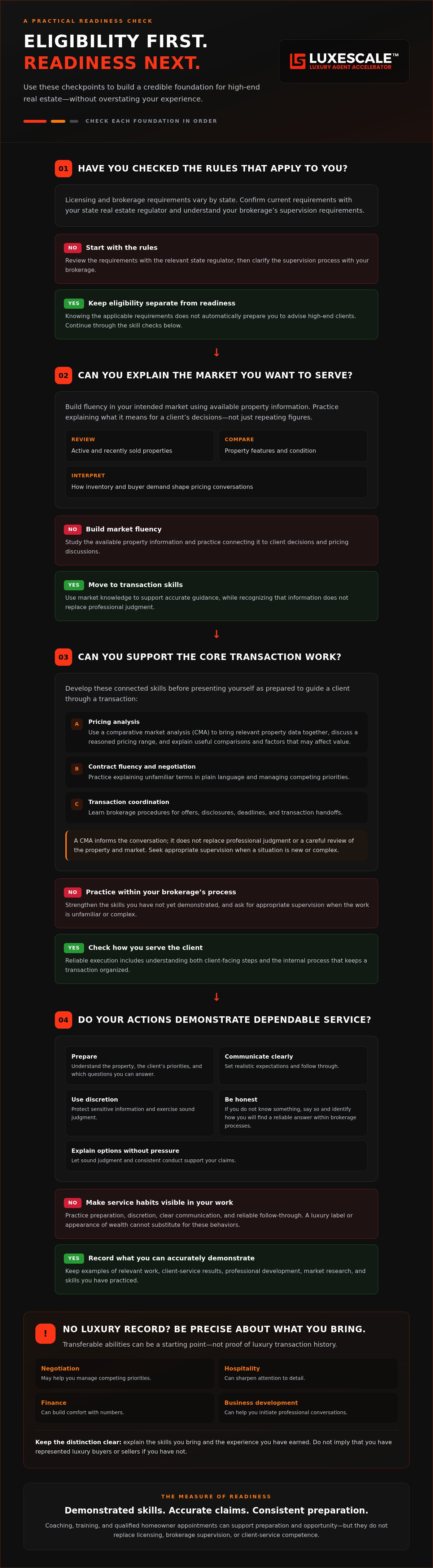
A Practical Path from Beginner to Luxury-Ready Agent
Make progress in stages, and use demonstrated ability to decide when you’re ready to take on more. This approach to breaking into high-end real estate with no experience avoids arbitrary deadlines and status signals. Each step produces evidence you can review, discuss with a mentor, or use to identify your next skill gap.
- Review licensing and affiliation requirements. Check current rules with your state real estate regulator, then identify the brokerage affiliation and supervision requirements that apply to you. Progress check: You can explain which requirements you’ve met and what remains before you can practice.
- Choose a learning environment. Look for relevant feedback, opportunities to observe transaction workflows, and clear guidance on when to seek supervision. Progress check: You know who to approach with questions and how to follow your brokerage’s procedures.
- Build a focused skills plan. Include pricing analysis, negotiation, presentation, and client communication. Turn each area into a practice activity, such as preparing a sample comparative market analysis or rehearsing a pricing conversation. Progress check: You can explain your reasoning clearly and identify where you need feedback.
- Immerse yourself in your service area. Review current listings and relevant sales, note property features and market context, and practice explaining how the evidence informs a pricing discussion. Progress check: You can support your observations with market information rather than broad claims.
- Demonstrate readiness honestly. Practice describing a client-service plan without suggesting you have luxury expertise or transactions you haven’t earned. Document professional development and relevant outcomes accurately. Progress check: Your examples show what you can do and where you’re still building experience.
- Pursue relevant exposure and review your progress. Participate consistently in professional relationships, seek permitted observation, and consider qualified opportunities when you’re prepared to handle the conversation. Use feedback, demonstrated skills, and client-service readiness to decide what to pursue next. Progress check: You can identify specific evidence of improvement and a concrete next step.
Competence builds credibility, and credibility positions you to pursue opportunity. That sequence matters more than an impressive image or a rushed claim of expertise. Qualified listing opportunities can expand access to conversations, but they don’t replace preparation, licensing, brokerage supervision, or your ability to serve the client well.
If you’re ready to pair deliberate preparation with relevant listing opportunities, explore how LuxeScale supports luxury listing opportunities.
Use Qualified Opportunities and Coaching to Support Your Luxury Market Entry
Preparation and access solve different problems. Coaching can strengthen how you handle a client conversation; a qualified listing appointment can put you in that conversation. Neither is a substitute for licensing, brokerage supervision, market knowledge, or the ability to serve a homeowner well. For agents focused on breaking into high-end real estate with no experience, an appointment is a chance to demonstrate readiness, not a shortcut around earning it.
What qualified listing appointments can, and cannot, do for a new agent
LuxeScale qualifies affluent homeowners who are ready to sell and schedules listing appointments directly for agents. That creates access to a seller conversation, not a guarantee of a listing, a signed client, or a completed transaction. You still need to understand the homeowner’s priorities, prepare relevant market information, communicate a clear service plan, and follow through. Trust is earned in the meeting and in every step that follows.
An appointment doesn’t change your professional responsibilities. You must meet applicable licensing requirements and operate within your brokerage’s supervision and procedures. If you’re still developing a skill, prepare carefully and seek appropriate guidance rather than overstating your experience or taking on responsibilities you aren’t qualified to handle.
How LuxeScale combines opportunity access with agent preparation
Alongside qualified appointments, LuxeScale provides coaching, training, and live video education to support agent preparation and conversion readiness. Use that support to strengthen how you open a seller conversation, explain your approach, respond to questions, and identify where you need further practice. For a closer look at appointment preparation, review this luxury listing appointment guide.
Participation is limited by territory exclusivity, which limits the number of participating agents. The model is performance-based: there are no monthly or recurring out-of-pocket charges, and a 20% fee is charged at closing. That fee structure doesn’t guarantee an appointment will convert or produce a closing. Be prepared to follow up professionally, work within your brokerage’s requirements, and deliver the service the homeowner expects.
If you’ve built the necessary foundation and are ready to pursue qualified seller conversations with preparation and support, explore LuxeScale’s luxury listing opportunities.
Build Your Luxury Real Estate Career One Credible Step at a Time
Breaking into high-end real estate with no experience doesn’t require pretending you’ve already earned a luxury track record. It calls for strong fundamentals, market knowledge, dependable client service, and honest communication about what you can do. Mentorship, professional relationships, and practical exposure can help you develop, while qualified opportunities give you a chance to apply that preparation.
LuxeScale helps agents access appointments with qualified affluent homeowners who are ready to sell, alongside coaching, training, and live video education. An appointment creates access to a conversation, not a guaranteed listing or closing. The performance-based model charges a 20% fee at closing, with no monthly or recurring out-of-pocket charges.
If you’re prepared to keep building your skills and pursue relevant seller conversations, explore LuxeScale’s luxury listing opportunities. Stay focused on competence before claims, and let each well-prepared interaction strengthen your credibility. Your next step can be practical, honest, and achievable.
Frequently Asked Questions
Is it possible to break into high-end real estate with no experience?
Yes, you can work toward the luxury market without a luxury sales record, but you’ll need to build the skills and professional foundation the work demands. Start by understanding applicable licensing and brokerage requirements, then develop market knowledge, transaction skills, and reliable client service. Be accurate about your background. Related experience in negotiation, hospitality, finance, or business development can be relevant, but it isn’t the same as a record of luxury transactions.
Do I need a real estate license to work in luxury real estate?
Licensing requirements depend on your state and the activities you plan to perform. Check current rules with the relevant state real estate regulator, and understand your brokerage’s requirements. Don’t assume you can independently advise or represent a seller without meeting applicable requirements. If you’re not yet eligible to practice, focus on education and permitted ways to learn from experienced professionals while you establish your path.
How can a new agent build credibility with affluent homeowners?
Build credibility through preparation and consistent conduct, not claims or appearances. Learn the market, support pricing discussions with relevant evidence, explain your service process clearly, protect client information, and follow through on commitments. Be candid about your experience while showing what you can competently do. For example, describe your client-service background accurately, but don’t present it as luxury transaction experience. Trust grows as clients see sound judgment in action.
What skills should I learn before pursuing luxury listings?
Develop pricing analysis, contract fluency, negotiation, transaction coordination, and clear client communication. Learn to prepare a comparative market analysis and explain how relevant sales and property differences inform a pricing discussion. Understand your brokerage’s procedures, including when to seek supervision on unfamiliar situations. Luxury clients still need accurate advice and dependable execution. Strong fundamentals help you deliver those standards without overstating your expertise or relying on an image of luxury success.
Can a new real estate agent work with luxury clients?
Yes, a new agent may pursue luxury clients when properly licensed for the work and supported by applicable brokerage supervision. A lack of past luxury sales doesn’t automatically rule you out, but you must be clear about your experience and prepared to serve the client. Build knowledge of the relevant market, practice your client conversations, and seek guidance when a situation exceeds your experience. An opportunity is a chance to earn trust, not proof of readiness by itself.
How do luxury real estate agents get listing opportunities?
Agents develop opportunities through professional relationships, referrals, consistent market expertise, and deliberate business development. LuxeScale also qualifies affluent homeowners who are ready to sell and schedules listing appointments for agents. An appointment creates access to a seller conversation, not an assured listing or closing. Its performance-based model charges a 20% fee at closing, with no monthly or recurring out-of-pocket charges. Agents remain responsible for preparation, follow-through, and client service.
Is mentorship important when entering the luxury real estate market?
Mentorship can help you develop judgment before taking on greater responsibility. An experienced agent may offer feedback on pricing explanations, client communication, offers, and transaction workflows, while observation can show how those skills work in practice. The availability and scope of mentorship vary, so take initiative: seek specific feedback, prepare questions, and act on what you learn. Mentorship supports development, but it doesn’t replace licensing, brokerage supervision, or your responsibility to represent your abilities honestly.

Article by
Mark Coppens
Mark Coppens is the Founder and Chairman of LuxeScale and Co-Team Lead of Living Vogue | eXp Luxury. He is an active elite-level luxury agent and the author of the upcoming book, POWER POSITIONING: From Missiles to Mansions – Why People Really Buy, and is a nationally recognized speaker on luxury real estate, consumer psychology, marketing, and business growth.
A U.S. Army veteran with an MBA in Marketing, Mark has generated more than $1 billion in career sales and now leads one of the nation's fastest-growing luxury referral platforms, referring more than $2 billion in luxury real estate opportunities each month to partner agents across the United States. He specializes in helping real estate agents generate more listings, break into the luxury market, and build scalable businesses through qualified referrals, award-winning training, coaching, and proven systems. His practical, psychology-driven approach has helped agents across the country increase their income while attracting more affluent clients and building lasting, referral-driven businesses.