
Buying Guide: Pre-Screened Affluent Home Sellers
What if affluent status is the least important part of a seller lead? A high-value home can look like a strong opportunity, but without verified intent and a clear appointment, it may consume hours without advancing your pipeline. That is the distinction to examine when evaluating pre screened affluent home sellers.
A seller appointment service should do more than pass along an impressive property profile. You need to know how the homeowner is qualified, what “ready to sell” means, whether the appointment is confirmed, and how referral terms and territory exclusivity work. Clear answers help you judge the opportunity on substance, not labels.
This guide explains what meaningful pre-screening should cover and which questions to ask before choosing a service. You’ll assess lead quality, appointment readiness, agent fit, and available support, then compare the provider’s incentives with your business goals. We’ll also look at how LuxeScale’s performance-based model, with a referral fee due at closing, may fit your business. Review the agreement for the exact terms before making a decision.
Key Takeaways
- Separate homeowner information from verified seller intent and a scheduled listing appointment before judging an opportunity.
- When evaluating pre screened affluent home sellers, ask what “ready to sell” means and how recently that intent was confirmed.
- Compare appointment services on qualification criteria, appointment expectations, agent support, territory terms, and payment structure, not lead volume alone.
- Check whether your experience, availability, and follow-up process are suited to the sellers you want to serve.
- Understand LuxeScale’s closing-based model and review the agreement for the precise referral terms and conditions.
What pre screened affluent home sellers should mean for a listing agent
“Pre-screened” should mean that a prospect has been assessed against clear, stated criteria, not simply identified as an affluent homeowner. A property’s value may make its owner relevant to your business, but it does not prove the owner intends to sell, has a suitable timeline, or is willing to meet with an agent. Before committing time to an appointment, ask what the provider verifies and how it defines a qualified opportunity.
An affluent homeowner lead is a person associated with a high-value property. A qualified seller opportunity is a homeowner whose selling intent, timing, and fit have been assessed against stated criteria. A scheduled listing appointment goes further: a meeting has been arranged, and its essential details are clear. This distinction matters because lead generation can capture interest, while screening and appointment setting are separate steps.
Does affluent homeowner status prove someone is ready to sell?
No. Wealth and property value suggest potential market fit, not a decision to list. Qualification should treat selling motivation, expected timing, and willingness to meet as separate factors. An owner may be curious about a property’s value without planning a move, or may expect to sell eventually without being ready to discuss representation.
Ask what “ready to sell” means in the provider’s process, when the homeowner’s intent was last confirmed, and how property fit is assessed. These questions help you understand the standard without assuming every service uses the same criteria or screening questions.
What separates a seller lead from a listing appointment?
A contact record gives you information about a person. A conversation shows some level of engagement, but may not establish intent or timing. A qualified seller opportunity has been assessed against relevant criteria. A listing appointment is a meeting scheduled for you and the homeowner to discuss a potential sale. None of these stages guarantees a signed listing or completed transaction.
Before accepting an appointment, confirm the homeowner’s name, the property being discussed, the meeting date and time, the format, who is expected to attend, and what the homeowner understands the meeting is for. Ask whether those details were confirmed with the homeowner and what happens if they need to reschedule. For guidance on preparing for these conversations, see this guide to qualified luxury listing appointments.
Use the same standard when reviewing pre screened affluent home sellers: check whether intent, timing, property fit, and appointment details are clear. That helps distinguish a potentially valuable introduction from a meeting that is genuinely ready for your attention.
How to assess seller intent, qualification, and appointment readiness
Use a consistent sequence before accepting a referral: understand the provider’s qualification criteria, find out how it applies them, verify the appointment details, and assess whether the opportunity fits your expertise and capacity. This gives you a practical way to evaluate the opportunity without treating unverified homeowner details as fact.
Start by asking what “ready to sell” means. Which criteria address seller intent, expected timing, property fit, and willingness to meet? When was the homeowner’s intent last confirmed, and what information will you receive before the appointment? General seller trends can provide context, but they cannot establish an individual homeowner’s plans. The National Association of REALTORS® provides broader buyer and seller research to help agents assess seller intent with market context in mind.
Which qualification details should agents request?
Ask the provider to explain its criteria and distinguish confirmed details from information you will need to learn yourself. Clarify what happens if the homeowner’s plans change, they cannot be reached, or the meeting needs to be rescheduled. These questions reveal how expectations are set without assuming that a provider follows a particular screening script.
Documented qualification criteria make referrals easier to evaluate because you can compare each opportunity against the same standard. Clear notes also help you prepare relevant questions without mistaking a lead summary for a complete picture of the seller’s circumstances.
How can agents validate appointment quality?
Before the meeting, confirm who arranged it, who is expected to attend, the date and format, and what the homeowner expects to discuss. Check whether the provider confirmed these details with the homeowner. A calendar entry alone does not establish that both parties are prepared. Then assess your own fit: can you serve the property and seller effectively, and do you have time to follow up?
Ask how appointment outcomes and agent feedback are recorded or reviewed. A defined feedback process can help clarify whether a referral matched the stated criteria and where expectations may need adjustment. For a wider view of pipeline development, explore these seller lead generation strategies.
Apply this framework when evaluating pre screened affluent home sellers: verify the criteria, confirm the meeting, and judge the opportunity against your business needs. If you’re exploring scheduled listing opportunities, review LuxeScale’s listing appointment approach and clarify its qualification and appointment terms directly.
Compare affluent seller appointment services beyond lead volume
A high lead count can hide important differences. Compare how each service defines a qualified seller, what it delivers, what support comes with the opportunity, how territory terms work, and when payment is due. An appointment service may handle prospect identification and scheduling, while self-generated leads give you more control over how you build and pursue your pipeline. Neither approach guarantees a signed listing or closing.
| Comparison point | Appointment service | Self-generated leads |
|---|---|---|
| Qualification transparency | Check the stated criteria and which details are confirmed. | You choose the criteria and assess each prospect yourself. |
| Appointment delivery | Confirm whether the service schedules a meeting and what details are shared. | You handle outreach, follow-up, and scheduling. |
| Support | Ask whether training or coaching is included and what it covers. | You arrange your own preparation and support. |
| Territory terms | Review how exclusivity is defined and whether it is confirmed in writing. | Your lead sources and prospecting may overlap with other agents. |
| Payment structure | Check when payment is due and which outcomes trigger it. | Review any costs or commitments tied to the channels you use. |
Use the table to compare documented service features, not promises about results. Claims about appointment quality, seller readiness, or transaction outcomes should be supported by clear definitions and evidence. For pre screened affluent home sellers, ask what the provider verifies and what you still need to establish in conversation with the homeowner.
What should a transparent referral arrangement explain?
Read the agreement to identify the exact event that makes a fee due, how a closing is defined, and which transactions qualify. Review how it addresses cancellations, disputes, territory exclusivity, and the scope of the service. LuxeScale describes its model as performance-based, with a 20% referral fee due at closing and no monthly or recurring out-of-pocket charges. Check the agreement for applicable terms, conditions, and exceptions. Consult a qualified legal or compliance professional if you need help interpreting your obligations.
How do coaching and territory terms affect service fit?
Training can be useful when it prepares you for the expectations and communication demands of affluent homeowner conversations. Ask what the coaching, training, and live video education cover. Clarify how territory exclusivity is defined, and request written confirmation of current availability and terms. For a broader due diligence framework, review these luxury referral partner evaluation criteria.
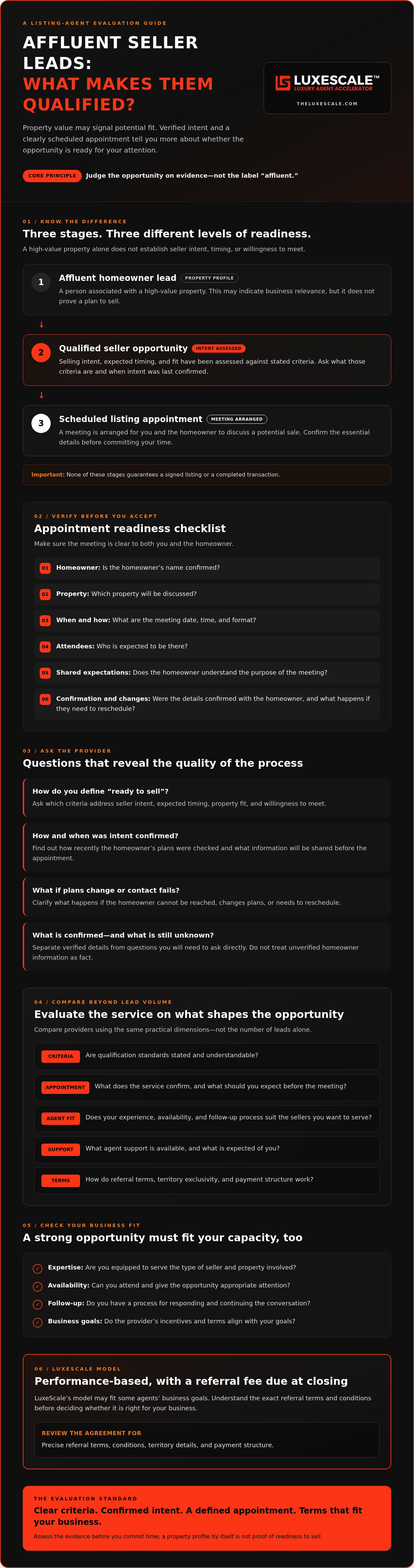
Use this checklist to decide whether the opportunity fits your business
A promising referral becomes valuable only if you can serve the homeowner well and follow through consistently. Before pursuing pre screened affluent home sellers, assess your readiness as well as the provider’s process. Property value is only one consideration. Your experience, capacity, and ability to guide a high-stakes conversation also matter.
- Relevant experience: Can you demonstrate the market knowledge and service approach affluent clients expect?
- Capacity: Can you prepare for appointments, respond promptly, and follow up without compromising service to current clients?
- Follow-up discipline: Do you have a repeatable way to track conversations, next steps, and outcomes?
- Business fit: Does the referral arrangement make sense alongside your current conversion process and transaction economics?
Questions to ask before accepting seller referrals
Request a plain-language explanation of how the provider defines seller qualification and schedules appointments. Ask what details you’ll receive beforehand, what the homeowner expects to discuss, and how the provider handles a changed timeline, cancellation, or missed meeting. Clarify what training, coaching, and ongoing communication are included, and how territory terms are defined. Get relevant expectations and commitments in writing before deciding.
Compare the arrangement with your current process. Consider the time and resources you spend generating, contacting, and qualifying prospects, then weigh those against the work required to prepare for and follow up after an appointment. Use your own business records rather than assumptions about conversion or transaction outcomes.
How to measure fit after starting
Agree with the provider on a review period and a consistent way to record each stage. Track whether you reached the homeowner, whether the appointment was held, whether a listing agreement followed, and whether the transaction closed. These are separate outcomes. Reviewing them separately can help identify whether a gap relates to lead quality, appointment expectations, agent fit, or follow-up.
Record useful feedback after each interaction, including any mismatch between the stated criteria and what you learned in conversation. Look for patterns before drawing conclusions. A single appointment may not show how well the arrangement fits your pipeline. Bring specific examples to the provider when discussing qualification standards, support, or appointment expectations.
If your experience and capacity align with the opportunity, review LuxeScale’s affluent seller appointments and assess whether its process, support, and written terms fit your business. Evaluate the arrangement based on documented expectations and your own results, not an assumed promise of closed transactions.
How LuxeScale connects qualified affluent sellers with listing agents
LuxeScale focuses on listing opportunities, not simply adding names to an agent’s contact list. The service identifies and qualifies affluent homeowners described as ready to sell, then schedules listing appointments with agents. That creates an opportunity for a direct seller conversation. The agent remains responsible for preparation, advice, follow-up, and earning the listing.
For agents seeking pre screened affluent home sellers, the distinction matters: a scheduled appointment is not a guaranteed listing or completed transaction. Before moving forward, ask LuxeScale to explain its current definition of seller readiness and how qualification is handled. Confirm what information you’ll receive ahead of each meeting so you can prepare without assuming details that have not been verified.
What agents can expect from the LuxeScale model
LuxeScale describes its arrangement as performance-based, with a 20% referral fee due at closing and no monthly or recurring out-of-pocket charges. The precise trigger, qualifying transaction, and any exceptions depend on the written agreement. Review those terms carefully rather than relying on a general description of “pay at closing.”
Agent support is another part of the model. LuxeScale offers coaching, training, and live video education to help agents prepare for affluent homeowner conversations. These resources support agent readiness, but they do not guarantee that an appointment will become a listing or that a transaction will close. Ask what support is included and how it relates to the opportunities you may receive.
How to take the next step with confidence
Before deciding whether the service fits, bring focused questions to the conversation:
- What criteria define an affluent homeowner as ready to sell, and how is that intent confirmed?
- What should the agent expect from a scheduled appointment, and what information is shared beforehand?
- How are follow-up, feedback, and changes to the homeowner’s plans handled?
- How are territory exclusivity and current availability defined and confirmed?
- What coaching and training are included, and what are the exact written payment terms?
Then consider your own capacity and luxury positioning. Can you serve the homeowners appropriately, attend the meetings, and follow through consistently? A clear match between agent readiness, qualification expectations, and contractual terms gives both sides a more grounded basis for a partnership. Review the details directly, including the scope of the service and any territory terms that apply.
Explore a LuxeScale partnership to discuss service fit, seller qualification expectations, and current territory availability.
Build a Listing Pipeline on Clear Expectations
The strongest opportunity is not simply an affluent homeowner’s name. It is a clearly defined path from qualification to a scheduled conversation, supported by terms you understand and a process that fits your business. Use that standard to evaluate pre screened affluent home sellers and choose opportunities you can serve with confidence.
LuxeScale identifies and qualifies affluent homeowners described as ready to sell, then schedules listing appointments for agents. Coaching, training, and live video education complement those opportunities. The performance-based model has no monthly or recurring out-of-pocket charges. Confirm the qualification process, service scope, territory availability, and all payment and closing terms in the agreement. An appointment creates an opportunity to earn a listing, not a guarantee of a transaction.
If the model aligns with your experience, capacity, and growth priorities, take the next step: Explore a LuxeScale partnership and discuss fit and expectations directly. A disciplined approach can help you build a more intentional pipeline and pursue high-value conversations with greater clarity.
Frequently Asked Questions
What does pre-screened mean for affluent home sellers?
Pre-screened means a homeowner has been assessed against criteria the provider can explain, not simply identified as owning a valuable property. Ask how the provider evaluates selling intent, expected timing, property fit, and willingness to meet. Then clarify which details have been verified and when. Definitions vary by service, so do not assume a lead label means the homeowner is ready to list or that every relevant detail has been confirmed.
How can real estate agents verify that an affluent seller is ready to list?
Ask the provider what readiness criteria it applied and when the homeowner’s plans were last confirmed. Before the meeting, clarify the homeowner’s expectations, appointment format, and any known timing or property details. Treat these as preparation signals, not proof that a listing will follow. Confirm important facts directly with the homeowner, then record whether the appointment occurred and what happened next to assess the referral process consistently.
Are pre-screened affluent seller leads better than standard real estate leads?
They may be more useful if screening reflects genuine seller intent and the service delivers an appointment suited to your business. A high-value property profile alone does not establish lead quality. Compare the provider’s criteria, appointment expectations, support, and agreement terms with those of other lead sources. Then evaluate your own contact, appointment, and conversion outcomes. Neither a premium label nor a large volume of contacts proves that a source will produce listings.
What questions should I ask a luxury seller appointment service?
Ask how the service defines seller readiness, which details it verifies, and how it schedules appointments. Clarify how changed plans, cancellations, and missed meetings are handled. Request a written explanation of referral terms, payment conditions, territory arrangements, and included coaching or training. Finally, compare those expectations with your follow-up capacity and ability to serve affluent clients. Clear answers make it easier to judge whether the arrangement fits your business.
Does a scheduled listing appointment guarantee a listing?
No. A scheduled appointment creates an opportunity to understand the homeowner’s needs and present your services, but it does not guarantee a listing agreement or completed sale. The outcome can depend on the seller’s plans, the fit between agent and homeowner, preparation, presentation, and follow-up. Assess a provider by its documented qualification and appointment process, then track your own results. Treat scheduled meetings as opportunities, not promised transactions.
How should I compare performance-based seller referral services?
Compare qualification criteria, appointment expectations, written terms, territory exclusivity, agent support, and how outcomes are reviewed. Identify exactly when a fee becomes due and which transactions are covered. Do not rely on a verbal summary. LuxeScale describes its model as performance-based, with a 20% referral fee due at closing and no monthly or recurring out-of-pocket charges. Review the agreement for the precise conditions and exceptions, and seek professional guidance for contractual questions.
Can newer agents work with affluent home sellers?
Yes, if they are prepared to demonstrate relevant market knowledge, communicate professionally, and deliver a credible listing process. Coaching or pre-appointment education may help you prepare for affluent homeowner conversations, but it does not replace your own preparation or experience. Assess what you can confidently deliver, ask the provider what support is included, and be candid about your capacity. A thoughtful service approach matters more than relying on a lead source to establish credibility for you.
What happens if a referred homeowner cancels or is not ready to sell?
The next steps depend on the provider’s process and written agreement. Before accepting referrals, ask how cancellations, missed appointments, changed timelines, or a mismatch with readiness criteria are handled. Clarify whether a review procedure or other remedy applies, and do not assume one exists unless the contract says so. Record what happened and share feedback through the agreed process. This creates a clear basis for evaluating appointment quality and expectations over time.

Article by
Mark Coppens
Mark Coppens is the Founder and Chairman of LuxeScale and Co-Team Lead of Living Vogue | eXp Luxury. He is an active elite-level luxury agent and the author of the upcoming book, POWER POSITIONING: From Missiles to Mansions – Why People Really Buy, and is a nationally recognized speaker on luxury real estate, consumer psychology, marketing, and business growth.
A U.S. Army veteran with an MBA in Marketing, Mark has generated more than $1 billion in career sales and now leads one of the nation's fastest-growing luxury referral platforms, referring more than $2 billion in luxury real estate opportunities each month to partner agents across the United States. He specializes in helping real estate agents generate more listings, break into the luxury market, and build scalable businesses through qualified referrals, award-winning training, coaching, and proven systems. His practical, psychology-driven approach has helped agents across the country increase their income while attracting more affluent clients and building lasting, referral-driven businesses.