
Fear of Prospecting in Real Estate: A Practical Guide to Taking Action
What if prospecting confidence came less from saying the perfect thing and more from having a clear reason to start the conversation? It’s understandable to hesitate when calls feel scripted, outreach risks an uncomfortable response, and rejection can make the next attempt harder. The fear of prospecting in real estate can turn a manageable daily task into one you keep putting off, leaving conversations and listing opportunities unpredictable.
You don’t need to eliminate every nerve before you take action. You need a practical routine that makes outreach feel relevant, prepared, and repeatable. This guide will help you identify what triggers your hesitation and build a lower-pressure approach to starting real estate conversations.
We’ll cover how to prepare without sounding rehearsed, lead with value, learn from rejection, and follow up consistently. You’ll also see how qualified seller appointments can shift some effort from initiating conversations to preparing for meaningful meetings, while coaching and pre-framing can help you approach high-stakes conversations with greater confidence.
Key Takeaways
- Recognize when ordinary nerves become avoidance that disrupts consistent business development.
- Understand how a prospecting trigger can lead to negative predictions, short-term relief from avoiding outreach, and longer-term pipeline costs.
- Reduce the fear of prospecting in real estate by shifting from pressure-led scripts to prepared, relevant conversations that leave room for listening.
- Use a repeatable sequence: choose an audience, prepare, initiate, listen, record what happened, and review your next step.
- Build confidence through practice and coaching. Qualified seller appointments can help you focus more effort on preparing for meaningful conversations.
Fear of Real Estate Prospecting: Why Outreach is Difficult
Prospecting means starting a business conversation before you know how the other person will respond. That uncertainty can bring nerves, hesitation, or avoidance, especially when the conversation could lead to a valuable client relationship. The fear of prospecting in real estate isn’t a diagnosis or proof that you lack ability. It’s discomfort around starting business-development conversations, and it can influence what you do next.
A practical definition: Prospecting fear is the unease that makes initiating or continuing business conversations feel harder than the action itself warrants. Some nerves are ordinary. Persistent avoidance is different: when calls, follow-ups, or referral conversations keep getting postponed, your pipeline can become less consistent. Each delay may bring short-term relief, but it leaves the conversation waiting and can add pressure to your next attempt.
What prospecting anxiety can look like in an agent’s day
It may look like moving a call to tomorrow, rewriting a message until it sounds perfect, or researching one more script instead of starting. Follow-ups can feel awkward if you’re unsure whether the person welcomes another conversation. Asking for a referral may feel too self-promotional, while an unfamiliar seller conversation can raise questions about what to say and how to earn trust.
The trigger can vary by channel. A phone call may bring concern about an immediate reaction; a text or email may prompt overediting; a referral request may feel personal. Identify the specific moment you hesitate. That gives you something more useful to work on than the broad judgment that you’re “bad at prospecting.”
Why rejection, uncertainty, and pressure can fuel avoidance
Fear of rejection is concern about a possible response, not evidence of poor skill. A prospect may be busy, uninterested, or already working with someone. When you treat every response as a verdict on your competence, one difficult interaction can make the next conversation feel riskier than it is.
Uncertainty about your opening can lead to overpreparation. You refine the script, anticipate every objection, and wait until you feel ready. But readiness can become a moving target. The longer you delay, the less familiar the action feels, which can make initiating the next conversation seem even harder.
Income pressure can intensify that cycle. If each call feels as though it must produce a client or listing, an ordinary conversation carries too much weight. Separate the action from the outcome: your immediate task is to begin a relevant conversation, not control the other person’s decision. Prospecting is different from panic selling, a large-scale selling of an investment that causes a sharp decline in prices, often driven by emotion and fear. The useful lesson is to notice when emotion is driving a reaction before you act or retreat.
Start by naming the moment you tend to avoid: the first call, the follow-up, or the ask. That precision turns a vague fear into a practical obstacle you can address.
How Prospecting Fear Works: Separate the Trigger From the Story
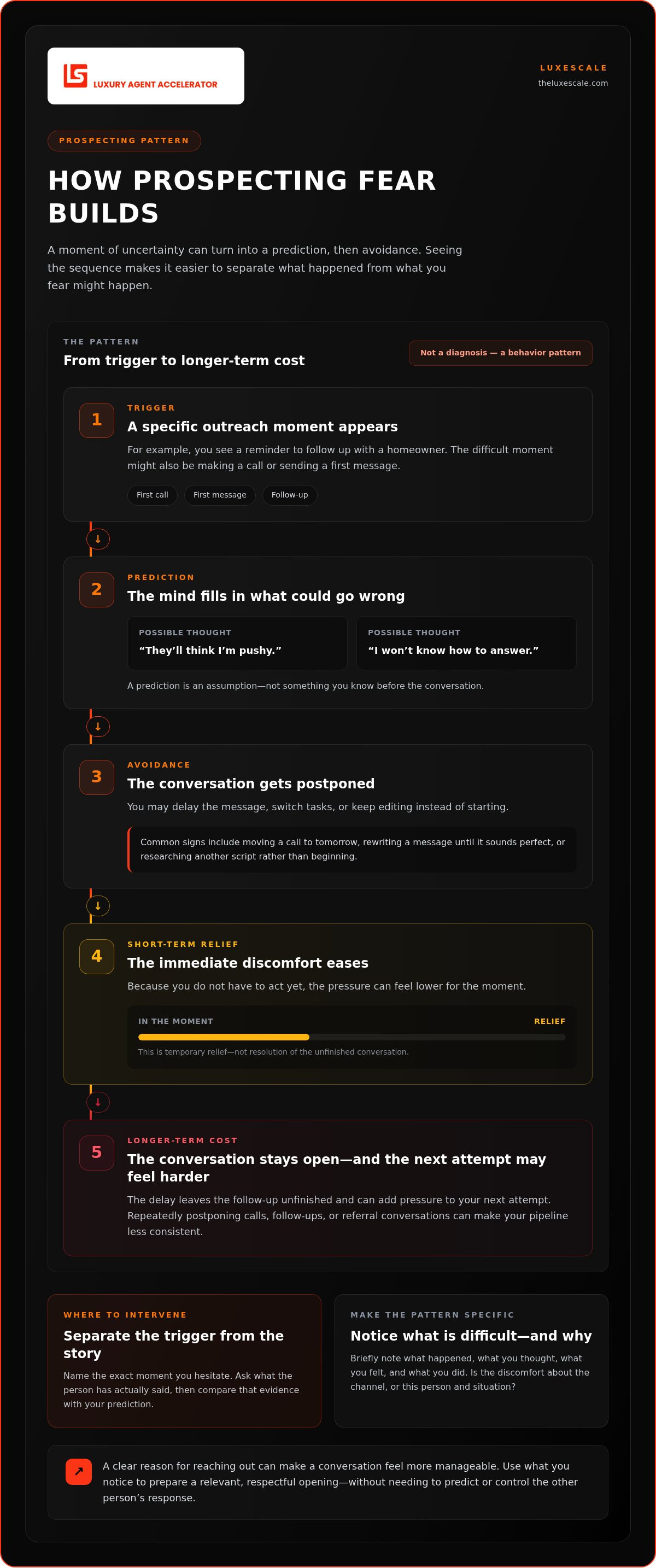
The fear of prospecting in real estate can feel like one broad problem, but it often follows a specific chain. A moment of uncertainty prompts a prediction about what might go wrong. Avoiding the task brings quick relief, yet the conversation remains unfinished and may feel harder to approach next time. This is a practical way to examine a behavior pattern, not a diagnosis.
Map the sequence to see where you can intervene:
- Trigger: You see a reminder to follow up with a homeowner.
- Prediction: “They’ll think I’m pushy,” or “I won’t know how to answer.”
- Avoidance: You postpone the message, switch tasks, or keep editing.
- Short-term relief: The immediate discomfort eases because you don’t have to act yet.
- Longer-term cost: The conversation remains open, and the delay can add pressure to your next attempt.
A vivid prediction can start to feel like a fact. But “I will sound pushy” is an assumption, not something you know before the conversation. Recognizing that difference gives you room to choose a professional, respectful opening instead of letting an imagined reaction make the decision for you.
Recognize the specific prospecting moments that trigger hesitation
Identify whether the hardest moment is making a call, sending a first message, or following up after no response. Then ask whether the discomfort comes from the channel itself or from this particular person and situation. Briefly note what happened, what you thought, what you felt, and what you did. A few factual observations can reveal patterns that a general label like “I hate prospecting” hides.
For example, you may find that calls feel manageable when you have a clear reason for reaching out, while follow-ups feel difficult when you can’t tell whether the person is interested. That’s useful information. It points to a specific preparation need, such as clarifying why you’re following up, rather than concluding that every form of outreach is a problem.
Challenge the assumptions that make outreach feel high-pressure
Use a simple thought-checking exercise inspired by cognitive behavioral therapy concepts. It’s a reflection tool, not clinical treatment. Write down the prediction, then compare it with observable evidence: what has the person actually said or done? If you don’t have evidence yet, record that honestly instead of treating a feared response as certain.
Next, reframe the purpose of the exchange. Relevant outreach offers a useful conversation; it doesn’t demand someone’s attention or a commitment. You control your preparation, clarity, timing, and respectful tone. You don’t control another person’s response, whether a seller is ready, or the market outcome.
When initiating every conversation feels like a barrier, qualified seller appointments can shift some of your effort toward preparing for the meeting itself. LuxeScale identifies and qualifies homeowners who are ready to sell, then schedules listing appointments for agents.
Pressure-Based Prospecting vs. Prepared, Value-Led Conversations
How you frame outreach affects both its tone and how manageable it feels to begin. Pressure-led prospecting focuses on securing a result. Prepared, value-led outreach starts with a relevant reason to connect, then makes room for the homeowner’s priorities. No script or channel guarantees an appointment or removes nerves, but a thoughtful approach gives you a clear process to rely on.
| Conversation element | Pressure-led approach | Prepared, value-led approach |
|---|---|---|
| Preparation | Rely on a generic pitch or improvise under pressure. | Know why you’re reaching out and what may be relevant to this homeowner. |
| Opening language | Lead with a sales agenda or a request for commitment. | Give a concise, honest reason for contacting them. |
| Listening | Focus on delivering the pitch and overcoming resistance. | Ask an open question, listen, and respond to what the seller actually says. |
| Follow-up | Push for an immediate decision or follow up without context. | Agree on a relevant next step, or respect the person’s preference not to continue. |
| Success measure | Judge the exchange only by whether it produces an appointment. | Assess whether the conversation was relevant, respectful, and clear, then note the response. |
What makes outreach sound transactional rather than useful?
A generic pitch could be sent to any homeowner: “I’m calling to see if you’re ready to sell.” A more considered opening gives a specific, truthful reason for connecting, then invites a response. For example: “I’m reaching out because you mentioned considering a move. Has anything changed in your plans?” Curiosity shifts the focus from delivering a pitch to understanding the seller’s priorities. Don’t manufacture urgency or promise an outcome you can’t control.
A negative response is information about fit, interest, or timing. It isn’t a verdict on your identity or a complete measure of your skill. Record what the person actually communicated, respect their answer, and use that information to guide any appropriate next step.
How high-trust seller conversations benefit from preparation
Preparation doesn’t mean memorizing every line. It means understanding the homeowner’s context, having relevant market knowledge ready, and knowing how to propose a clear next step without forcing it. In high-stakes seller conversations, that groundwork supports credibility while leaving room to adapt. A luxury listing presentation guide can help you plan how to communicate your value in a listing meeting.
Build trust before, during, and after the first exchange: make outreach relevant, listen closely, and follow through on what you agree. Think about how your positioning supports those conversations and gives homeowners a clear reason to hear from you; establishing a strong, credible web presence with XcellentDigital can help validate your expertise before outreach even begins. A deliberate approach can make the fear of prospecting in real estate easier to manage without pretending uncertainty will disappear.
A Step-by-Step Routine for Overcoming Prospecting Fear
A repeatable routine reduces the number of decisions you need to make before outreach. Keep the first action small: one audience, one focused task, and a clear finish point. You’re not trying to guarantee a response. You’re building a reliable process for taking action even when confidence hasn’t caught up yet.
- Select one audience. Choose a specific group or type of contact and one relevant reason to reach out. A focused task, such as following up with homeowners who previously asked about selling, is easier to start than “prospect more.”
- Prepare briefly. Write a natural opening, the useful reason for contacting them, one question, and a respectful way to end the exchange. Set a limit on preparation so it supports action instead of becoming another form of delay.
- Initiate. Use a cue to prompt the first move. For example: “After I finish my morning planning, I’ll make the first follow-up call.” This links a specific moment with a specific action.
- Listen. Let the homeowner’s response guide the conversation. Ask a relevant question, pay attention to what they say, and avoid rushing to fill every pause with your pitch.
- Record. Note the action you took, the response, any agreed next step, and what felt challenging. Keep the record factual and brief.
- Review. Decide what to repeat or adjust during your next outreach block. Track behaviors you control, such as prepared conversations and thoughtful follow-ups, rather than judging the session solely by appointments.
Prepare one focused prospecting block before outreach
Choose a realistic time window that fits your schedule and define what you’ll do within it, such as sending a first message or completing a follow-up task. Keep the opening concise and grounded in a genuine reason for contact. Prepare a respectful exit too, so you know how to close if the person isn’t available or interested. The goal is to start, not to script every possible response.
Before the block, make the cue specific: “When I sit down after my team meeting, I’ll open my prepared contact list and send the first message.” Then take that first action, even if you still feel some hesitation.
Review each conversation without turning outcomes into self-judgment
After the interaction, ask: What happened? Which part felt difficult? What would I keep or change next time? Separate the quality of your process from the homeowner’s readiness to sell. A well-prepared, respectful conversation can still end without an appointment. That outcome tells you about this interaction, not your worth or potential as an agent.
Practice challenging openings or objections through brief role-play with a trusted peer. Rehearsal can make the words more familiar, while feedback helps you refine your delivery without chasing a perfect script.
Consistent action builds evidence that you can handle the next conversation, even before you feel fully confident. If you want qualified seller opportunities and coaching to support your preparation, explore LuxeScale’s listing appointments and agent support.
Build Prospecting Confidence With Better Preparation and Qualified Opportunities
Preparation, practice, and a reliable system can make seller conversations more manageable, though they can’t remove every uncertain outcome. A homeowner may have different priorities, change their plans, or decide not to move forward. Confidence comes from being ready to respond professionally, not from controlling every result. That distinction helps keep the fear of prospecting in real estate from defining how you approach each opportunity.
Prepare for the appointment, not just the first outreach
Reaching a qualified seller is the beginning of the conversation, not the finish line. Before recommending a strategy, clarify what the homeowner hopes to achieve, what matters most about their timing, and what questions they want answered. Then connect your guidance to those priorities. This keeps the meeting focused on the seller rather than on delivering a presentation word for word.
Review guidance on mastering luxury listing appointments as you prepare. Coaching can also help you rehearse the parts that benefit from practice: listening without rushing, explaining your value clearly, and agreeing on a useful next step. Rehearsal won’t predict every question, but it can help you enter the meeting with a stronger structure.
Make prospecting support fit a performance-minded business
LuxeScale identifies and qualifies affluent homeowners who are ready to sell, then schedules listing appointments for agents. This can shift some business-development effort away from initiating every conversation and toward preparing for a substantive seller meeting. Prospects are vetted for seller readiness, while you remain responsible for understanding the homeowner’s goals and presenting an appropriate approach.
Support includes complementary coaching, training, and live video education to help agents prepare for high-stakes conversations. There are no monthly or recurring out-of-pocket charges. LuxeScale’s performance-based model charges a 20% referral fee at closing. Participation is exclusive within a territory, with the number of agents in each territory limited.
Qualified appointments can make prospecting feel more focused, but they don’t eliminate uncertainty or replace preparation. Treat each meeting as an opportunity to listen, assess fit, and guide the homeowner through a clear discussion. The goal isn’t to perform perfectly. It’s to bring a consistent, thoughtful process to the opportunity in front of you.
If a more structured path to seller conversations would support your business, explore LuxeScale’s luxury listing appointment support.
Take the Next Step Toward More Confident Conversations
Choose one conversation you’ve been putting off and define a useful outcome that doesn’t depend on winning business. You might learn the homeowner’s timing, understand what they need, or establish whether a future follow-up makes sense. Then take that next step and note what you learned. This shifts your attention from trying to control someone else’s decision to developing your own judgment and skill.
The fear of prospecting in real estate doesn’t have to vanish before you act. Confidence can grow as you build experience, refine your approach, and see that you can handle a range of responses. Each thoughtful conversation gives you a chance to become more deliberate about how you serve potential clients.
Ready to create more opportunities for meaningful seller conversations? Explore LuxeScale’s luxury listing appointment support and take the next step toward a more structured way to connect with qualified sellers.
Frequently Asked Questions
Is fear of prospecting in real estate normal?
Yes, feeling uneasy before starting a business conversation is common, and it doesn’t automatically mean you’re unsuited to real estate. The useful question is whether the discomfort is affecting your work. If you repeatedly avoid a particular channel, note what you’re anticipating and consider practicing that situation with a colleague. If anxiety feels intense or affects your wellbeing beyond prospecting, consider seeking support from a qualified mental health professional.
How can I stop being afraid of cold calling in real estate?
You may not be able to switch off nerves instantly, but you can make the call more manageable. Before dialing, write a one-sentence reason for reaching out and one question that invites the homeowner to share their situation. Practice the opening aloud, then make a single call rather than waiting to feel completely ready. Afterward, assess whether you communicated clearly, not whether the person agreed to meet.
Can you be successful in real estate if you dislike prospecting?
Yes, but you’ll need a deliberate way to create conversations rather than relying on a channel you consistently avoid. Build relationships through past clients, referrals, professional connections, and useful follow-up, while noticing which activities you can sustain. You can also explore automated lead generation systems such as The Fraction or rely on qualified appointment opportunities to put more emphasis on preparing for seller meetings. Disliking one form of outreach doesn’t mean you must abandon business development altogether.
What should I say when a homeowner says they are not interested?
Respond calmly and respect the answer. You could say, “Understood. Thanks for letting me know. I won’t keep you.” If they offer a reason, listen without arguing or trying to overcome their decision. Don’t assume “not interested” means “try a harder pitch.” Close politely, make a factual note of their preference, and only consider future contact if it’s appropriate and welcome.
How do I prospect without sounding pushy?
Make the reason for your contact clear, keep your opening brief, and give the homeowner room to decline or guide the conversation. For example, explain why the information may be relevant, then ask whether they’d like to discuss it. Avoid manufactured urgency, sweeping claims, or repeated follow-ups after someone has asked you to stop. A respectful exchange prioritizes the person’s needs over securing an immediate appointment.
Should real estate agents use a script when prospecting?
A script can be a useful reference, but it shouldn’t replace listening. Prepare a few flexible prompts: how to introduce yourself, why you’re calling, a question to understand the homeowner’s plans, and a courteous way to end. Use language that sounds natural to you, then adapt based on the person’s response. If you find yourself reciting lines without hearing the answer, simplify the script.
How long does it take to become confident at prospecting?
There’s no fixed timeline. Confidence develops differently depending on your experience, the conversation type, and how regularly you practice. Track progress through observable changes: starting more promptly, needing fewer notes, or recovering more easily after an awkward exchange. Review those signs over time instead of expecting one successful call to remove all hesitation. If a particular situation remains difficult, practice that scenario specifically rather than restarting your whole approach.

Article by
Mark Coppens
Mark Coppens is the Founder and Chairman of LuxeScale and Co-Team Lead of Living Vogue | eXp Luxury. He is an active elite-level luxury agent and the author of the upcoming book, POWER POSITIONING: From Missiles to Mansions – Why People Really Buy, and is a nationally recognized speaker on luxury real estate, consumer psychology, marketing, and business growth.
A U.S. Army veteran with an MBA in Marketing, Mark has generated more than $1 billion in career sales and now leads one of the nation's fastest-growing luxury referral platforms, referring more than $2 billion in luxury real estate opportunities each month to partner agents across the United States. He specializes in helping real estate agents generate more listings, break into the luxury market, and build scalable businesses through qualified referrals, award-winning training, coaching, and proven systems. His practical, psychology-driven approach has helped agents across the country increase their income while attracting more affluent clients and building lasting, referral-driven businesses.