
High Net Worth Home Buyer Referral Network: A 2026 Agent Buying Guide
What makes an affluent-buyer introduction worth your time: the buyer’s financial readiness, a clear purchase timeline, or the support you receive before the first conversation? A high net worth home buyer referral network should offer more than a name and number. Useful context about a buyer’s goals, timing, and interest in speaking can help you decide how to respond and prepare for a relevant first conversation.
It’s reasonable to be selective. A generic lead may provide little context, while recurring marketing costs can add up before you know whether an opportunity will convert. In luxury real estate, credibility matters from the first exchange. Strong market knowledge, thoughtful questions, and clear communication help you deliver a polished client experience.
This guide explains how to evaluate a network by prospect qualification, agent coaching, territory access, and fee structure. You’ll also learn what to understand about when a referral fee is due and how a closing-based model differs from recurring charges. LuxeScale provides affluent buyer referrals with no monthly or recurring out-of-pocket charges and a 20% fee at closing. Use the criteria below to assess whether that model fits your business and how you want to grow.
Key Takeaways
- Assess a high net worth home buyer referral network by the context behind each introduction, not just the number of prospects it sends.
- Compare networks on buyer readiness, handoff quality, agent support, and territory access to judge how well they fit your business.
- Understand when fees are due and how a closing-based model differs from recurring costs before you commit.
- Use a focused first-conversation process to uncover the buyer’s goals, timing, and preferred next steps.
- Consider how LuxeScale’s affluent buyer referrals and agent support may complement its primary focus on luxury listing appointments.
What a High Net Worth Home Buyer Referral Network Should Deliver
A high net worth home buyer referral network connects real estate agents with prospective affluent buyers through introductions that can start a client relationship. A referral is an opportunity to begin a conversation, not proof of financing, signed representation, or a completed purchase. It is also different from a brokerage relationship, which defines an agent’s professional affiliation and responsibilities.
Wealth labels alone don’t establish whether a prospect is a good fit. The broad High-Net-Worth Individual (HNWI) category can help frame who an affluent buyer may be, but you still need to understand the person’s goals, timing, readiness, and expectations. Those details help determine whether the opportunity matches your expertise and capacity.
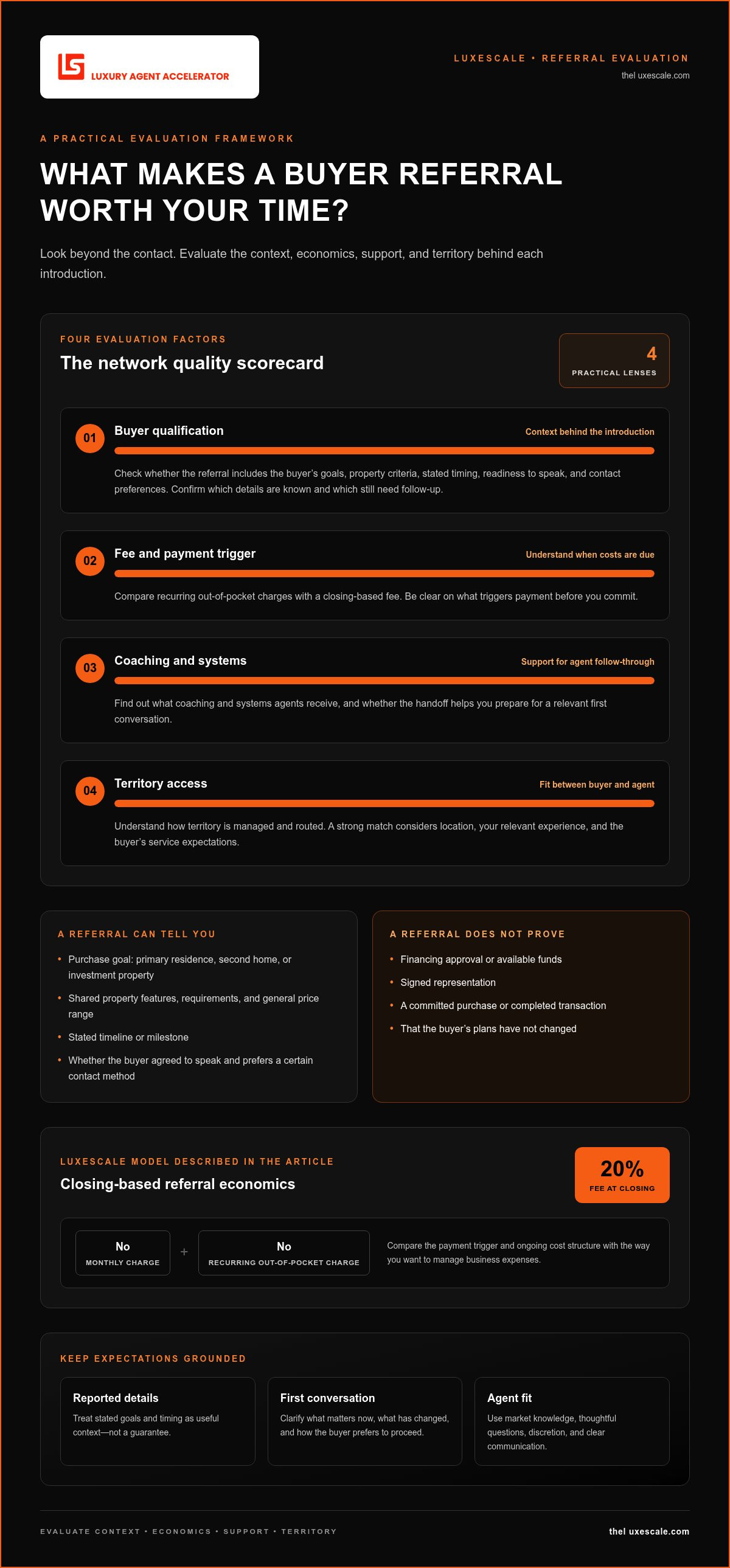
Evaluate a network through four practical lenses: the quality of buyer qualification, the fee and payment trigger, the coaching and systems agents receive, and how territory access is managed. Together, these factors reveal whether a referral model supports relationship-building or simply adds contacts to your pipeline.
How buyer referrals differ from ordinary real estate leads
A broad marketing inquiry or unverified contact record may offer little more than a name and contact details. A referral can provide a direct introduction and useful context, such as the buyer’s property goals, stated timeline, and willingness to speak. That information helps you make your first response specific rather than sending a generic follow-up.
Use the information as a starting point, not a conclusion. A buyer’s plans may change, and an introduction doesn’t confirm financing, representation, or a future transaction. In your first conversation, clarify what the prospect wants, what has changed, and whether you can serve them effectively.
What affluent buyers expect from an agent
Affluent buyers may expect discretion, responsive communication, market fluency, and advice tailored to their priorities. The standard is set by the client’s needs, not just the property’s price. Prepare by knowing your market, listening closely, and explaining next steps clearly.
Access to prospects creates an opportunity; your expertise and follow-through shape the experience. For related guidance on preparing for high-stakes conversations, explore this luxury listing appointment guide. The same appointment skills can help you present your value clearly when a prospective buyer is deciding whom to trust.
How a High Net Worth Buyer Referral Network Qualifies and Routes Prospects
A useful introduction gives you enough context to decide how to begin while making clear what still needs to be confirmed. When evaluating a high net worth home buyer referral network, look for information about four areas: purchase goals, timing, readiness to engage, and communication preferences. Qualification varies by network, so understand what information is gathered instead of assuming every referral has gone through the same screening process.
Which buyer details make a referral actionable?
Buyer goals might include a primary residence, a second home, or an investment property. Useful property criteria can include preferred features, a general price range, and must-haves. Timing helps you understand whether the prospect is exploring or preparing to act. Knowing whether the buyer has agreed to speak, and how they prefer to be contacted, helps you make an appropriate introduction.
Separate reported details from assumptions. A prospect’s stated timeline is useful context, not a commitment. A price range doesn’t establish available funds or loan approval. Use the first conversation to clarify what matters now and whether anything has changed.
- Goals: What type of purchase is the buyer considering?
- Property criteria: Which features or requirements have they shared?
- Timing: Is there a stated target or milestone?
- Engagement: Have they agreed to speak, and how do they prefer to be contacted?
- Known versus unknown: Which details came directly from the buyer, and which require follow-up?
This checklist makes conversations about referrals more precise. It also keeps expectations grounded: a qualified prospect isn’t necessarily financing-approved, represented by you, or certain to close.
How should a network match a buyer with an agent?
A strong match considers more than location. The agent’s experience should align with the buyer’s property goals and service expectations. Territory fit also matters: the agent needs to be able to respond and offer relevant market guidance. Understand how the introduction is routed and what context accompanies it.
A clear handoff identifies the prospect’s preferred next step, such as an introductory call, and gives you enough information to respond with relevance. Then verify the details directly, listen for the buyer’s priorities, and agree on appropriate next steps. For broader criteria to assess a referral partner, read this luxury referral partner buying guide.
If you’re considering a network that combines affluent buyer referrals with agent support, explore LuxeScale’s referral opportunities as part of your evaluation.
Compare Buyer Referral Networks by Qualification, Economics, and Exclusivity
A referral model can reduce acquisition costs upfront, but a low barrier to entry doesn’t make an unqualified prospect commercially valuable. Compare the quality of the introduction and the support around it with the fee, payment trigger, and territory policy. For a high net worth home buyer referral network, lead volume alone is a weak measure of value.
| Evaluation area | What to compare | LuxeScale’s stated model |
|---|---|---|
| Qualification | What buyer goals, timing, property criteria, and willingness to engage are shared? | Affluent buyer referrals are part of the offering; assess each introduction by the context provided. |
| Handoff | Does the introduction provide a clear next step and useful information for your first conversation? | Review the referral context and clarify details directly with the prospect. |
| Agent support | Are training, coaching, systems, and support part of the relationship? | Referral opportunities are accompanied by agent coaching, training, systems, and support. |
| Territory policy | How many agents may access the same territory, and what does that policy mean in practice? | Territory exclusivity limits the number of agents in each territory; it doesn’t promise referral volume. |
| Payment trigger | Is payment recurring, due at a defined milestone, or triggered by a closing? | A 20% referral fee is due at closing, with no monthly or recurring out-of-pocket charges. |
How to evaluate a closing-based referral fee
A closing-based fee ties payment to a transaction rather than a monthly subscription. In LuxeScale’s model, the 20% fee is due at closing, with no monthly or recurring out-of-pocket charges. That payment structure can reduce recurring costs, but the fee still needs to make sense alongside the introduction and support. Read the written terms carefully so you understand the payment trigger and how the fee is calculated before committing.
Evaluate the process as well as the economics. Consider what information accompanies an introduction, how the handoff works, and what coaching and systems support your follow-through. Clear terms help you assess the full arrangement without relying on unsupported conversion promises.
What territory exclusivity changes for an agent
Limiting the number of agents in a territory can reduce direct overlap within the network. It doesn’t establish how many prospects you’ll receive or whether any will transact. Treat exclusivity as one part of the value equation, alongside qualification, support, and payment terms. For broader ideas on building a luxury referral pipeline, read this luxury real estate referral growth guide.
Prepare to Convert Affluent Buyer Referrals into Strong Client Relationships
A referral creates an opening. Your preparation determines whether the first exchange feels relevant, discreet, and well managed. Use a repeatable process so each prospective buyer receives thoughtful attention, and review your own results to identify where your approach can improve.
A practical first-contact sequence for referred buyers
- Review the introduction. Note what the buyer has shared about their goals, property criteria, timeline, and preferred way to communicate. Separate known details from anything you’ll need to clarify.
- Respond promptly and personally. Acknowledge the introduction, refer to a stated priority, and suggest a convenient way to continue the conversation. Avoid a generic message that could apply to any prospect.
- Discover the buyer’s needs. Ask open questions about timing, property preferences, decision priorities, and what a successful search looks like to them. Listen first, then tailor your guidance.
- Agree on a next step. Confirm a specific action, such as a follow-up conversation or sharing relevant information. Record the agreed action in your existing workflow so the conversation doesn’t lose momentum.
Consistency builds confidence. Track each referral’s response, conversations, appointments, and eventual outcome. Reviewing these stages can help you see where follow-up is strong and where your process needs refinement. Use the records to understand your own results over time, not to compare them with an unsupported industry benchmark.
How coaching can strengthen agent readiness
Affluent-client conversations call for more than access to prospects. Coaching, training, and practical systems can help you prepare to introduce your expertise, ask focused questions, and communicate next steps clearly. Live video education can help you rehearse how you present value and respond to client priorities. Preparation makes the exchange more confident without turning it into a script.
Pre-framing the conversation helps set expectations. Explain what you’ll cover, invite the buyer to share their priorities, and outline how you can guide the next stage. That clarity supports a polished experience while leaving room to adapt to the individual. For related guidance on preparing a high-stakes presentation, read the luxury listing presentation guide.
To pair affluent-buyer referrals with agent preparation, explore LuxeScale’s referral approach.
Assess Whether LuxeScale Fits Your High Net Worth Buyer Referral Strategy
A referral partnership is strongest when the opportunity, economics, and agent support fit the way you want to grow. LuxeScale provides affluent buyer referrals for agents prepared to serve discerning clients, communicate with care, and follow through consistently. Buyer referrals are one part of the offer. Luxury listing appointments are LuxeScale’s primary service, alongside affluent seller referrals.
What LuxeScale brings to an agent referral partnership
The model pairs referral opportunities with agent preparation. Coaching, training, systems, and support accompany referrals, helping you prepare for high-stakes conversations rather than relying on a contact alone. Territory exclusivity limits the number of agents in each territory, which can reduce direct overlap within the network. It doesn’t promise a set number of introductions or completed transactions.
The referral fee is 20% at closing, with no monthly or recurring out-of-pocket charges. The payment trigger is tied to a closing rather than a recurring subscription. Before joining any high net worth home buyer referral network, review the written partnership terms so you understand how the fee applies, what support is included, and how referrals are handled.
How to take the next step with confidence
Start with an honest assessment of your capacity. Can you respond reliably, give affluent clients a polished experience, and maintain a disciplined follow-up process? Consider whether your market knowledge and communication style align with the expectations of the buyers you want to serve. Referrals create potential, but your preparation and client service shape the relationship.
Read the written terms carefully, including the referral-fee trigger and territory policy. Consider any state-specific requirements that may apply to referral arrangements as part of your review. A clear understanding of the model helps you make a sound business decision without relying on assumptions about volume or results.
If affluent buyer referrals, agent support, and closing-based economics align with your growth strategy, explore LuxeScale’s referral partnership.
Choose a Referral Model That Supports Your Growth
The right high net worth home buyer referral network should offer more than access to affluent prospects. Evaluate the context behind each introduction, the agent support available, territory terms, and when fees are due. Buyer intent and fit matter more than lead volume alone. A referral is an opportunity to build a relationship, not a guaranteed transaction.
LuxeScale provides affluent buyer referrals alongside its primary focus on luxury listing appointments. The referral fee is 20% at closing, with no monthly or recurring out-of-pocket charges. Coaching, training, systems, and support accompany referral opportunities, while territory exclusivity limits the number of agents in each territory.
Consider whether you’re ready to serve affluent clients and follow up consistently. Review the written terms and assess how the model aligns with your business priorities. Explore LuxeScale’s referral partnership to take a clear-eyed next step toward building your luxury business.
Frequently Asked Questions
What is a high net worth home buyer referral network?
A high net worth home buyer referral network connects real estate agents with prospective affluent buyers through introductions. It can provide a starting point for a client relationship, but an introduction isn’t a guarantee of financing, representation, or a completed purchase. Evaluate the buyer’s stated goals, timing, and willingness to speak, along with the agent support and fee terms attached to the referral.
How do real estate agents get referrals to wealthy home buyers?
Agents can build buyer referrals through past clients, professional relationships, other agents, and referral networks that connect them with affluent prospects. A useful introduction includes relevant context, such as the buyer’s property goals and preferred timing, so you can respond personally. LuxeScale provides affluent buyer leads alongside luxury listing appointments, its primary service, with coaching and training to support agents’ client conversations.
Are high net worth buyer referrals qualified leads?
Not necessarily. Qualification can mean that details such as the buyer’s goals, property criteria, timeline, or willingness to speak have been gathered. It doesn’t establish loan approval, available funds, signed representation, or certainty of purchase. Distinguish details reported by the buyer from assumptions, then confirm priorities and readiness directly during your first conversation.
How much does a high net worth real estate referral network charge?
Fees and payment structures vary by network, so review the written terms before joining. LuxeScale’s referral model charges a 20% fee at closing and has no monthly or recurring out-of-pocket charges. Make sure you understand what event triggers payment and how the fee applies. Consider the introduction quality and accompanying support alongside the fee, rather than comparing costs alone.
Is a pay-at-closing referral network worth it for real estate agents?
It may suit agents who prefer a fee tied to a completed closing rather than recurring out-of-pocket charges. Whether it’s worthwhile depends on the quality and fit of the introductions, the support provided, the written payment terms, and your capacity to follow through. Don’t treat the payment model as a promise of conversion. Assess the opportunity against your business strategy and client-service strengths.
Can agents receive exclusive territory access through a referral network?
Some networks limit the number of agents in a territory. LuxeScale’s territory exclusivity limits how many agents are allowed in each territory, which can reduce direct overlap within the network. Exclusivity doesn’t guarantee a particular number of referrals or transactions. Review the written territory terms and consider how the policy fits your business before making it part of your growth plan.
What should agents ask before joining a luxury buyer referral network?
Understand what buyer details are shared, how introductions are handed off, what coaching and support accompany referrals, and how territory access works. Clarify the fee amount and payment trigger in the written terms, including what happens if a prospect doesn’t transact. Assess whether you have the time, market fluency, and follow-up process to serve affluent clients well. Consider any applicable state-specific requirements as part of your review.

Article by
Mark Coppens
Mark Coppens is the Founder and Chairman of LuxeScale and Co-Team Lead of Living Vogue | eXp Luxury. He is an active elite-level luxury agent and the author of the upcoming book, POWER POSITIONING: From Missiles to Mansions – Why People Really Buy, and is a nationally recognized speaker on luxury real estate, consumer psychology, marketing, and business growth.
A U.S. Army veteran with an MBA in Marketing, Mark has generated more than $1 billion in career sales and now leads one of the nation's fastest-growing luxury referral platforms, referring more than $2 billion in luxury real estate opportunities each month to partner agents across the United States. He specializes in helping real estate agents generate more listings, break into the luxury market, and build scalable businesses through qualified referrals, award-winning training, coaching, and proven systems. His practical, psychology-driven approach has helped agents across the country increase their income while attracting more affluent clients and building lasting, referral-driven businesses.