
How to Become a Luxury Real Estate Agent: The 2026 Strategic Blueprint
What if the barrier to entry in the $5.6 million ultra-luxury market wasn't your past portfolio, but your current acquisition strategy? Most ambitious professionals believe they need a decade of high-end experience to compete for affluent listings. You likely feel the weight of the chicken-and-egg dilemma, where you need luxury credentials to win the very clients who provide them. It's frustrating to watch competitors dominate elite markets simply because they have the right connections or a massive marketing budget.
This guide reveals how to become a luxury real estate agent by utilizing a results-driven framework that removes financial risk and bypasses traditional gatekeepers. You'll learn to secure high-end appointments with the confidence of an industry veteran, even if your current track record is rooted in the mid-market. We'll break down the 2026 regulatory shifts, the psychology of the modern high-net-worth individual, and the repeatable system for scaling toward seven-figure commissions. The transition from high-volume sales to high-margin dominance requires a shift in perspective; it's time to stop waiting for permission and start engineering your own elite status.
Key Takeaways
- Transition from a transactional salesperson to a strategic advisor by prioritizing discretion and time-to-sale efficiency over vanity listing prices.
- Master high-value technical expertise like architectural history and net operating income (NOI) to establish immediate authority with affluent sellers.
- Discover how to become a luxury real estate agent by utilizing pre-framing techniques that establish your credibility before you even step into the first meeting.
- Replace outdated lead-generation costs with a performance-based system that provides guaranteed Luxury Listing Appointments for a 20% fee at closing.
- Build a scalable, seven-figure business by leveraging a strategic accelerator that handles complex business development while you focus on elite-level execution.
The Evolution of the Luxury Real Estate Agent in 2026
The role of a Real estate agent has undergone a fundamental transformation. In the elite tiers of the market, the 2026 professional isn't just a facilitator; they're a strategic advisor for high-net-worth individuals (HNWIs). This evolution moves away from the "grind" of mid-market sales toward a more sophisticated model of wealth consultancy. If you're researching how to become a luxury real estate agent, understand that your value is no longer measured by how many homes you sell, but by the level of strategic insight you provide. The luxury real estate agent is a specialist in high-stakes asset management who protects client equity through sophisticated market intelligence and absolute discretion.
Why Mid-Market Tactics Don't Scale to Luxury
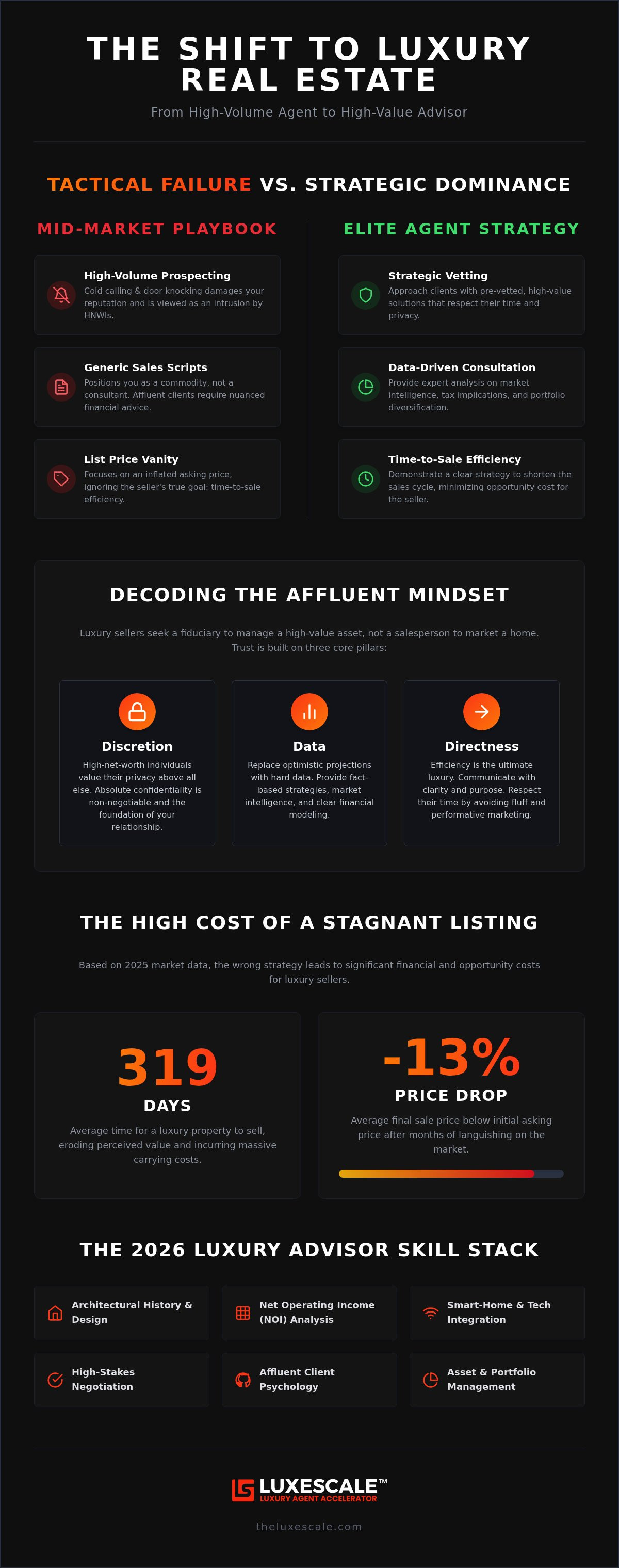
Traditional volume-based prospecting fails in the $2M+ segment because it ignores the psychological profile of the affluent. Door knocking and generic cold calling don't just yield low returns; they actively damage your professional reputation. High-net-worth sellers value discretion and privacy above all else. They view unsolicited contact as an intrusion rather than an opportunity. To succeed, you must replace high-volume noise with high-value vetting and strategic positioning. Consider these critical failures of mid-market tactics:
- Intrusion vs. Invitation: Affluent homeowners prioritize privacy and expect to be approached with a pre-vetted solution, not a generic pitch.
- Commodity vs. Consultant: Generic sales scripts signal a lack of market depth. HNWIs require nuanced advice on tax implications and portfolio diversification.
- Brand Erosion: Aggressive prospecting creates a perception of desperation. In luxury, scarcity and exclusivity are your most valuable currencies.
The 2026 Luxury Market Landscape
The current market is defined by affluent migration toward "lifestyle markets" and a demand for total digital transparency. Buyers and sellers now have access to more raw data than ever. Your role is to interpret that data to create a competitive advantage. Success in this environment requires a repeatable system for securing luxury real estate listing appointments. Mastering these high-stakes meetings is the new industry gold standard. It’s the difference between being a commodity and being a necessity.
When learning how to become a luxury real estate agent, focus on the systems that allow you to present data-driven strategies. Modern luxury clients are increasingly tech-savvy and environmentally conscious. They look for agents who understand smart-home integration and sustainable design as much as they understand market trends. By positioning yourself as a strategic accelerator rather than a traditional salesperson, you align your goals with the financial interests of your clients, ensuring mutual success in a high-stakes environment.
Decoding the Affluent Mindset: What Sellers Actually Demand
Affluent sellers operate on a different psychological plane than the mid-market consumer. They aren't looking for a salesperson to market a home; they're seeking a fiduciary to manage a high-value asset. To understand how to become a luxury real estate agent, you must first master the three pillars of affluent trust: Discretion, Data, and Directness. High-net-worth individuals (HNWIs) value their privacy above all else. They demand data-backed strategies rather than optimistic projections. Most importantly, they respect directness. They don't have time for fluff or performative marketing. Efficiency is the ultimate currency in the luxury segment.
While mid-market sellers often focus on "list price vanity," savvy luxury homeowners prioritize "time-to-sale." Data from 2025 shows that luxury properties took an average of 319 days to sell, often closing 13% below their initial asking price. Affluent sellers understand that a stagnant listing damages the property's perceived value and incurs massive opportunity costs. Your ability to demonstrate how you will shorten this cycle is what secures the listing. You must identify their silent objections early. They're often wondering if you truly understand their lifestyle or if you have the emotional intelligence to handle high-stakes negotiations with their peers.
The Wealth Psychology Framework
Effective communication requires distinguishing between "Old Money" and "New Wealth." Old Money priorities often center on legacy, heritage, and quiet excellence. New Wealth, driven by tech and innovation, values speed, disruption, and modern ROI. While every licensed professional understands the basic professional and legal duties of an agent, the luxury sector demands an elevated standard of care. You must position yourself as an advisor who understands the return on investment for property staging and capital improvements. If you can't articulate the financial logic behind a $100,000 preparation budget, you've already lost their respect.
Critical Questions Affluent Sellers Ask
Expect rigorous vetting during your presentation. Sellers will scrutinize your specific strategy for how to attract high-end real estate clients to ensure you aren't just relying on the MLS. They will ask how you protect their privacy during the listing process, especially with new federal regulations regarding beneficial ownership disclosures. You must demonstrate a qualified buyer pipeline for their specific asset class. If you lack a personal portfolio, leveraging strategic accelerators that provide guaranteed luxury listing appointments can bridge the credibility gap. This allows you to walk into a meeting with a pre-vetted plan and the confidence of a seasoned industry insider.
Building Your Luxury Skill Stack: Education vs. Execution
Letters after your name don't sell mansions. While many professionals spend years pursuing designations like CLHMS or GUILD, these credentials rarely act as the primary catalyst for a listing agreement. Understanding how to become a luxury real estate agent requires a clear distinction between theoretical knowledge and high-stakes execution. Affluent sellers aren't impressed by a certificate; they're impressed by an agent who can articulate the net operating income (NOI) of an investment property or the historical significance of a specific architectural style. You must bridge the "Execution Gap," where even the most educated agents fail because they lack a systematic way to secure and convert appointments.
The industry is full of "starving scholars" who possess deep knowledge of luxury home market trends but have no pipeline to apply it. To dominate the high-end segment, you must balance your academic foundation with specialized real estate training that focuses on the mechanics of conversion. Your skill stack should prioritize market intelligence over generic sales scripts. When you can discuss zoning laws or the provenance of high-end construction materials with the same fluency as a developer, you move from being a vendor to a trusted advisor.
Essential Knowledge for the Elite Agent
Mastering the technical details of a property is non-negotiable. You need to understand the nuances of high-end construction, such as the difference between Carrara and Calacatta marble, or the structural benefits of steel-frame residential builds. Beyond the physical asset, you must grasp the tax implications of high-value transfers. This includes staying current on beneficial ownership disclosure regulations effective as of 2026. While your strategy may be national in scope, your ability to interpret localized data points ensures your advice remains relevant and protective of the client’s equity.
Bridging the Gap with Strategic Partnerships
Top producers don't spend their time cold calling; they outsource the labor-intensive prospecting phase to specialists. This allows them to focus entirely on elite-level execution. By leveraging luxury real estate referrals, you can build an immediate portfolio without the high overhead of traditional marketing. The most efficient path forward involves performance-based models. Instead of risking capital on unproven leads, you pay a 20% fee only at closing. This model removes financial anxiety and aligns your success with a strategic accelerator that provides guaranteed Luxury Listing Appointments. It’s a shift from gambling on visibility to investing in verified opportunities.
Strategic Market Entry: Credibility Without a Portfolio
Entering the elite market without a portfolio is the primary hurdle for those learning how to become a luxury real estate agent. You don't need a history of $10M closings to win a $10M listing. You need a history of strategic results. The "Pre-Framing" technique allows you to establish authority before you even enter the room. By leveraging third-party credibility, you bypass the "lack of luxury history" objection. Your luxury listing presentation should focus exclusively on the seller's outcome and the specific mechanics of the sale. Outcomes matter more than your biography.
Vetting high-net-worth prospects is a critical phase of market entry. It ensures you aren't wasting professional time on unmotivated leads. Serious sellers in the luxury segment are driven by lifestyle shifts or portfolio rebalancing. They value their time as much as their equity. Your job is to demonstrate that you are the most efficient path to their desired result. This requires a shift from chasing visibility to securing verified, high-stakes opportunities.
The Art of the Pre-Framing
Your digital footprint must reflect elite status within 30 days. Use video education to provide deep-dive analysis on market trends, positioning yourself as a sophisticated advisor. This creates a sense of familiarity and trust before the first meeting. Qualified listing referrals are the most effective way to enter new price points. They provide an immediate transfer of trust from a credible source. This approach moves the conversation from your past sales to your present expertise. Consistency is key. Every piece of content must reinforce your position as a market authority.
Vetting and Qualifying Affluent Leads
Not every homeowner in the $1.2 million luxury bracket is a serious seller. You must distinguish between "tire kickers" and motivated HNW sellers early in the process. Key metrics for qualifying seller leads include their specific timeline and their understanding of current "time-to-sale" averages. Motivation in the luxury sector is rarely driven by financial distress. It is driven by the desire for a lifestyle upgrade. Securing exclusivity in your territory is your greatest competitive advantage. It limits your competition and allows you to focus on high-value execution.
To secure these high-stakes opportunities without the upfront marketing risk, you can apply for exclusive luxury listing appointments in your territory. This performance-based model ensures you only pay for results, aligning your growth with a proven system for success.
The Performance-Based Path to Luxury Dominance
Traditional lead generation is a relic of a less efficient era. Paying for clicks or unvetted names is a 2010 strategy that drains capital without guaranteeing revenue. The 2026 standard for anyone learning how to become a luxury real estate agent is paying for appointments. This shift moves the financial risk from the agent to the lead partner, creating a model based on mutual success. LuxeScale operates as a strategic accelerator by providing guaranteed Luxury Listing Appointments with zero upfront costs. This allows you to bypass the high overhead of traditional luxury marketing and focus on closing high-value transactions.
The core advantage of this model is the 20% referral fee paid only at closing. This alignment ensures your partner is as invested in the final sale as you are. Unlike generic platforms that sell the same lead to dozens of competitors, territory exclusivity ensures you're the sole representative for these high-value opportunities. It transforms your business from a volume-based hustle into a precision-based luxury practice. You aren't just buying data; you're securing a seat at the table with motivated, affluent sellers.
Securing Guaranteed Listing Appointments
LuxeScale utilizes a data-driven approach to identify and qualify affluent homeowners who are ready to sell. We move beyond the "lead generation" phase and handle the appointment setting for you. This allows you to stop wasting professional time on cold calls and focus entirely on your core expertise: elite-level execution at the listing table. When the prospecting is handled by a specialist, you can scale your business by focusing on the quality of your listings rather than the quantity of your outreach. It is a streamlined path to 7-figure commissions that respects the time of a high-performing professional.
Your Next Steps to Luxury Success
Evaluate your current territory for its luxury potential. The threshold for the luxury market often starts at the top 10% of listings, which in early 2026 was approximately $1.2 million. Once you understand your market benchmarks, your next step is applying for a luxury real estate referral partner position. This exclusivity limits competition and provides the training and pre-framing support necessary for high-end dominance. Use this final checklist to prepare for your first high-end appointment:
- Verify Market Entry: Confirm the local price points for the top 10% and 1% segments.
- Secure Exclusivity: Apply for territory rights with a performance-based partner to eliminate local competition.
- Master Technicals: Review architectural history and construction materials for the specific asset class.
- Execute with Confidence: Use pre-framing materials to establish authority before the meeting begins.
Engineering Your High-End Dominance
The transition to the elite market is not a matter of luck; it's a matter of strategy. You've seen that mastering how to become a luxury real estate agent requires a shift from mid-market volume to high-stakes asset management. By prioritizing discretion, technical market data, and sophisticated pre-framing, you can command authority even without a massive high-end portfolio. Success in 2026 demands a departure from high-overhead marketing and unvetted leads.
Instead, you must align with a strategic accelerator that shares the risk. LuxeScale provides the framework for this transition by delivering guaranteed Luxury Listing Appointments directly to your calendar. You'll benefit from a model that includes expert coaching and pre-framing support, ensuring you enter every meeting with a significant competitive edge. Secure Your Exclusive Luxury Territory with LuxeScale Today and leverage a performance-based 20% referral fee where you only pay when you close. The path to seven-figure commissions is open to those who choose precision over the grind. Start your journey toward luxury dominance now.
Frequently Asked Questions
Do I need a special license to become a luxury real estate agent?
You don't need a specialized license beyond your standard state-issued real estate license. Every professional in the high-end sector begins with the same licensing requirements as any other residential agent. Specialization is achieved through market expertise and strategic positioning rather than additional government regulation. Focus on building a portfolio of high-value knowledge and accessing elite networks to differentiate yourself from the general market and win affluent clients.
How much does it cost to break into the luxury market?
Traditional entry costs can range from $500 to $2,000 for licensing plus thousands more for high-end marketing and branding. However, modern performance-based models allow you to enter the market with zero upfront costs for business development. By partnering with a strategic accelerator, you avoid the financial risk of unproven advertising. You simply pay a 20% referral fee only when you successfully close a transaction, aligning your expenses with your actual revenue.
Is it possible to get luxury listings without any prior experience in high-end sales?
You can secure high-end listings without prior experience by leveraging strategic partnerships and third-party credibility. Affluent sellers prioritize market intelligence and a results-driven framework over your personal sales history. If you can provide a qualified buyer pipeline and a sophisticated asset management plan, you can win these meetings. Utilizing a partner to secure Luxury Listing Appointments provides the authority needed when you are learning how to become a luxury real estate agent.
What is the best real estate designation for luxury agents in 2026?
While designations like CLHMS or GUILD provide foundational education, the best credential in 2026 is a proven track record of market intelligence. Affluent clients value an agent who understands architectural history, tax implications, and asset management more than a specific certification. Your ability to interpret data and provide strategic advice is the ultimate differentiator. Focus on training that translates directly into secured appointments and successfully closed luxury transactions.
How do I find affluent homeowners who are actually ready to sell?
Finding motivated high-net-worth sellers requires a data-driven approach that identifies lifestyle shifts and portfolio rebalancing. You can bypass the inefficiency of cold calling by utilizing a system that qualifies prospects based on their actual readiness to list. This moves your business from broad lead generation to specific appointment setting. Partnering with a specialist like LuxeScale ensures you are only meeting with homeowners who have been vetted for motivation and high-value potential.
What commission split is standard for luxury real estate referrals?
A standard performance-based referral fee for high-end listings is 20% of the commission, paid only upon a successful closing. This model is becoming the industry standard because it removes the agent's upfront financial risk. It ensures that the referral partner is fully invested in the success of the transaction. Avoid models that require high monthly fees or upfront marketing costs without a guarantee of verified appointments or results.
How long does it typically take to close your first luxury listing?
Closing times in the elite segment are typically longer than in the mid-market, with luxury properties averaging 319 days to sell as of late 2025. This extended timeline is due to the smaller pool of qualified buyers and the complexity of high-value transactions. When researching how to become a luxury real estate agent, it's vital to account for these cycles. Success requires a consistent pipeline of appointments to ensure steady revenue despite the extended sales time.
What should be included in a luxury listing presentation?
A high-end presentation must prioritize discretion, market data, and a clear marketing strategy. Include a detailed analysis of the property's unique architectural value and a specific plan for attracting high-net-worth buyers. You should also demonstrate how you will protect the seller's privacy throughout the process. Focus on the financial outcome and the return on investment for any suggested property preparations rather than your own professional biography or generic marketing materials.

Article by
Mark Coppens
Mark Coppens is the Founder and Chairman of LuxeScale and Co-Team Lead of Living Vogue | eXp Luxury. He is an active elite-level luxury agent and the author of the upcoming book, POWER POSITIONING: From Missiles to Mansions – Why People Really Buy, and is a nationally recognized speaker on luxury real estate, consumer psychology, marketing, and business growth.
A U.S. Army veteran with an MBA in Marketing, Mark has generated more than $1 billion in career sales and now leads one of the nation's fastest-growing luxury referral platforms, referring more than $2 billion in luxury real estate opportunities each month to partner agents across the United States. He specializes in helping real estate agents generate more listings, break into the luxury market, and build scalable businesses through qualified referrals, award-winning training, coaching, and proven systems. His practical, psychology-driven approach has helped agents across the country increase their income while attracting more affluent clients and building lasting, referral-driven businesses.