
How to Build Confidence as a New Real Estate Agent with Luxury Clients
What if luxury clients judge your preparation more than the length of your résumé? If you’re a new agent, a listing appointment can feel intimidating, especially when a homeowner expects clear answers and steady guidance. Learning how to build confidence with luxury clients starts with a repeatable process, not pretending you’ve handled every situation before.
A shorter track record may leave you wondering whether you can establish credibility or respond well to a difficult question. But confidence doesn’t require exaggerating your experience. It grows when you understand the client’s priorities, arrive with a clear plan, communicate honestly, and follow through consistently.
This article covers how to prepare for high-stakes conversations, present your expertise with integrity, and respond thoughtfully when you don’t know an answer on the spot. You’ll also learn how deliberate practice, useful feedback, and reliable client service can turn preparation into composure at every stage of your career.
Key Takeaways
- Luxury appointments can feel high stakes early in your career, but clients value attentive expertise, sound judgment, and dependable communication over bravado.
- Use a consistent pre-appointment sequence: research the property and client, clarify your objectives, prepare supporting evidence, plan questions, and decide how you’ll follow up.
- When a seller asks a difficult question, listen fully, clarify their concern, answer what you know, and explain how you’ll follow up on anything unresolved.
- Build confidence with luxury clients through a repeatable cycle of preparation, practice, real-world application, and review.
- LuxeScale connects agents with qualified affluent seller appointments and provides complementary coaching, training, and live video education to support conversion skills.
Why New Real Estate Agents Can Feel Intimidated by Luxury Clients
A luxury listing appointment can feel like a test when you’re still building your experience. The homeowner may have high expectations, the property may involve complex details, and you may worry that one uncertain answer will reveal how new you are. That pressure can shift your attention away from the client and toward managing your own nerves.
Confidence isn’t bravado. A seller doesn’t need you to dominate the conversation or imply you’ve handled transactions you haven’t. They need attentive expertise, sound judgment, and dependable communication. Fear of being judged can lead agents to overtalk, apologize for reasonable questions, or promise outcomes they can’t control. Instead, pause, listen, and respond to what the homeowner actually asked.
Professional confidence is prepared, honest, client-focused communication that makes the next step clear. Use that standard to assess your conduct instead of measuring yourself against an imagined “perfect” luxury agent. A Real estate broker has a broader professional role than simply presenting a property. Keeping that wider context in mind can help newer agents focus on sound service rather than appearances.
Before the conversation, notice whether anxiety is pushing you toward any of these responses:
- Filling every pause with extra claims instead of giving the client room to explain.
- Apologizing for your career stage before the homeowner has raised it as a concern.
- Making unsupported promises about price, timing, or buyer response to sound reassuring.
- Guessing at an answer instead of clarifying the question and committing to a reliable follow-up.
What affluent homeowners need from a listing agent
Start by understanding the person, not making assumptions about their wealth or personality. Ask what matters most in the sale, what concerns could affect the decision, what timing they have in mind, and who else will weigh in. Listen for priorities such as discretion, flexibility, or a clear decision process. Then summarize what you heard and agree on a practical next step. This kind of attentive follow-through builds trust without self-promotion.
Why a short luxury track record does not have to end the conversation
Present your experience accurately. You can describe relevant work with sellers, negotiations, marketing, or transaction coordination without implying that it involved luxury properties if it didn’t. If a question goes beyond what you know, say so plainly, identify what you need to verify, and explain when you’ll follow up. Clients can assess your process as well as your past results. Learning how to build confidence with luxury clients means treating each interaction as practice: prepare carefully, communicate honestly, and review what you can improve next time.
How to Prepare for a Luxury Client Conversation Before It Begins
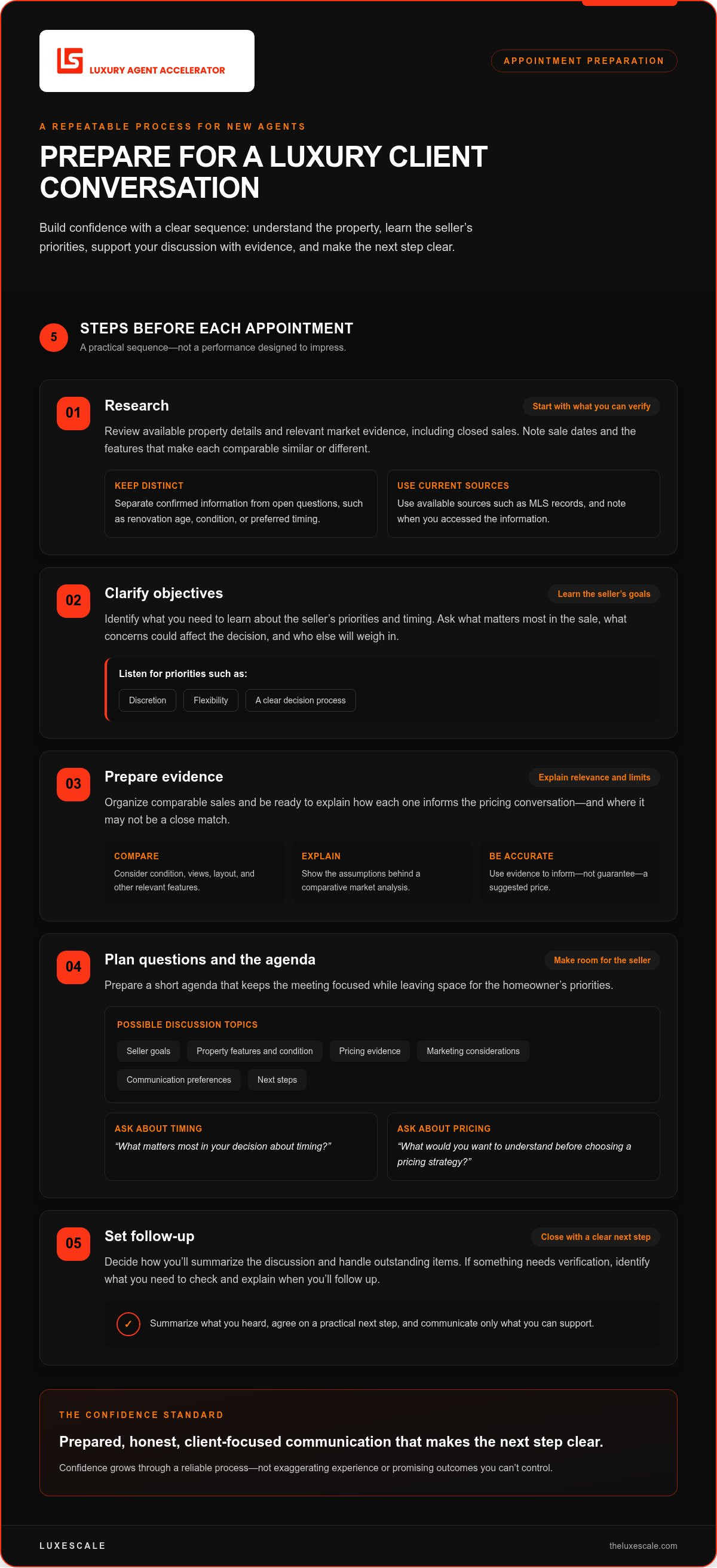
Preparation is a practical confidence tool, not a performance designed to impress a homeowner. You don’t need a polished speech or a binder full of decorative charts. You need a clear view of what you know, what you still need to learn, and how the conversation can help the seller make informed decisions. That structure turns uncertainty into a focused discussion.
Use this sequence before each appointment:
- Research: Review available property details and relevant market evidence.
- Clarify objectives: Identify what you need to learn about the seller’s goals and timing.
- Prepare evidence: Organize comparable sales and be ready to explain their relevance and limitations.
- Plan questions: Choose questions that uncover priorities instead of assuming them.
- Set follow-up: Decide how you’ll summarize the discussion and handle outstanding items.
Research the property, seller, and relevant market evidence
Start with what you can verify. Review available property information and relevant closed sales, noting each comparable’s sale date and the features that make it similar or different. Use current sources available to you, such as your MLS records, and note when you accessed the information. Separate confirmed details from open questions: a renovation’s age, a feature’s condition, or the seller’s preferred timing may need clarification from the homeowner.
When you discuss a comparative market analysis, explain the assumptions behind it. A nearby sale may look like a close match but differ in condition, views, layout, or other features that affect its usefulness. Avoid presenting a suggested price as a guaranteed result. Instead, show how the evidence informs a pricing conversation, identify its limits, and invite the seller to share context that could change the analysis.
Set an agenda and prepare for likely questions
A short agenda helps keep the appointment focused while leaving room for the seller’s priorities. Plan to discuss the homeowner’s goals, the property’s features and condition, relevant pricing evidence, potential marketing considerations, communication preferences, and agreed next steps. Before the meeting, prepare concise explanations of how you approach marketing, negotiation, updates, and the listing process. Keep them accurate to your own services and experience.
Prepare questions, too. You might ask, “What matters most in your decision about timing?” or “What would you want to understand before choosing a pricing strategy?” These prompts make the discussion collaborative and reveal what information will be useful, rather than forcing you to guess what matters to the client.
For a presentation structure that keeps the conversation organized, use this luxury listing presentation guide as a planning reference. Tailor the agenda to the seller rather than reciting a fixed script. A clear framework, paired with a responsive conversation, is a practical way to build confidence with luxury clients.
Afterward, send a concise recap of the seller’s priorities, the information discussed, and any follow-up you agreed to complete. LuxeScale pairs luxury listing opportunities with complementary coaching and support. Learn more about LuxeScale’s coaching and luxury listing opportunities.
How to Build Credibility When Luxury Sellers Ask Tough Questions
A difficult question isn’t a cue to perform certainty. Confidence doesn’t mean knowing everything; it means responding with care, accuracy, and a clear next step. If you improvise an answer to avoid seeming inexperienced, a seller may notice the gap between your confidence and the evidence. A measured response protects your credibility and keeps the conversation focused on the client’s decision.
Use a simple response pattern: listen without interrupting, clarify what the seller wants to know, answer the part you can support, then explain how and when you’ll follow up on anything unresolved. For example, if a homeowner asks whether a particular feature will increase the sale price, clarify whether they’re asking about buyer appeal or comparable sales. Explain what the available evidence can show and what it can’t establish on its own.
Respond to experience and pricing questions without overclaiming
Answer experience questions with relevant specifics, not inflated labels. If you haven’t represented a luxury seller before, don’t imply that you have. Describe applicable work accurately, such as guiding sellers through a pricing decision, coordinating a transaction, or communicating through a negotiation, but only if those examples reflect your actual experience. Then connect those skills to the seller’s needs without suggesting every property or transaction is the same.
For a pricing question, explain how you’re assessing comparable sales, including their similarities, differences, and the assumptions behind your analysis. Invite the seller’s perspective on timing and priorities before recommending a strategy. If you need more information, be direct: “I’d like to review the most relevant recent sales before giving you a considered view. I’ll follow up with the comparisons and explain how I’m weighing them.” That answer is stronger than offering a quick number without context.
Use listening and follow-through to strengthen trust
Before offering a recommendation, ask an open question such as, “What would make this process feel successful to you?” or “What concerns would you like us to address before discussing a strategy?” Reflect the answer in plain language: “It sounds like preserving flexibility on timing matters as much as the pricing decision. Have I understood that correctly?” This gives the seller a chance to correct your interpretation before you advise.
For questions about marketing or communication, be specific about the approach you can deliver. You might say, “I can outline the marketing plan I recommend and explain how I’ll keep you updated,” or, “Let’s agree on how you prefer to receive updates and what information you want included.” Avoid promising reach, buyer demand, or a result you can’t control.
After the meeting, record each agreed action, the information you need to verify, and the follow-up you promised. Deliver it within the timeframe you gave, or communicate promptly if something changes. This is how to build confidence with luxury clients: your credibility grows through accurate answers and consistent actions, not a claim to have every answer on the spot.
A Practical Routine for Building Confidence with Luxury Clients
Confidence develops through repetition, not a single perfect appointment. Use a simple cycle: prepare one skill, practise it, apply it in a real conversation, then review what happened. Keep the focus narrow. If you’re working on explaining your pricing rationale, rehearse that explanation rather than trying to overhaul your entire presentation at once. Small, deliberate adjustments make it easier to see progress and build on it.
Work through the cycle consistently:
- Prepare one skill: Choose a specific moment you want to handle more effectively, such as opening the meeting or responding to a pricing concern.
- Practise it: Role-play with a trusted peer or coach. Ask them to take the seller’s perspective and raise realistic questions.
- Apply it: Use the skill in your next client conversation, staying responsive rather than forcing a script.
- Review it: Note what felt clear, how the seller responded, and one adjustment to test next time.
Practise the moments that create the most uncertainty
Rehearse your opening, how you’ll explain the meeting agenda, and the questions you’ll use to invite the seller’s priorities. Then practise challenging moments: a question about your experience, a concern about price, or a request for a marketing detail you need to verify. Slow down. Answer only what you can support and make the next step clear. Time yourself giving a concise explanation of your proposed process, then revise any language that sounds vague, defensive, or overcomplicated.
Practise more than once, changing the seller’s question or tone so you learn to respond instead of reciting. A useful appointment walkthrough can help you rehearse the flow from introduction to next steps. Use the luxury listing appointment guide to identify moments worth practising, then adapt the approach to your communication style and the client’s needs.
Review each interaction and turn feedback into progress
After an appointment, assess your preparation, listening, clarity, follow-through, and how well the discussion reflected the seller’s stated priorities. Write down one piece of evidence that shows progress, such as asking a useful follow-up question or explaining a point more clearly. Then choose one improvement, not a long list of perceived failures. A focused review keeps the process constructive.
Ask a mentor or coach to listen to one specific skill at a time, such as your opening or how you handle a pause after a difficult question. Track recurring questions and refine your responses using accurate, current information. Don’t aim to sound flawless. Aim to become more deliberate and dependable with each conversation. That is how to build confidence with luxury clients as a professional habit.
LuxeScale combines agent coaching with luxury listing appointments. Explore LuxeScale’s agent coaching and listing appointments.
How LuxeScale Helps Agents Apply Confidence-Building Skills
Preparation and practice build confidence, but agents also need opportunities to use those skills in real client conversations. LuxeScale helps agents pursue luxury listings by identifying and qualifying affluent homeowners who are ready to sell, then scheduling listing appointments. In a scheduled conversation, you can apply what you’ve prepared: ask focused questions, listen for the seller’s priorities, and communicate your recommendations clearly.
Qualification matters. LuxeScale vets affluent homeowners to connect agents with serious sellers rather than casual inquiries. An appointment is an opportunity to understand the seller’s needs and demonstrate your approach. Your preparation, judgment, and follow-through still shape how the conversation develops.
Connect qualified appointments with deliberate preparation
Before a scheduled appointment, use the preparation framework from earlier in this article. Review relevant property and market information, identify what you need to learn from the seller, and plan questions that will reveal their priorities. During the conversation, focus on understanding the homeowner rather than rushing to deliver a pitch. Afterward, reflect on what worked and what you want to strengthen before the next appointment. Repeated opportunities to apply a consistent process can help turn preparation into a reliable professional habit.
Keep your expectations grounded. A qualified seller conversation creates room to build rapport and present your value, but the homeowner makes the decision about representation. Confidence means leading that discussion with care, not assuming its outcome.
Use coaching and education to keep strengthening client conversations
LuxeScale provides complementary coaching, training, and live video education to help agents improve their conversion skills. Use those resources to work on a specific challenge, such as opening an appointment, discussing pricing evidence, or handling a question you found difficult. Bring a real example from a recent conversation, identify what you wanted to communicate, and practise a clearer response. Focused feedback can help you refine your approach while keeping your answers accurate and aligned with the client’s needs.
For agents building a broader plan to reach affluent sellers, the luxury client attraction strategy offers a related growth perspective. Pairing client-facing practice with a deliberate approach to attracting opportunities can support steady professional development. That’s a practical way to build confidence with luxury clients: strengthen the skill, apply it in conversation, and use reflection and coaching to improve.
LuxeScale uses a performance-based model with a 20% fee at closing and no monthly or recurring out-of-pocket charges. Learn about the company’s approach to qualified listing appointments and agent development at LuxeScale.
Take Your Next Client Conversation Forward
Your next luxury appointment doesn’t need to prove that you’ve mastered every situation. Treat it as an opportunity to prepare with purpose, stay curious, and strengthen one part of your client communication. Choose a skill to focus on before the meeting, then reflect afterward on what you learned. Consistent action turns the question of how to build confidence with luxury clients into a professional practice you can keep developing.
If you want support applying that practice to luxury listing growth, LuxeScale brings agent development together with qualified seller appointments. Its coaching, training, and live video education can help you keep sharpening your client-facing approach. The performance-based model charges a fee at closing and has no monthly or recurring out-of-pocket charges. LuxeScale also limits the number of agents in each territory.
Explore how LuxeScale supports luxury listing growth and take the next step toward leading client conversations with greater assurance. You don’t need to be the most experienced agent in the room to make a strong impression. You need to be prepared, attentive, and committed to improving with every interaction.
Frequently Asked Questions
How can a new real estate agent sound confident with luxury clients?
Make your preparation visible without turning the appointment into a performance. Bring a concise outline, know which property details you’ve verified, and use plain language instead of industry jargon. Ask the seller what they hope to accomplish before offering recommendations. If you’re unsure, pause instead of guessing. Learning how to build confidence with luxury clients starts with making each answer clear, relevant, and grounded in what you can support.
Can a new agent work with luxury real estate clients without a long track record?
Yes. A shorter luxury track record doesn’t erase useful experience in client service, negotiation, transaction coordination, or property marketing. Explain where you’ve developed those skills and how they relate to the seller’s needs. Keep the distinction clear: experience with a transferable skill is not the same as a history of luxury sales. A prospective client can then assess your actual strengths and the care you’ll bring to their transaction.
What should a real estate agent say when a luxury seller asks about experience?
Answer directly, then give a relevant example. You might say, “I’m building my experience with luxury listings, and my work with sellers has strengthened my approach to negotiation and communication. I’d be glad to explain how I’d apply that here.” Only name skills and examples that reflect your actual work. Then ask what aspect of your experience matters most to the seller, so you can address their concern rather than deliver a generic résumé.
How do I prepare for a luxury listing appointment?
Before the appointment, verify the property details you can access and review comparable sales, noting differences that may affect your analysis. Write a brief agenda that leaves room for the homeowner’s priorities, then prepare questions about timing, decision-makers, and concerns. Bring only evidence that supports the discussion. Before you leave, clarify the next step and who will handle it. Afterward, send a recap that captures decisions and open items.
How can real estate agents overcome nervousness before a listing appointment?
Use a short routine to shift attention from self-consciousness to the client. Review your agenda and the seller’s known priorities, then rehearse the opening and one challenging question aloud. Take a few slow breaths and remind yourself of the meeting’s purpose: understand the homeowner’s situation, not deliver a flawless performance. Arrive with time to settle in, check your notes, and identify the first question you’ll ask.
What if I do not know the answer to a luxury client's question?
Don’t guess. Acknowledge the question, clarify what the seller needs to know, and identify the part you can answer accurately. Then say what you’ll verify, what information you need, and when you’ll follow up. For example: “I want to confirm that detail before advising you. I’ll research it and send you a clear answer by the time we agreed.” Record the commitment and follow through.
Does confidence matter more than experience in luxury real estate?
Neither confidence nor experience works well alone. Experience can provide useful perspective, while preparation helps you apply it to the property and seller in front of you. Confidence helps you communicate your reasoning without overstating what you know. Reliable service supports your words through consistent actions. If you’re newer, be transparent about your background and demonstrate your process. Sellers can evaluate how you listen, explain options, and manage agreed responsibilities.

Article by
Mark Coppens
Mark Coppens is the Founder and Chairman of LuxeScale and Co-Team Lead of Living Vogue | eXp Luxury. He is an active elite-level luxury agent and the author of the upcoming book, POWER POSITIONING: From Missiles to Mansions – Why People Really Buy, and is a nationally recognized speaker on luxury real estate, consumer psychology, marketing, and business growth.
A U.S. Army veteran with an MBA in Marketing, Mark has generated more than $1 billion in career sales and now leads one of the nation's fastest-growing luxury referral platforms, referring more than $2 billion in luxury real estate opportunities each month to partner agents across the United States. He specializes in helping real estate agents generate more listings, break into the luxury market, and build scalable businesses through qualified referrals, award-winning training, coaching, and proven systems. His practical, psychology-driven approach has helped agents across the country increase their income while attracting more affluent clients and building lasting, referral-driven businesses.