
How to Build Credibility in Luxury Real Estate in 2026
What if your next luxury listing appointment depended less on the homes already on your résumé than on the judgment you demonstrate before the meeting? Learning how to build credibility in luxury real estate can feel especially challenging when you’re still developing a high-end portfolio and aren’t sure what affluent homeowners expect from an agent.
That uncertainty is understandable. A polished image or confident pitch can open a conversation, but sellers need evidence that you understand their property, its market position, and the decisions ahead. Credibility comes from preparation, sound judgment, and a clear explanation of the value you bring, not from status signals or inflated claims.
This guide offers a practical approach to earning trust before a homeowner chooses a listing agent. You’ll learn how to shape an evidence-based value proposition, prepare for seller conversations, and demonstrate market knowledge while your luxury track record is still growing. You’ll also learn how to tailor your preparation to the property and its likely buyers, then build a repeatable system that supports stronger listing appointments.
Key Takeaways
- Affluent sellers assess credibility through preparation, market judgment, discretion, communication, and follow-through.
- Support your value proposition with verifiable experience, property knowledge, market evidence, and credentials rather than image alone.
- A limited luxury track record is a challenge you can address with transparency and a clear plan, not a reason to overstate your experience.
- Use a repeatable process: research the property, identify seller priorities, prepare relevant proof, communicate clearly, and follow through.
- Learn how to build credibility in luxury real estate while developing your pipeline through qualified seller opportunities and structured preparation.
What Credibility in Luxury Real Estate Looks Like to Affluent Sellers
Representing a high-value home puts every recommendation under scrutiny. Sellers are trusting you to understand what makes their property distinctive, interpret its market position, and guide consequential decisions with care. A compelling presentation matters, but credibility is built through choices and conduct a homeowner can observe. The goal is to show relevant expertise before asking a seller to place confidence in you.
In luxury real estate, credibility is the trust a seller develops when an agent consistently demonstrates preparation, sound market judgment, discretion, clear communication, and reliable follow-through. Understanding Credibility helps clarify why trust depends on more than an agent’s own claims. In a listing conversation, sellers look for evidence in what you know, how you explain it, and whether your actions match your words.
That evidence is different from appearance. Refined branding, polished materials, and a confident manner can support a professional impression, but they don’t prove that you understand a particular property or can explain its position in the market. Expertise becomes tangible when you can discuss relevant comparable sales, identify features that may influence buyer interest, and explain the reasoning behind your recommendations. Use only verifiable transaction history, market data, testimonials, and credentials. A precise, supportable statement carries more weight than an impressive claim without context.
What affluent homeowners need to feel before choosing an agent
Sellers want to see how you make decisions, not just hear that you have experience. They notice whether you arrive prepared to discuss the home, distinguish confirmed facts from assumptions, and explain what information would shape your advice. They also assess how you communicate: Do you answer directly? Do you respect their time and privacy? Do you listen before recommending a course of action?
Listening is practical, not performative. Ask what matters most to the homeowner, such as timing, privacy, or how the home is presented. Then reflect those priorities accurately and show how they inform your approach. This signals respect and keeps a generic pitch from taking over the conversation. Credibility is earned trust, not a title an agent can simply claim.
Why credibility matters before the listing presentation
A seller begins forming an impression at first contact. A thoughtful response, relevant questions, and a clear next step can make it easier for the homeowner to share goals and concerns. Inconsistent messages or missed follow-ups create uncertainty before you have presented a strategy. Reliability shows in small actions: arrive prepared, send what you promised, and keep the homeowner informed about what happens next.
That early consistency creates a stronger foundation for the formal appointment. For a closer look at preparing for that conversation, explore this guide to luxury real estate listing appointments. The larger lesson in how to build credibility in luxury real estate is straightforward: make your judgment visible through relevant evidence and dependable behavior, then let the quality of your preparation speak for itself.
Build Luxury Real Estate Credibility With Evidence, Not Image Alone
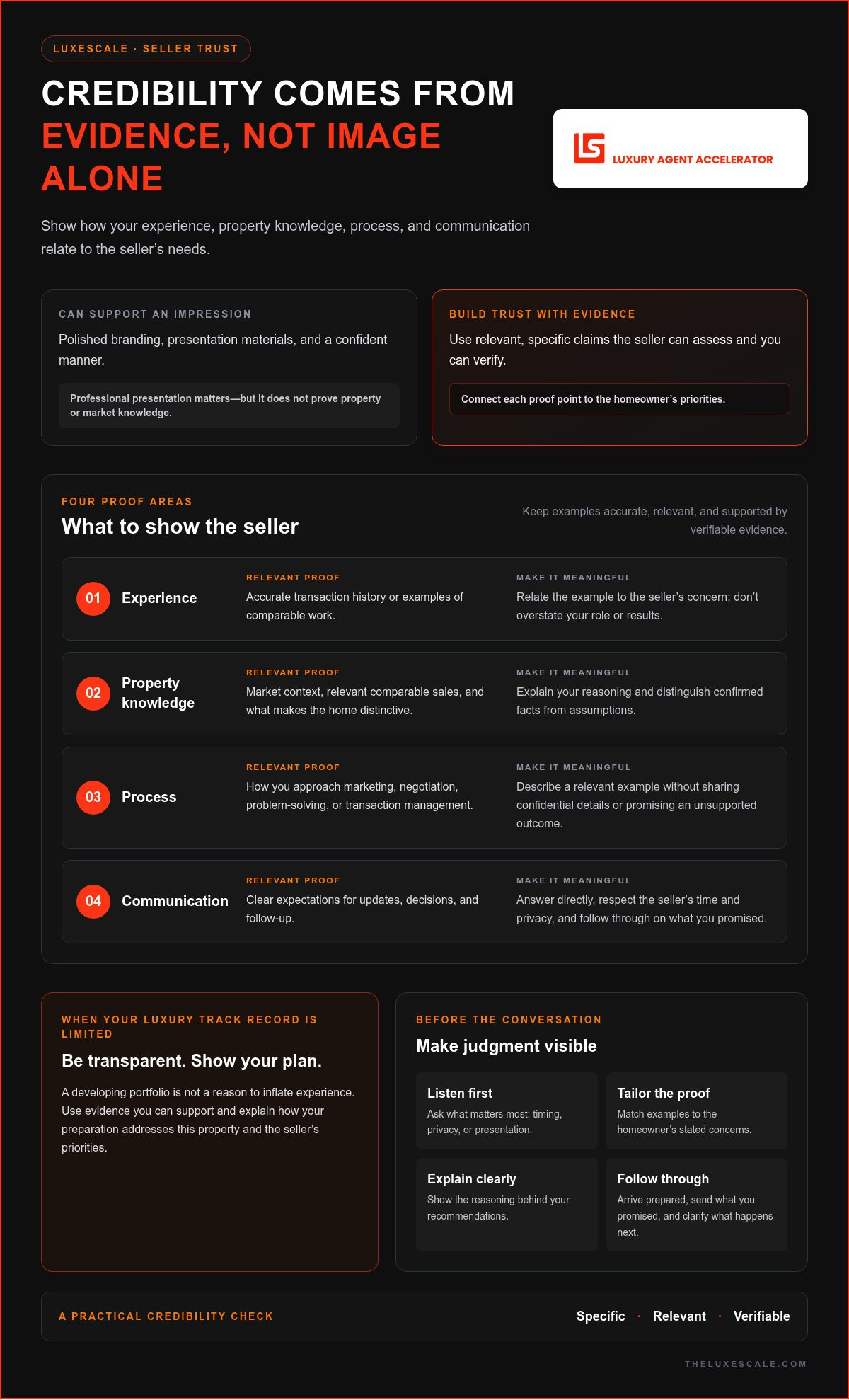
A seller doesn’t need another polished claim that you’re an expert. They need to see why your experience, preparation, and approach are relevant to their home and priorities. Build your proof around four areas: relevant experience, property knowledge, a clear process, and reliable communication. Together, these show how you think and what a homeowner can expect from working with you.
Credibility claims should be specific, relevant to the seller’s needs, and supported by verifiable evidence. Use that standard when preparing a presentation, online profile, or initial conversation.
- Experience: Share accurate transaction history or examples of comparable work.
- Property knowledge: Bring relevant market context and explain what makes the home distinctive.
- Process: Describe how you approach marketing, negotiation, problem-solving, or transaction management.
- Communication: Set clear expectations for updates, decisions, and follow-up.
Choose proof points that answer the seller’s real concerns
Match each example to a question the homeowner is likely weighing. If the seller is concerned about reaching the right buyers, explain a marketing approach you’ve used and what you can substantiate about its results. If they’re focused on navigating a complex transaction, describe a relevant problem you helped resolve without revealing confidential details. Connect the proof to the seller’s stated priorities instead of presenting disconnected wins from your résumé.
Keep the language measured. “I’m the area’s top agent” means little without clear, supportable context. A relevant transaction, a verifiable testimonial, or a credential you actually hold gives the seller something concrete to assess. Professional conduct matters too. The NAR Code of Ethics offers a reference point for the ethical standards REALTORS® commit to uphold. Don’t overstate your role or promise an outcome you can’t substantiate.
Demonstrate market knowledge without pretending to know everything
Prepare comparable-property context that helps frame the conversation, and explain how closely each example matches the home. Differences in location, condition, features, or timing may limit what a comparison can tell you. Separate confirmed facts from estimates and questions that need further analysis. That distinction doesn’t weaken your position. It shows the seller that your recommendations are based on evidence, not false certainty.
Thoughtful questions can demonstrate expertise as effectively as polished answers. Ask which features the homeowner believes matter most, what timing they’re considering, and what concerns they want addressed. Use those answers to focus your research and explain what you’ll evaluate next. If your luxury-specific transaction history is limited, present transferable experience honestly: identify the skill you used, the context, and why it may apply, without implying it proves a luxury result.
Agents seeking to strengthen their preparation through relevant seller conversations can explore qualified luxury listing opportunities. LuxeScale identifies and qualifies affluent homeowners who are ready to sell, then schedules listing appointments. Its coaching and training also support agents preparing for seller conversations.
Does a Limited Luxury Track Record Undermine Your Credibility?
A limited luxury track record is a challenge to address, not proof that you can’t represent a high-value property. But it does change what you need to demonstrate. If you haven’t completed comparable luxury transactions, don’t imply that you have. Inflated claims may win attention briefly, then undermine trust when a seller asks for specifics. Confidence helps only when it rests on competence, preparation, and evidence.
Instead, show what genuinely transfers to the homeowner’s needs. Skills in negotiation, marketing, transaction management, or resolving complex issues can be relevant across price points, but they aren’t the same as luxury-specific results. Explain your actual role, the situation you handled, and the outcome you can verify. Then identify what you’ll do to build property-specific knowledge, such as researching relevant comparables or clarifying details that could affect positioning.
How to discuss transferable experience with integrity
Choose examples for their relevance, not their prestige. If a seller values careful negotiation, describe a real negotiation you managed and your part in it. If they prioritize privacy or communication, explain the practices you’ve used to protect sensitive information or keep clients informed. Don’t suggest that success in one type of transaction guarantees the same result in another. Pair each example with a concrete preparation step for this property, so the seller sees both your existing capability and your plan to address what’s new.
A useful credibility check is to separate what you can prove from what you can reasonably commit to doing. Transaction records, client testimonials, and credentials must be accurate and presented in context. An expensive brand identity, luxury imagery, or a confident tone may create polish, but none establishes your experience. Unsupported superlatives and inflated promises add risk rather than reassurance.
What to do when a seller asks about luxury experience
Answer the question directly. Avoid defensiveness, invented credentials, and long explanations that obscure the facts. Then move to the work the seller can evaluate: your understanding of the property, the marketing decisions you recommend, how you’ll communicate, and how you’ll execute the plan. If an area needs further analysis, say so and explain your next step. This shows judgment, not weakness.
Prepare a concise response in your own words, using only facts you can substantiate. For example: “My luxury-specific transaction history is limited. My experience includes [relevant, verifiable work], where I handled [your actual role]. For your property, I’ve prepared [specific research or next step], and I’d like to understand your priorities around [relevant seller concern].” Replace each bracket with true details. Don’t use the script to imply a result or capability you haven’t demonstrated.
That balance is central to how to build credibility in luxury real estate: be candid about the limits of your record, precise about your relevant strengths, and disciplined about the preparation the opportunity requires. A seller doesn’t need bravado. They need a clear basis for evaluating your judgment and a realistic picture of how you’ll represent their interests.
How to Build Credibility in Luxury Real Estate: A Practical Plan
Credibility grows from a process you can repeat, not a costly rebrand or a more elaborate presentation. To understand how to build credibility in luxury real estate, make each stage of the seller conversation visible: learn the property, understand the homeowner’s priorities, prepare relevant evidence, communicate clearly, and complete every promised next step. Each action gives the seller a concrete reason to trust your judgment.
Prepare for a seller conversation with property-specific insight
Before the meeting, review available details about the home and relevant market context. Note what you know, what needs verification, and what you shouldn’t assume. Prepare questions about the homeowner’s timing, decision criteria, concerns, and preferred communication. This gives you a focused meeting plan built around the property and seller, rather than a generic presentation that could apply to any listing.
Use this sequence as a working checklist. Each step pairs a professional action with the confidence it can help establish:
- Step 1: Research the property. Review available features and relevant comparable-property context so your opening discussion reflects the specific home.
- Step 2: Define seller priorities. Ask about timing, concerns, and decision criteria so your recommendations address what matters to the homeowner.
- Step 3: Prepare relevant evidence. Select verifiable examples, data, or process details that support the advice you plan to give.
- Step 4: Communicate with clarity. Explain your reasoning, distinguish confirmed facts from assumptions, and set clear expectations for next steps.
- Step 5: Follow through. Deliver promised information and updates so your conduct matches the expectations you established.
Turn the meeting into consistent, trust-building follow-through
At the close of the conversation, summarize the seller’s priorities in plain language. Confirm the actions you’ve agreed to take and explain what information you’ll provide next. If an answer requires more research, say so directly and make the next step clear. This is more persuasive than guessing to maintain an appearance of certainty.
Afterward, record the homeowner’s questions, commitments, and any topics that required additional research. Before your next appointment, review those notes. If the same knowledge gap recurs, strengthen your preparation around it. Over time, this feedback loop sharpens your meeting plan and helps you respond with greater precision without adding unnecessary polish or expense.
For help structuring the presentation itself, use this guide to a luxury listing presentation alongside your property-specific research. Then keep the focus on execution. LuxeScale supports agents pursuing qualified luxury listing appointments with affluent homeowners who are ready to sell, along with training and coaching to prepare for seller conversations. Explore LuxeScale’s luxury listing appointment opportunities as a way to put this preparation into practice.
How LuxeScale Helps Agents Prepare for Luxury Listing Opportunities
A strong credibility strategy depends on more than knowing what to do. You also need relevant opportunities to put that preparation into practice. LuxeScale helps agents pursue luxury listing appointments by identifying and qualifying affluent homeowners who are ready to sell, then scheduling appointments for agents to speak with them.
A qualified appointment creates an opportunity to demonstrate your judgment, not an automatic path to a listing. It doesn’t replace your responsibility to research the property, understand the homeowner’s priorities, communicate clearly, and follow through. Each seller conversation still calls for individual preparation and evidence-based recommendations. The appointment is the opportunity; your preparation and execution shape the seller’s experience.
Connect qualified opportunities with deliberate preparation
Before an appointment, review the information available to you and prepare questions that will clarify the seller’s goals, concerns, and decision process. LuxeScale’s agent pre-framing, coaching, training, and live video education complement that preparation by helping you approach seller conversations with a more structured plan. Use that support to sharpen your thinking, not to substitute a script for listening or market knowledge.
After the meeting, assess what the conversation revealed. Did the homeowner need clarity on timing, property positioning, or communication? Record unanswered questions, complete the agreed follow-up, and use any knowledge gaps to guide further research. This keeps your conduct at the center of credibility: the appointment creates an opportunity, while preparation and execution shape the seller’s experience.
Choose a next step that supports your luxury-market growth
The practical framework remains the same: prepare carefully, communicate honestly, and support claims with relevant evidence. For agents pursuing more luxury seller conversations, LuxeScale combines qualified homeowner opportunities with complementary coaching and training. That structure can help you apply the credibility habits in this guide while continuing to develop your approach to listing appointments.
The referral model is performance-based: LuxeScale charges a 20% referral fee at closing, with no monthly or recurring out-of-pocket charges. If you’re ready to explore support for pursuing luxury listing appointments, explore LuxeScale’s luxury listing appointment support.
Put Your Credibility Strategy Into Practice
Your next step is to make preparation a consistent part of your business, one seller conversation at a time. The principles behind how to build credibility in luxury real estate become valuable when homeowners can see them in your questions, recommendations, and follow-through. Keep refining your approach as you learn which seller concerns call for deeper research or clearer communication.
If you’re ready to pursue relevant luxury listing conversations, LuxeScale qualifies affluent homeowner prospects before scheduling listing appointments. Complementary coaching, training, and live video education support your preparation, while your judgment and execution remain central to the seller’s experience.
Explore LuxeScale luxury listing appointment support and take a practical next step toward your luxury-market goals. With disciplined preparation and relevant opportunities to apply it, you can build trust steadily and move forward with confidence.
Frequently Asked Questions
Can a real estate agent build luxury credibility without prior luxury listings?
Yes, an agent can build credibility without a portfolio of luxury listings by making their capabilities easy to assess. Prepare a short case study from a relevant past transaction that identifies the challenge, your exact role, and the documented outcome. Then explain what changes in your approach for the property in front of you. That’s a practical way to show how to build credibility in luxury real estate without suggesting you have experience you don’t.
What credentials do you need to work in luxury real estate?
Credential requirements depend on the agent’s role and jurisdiction, so verify the rules that apply to your work before representing yourself to clients. Additional designations or training may help develop specialized knowledge, but a credential alone doesn’t tell a seller how you’ll handle their property. Explain what a qualification covers, when you earned it, and how the learning informs a specific part of your work, such as evaluating a property’s market position.
How can social media help a luxury real estate agent build credibility?
Social media can help by showing how you think, not just which properties you feature. Share a brief explanation of a market term, a checklist for preparing a home for photography, or a general lesson from a transaction without identifying the client. Check every factual claim before posting, and get permission before sharing client details or images. A consistent, useful feed gives prospective sellers a sample of your communication style before you meet.
Should a real estate agent use a luxury designation to build credibility?
A luxury designation can support credibility if you explain accurately what it represents and how the training relates to a seller’s needs. Treat it as one piece of context, not a guarantee of transaction skill or results. For instance, if a course covered marketing strategy, describe how that knowledge shapes your proposed campaign, then support your recommendations with relevant examples. Sellers can better judge the designation’s value when you connect it to practical work.
How do you answer a seller who asks whether you have sold luxury homes before?
Answer plainly, then give the seller a useful basis for evaluating your approach. You might say, “I haven’t completed a sale at this price point yet. I can show you how I’ve handled comparable challenges, and I’ve prepared a property-specific plan for your goals.” Be ready to explain the evidence behind your examples and identify any questions you still need to research. This keeps the conversation candid and focused on the work ahead.
How can an agent show market expertise before a listing appointment?
Bring a concise market brief with the source and date for each data point, plus a note about why each comparison is relevant or limited. For example, distinguish a property with a similar layout from one whose condition or setting differs substantially. Use the brief to frame questions, not to force a valuation before you understand the home. This approach shows how to build credibility in luxury real estate through transparent analysis rather than certainty without support.
How can a new luxury agent build confidence before meeting affluent homeowners?
A new luxury agent can build confidence by rehearsing the parts of the conversation that feel least familiar. Practice explaining your marketing rationale, responding to questions about experience, and pausing when you need to verify a detail. Coaching, structured training, and live video education can provide a setting to refine those skills. Confidence should come from knowing how you’ll prepare and respond, not from memorizing status-driven language or promising outcomes you can’t control.

Article by
Mark Coppens
Mark Coppens is the Founder and Chairman of LuxeScale and Co-Team Lead of Living Vogue | eXp Luxury. He is an active elite-level luxury agent and the author of the upcoming book, POWER POSITIONING: From Missiles to Mansions – Why People Really Buy, and is a nationally recognized speaker on luxury real estate, consumer psychology, marketing, and business growth.
A U.S. Army veteran with an MBA in Marketing, Mark has generated more than $1 billion in career sales and now leads one of the nation's fastest-growing luxury referral platforms, referring more than $2 billion in luxury real estate opportunities each month to partner agents across the United States. He specializes in helping real estate agents generate more listings, break into the luxury market, and build scalable businesses through qualified referrals, award-winning training, coaching, and proven systems. His practical, psychology-driven approach has helped agents across the country increase their income while attracting more affluent clients and building lasting, referral-driven businesses.