
How to Close Multi-Million-Dollar Listings in 2026
A luxury listing appointment isn’t won by the most polished pitch. It’s won by the agent who understands what the seller is deciding before presenting proof. If you’re learning how to close multi million dollar listings, that shift matters: affluent homeowners want a clear strategy for their priorities, their property, and the sale, not a presentation that could be delivered to anyone.
Credibility matters, but it can be difficult to show relevant experience without overstating it, especially when a seller is comparing you with a more established agent. Start with focused discovery. Ask what’s prompting the move, what matters most in the outcome, and how the seller will evaluate their options. Then connect your market insight and recommendations directly to those answers.
This article lays out a repeatable process for earning trust, leading a seller-centered conversation, addressing objections, and agreeing on a clear next step. You’ll learn how to establish credibility honestly, present a pricing and marketing strategy with purpose, and follow up in a way that keeps the seller’s priorities at the center.
Key Takeaways
- Understand the difference between securing a seller’s representation agreement and closing the eventual property sale.
- Prepare with a focused sequence: verify property details, identify seller priorities, select relevant evidence, and set a clear appointment agenda.
- Connect each recommendation to the seller’s goals, and respond to objections with clarifying questions and substantiated information.
- Learn how to close multi million dollar listings by recapping priorities, confirming fit, surfacing concerns, and asking directly about the seller’s decision.
- Use a consistent follow-up process, and refine your appointment approach through coaching and practice.
What Does It Mean to Close a Multi-Million-Dollar Listing?
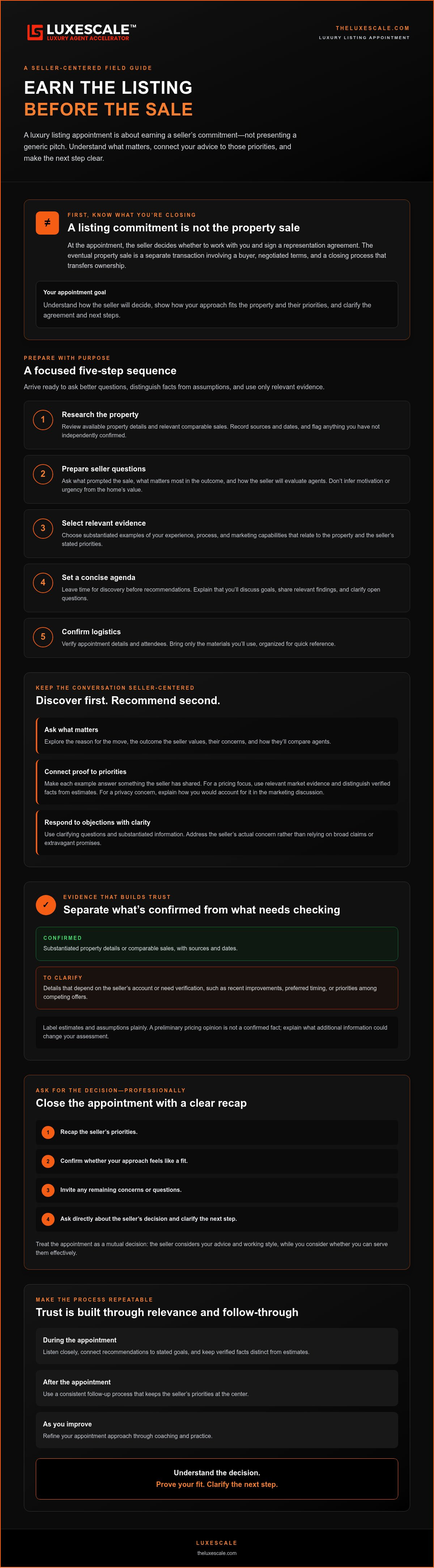
To close a listing is to earn the seller’s commitment to work with you and complete a signed representation agreement. It is not the same as closing the property sale. At the listing appointment, the seller evaluates whether you’re the right agent and decides whether to engage you. The eventual transaction involves a buyer, negotiated terms, and a separate closing process that transfers ownership.
That distinction shapes how to close multi million dollar listings. Your goal at the appointment isn’t to force a quick yes or predict every step of a future sale. It’s to understand how the seller will make a decision, show how your approach fits the property and their priorities, and make the agreement and next steps clear.
What affluent sellers are deciding when they interview agents
Sellers are assessing more than your presentation materials. They want to know whether you understand their property, communicate clearly, exercise sound marketing judgment, and can guide decisions with confidence. A home’s value alone doesn’t tell you what matters to its owner. Ask what’s motivating the sale, what outcome they value most, what concerns them, and how they’ll compare agents.
Treat the appointment as a mutual decision. You’re evaluating whether you can serve the seller effectively; they’re deciding whether your advice and working style earn their trust. That balance is more credible than assuming a high-value home calls for extravagant promises.
Why a generic pitch can lose a high-value listing
Broad claims such as “I provide exceptional service” or “I’ll get you the best price” don’t explain how you’ll address this seller’s needs. A feature-heavy presentation can have the same problem: impressive materials may still leave the seller wondering how your recommendations apply to their home.
Make each piece of evidence answer a priority the seller has shared. If privacy is a concern, explain how you would account for it in the marketing discussion. If pricing is the focus, show relevant market evidence and distinguish verified facts from estimates. The aim isn’t to show everything you’ve prepared. It’s to connect the right evidence to the seller’s actual questions.
For a deeper look at organizing your materials, see this luxury listing presentation guide. A polished presentation can support the conversation, but relevance earns attention. Lead with discovery, then use your expertise to address what the seller says matters.
How to Prepare for a Multi-Million-Dollar Listing Appointment
A strong appointment starts before you arrive. Prepare to ask sharper questions, separate verified information from assumptions, and choose evidence that helps the seller make a decision. Use this five-step sequence to stay focused.
- 1. Research the property. Review available property details and relevant comparable sales. Record each source and date, and flag information you haven’t independently confirmed.
- 2. Prepare seller questions. Ask what prompted the sale, what matters most in the outcome, and how the seller will evaluate agents. Don’t infer urgency, motivation, or financial circumstances from the home’s value.
- 3. Select supporting evidence. Choose substantiated examples of your experience, process, and marketing capabilities that relate to the property and the seller’s stated priorities.
- 4. Set a concise agenda. Leave time for discovery before making recommendations. Explain that you’ll discuss the seller’s goals, share relevant findings, and clarify open questions.
- 5. Confirm logistics. Verify the appointment details and who will attend. Bring only the materials you’ll use, organized so you can find relevant information quickly.
Separate confirmed facts from questions to resolve
Use a simple two-part checklist. Under Confirmed, note details you can substantiate, such as recorded property features or comparable sales, along with their sources and dates. Under To clarify, list anything that depends on the seller’s account or needs verification, such as recent improvements, preferred timing, or priorities among competing offers.
Label estimates and assumptions plainly. For example, distinguish a preliminary pricing opinion from a confirmed fact, and explain what additional information could change your assessment. This keeps your recommendations grounded and helps protect trust.
Build an evidence-led appointment plan
Choose proof for relevance, not volume. A past example is useful when it demonstrates a capability that applies to this property; a marketing claim is useful when you can explain the process behind it. Keep the agenda flexible enough to follow the seller’s answers rather than forcing a fixed pitch. For more preparation ideas, review this luxury listing appointment guide.
Preparation is a skill you can refine. Broader study of real estate strategy, finance, and market analysis, such as the Real Estate Management Program from Harvard Business School, can add context to your professional development. For agents seeking more opportunities to practice seller conversations, LuxeScale’s listing appointments may be worth exploring.
This preparation gives you a repeatable foundation for how to close multi million dollar listings: arrive informed, stay curious, and support recommendations with evidence the seller can evaluate.
How to Present Your Value and Handle Seller Objections
Present your value in the seller’s terms. First identify the priority behind a concern, then recommend an action and show the evidence that supports it. A useful principle: Connect every recommendation to an objective the seller has stated and support it with information they can verify. This keeps the conversation specific, measured, and easier to evaluate.
Respond to concerns about experience, pricing, and marketing
Don’t rush to rebut an objection. Ask what’s behind it and what evidence would help the seller feel confident. Then respond directly, without overstating your track record or promising a result you can’t control.
- Concern: “You haven’t sold many homes like mine.” Ask, “Which part of this property or sale feels most important to get right?” Acknowledge your relevant experience honestly, then explain transferable capabilities, such as your process for evaluating comparable sales or coordinating the proposed marketing approach. Use examples you can substantiate.
- Concern: “How did you arrive at that price?” Ask what the seller is trying to achieve and what market information they’ve already considered. Explain your analysis using relevant, dated comparable sales, noting differences and uncertainty. Present a reasoned pricing strategy, not a guaranteed sale price.
- Concern: “What will your marketing actually include?” Ask which buyers the seller hopes to reach and what matters about the property’s presentation. Describe the specific deliverables you’re proposing and how each supports the property’s positioning. Avoid unsupported claims about reach, timing, or performance.
If your experience in a particular price segment is limited, don’t disguise that fact. Explain what you’ve done that is relevant, how you’ll approach the property’s specific challenges, and what you’ll verify before making recommendations. Credibility grows when your explanation is transparent and your evidence is pertinent.
Make the listing presentation a decision tool
Organize your presentation so the seller can follow the reasoning behind your recommendations. A simple comparison helps:
- Seller priority: Protect privacy. Proposed action: Discuss marketing choices that respect the seller’s preferences. Supporting proof: Clarify which options are available and what each involves.
- Seller priority: Set a defensible asking price. Proposed action: Review relevant comparable sales. Supporting proof: Show sources, dates, and meaningful differences.
- Seller priority: Understand the marketing plan. Proposed action: Outline specific deliverables. Supporting proof: Provide examples you can verify and explain.
Keep each claim specific to the property and invite questions. This makes the appointment a decision process, not a contest of broad promises. For broader positioning ideas, explore this high-end client attraction strategy. That seller-centered discipline is central to how to close multi million dollar listings with integrity.
How to Ask for the Listing and Follow Up Professionally
Once you’ve presented a plan grounded in the seller’s priorities, make the decision clear without creating pressure. A direct, respectful close gives the seller room to respond and gives you a clear basis for what happens next.
Ask directly without applying pressure
Recap the goals the seller shared, the recommendations you’ve discussed, and how you would work together. Then ask: “Does this approach feel like the right fit, and are you ready to move forward?” A clear question is more useful than hinting at a commitment or ending with a vague “Let me know.”
If they’re not ready, stay curious: “What information or decision is still outstanding?” Listen, clarify, and agree on a next step that respects their timeline. Don’t invent a deadline to force action. Record what you agreed to and how the seller prefers you to follow up.
Clarify the agreement and follow up with substance
Before signing, walk through the representation agreement and confirm the terms, responsibilities, requested documentation, and immediate next steps. Give the seller time to review and ask questions. If something needs clarification, verify it rather than guessing or treating an assumption as settled.
Make follow-up consistent with the seller’s stated timeline and preferred communication method, not an arbitrary cadence. If they want time to review materials before reconnecting, agree on when and how you’ll check in. If they request an answer first, send that information before asking for a decision.
A useful follow-up message can be concise:
- Recap: “You said your key priorities are [priority] and [priority].”
- Plan: “We discussed [recommendation] because it addresses [stated goal].”
- Open items: “I’ll send or confirm [requested information].”
- Next step: “As agreed, I’ll contact you by [time or date] through [preferred method] to discuss any remaining questions.”
Correct uncertainties promptly. If new information changes your recommendation, explain what changed and why. That consistency demonstrates sound judgment, whether the seller is ready to sign now or needs more time.
No script guarantees a signed listing. The practical discipline behind how to close multi million dollar listings is to ask clearly, honor the seller’s process, and make each follow-up useful. If you want to strengthen your seller conversations with coaching and qualified listing opportunities, explore LuxeScale’s listing appointments and agent support.
Build a Repeatable Path to More Luxury Listing Opportunities
Winning a listing shouldn’t depend on improvising a new approach each time. Use a consistent sequence: start with a qualified opportunity, discover the seller’s priorities, connect recommendations to relevant evidence, clarify the representation agreement, and follow up according to the seller’s preferences. Repeating the process helps you identify what builds trust and where your conversations need refinement. It doesn’t guarantee a signed agreement, but it gives you a disciplined way to improve.
Evaluate appointment sources by fit, qualification, and support
An appointment source should fit your business capacity and the kinds of seller conversations you’re prepared to lead. Before committing, ask how seller readiness is assessed, what information you’ll receive before each appointment, and what “qualified” means in practice. Confirm the current criteria rather than relying on assumptions. Also ask about territory availability, any exclusivity terms, and the coaching or support available to help you prepare and improve.
Review written referral terms carefully so you understand your obligations and how the arrangement works. Compare those terms with your business goals and your ability to serve the appointments effectively. More opportunities only help if you have the time and process to follow through with each seller.
Where LuxeScale may fit an agent’s growth plan
LuxeScale helps agents pursue luxury listings by identifying and qualifying affluent homeowners who are ready to sell, then scheduling listing appointments. Its accompanying support includes training, coaching, systems, and live video education intended to strengthen agent conversion. The performance-based model involves a 20% fee at closing, with no monthly or recurring out-of-pocket charges. Review the written terms and confirm current appointment qualification criteria and territory availability before deciding whether the fit works for you.
For an agent spending substantial time prospecting, qualified seller appointments may create more room for direct seller conversations. The value still depends on your preparation, judgment, and follow-through. Coaching and practice can help you refine those skills over time, but not every appointment will convert.
If you’ve assessed your capacity and want to explore whether this approach aligns with your goals, explore LuxeScale’s luxury listing appointment support. A repeatable process, paired with opportunities that fit your business, gives you a practical foundation for how to close multi million dollar listings with greater consistency.
Turn a Stronger Listing Process Into Consistent Growth
Closing a high-value listing starts with understanding the seller’s decision, not delivering a flawless pitch. Prepare with verified information, connect each recommendation to the seller’s priorities, and ask directly for the agreement. Then follow up with useful answers and next steps that respect the seller’s timing.
That repeatable approach is the foundation of how to close multi million dollar listings. With practice, you can build credibility through relevant evidence and a clear process, even when your luxury track record is still growing.
If qualified seller conversations are part of your growth plan, LuxeScale provides appointments with qualified affluent homeowners, along with complementary coaching, training, and live video education. Agent participation is limited by territory, so confirm current fit and availability. Explore LuxeScale’s luxury listing appointment support and consider whether it aligns with your goals.
Keep refining your process. Each thoughtful seller conversation is an opportunity to earn trust and strengthen your next appointment.
Frequently Asked Questions
How do you close a multi-million-dollar listing when you have limited luxury experience?
Be honest about your track record, then show how your relevant skills and verifiable results apply to the seller’s needs. Learning how to close multi million dollar listings doesn’t require pretending to have experience you haven’t earned. Prepare thoroughly, ask focused questions, and explain your process for this property. If a question falls outside your expertise, say so, then explain how you’ll verify the answer and follow up accurately.
What should you say to win a luxury listing appointment?
Start by asking what matters most in the sale, what prompted the decision, and how the seller will compare agents. Then reflect their priorities back and connect your recommendations to evidence they can assess. For example: “You’ve said privacy and a well-supported price are priorities. I’ll explain how my proposed approach addresses each one.” Before wrapping up, ask what concerns remain and what information would help the seller decide.
How do you handle a seller who says another agent has more experience?
Acknowledge the concern without criticizing the other agent or becoming defensive. Ask which experience matters most to the seller, then share relevant, verifiable examples of your own judgment, service, or results. Be clear about any gap in your background. You don’t need to claim equal credentials; help the seller evaluate whether your specific plan fits the property and their priorities. If you can’t substantiate a claim, leave it out.
Should you present a listing price during the first luxury appointment?
Present a pricing recommendation only when you have reliable property information and relevant market evidence to support it. Explain the basis for your analysis, its limitations, and factors that could affect the recommendation. If important details are missing, identify what needs verification and agree on when you’ll follow up. Avoid promising a sale price or outcome the evidence can’t support. A transparent preliminary assessment is more credible than false certainty.
How soon should you follow up after a luxury listing appointment?
Follow up when you said you would, using the seller’s preferred communication method and timeline. Send a concise recap of their priorities, your proposed approach, unanswered questions, and agreed next steps. If the seller hasn’t set a decision date, ask permission to reconnect at a mutually convenient time. Make each contact useful by providing requested information or resolving an open question. Repeated check-ins without substance can weaken trust.
What if an affluent homeowner is not ready to sign after the appointment?
Treat hesitation as information, not a reason to apply pressure. Ask what remains unresolved, whether the seller needs additional evidence, or whether another decision-maker should join the conversation. Confirm the preferred next step and timing, then follow through as agreed. If the fit isn’t right, respond professionally and leave the conversation on respectful terms. A clear process protects trust, even when the seller chooses not to list with you.
Can a real estate agent close a multi-million-dollar listing without a large portfolio?
Yes. A large portfolio can help, but it isn’t the only evidence a seller can consider. Demonstrate preparation, clear communication, sound judgment, relevant experience, and a plan tailored to the property. Use documented examples where available, and explain how they apply. Be transparent about your background. Don’t borrow another agent’s results or present unsupported claims as your own. A seller can then assess your actual approach and decide whether it fits.

Article by
Mark Coppens
Mark Coppens is the Founder and Chairman of LuxeScale and Co-Team Lead of Living Vogue | eXp Luxury. He is an active elite-level luxury agent and the author of the upcoming book, POWER POSITIONING: From Missiles to Mansions – Why People Really Buy, and is a nationally recognized speaker on luxury real estate, consumer psychology, marketing, and business growth.
A U.S. Army veteran with an MBA in Marketing, Mark has generated more than $1 billion in career sales and now leads one of the nation's fastest-growing luxury referral platforms, referring more than $2 billion in luxury real estate opportunities each month to partner agents across the United States. He specializes in helping real estate agents generate more listings, break into the luxury market, and build scalable businesses through qualified referrals, award-winning training, coaching, and proven systems. His practical, psychology-driven approach has helped agents across the country increase their income while attracting more affluent clients and building lasting, referral-driven businesses.