
Luxury Home Buyer Leads: 2026 Buying Guide for Agents
What makes a qualified luxury home buyer lead worth your time: a high budget, or a clear reason to act? A price range alone can’t tell you whether a prospect is motivated, aligned with your expertise, or ready for a meaningful conversation. Lead quality comes from intent, fit, and disciplined follow-through.
If you’ve spent time chasing prospects who aren’t prepared or well matched, your concern is justified. Lead quality isn’t always obvious, and unclear fees or follow-up expectations can make a new opportunity harder to assess. A consistent framework helps you decide where to invest your time before the pursuit begins.
This guide shows you how to evaluate buyer intent, financial readiness, timing, and fit; compare lead-generation models; and build a follow-up process suited to high-value clients. You’ll also learn how LuxeScale’s performance-based referral model works: a 20% fee is due at closing, with no monthly or recurring out-of-pocket charges. The goal is a more deliberate path to affluent-client growth, supported by training and coaching.
Key Takeaways
- Assess buyer context, motivation, property fit, contact expectations, and handoff details before deciding how to proceed.
- Separate verified prospect information from marketing claims, and don’t treat a high price range as proof of buying readiness.
- Compare self-generated, paid-campaign, and referral-based leads by the effort, control, and payment structure each involves.
- Use a concise, attentive first conversation to understand the buyer’s needs, clarify fit, and agree on practical next steps.
- Evaluate qualified luxury home buyer leads as part of a broader growth strategy, including the support and referral terms that shape your business fit.
What Makes Qualified Luxury Home Buyer Leads Worth Pursuing?
A luxury inquiry deserves your attention when it gives you a credible reason to start a relevant conversation, not simply because the prospect mentions an expensive property. A luxury buyer lead is a prospect whose stated needs and demonstrated buying intent justify a relevant conversation with an agent equipped to serve them. That definition keeps qualification focused on what the buyer communicates, rather than assumptions about wealth or a presumed purchase.
Useful lead generation connects potential clients with a thoughtful next step. For agents, the practical test is whether the information available helps you understand the prospect’s goals and respond appropriately. A price range may help establish property fit, but it doesn’t reveal motivation, timing, or readiness to engage.
Which signals suggest a luxury buyer is ready to engage?
Look for specific, observable signals: the prospect describes property preferences, explains what is prompting the purchase, and shows willingness to discuss next steps. Those details give you a starting point for a useful conversation. A buyer seeking a particular kind of home for a stated lifestyle change, for example, has shared more actionable context than someone who has only browsed a broad price range.
Keep facts separate from inference. A stated budget doesn’t prove access to funds, and expressed interest doesn’t establish urgency. Ask concise follow-up questions about goals and timing, then listen for answers that clarify whether your expertise and service approach fit. Qualification helps you decide how to engage. It can’t guarantee a transaction.
Why lead quality matters more than raw volume
Every poorly matched inquiry can require research, outreach, and follow-up without giving you enough context to make those efforts relevant. That time comes from somewhere: often from serving current clients or responding carefully to better-aligned prospects. A smaller number of conversations with clearer needs can help you focus your attention, even though no lead source can promise a particular outcome.
Use fit as a working filter. Consider whether the buyer’s stated goals align with the properties and level of service you can provide, whether the timing supports a meaningful discussion, and whether the available contact information makes respectful follow-up possible. If key details are missing, treat that as a prompt to clarify, not as proof of disinterest or readiness.
For a related perspective on the seller side of high-value real estate growth, see this guide to seller leads and high-ticket strategies. It focuses on seller opportunities, while this section centers on assessing buyer intent. The distinction matters: each prospect type calls for different questions, context, and follow-through.
How to Evaluate Luxury Buyer Lead Qualification Before You Commit
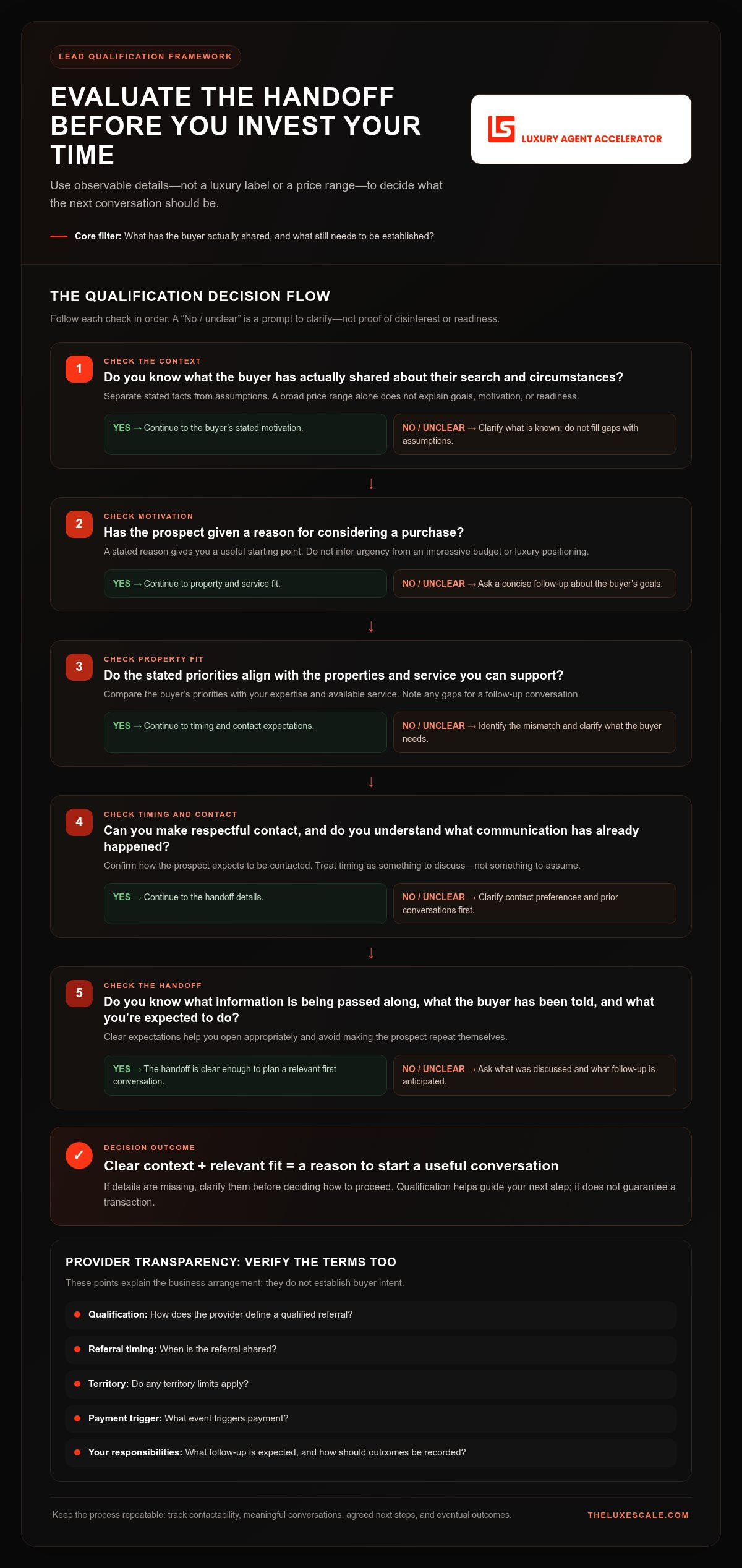
A clear qualification process helps you judge a referral on evidence, not labels. Qualification criteria should be specific, observable, and repeatable so every lead is assessed against the same practical standards. For qualified luxury home buyer leads, review what the prospect has actually shared, what remains unknown, and whether the opportunity merits your next step.
Use this sequence to assess the handoff:
- Prospect context: Identify the information provided about the buyer’s search and circumstances. Separate stated facts from assumptions.
- Motivation: Note the reason the prospect gives for considering a purchase. Don’t infer urgency from an impressive budget or a luxury label.
- Property fit: Compare the stated priorities with the properties and level of service you can reasonably support. Flag gaps for a follow-up conversation.
- Contact expectations: Clarify how the prospect expects to be contacted and what communication has already taken place.
- Handoff: Understand what information is being passed along, what the prospect has been told, and what action the agent is expected to take.
What information should a useful buyer referral include?
A useful referral gives you enough context to open with a relevant question. That may include the buyer’s stated search priorities, purchase motivation, and any context they’ve shared about their plans. The key is not an exhaustive profile; it’s clarity about what the prospect has expressed and what still needs to be established directly.
Clear handoff expectations matter just as much. If you know what the prospect has already discussed and what follow-up is anticipated, you can avoid making them repeat themselves and shape your opening appropriately. Treat missing details as questions to clarify, not facts to fill in yourself.
How can agents assess lead-provider transparency?
Look for clear explanations of how a provider defines qualification, when a referral is shared, whether territory limits apply, and what event triggers payment. These terms shape the business arrangement, but they don’t establish the buyer’s intent or guarantee a transaction. Be equally clear on your responsibilities after receiving a referral, including follow-up expectations and how outcomes should be recorded.
Track contactability, meaningful conversations, agreed next steps, and eventual outcomes using the same definitions each time. This gives you a more useful view of lead quality than relying on promotional wording alone. For broader criteria on evaluating a working relationship, read this guide to choosing a luxury real estate referral partner.
Agents exploring affluent buyer opportunities can also review LuxeScale’s buyer lead and agent support model as one option in a performance-oriented growth strategy.
Which Luxury Buyer Lead Model Fits Your Business?
The right lead model depends on your capacity, appetite for control, and preferred payment structure. Self-generated prospecting offers the most control over outreach and targeting, but it also requires you to build and manage the pipeline. Paid campaigns can give you more control over the campaign itself, while adding ongoing management and a spend structure that may not depend on a closing. Referral-based opportunities can reduce the burden of sourcing, but terms, qualification clarity, and follow-up responsibilities vary.
Use this comparison to identify the trade-offs that matter to your business. A source alone can’t establish buyer intent, agent fit, or eventual conversion. Review those factors separately when assessing qualified luxury home buyer leads.
| Model | Qualification clarity | Agent workload | Fee trigger | Support | Exclusivity |
|---|---|---|---|---|---|
| Self-generated | You define how you identify and assess prospects. | High sourcing and follow-up responsibility. | Prospecting or marketing expenses depend on your approach. | You provide or arrange your own support. | You control your outreach; access isn’t inherently exclusive. |
| Paid campaign | Depends on the targeting, intake process, and information gathered. | You manage the campaign and respond to inquiries. | Campaign billing terms vary and may apply before a closing. | May include campaign services, depending on the arrangement. | Depends on the campaign and its terms. |
| Referral-based | Depends on how the referral is defined and what prospect context is shared. | Less sourcing work, but the agent still handles follow-up. | Depends on the agreement; LuxeScale charges a 20% referral fee at closing. | Can include agent education and coaching. LuxeScale provides complementary training, coaching, systems, and support. | Terms vary. LuxeScale limits the number of participating agents in each territory. |
When does a referral-based model make sense?
A closing-based arrangement may suit agents who want to limit monthly or recurring out-of-pocket charges. LuxeScale’s model has no monthly or recurring out-of-pocket charges, with a 20% referral fee due at closing. That fee remains a business cost, so assess it against your conversion economics and operating capacity. The arrangement doesn’t guarantee that a referral will close.
How should exclusivity and support affect the comparison?
Territory limits can shape how many agents participate in an area, but they don’t establish how many leads you’ll receive. Compare access alongside the practical value of coaching, training, and live video education, especially if you’re building confidence in affluent-client conversations. For more on referral strategy and pipeline growth, read luxury real estate referrals and pipeline growth.
No model wins for every agent. Choose the structure you can support consistently, then evaluate each opportunity on its own context, costs, and follow-through demands.
How to Convert a Qualified Luxury Buyer Lead Into a Strong First Conversation
A promising referral is only the starting point. Your first conversation should help the buyer feel understood, establish whether you can serve their needs, and set a clear next step. Keep it polished and concise. Respect the prospect’s time and privacy, and let their answers guide the discussion rather than launching into a prepared pitch.
Use a simple sequence to keep the exchange focused:
- Respond: Acknowledge the inquiry and introduce yourself clearly. Keep the opening warm and professional.
- Establish context: Refer to the information the buyer has already shared, then invite them to fill in what’s missing.
- Listen: Give the prospect room to explain what matters most before recommending properties or services.
- Clarify fit: Explore whether their priorities align with your expertise and how you can support their search.
- Agree on next steps: Confirm an action that works for both sides, such as a follow-up conversation or sharing relevant information.
What should the first conversation accomplish?
Start with the buyer’s stated needs, not assumptions based on a property price or perceived wealth. Open-ended questions invite useful context: “What matters most in your search?” “What’s prompting the move?” and “How are you approaching timing and decisions?” Listen for priorities, constraints, and who else is involved in the decision-making process. You don’t need to resolve every detail at once. Close by summarizing what you heard and agreeing on one clear next step, without pushing for a commitment the buyer isn’t ready to make.
How can agents build credibility with affluent buyers?
Preparation carries more weight than posturing. Be ready to discuss relevant market conditions, explain the buying process in plain language, and answer questions directly. If you need to verify a detail, say so and follow through. Avoid status assumptions and exaggerated claims; confidence comes from clear guidance and consistent service. Keep a concise record of response attempts, the buyer’s stated priorities, and agreed actions in your existing workflow, so future follow-up feels informed rather than repetitive.
Some appointment skills transfer across client conversations, though the focus differs: this guide to luxury real estate listing appointments centers on sellers, while a buyer conversation calls for discovery around the purchase.
To strengthen your approach to affluent-client conversations, explore LuxeScale’s buyer leads and agent support, including training and coaching designed to support your professional growth.
How LuxeScale Supports Agents Seeking Qualified Luxury Home Buyer Leads
LuxeScale gives agents seeking qualified luxury home buyer leads access to affluent buyer opportunities alongside professional support for building a stronger luxury business. The model is performance-based: a 20% referral fee is due at closing, with no monthly or recurring out-of-pocket charges. The fee is tied to a completed transaction, but it doesn’t guarantee a buyer will move forward or close.
Lead access is one part of the partnership. LuxeScale also provides complementary coaching, training, systems, and live video education. These resources can help you prepare for affluent-client conversations and strengthen the process you use after a referral arrives. Territory exclusivity limits the number of participating agents in each territory; it doesn’t promise a particular lead quantity or outcome.
What agents can expect from the partnership model
LuxeScale’s offering includes affluent buyer leads, but agents should assess each opportunity through their own conversations and service capabilities. The 20% referral fee is tied to closing, and the absence of monthly or recurring out-of-pocket charges can make the structure worth considering if you prefer not to add those ongoing expenses. Coaching and education support your readiness to serve affluent buyers. They’re not a substitute for consistent follow-up, nor a guarantee of conversion.
What to consider before taking the next step
Start with your capacity. Can you respond thoughtfully, maintain a polished follow-up process, and provide the level of service an affluent buyer expects? Then weigh the referral structure alongside the available training and coaching, and consider how territory exclusivity fits your growth plans. A sound decision accounts for the full working relationship, not just the prospect of receiving leads.
LuxeScale supports agents prepared to work buyer opportunities with discipline and who value education alongside lead access. Consider the partnership in the context of your business goals, current workload, and approach to client service.
Explore LuxeScale’s approach to luxury buyer leads and take the next step toward building your luxury business with a performance-based lead and support model.
Build a More Intentional Luxury Buyer Pipeline
Strong luxury lead generation starts with discernment. Assess a buyer’s stated goals, motivation, and timing rather than treating price range as proof of readiness. Then compare lead models by their workload, payment structure, and support, and use a thoughtful first conversation to clarify fit and agree on next steps. That process helps you decide where to invest your time without assuming any lead will convert.
For agents considering qualified luxury home buyer leads, LuxeScale offers affluent buyer leads alongside coaching, training, and live video education. Its 20% referral fee is due at closing, with no monthly or recurring out-of-pocket charges, and territory exclusivity limits the number of participating agents. These features can support a performance-oriented growth strategy, while your follow-through and client service remain central to the outcome.
Explore whether the approach aligns with your goals and capacity. Explore LuxeScale’s approach to qualified luxury buyer leads and take a considered next step toward building your luxury business with confidence.
Frequently Asked Questions
What qualifies as a luxury home buyer lead?
A luxury home buyer lead is a prospective buyer whose stated goals and buying intent warrant a relevant conversation with an agent. Qualification depends on more than a high property budget. Look for useful context, such as the buyer’s search priorities, motivation, timing, and willingness to discuss next steps. These signals help you assess fit and respond appropriately, but they don’t guarantee readiness to purchase or a completed transaction.
How can I tell whether a luxury buyer lead is serious?
Assess what the prospect has actually said and done, rather than guessing from perceived wealth or an advertised price range. Specific preferences, a clear reason for buying, and openness to discussing timing or next steps can support a meaningful conversation. Ask thoughtful questions to clarify what’s known and what remains uncertain. Seriousness is best evaluated through direct communication, not assumed from a lead description or provider’s marketing language.
Are luxury home buyer leads exclusive to one real estate agent?
Exclusivity depends on the provider’s arrangement, so don’t assume every referral is assigned to one agent. LuxeScale limits the number of participating agents in each territory. That territory-level limit doesn’t, by itself, establish that each individual buyer lead is exclusive to a single agent. Review how the referral arrangement defines access and participation, then consider whether those terms fit your business strategy and capacity to serve affluent buyers.
How do referral fees for luxury buyer leads work?
Referral fees are governed by the agreement between the lead provider and agent, including the event that triggers payment. LuxeScale’s performance-based model charges a 20% referral fee at closing, with no monthly or recurring out-of-pocket charges. The fee is still a business expense, so consider its terms alongside your follow-up process, service capacity, and transaction economics. A closing-based structure doesn’t guarantee that a lead will convert.
Can new agents convert qualified luxury home buyer leads?
New agents can pursue qualified luxury home buyer leads if they’re prepared to respond professionally, understand the buying process, and provide consistent client service. Experience matters, but preparation and follow-through matter too. Be ready to clarify the buyer’s priorities, communicate what you can support, and seek guidance when needed. LuxeScale’s complementary coaching and training can help agents prepare for affluent-client conversations, but it can’t guarantee a conversion or closing.
How quickly should I follow up with a luxury buyer lead?
Follow up promptly and in line with the prospect’s stated contact preferences and the expectations communicated during the referral. A timely, concise introduction helps establish context, while repeated messages without a response can feel intrusive. Refer to what the buyer has already shared, invite them to clarify priorities, and suggest a clear next step. Record your attempts and agreed actions in your existing workflow so follow-up remains consistent and informed.
What is the difference between buyer leads and listing leads?
Buyer leads are people exploring a home purchase, so your first conversation should clarify search priorities, motivation, timing, and decision-making needs. Listing leads are homeowners considering selling, so the discussion centers on their property, selling goals, and readiness to list. The two opportunities require different questions and follow-up. LuxeScale offers affluent buyer leads as well as seller-focused opportunities, including luxury listing appointments.
Does LuxeScale provide training alongside affluent buyer leads?
Yes. LuxeScale provides complementary coaching, training, systems, and live video education alongside its affluent buyer leads. This support can help agents prepare for high-value client conversations and strengthen their approach to follow-up. It’s professional support, not a promise that a prospect will convert or complete a purchase. Agents should still assess each buyer’s needs directly and apply a consistent process from first contact through next steps.

Article by
Mark Coppens
Mark Coppens is the Founder and Chairman of LuxeScale and Co-Team Lead of Living Vogue | eXp Luxury. He is an active elite-level luxury agent and the author of the upcoming book, POWER POSITIONING: From Missiles to Mansions – Why People Really Buy, and is a nationally recognized speaker on luxury real estate, consumer psychology, marketing, and business growth.
A U.S. Army veteran with an MBA in Marketing, Mark has generated more than $1 billion in career sales and now leads one of the nation's fastest-growing luxury referral platforms, referring more than $2 billion in luxury real estate opportunities each month to partner agents across the United States. He specializes in helping real estate agents generate more listings, break into the luxury market, and build scalable businesses through qualified referrals, award-winning training, coaching, and proven systems. His practical, psychology-driven approach has helped agents across the country increase their income while attracting more affluent clients and building lasting, referral-driven businesses.