
Luxury Real Estate Agent Training: Build Skills That Win High-End Clients in 2026
A luxury designation won’t earn a seller’s trust if you can’t explain your pricing strategy, demonstrate market knowledge, or guide a high-stakes conversation. Effective luxury real estate agent training goes beyond credentials. It prepares you to represent distinctive properties and meet affluent clients’ expectations with confidence.
If you’re weighing a course, certification, or coaching program, focus on what you’ll be able to do differently afterward. Education matters when you can apply it in the moments that shape a listing opportunity.
This guide covers the knowledge and client-facing skills a useful training plan should address, how to compare learning formats, and ways to put new skills to work in seller conversations.
Practice is essential. Training, coaching, and live video education can connect specialized knowledge with real-world preparation, including conversations with qualified affluent sellers.
Key Takeaways
- Luxury real estate agent training should build market judgment, pricing skill, negotiation, communication, and service habits, not just add a credential.
- Assess your current strengths and choose one practical behavior to improve, such as explaining a pricing recommendation clearly.
- Compare certification, self-paced study, live instruction, coaching, and peer learning by how well each fits your experience and learning needs.
- Turn education into results through a repeatable cycle of study, practice, feedback, and review.
- Pair skill development with qualified seller opportunities and preparation for confident listing conversations.
Luxury Real Estate Agent Training: Why High-End Representation Requires More Than a Credential
You’re ready to compete for higher-value listings, but choosing training that improves your performance can be difficult. A designation may add credibility, while a course may teach specialized knowledge. The practical question is whether you’ll be better prepared to advise a seller, explain your recommendations, and tailor your process to the property and client.
Luxury real estate agent training is structured development in the knowledge, judgment, communication, and service required to represent high-end properties. It builds on the fundamentals of real estate practice, including the roles and responsibilities outlined in this overview of a real estate broker. Specialized learning applies those foundations to distinctive properties, nuanced pricing decisions, and client expectations that can call for greater discretion and a tailored approach.
Course completion shows that you studied the material; client-ready competence shows that you can apply it clearly and reliably in a real seller conversation.
What does luxury real estate agent training cover?
Training may address market fluency, comparable-property analysis, pricing judgment, negotiation, communication, and client service. Curriculum varies by provider and format, so look beyond topic titles to see whether the learning includes practical application. For example, a pricing module is more useful when you practice presenting a recommended range, explaining the evidence behind it, and responding to a seller with a different expectation.
Translate each topic into an observable behavior you can rehearse:
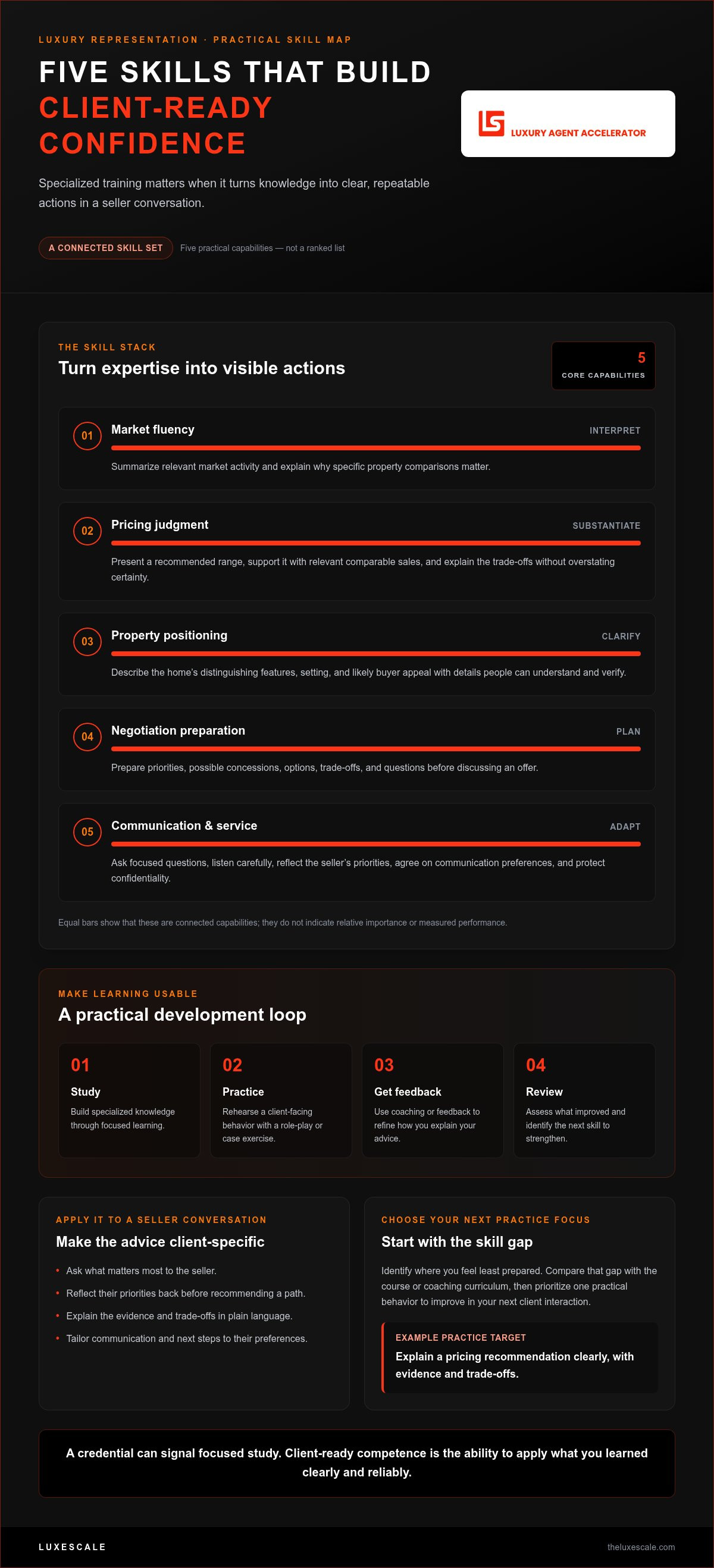
- Market knowledge: Explain how a property’s location, features, and likely buyer profile shape its competitive position.
- Pricing judgment: Support a recommendation with relevant comparable sales and a clear rationale.
- Negotiation: Prepare options and trade-offs before discussing an offer.
- Communication: Ask focused questions, listen carefully, and summarize the client’s priorities.
- Service: Adapt updates and next steps to the seller’s preferences while protecting confidentiality.
Who benefits from specialized luxury training?
Agents entering the segment can use structured learning to identify unfamiliar market concepts and prepare for conversations that differ from their usual transactions. Experienced agents may benefit when they want to refine a specific part of their approach, such as substantiating a premium price, presenting a property’s distinctive value, or communicating with greater precision.
Start with a skills-gap review. Identify the situations where you feel least prepared, then compare those gaps with the course or coaching curriculum. Prioritize the skill that could most improve your next client interaction, and practice it through a role-play, case exercise, or feedback session. A luxury designation can signal focused study, but it doesn’t replace demonstrated ability or guarantee new business. The value comes from turning learning into consistent, client-centered action.
The Core Skills Luxury Real Estate Agent Training Should Build
A polished presentation matters, but high-end representation depends on more than a property’s price. A home’s design, location, ownership priorities, privacy needs, and likely buyer pool can all shape the work. Strong luxury real estate agent training connects specialized knowledge to repeatable behaviors, so you can explain your advice and adapt your service to the client in front of you.
Preparation earns its value when it helps you tailor sound advice to a client’s priorities and build trust through every decision.
Pricing, market fluency, and property positioning
Market fluency means interpreting relevant activity, not reciting broad trends. Practice comparing similar properties, identifying meaningful differences, and explaining how those differences affect positioning. Then build a property-specific narrative. Replace generic claims such as “exceptional home” with clear, supportable details about the home’s features, setting, and appeal to its likely audience.
Pricing judgment also means discussing trade-offs. Rehearse presenting a recommended range, the evidence behind it, and the implications of alternative pricing choices. The National Association of REALTORS® outlines options for continued specialization in its Real Estate Designations and Certifications directory. Whichever learning path you choose, look for ways to practice explaining analysis in plain language.
- Market fluency: Summarize relevant market activity and explain why specific comparisons matter.
- Pricing: Present evidence, state your recommendation, and explain the trade-offs without overstating certainty.
- Positioning: Describe what distinguishes the property using details a buyer can understand and verify.
- Negotiation: Prepare priorities, possible concessions, and questions before discussing an offer.
- Service delivery: Agree on communication preferences, document next steps, and handle sensitive information professionally.
Negotiation, discretion, and client communication
Effective communication starts with listening. Ask what matters most to the seller, reflect their priorities back, and adapt your recommendations accordingly. A client focused on timing may need a different discussion from one prioritizing privacy or a particular financial outcome. Don’t assume every affluent client has the same expectations, decision process, or preferred level of service.
Discretion is a practice, not a label. Confirm what information the client is comfortable sharing, use appropriate channels, and avoid discussing private details casually. Professionalism also means setting clear expectations, following through on agreed actions, and communicating changes promptly.
Role-play makes these skills easier to assess. Practice with a seller who challenges your pricing rationale, requests an unrealistic timeline, or raises a concern you need to clarify. After each scenario, review whether you listened without interrupting, answered directly, explained options, and agreed on a clear next step. LuxeScale’s agent training and coaching supports preparation for listing conversations and qualified seller opportunities.
How to Compare Luxury Real Estate Agent Training Formats
The right format depends on the skill you need to build, how you learn, and how you’ll apply the material. A recognized credential can document study, but it doesn’t show on its own how effectively you handle a seller conversation. Compare programs by what they help you do, not just by the name attached to completion.
Use this framework to weigh common learning formats:
Certification course
Best fit: Agents seeking a structured curriculum and formal recognition.
Practical strength: Provides organized subject matter and defined completion milestones.
Likely limitation: Recognition doesn’t necessarily demonstrate applied skill.
Self-paced study
Best fit: Agents who need flexibility or want to focus on selected topics.
Practical strength: Lets you revisit material and learn around existing commitments.
Likely limitation: Requires self-discipline and may offer little feedback.
Live instruction
Best fit: Learners who benefit from discussion and direct questions.
Practical strength: Offers interaction and can clarify concepts in the moment.
Likely limitation: The session may leave limited time for individualized practice.
Coaching
Best fit: Agents working through specific decisions or conversations.
Practical strength: Allows focused review, rehearsal, and feedback.
Likely limitation: Its value depends on how closely the guidance fits your goals.
Peer learning
Best fit: Agents who want to exchange perspectives and discuss real scenarios.
Practical strength: Exposes you to different approaches and shared problem-solving.
Likely limitation: The quality and relevance of discussion can vary.
Certification, coursework, and live instruction
A structured curriculum can provide a clear sequence, core concepts, and milestones to track your progress. Self-paced coursework offers control over timing, while live instruction creates space to test your understanding through discussion. Neither format is automatically superior. Match it to your learning gap: choose flexibility to review unfamiliar concepts, or live interaction when you need to examine your reasoning aloud and hear other perspectives.
Before enrolling, assess four factors: whether the curriculum fits your goals, whether instructors bring relevant experience, whether you’ll practice skills rather than only absorb information, and whether there’s a way to apply or revisit learning afterward. A credential signals completion; practice, feedback, and reflection provide more direct evidence of development.
Coaching and applied practice
Coaching can help you examine why you made a decision, consider alternatives, and rehearse how you’ll explain your advice. Practical exercises make concepts usable: role-play a listing appointment, review your questions, then refine your opening and response to seller concerns. Rehearse again after feedback. That cycle helps you carry learning beyond course completion and into real client interactions.
For luxury real estate agent training, prioritize formats that connect learning to the appointments and conversations you want to handle with confidence. A course can build knowledge; deliberate practice helps you put it to work.
Turn Luxury Real Estate Training Into a Practical Development Plan
Training creates value when it changes what you do in a client conversation. Build a routine: identify a skill gap, choose learning that addresses it, study the material, practice a specific behavior, get feedback, and review your progress. Keep the cycle focused. Trying to improve every part of your business at once makes it harder to see what’s working.
Build a focused learning plan from skill gaps
Start by assessing your confidence in pricing, negotiation, communication, and service. Use a simple rating scale, then add an example that supports each rating. You might feel comfortable presenting comparable sales but less confident responding when a seller challenges your recommended price. That specific gap gives you a useful learning target.
Choose the priority that would most strengthen an upcoming client interaction, rather than collecting credentials without a clear purpose. Set a review point after you’ve had time to study and practice. Then decide whether to keep building the same skill or shift attention to another gap.
- Assess: Identify a real situation where you want to improve.
- Select: Choose learning that directly addresses that need.
- Study: Capture the principle or technique you intend to use.
- Practice: Rehearse one observable behavior, such as asking an open-ended discovery question before presenting a recommendation.
- Receive feedback: Ask a peer or coach to assess your behavior against clear criteria.
- Review: Record what changed, what still feels difficult, and what you’ll practice next.
Make the goal measurable at the behavior level. For example, during a role-play, aim to ask several relevant discovery questions before proposing a strategy. Track each practice session with the date, scenario, behavior tested, feedback received, and one adjustment for next time. Brief notes are enough. The purpose is to spot progress and patterns, not to create paperwork.
Practice skills before high-stakes seller conversations
Role-play discovery questions, objections, and the explanation of a pricing or marketing recommendation. Ask your practice partner to take a realistic seller perspective, then repeat the scenario after feedback. Evaluate whether you listened without interrupting, addressed the concern directly, explained your reasoning clearly, and agreed on a next step. If you’re preparing for a listing presentation, rehearse the sequence and transitions, not just the opening pitch.
Training transfers into practice when you can demonstrate the target behavior consistently, explain your reasoning, and adapt it to a client’s priorities. LuxeScale pairs training and coaching with qualified seller opportunities, helping agents prepare for real listing conversations. Explore LuxeScale’s agent training and coaching as a next step in building that preparation into your development plan.
How LuxeScale Supports Luxury Real Estate Agent Training and Opportunity
Once you’ve identified the skills to build and how you’ll practice them, the next step is applying that preparation in seller conversations. LuxeScale connects qualified affluent homeowner opportunities with agent training and support, linking education to the work of pursuing luxury listings.
Training alongside qualified luxury listing appointments
LuxeScale identifies and qualifies affluent homeowners who are ready to sell, then schedules luxury listing appointments for agents. Use the opportunity to put your preparation to work: listen closely to the seller’s priorities, ask focused questions, explain your recommendations, and agree on clear next steps. An appointment gives you the chance to demonstrate your value, though the seller still makes the decision about representation.
Prepare before the meeting. Review the homeowner’s stated needs, organize questions that will help you understand their goals, and plan how you’ll explain your approach without assuming what matters most to them. LuxeScale’s complementary training and coaching can help you strengthen those habits and approach referred opportunities with greater confidence.
The model is performance-based: LuxeScale receives a 20% referral fee at closing, with no monthly or recurring out-of-pocket charges. This ties the fee to a completed transaction rather than a recurring monthly expense, while the seller’s decision remains dependent on the fit between their needs and your approach.
Coaching and support that reinforce agent readiness
Education is most useful when you can revisit a decision, practice a conversation, and refine your approach. LuxeScale provides complementary training, coaching, and live video education to support agents as they prepare for referred opportunities. The business is led by experienced luxury agents, bringing relevant professional perspective to that support.
Use coaching to work through a specific challenge, such as explaining a pricing recommendation or responding to a seller’s concern. Apply the feedback in a practice conversation, then reflect on what you’d adjust for an actual appointment. Live video education supports continued learning, while coaching helps connect concepts to your approach and development priorities.
This support complements, rather than replaces, sound judgment and personal preparation. A qualified appointment gives you a setting to apply what you’ve learned; training and feedback can help you improve how you listen, advise, and follow through. Bring relevant market knowledge, a tailored process, and clear communication to each conversation.
If you’re ready to pair practical preparation with qualified luxury seller opportunities, explore LuxeScale’s agent opportunities and support.
Put Your Next Skill Into Practice
Your next step doesn’t need to be another credential. Choose one capability that would make your seller conversations clearer, then create a deliberate opportunity to practice it. A focused question, a well-supported recommendation, or a thoughtful response to a concern can strengthen the experience you provide.
That’s the practical purpose of luxury real estate agent training: not simply to know more, but to bring better judgment and preparation to the moments when a client needs your guidance. Progress comes from applying what you learn, reflecting on how it lands, and refining your approach with each conversation.
Connect your development with opportunities to represent affluent sellers. LuxeScale brings qualified seller opportunities together with agent support through a performance-based model with no monthly or recurring out-of-pocket charges.
Explore how LuxeScale supports luxury agents and take your next step toward more confident, capable representation.
Frequently Asked Questions
Do luxury real estate agents need a certification?
No, a certification isn’t the only way to develop luxury-market capability. It can show focused study and introduce specialized concepts, but consider whether the program addresses a real gap and includes ways to apply its lessons. For example, after studying property positioning, practice explaining why a home may appeal to a particular buyer. A designation is one part of professional development; clients also experience your preparation, judgment, communication, and service.
Can a new real estate agent take luxury training?
Yes, new agents can study luxury-market concepts, but specialized learning works best alongside a solid grasp of transaction fundamentals. Identify where you need more experience, then choose coursework or coaching that addresses those gaps. Before presenting yourself as a luxury specialist, practice explaining your role and experience accurately. A role-play with a peer can help you answer a seller’s questions clearly without overstating your track record or capabilities.
Is online luxury real estate training effective?
Yes, online training can be effective if it gives you relevant material and a way to use it. Before starting, set a learning objective, such as improving how you explain a property’s competitive position. After each lesson, write down one idea to test in a practice scenario and one question to revisit. Self-paced study can suit a busy schedule; live online sessions may make it easier to discuss a challenging example and get feedback.
How long does luxury real estate agent training take?
There’s no single timeline because course structure, study pace, and practice requirements differ. Review the schedule and set aside time for application, not just lessons. A course might introduce negotiation concepts in a short period, while becoming comfortable responding to seller concerns takes repeated practice. Track progress with a concrete behavior, such as clearly summarizing a client’s priorities before recommending next steps, rather than treating course completion as the finish line.
Does luxury real estate training guarantee listings?
No. Training can strengthen your preparation, but it can’t guarantee that a seller will choose you. Listing decisions depend on the client’s needs, the property, the market, your experience, and how you handle the conversation. Treat claims of certain business results cautiously. A more useful measure is whether you can explain your recommendations with relevant evidence, respond thoughtfully to concerns, and follow through on the process you’ve discussed with the seller.
How can I keep my luxury real estate knowledge current?
Build a routine for reviewing market evidence and learning from completed client interactions. After a listing meeting or transaction, note which questions came up, what information helped the client decide, and where your explanation could have been clearer. Discuss a difficult scenario with an experienced colleague, then update your approach if the feedback reveals a useful adjustment. Revisiting those notes regularly helps turn new information into more deliberate advice and service.
Should I choose a luxury designation or coaching first?
Choose based on the problem you need to solve. If you need a structured introduction to luxury-market concepts, coursework or a designation may be the better starting point. If you understand the concepts but find it difficult to apply them in conversation, coaching can focus on how you explain a recommendation or respond to a concern. Before committing, compare the learning objectives and decide how you’ll assess progress in practice.

Article by
Mark Coppens
Mark Coppens is the Founder and Chairman of LuxeScale and Co-Team Lead of Living Vogue | eXp Luxury. He is an active elite-level luxury agent and the author of the upcoming book, POWER POSITIONING: From Missiles to Mansions – Why People Really Buy, and is a nationally recognized speaker on luxury real estate, consumer psychology, marketing, and business growth.
A U.S. Army veteran with an MBA in Marketing, Mark has generated more than $1 billion in career sales and now leads one of the nation's fastest-growing luxury referral platforms, referring more than $2 billion in luxury real estate opportunities each month to partner agents across the United States. He specializes in helping real estate agents generate more listings, break into the luxury market, and build scalable businesses through qualified referrals, award-winning training, coaching, and proven systems. His practical, psychology-driven approach has helped agents across the country increase their income while attracting more affluent clients and building lasting, referral-driven businesses.