
Outsourced Prospecting for Luxury Realtors: 2026 Guide
What if your next luxury listing conversation began with a seller who was already qualified, while you kept control of the relationship? That’s the promise of outsourced prospecting for luxury realtors, but a booked appointment is valuable only when the homeowner is a genuine fit and the handoff protects the client experience. Inconsistent opportunities and hours spent prospecting can pull your focus away from advising clients and preparing listings.
You’re right to look beyond lead volume. For a high-end business, seller qualification, appointment handoff, and commercial terms all matter. The right arrangement should support your service standards, not leave you sorting through generic contacts or unclear responsibilities.
This 2026 guide explains how to assess prospecting models, what to ask about seller readiness and relationship ownership, and how to evaluate coaching, territory policies, and payment terms. It also covers LuxeScale’s qualified luxury listing appointments and closing-based referral model, so you can compare the fit with your goals and confirm the written terms before deciding.
Key Takeaways
- Assess prospecting by whether it sources and qualifies potential sellers, not simply by how many names it delivers.
- Use a clear qualification and appointment process to confirm seller interest and context while keeping the listing consultation in your hands.
- Compare outsourced prospecting, in-house work, and software-only workflows by agent time, messaging control, handoff quality, and accountability.
- Before signing, get written definitions for qualified appointments, territory boundaries, attribution, and dispute handling.
- Evaluate outsourced prospecting for luxury realtors against your need for qualified seller appointments, less prospecting work, and training support.
What outsourced prospecting for luxury realtors actually includes
Every hour spent finding potential sellers is an hour you can’t spend preparing a listing, advising a client, or strengthening an existing relationship. Outsourced prospecting for luxury realtors shifts some business-development work to a partner. Depending on the agreement, that partner may identify prospective sellers, assess their interest and readiness, and introduce qualified prospects through a scheduled appointment.
This involves more than receiving a name and phone number. A contact is not automatically a seller opportunity, and an appointment is a chance to advise, not a guaranteed listing or closing. You still need to understand the homeowner’s priorities, demonstrate relevant expertise, and earn the business. The fundamentals of lead generation help explain how prospects enter a pipeline, but a service’s value depends on what happens between initial identification and your conversation with the homeowner.
How outsourced prospecting differs from software and lead lists
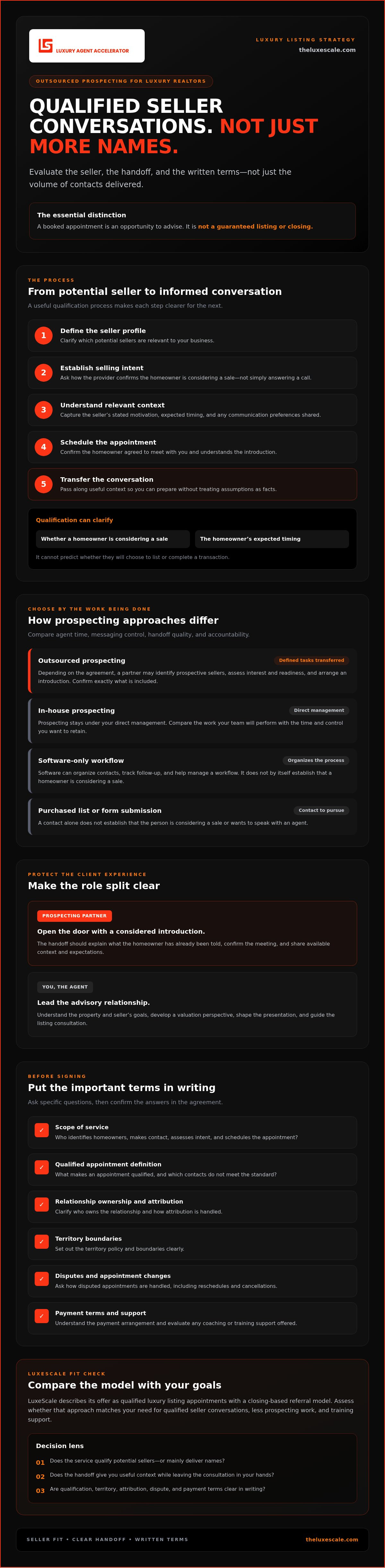
Software can organize contacts, track follow-up, and help manage a prospecting workflow. A service may go further by conducting research and outreach, assessing seller intent, and arranging an introduction. A purchased list or form submission generally gives you a contact to pursue. It does not, by itself, establish that the person is considering a sale or wants to speak with an agent.
Providers vary, so clarify the actual scope before comparing options. Ask who identifies homeowners, who makes contact, what questions are used to assess intent, and who schedules the appointment. Don’t assume that “qualified lead” means a confirmed seller conversation.
Why luxury seller prospecting requires a different handoff
High-end seller conversations call for a considered introduction. Trust, discretion, and relevant expertise can shape whether a homeowner feels comfortable discussing a possible sale. The handoff should give you useful context, such as the prospect’s stated interest and timing, while respecting any preferences the person has shared. Avoid assuming that affluent homeowners have the same reasons for selling or prefer the same communication style.
The partner’s role is to open the door. Yours is to lead the advisory relationship: understand the property and seller’s goals, develop a valuation perspective, shape the presentation, and guide the listing consultation. A clear handoff helps you prepare without making the interaction feel scripted or impersonal.
This separates outsourced prospecting from automating follow-up or hiring an in-house team. Automation supports tasks you or your staff perform, while an in-house team puts prospecting under your direct management. An outsourced provider may take on defined sourcing and qualification steps. Compare which tasks are transferred, what context is delivered, and which responsibilities you retain. Then confirm each in writing.
How a luxury prospecting partner should qualify sellers and book appointments
A useful qualification process follows a clear sequence: define the seller profile, identify selling intent, understand relevant context, schedule a meeting, and transfer the conversation to you. Each step should make the next one more informed. Qualification can establish that a homeowner is considering a sale and clarify their expected timing. It cannot predict whether they’ll choose to list or complete a transaction.
This distinction matters in outsourced prospecting for luxury realtors. A curious homeowner and an active seller may both answer a call, but they don’t represent the same opportunity. Ask how the provider confirms the prospect’s connection to the property, what questions establish intent, and how it distinguishes a possible future move from a current desire to discuss selling. Request a written definition of a qualified appointment, including examples of contacts that don’t meet the standard and how disputed appointments are handled.
What a strong agent handoff looks like
The handoff should preserve trust, not force you to restart the conversation. Confirm who introduces you, what the homeowner has already been told, and whether they agreed to meet with you. Before the consultation, you should receive the available context: the seller’s stated motivation, expected timing, appointment details, and any expectations set about next steps. Use that information to prepare, but don’t treat assumptions as facts.
Agree in advance on the process for reschedules, cancellations, duplicate prospects, and follow-up after the appointment. For example, define how a changed meeting time will be shared and who contacts the homeowner next. Put these responsibilities in writing so the provider, agent, and prospect have consistent expectations.
Review conduct, consent, and data practices
Qualification also involves how a provider gathers and uses information. Ask what contact permissions it relies on, how it handles privacy and opt-out requests, and what safeguards guide outreach. Have qualified counsel review applicable state rules and fair housing considerations for the provider’s methods and your own responsibilities. The NAR Code of Ethics is a useful reference for professional conduct. It doesn’t replace legal advice about a particular prospecting arrangement.
For a practical comparison, review how LuxeScale’s luxury listing appointments are qualified and handed off, then ask the same questions of any provider you’re considering. You should know why the homeowner is meeting, what has been communicated, and what happens next.
How to compare outsourced luxury prospecting with DIY and software
Choose a model based on where your prospecting process breaks down. If you can generate conversations but lose track of follow-up, software may be enough. If outreach and qualification consume time you need for listing work, a service may help. Outsourced prospecting for luxury realtors can reduce that workload, but it won’t replace your market judgment, client advice, or follow-through.
| Factor | Outsourced service | In-house prospecting | Software-only workflow |
|---|---|---|---|
| Prospect qualification | May include research, outreach, and assessment of seller intent. Confirm the provider’s criteria. | Your team defines and applies the criteria, with consistency depending on training and oversight. | Can organize or score information you enter, but doesn’t necessarily verify selling intent. |
| Agent time required | Less time on assigned prospecting tasks, plus time to review handoffs and meet prospects. | Time goes to recruiting, training, supervising, and quality-checking the team. | You or your staff still source and engage prospects. Automation may reduce repetitive work. |
| Messaging control | Depends on the agreement and approval process. Set expectations for tone and claims. | Direct control, with responsibility for coaching and consistency. | High control over templates and workflows, but you supply the messaging. |
| Handoff quality | Can include seller context and appointment details. Define what must be delivered. | Can be tailored closely to your process, provided staff capture and pass on context. | Records activity, but a person may still need to interpret it and prepare the introduction. |
| Accountability | Should be defined in writing, including appointment standards and dispute handling. | Managed internally through clear responsibilities and performance reviews. | Supports tracking. It doesn’t own prospecting outcomes. |
When outsourcing may fit better than building an internal team
Start with your calendar and pipeline. Consider how much time you can consistently devote to prospecting, how many listing opportunities you’re already managing, and whether you have capacity to serve additional clients. Then account for the work of recruiting, training, and supervising staff. Compare those responsibilities with a provider’s written scope. Outsourcing isn’t automatically simpler if oversight and follow-up remain unclear.
When software or self-prospecting may be the better choice
Choose software if you already have a reliable prospecting process and mainly need organization or automation. Keep prospecting in-house if direct outreach is a strength and you can protect time for it. Consider a service when seller qualification and appointment-setting are the bottlenecks, but set boundaries for messaging, handoffs, and accountability. Delegation doesn’t have to dilute personal service: you retain the relationship and advice when the introduction is transparent and responsibilities are clear.
A practical checklist for vetting an outsourced prospecting provider
Before signing, use provider calls to test how the service works in practice, not just how it’s described in a sales conversation. For outsourced prospecting for luxury realtors, the agreement should make appointment standards, territory access, attribution, and commercial responsibilities clear enough to evaluate before a prospect is introduced.
Questions to ask about performance and accountability
- How do you define a qualified appointment? Ask what the provider verifies about ownership, seller interest, timing, and willingness to meet with an agent. Request the definition in writing, along with examples of appointments that would not qualify.
- What do you track beyond appointment volume? Ask whether reporting distinguishes qualified appointments from scheduled meetings and tracks attendance or other agreed indicators. Request support for performance claims and check whether the examples reflect a business model like yours.
- How are problems reviewed? Clarify how missed, duplicate, canceled, or out-of-scope appointments are reported, who reviews them, and what resolution process applies. Confirm any deadlines for raising a dispute.
- How is attribution established? Agree on how the provider connects an introduction to a prospect, and how existing relationships or duplicate records are handled.
Questions to ask about brand, territory, and commercial terms
Your reputation is part of the service experience. Ask how the provider represents you, what it tells homeowners about you and the meeting, and how it secures permission for outreach and introductions. Review the outreach approach and have qualified counsel assess applicable compliance considerations before committing.
Define territory in writing. Ask what boundaries apply, whether exclusivity is offered, how it works, and whether availability or boundaries can change. Don’t rely on a verbal description when the agreement can spell out the terms.
Review the full commercial arrangement. Confirm how any referral fee is calculated, what event triggers payment, what happens if a transaction doesn’t close, and how attribution affects the obligation. Check for monthly or other charges, agreement length, termination and cancellation conditions, and each party’s responsibilities. A closing-based model can align payment with a completed transaction, but the written terms determine your actual commitment. Ask a qualified real estate attorney to review the referral arrangement and outreach practices before you sign.
Use the answers to compare providers on more than headline claims. If you’re evaluating LuxeScale’s luxury listing appointments, review LuxeScale’s prospecting model and confirm the current written terms, referral-fee calculation, payment trigger, and territory availability directly before making a decision.
How to decide whether LuxeScale fits your luxury listing strategy
The right partner depends on the gap in your business. If you need more qualified seller conversations, want to reduce time spent prospecting, or value training to help you prepare for listing consultations, an appointment service may be worth evaluating. Outsourced prospecting for luxury realtors works best when you have room to serve prospects and a clear process for taking ownership of each relationship.
Signs a performance-based appointment service may fit
Consider whether you can respond to introductions, prepare for consultations, and provide a high-touch experience if a prospect chooses to work with you. A service may fit if you want help identifying and qualifying affluent homeowners rather than software alone, and you’re comfortable assessing a referral arrangement tied to a closing. If your schedule is already full or you mainly need better organization for a prospecting process you run yourself, another model may be more suitable.
LuxeScale identifies and qualifies affluent homeowners who are ready to sell, schedules luxury listing appointments, and provides agent training and coaching support. Its performance-based model has a 20% referral fee at closing, with no monthly or recurring out-of-pocket charges. Before deciding, review the written agreement and confirm how the fee is calculated, what triggers payment, and how territory exclusivity is defined and currently available.
Prepare for a provider conversation and next steps
Bring specific criteria to the discussion so you can assess fit rather than rely on broad promises. Be ready to explain the sellers you serve, your capacity for new listing consultations, your pipeline needs, and what information you expect with each appointment. Ask how prospects are qualified, what training is included, and how the handoff supports your approach to client service.
- Clarify your priorities: Decide whether your main need is qualified seller appointments, less time spent prospecting, or coaching support.
- Check your capacity: Consider how quickly you can follow up and whether you can take on additional listing conversations.
- Compare written terms: Review qualification standards, referral-fee calculation and payment trigger, cancellation conditions, and territory boundaries.
- Verify availability: Confirm current territory availability and the exact meaning of any exclusivity before committing.
After reviewing those points, consider a fit conversation with LuxeScale to discuss how its appointments and agent support align with your listing strategy. Bring your questions and use the discussion to verify the details that matter to your business.
If the model fits your needs, explore LuxeScale’s luxury listing appointment service as a next step. Review the written terms and territory details before making a decision.
Build a More Deliberate Luxury Listing Pipeline
Outsourced prospecting for luxury realtors is most valuable when it creates qualified seller conversations and gives you a clear, professional handoff. Compare providers by how they assess seller intent, define appointment quality, protect your client experience, and document commercial and territory terms. A scheduled meeting is a chance to advise, not a promised listing or closing.
LuxeScale focuses on qualifying affluent sellers and scheduling luxury listing appointments, with training, coaching, and live video education to support agents. Its model has no monthly or recurring out-of-pocket charges, but review the current written agreement carefully, including the referral-fee calculation and payment trigger, before deciding.
If qualified appointments and agent development align with your growth plan, explore LuxeScale’s luxury listing appointment service and use your questions about qualification, handoffs, and terms to guide the conversation. With the right fit and your expertise leading each consultation, you can build a more intentional path to growth.
Frequently Asked Questions
What does outsourced prospecting for luxury realtors include?
It can include researching potential sellers, contacting homeowners, assessing their interest and timing, and scheduling an introduction with an agent. The exact scope varies by provider. Some deliver contact details only, while others qualify seller intent and arrange luxury listing appointments. Confirm who handles each step, what information you receive before the meeting, and what responsibilities remain yours. An appointment creates an opportunity to advise, not a guaranteed listing or closing.
Is outsourced prospecting worth it for luxury real estate agents?
It may be worthwhile if prospecting consistently takes time away from listing preparation and client service, and you have capacity to meet and advise additional sellers. Compare the provider’s qualification standards, handoff, fees, and accountability with the time and oversight required to do the work yourself or hire internally. It’s less compelling if you already have a strong process, sufficient prospecting time, or limited capacity for new consultations.
How do I know whether a luxury seller lead is qualified?
A qualified lead should have more behind it than a name or inquiry. Ask whether the provider verifies the prospect’s connection to the property, stated interest in selling, expected timing, and willingness to speak with an agent. Request the provider’s written appointment definition and examples of exclusions. These checks help distinguish a homeowner considering a sale from someone who is only curious, but they can’t guarantee a listing.
Can an outsourced prospecting team protect my personal brand?
It can support a consistent client experience if you set clear expectations for outreach, introductions, and messaging. Ask what the homeowner is told about you, how the provider represents your expertise, and how you approve or guide communications. Agree on what context you’ll receive before an appointment and who follows up afterward. Your reputation still depends on your own advice, preparation, and conduct once the conversation is handed to you.
How does a closing-based referral fee work for real estate agents?
In a closing-based arrangement, the agent pays a referral fee when a transaction closes, according to the agreement. LuxeScale describes its model as a 20% referral fee at closing, with no monthly or recurring out-of-pocket charges. Before committing, review the written terms and confirm the fee calculation, the event that triggers payment, how attribution works, and what happens if a transaction doesn’t close. Don’t assume all providers use the same terms.
What should I ask before choosing an outsourced prospecting provider?
Ask for written definitions of qualified appointments, territory boundaries, attribution, and dispute handling. Clarify how the provider measures qualification and attendance, handles duplicates or cancellations, and represents you to homeowners. Review all fees, payment triggers, agreement length, termination conditions, and responsibilities. Check current territory availability and whether exclusivity can change. Have qualified counsel review referral terms and outreach practices before signing, especially if responsibilities or compliance expectations aren’t clear.

Article by
Mark Coppens
Mark Coppens is the Founder and Chairman of LuxeScale and Co-Team Lead of Living Vogue | eXp Luxury. He is an active elite-level luxury agent and the author of the upcoming book, POWER POSITIONING: From Missiles to Mansions – Why People Really Buy, and is a nationally recognized speaker on luxury real estate, consumer psychology, marketing, and business growth.
A U.S. Army veteran with an MBA in Marketing, Mark has generated more than $1 billion in career sales and now leads one of the nation's fastest-growing luxury referral platforms, referring more than $2 billion in luxury real estate opportunities each month to partner agents across the United States. He specializes in helping real estate agents generate more listings, break into the luxury market, and build scalable businesses through qualified referrals, award-winning training, coaching, and proven systems. His practical, psychology-driven approach has helped agents across the country increase their income while attracting more affluent clients and building lasting, referral-driven businesses.