
Real Estate Referrals That Pay at Closing: How the Model Works
What if your next real estate referral didn’t require an upfront lead payment, but still came with clear terms and a qualified prospect? That’s the appeal of real estate referrals pay at closing: you pay a referral fee only when a transaction closes. But “no upfront cost” doesn’t automatically make an opportunity worthwhile. The quality of the introduction, the fee, and the agreement all affect the economics.
If you’ve watched marketing spend add up before a lead becomes a client, a performance-based model can feel like a more controlled way to grow. The key is understanding what the referral includes. A vetted seller with a listing appointment scheduled is different from an unqualified name on a contact list. Weigh the fee against the prospect’s readiness, the follow-up involved, and the potential commission.
This article explains how pay-at-closing referrals work, what to evaluate before accepting one, and which agreement and compliance questions deserve attention. LuxeScale’s model includes a 20% referral fee at closing, no monthly or recurring out-of-pocket charges, and coaching and training to help agents prepare for luxury listing conversations.
Key Takeaways
- Understand when a referral fee is triggered and why deferred payment isn’t the same as a free lead or guaranteed commission.
- Use written terms to clarify the fee, qualifying transaction, payment event, and required documentation before accepting an introduction.
- Compare real estate referrals pay at closing with upfront and recurring models by weighing payment timing, financial exposure, and obligations.
- Assess referral quality by looking beyond contact details to the prospect’s readiness and the next step already arranged.
- Review compliance considerations for the specific parties and transaction, and understand how LuxeScale connects agents with affluent sellers.
What Does Real Estate Referrals Pay at Closing Actually Mean?
A real estate referral that pays at closing is an arrangement in which an agent or brokerage owes agreed referral compensation only after a qualifying real estate transaction closes. The written agreement should define the qualifying transaction and how the fee is calculated. Payment is deferred until the stated trigger; it isn’t a free lead, a guaranteed commission, or a promise that a prospect will become a client.
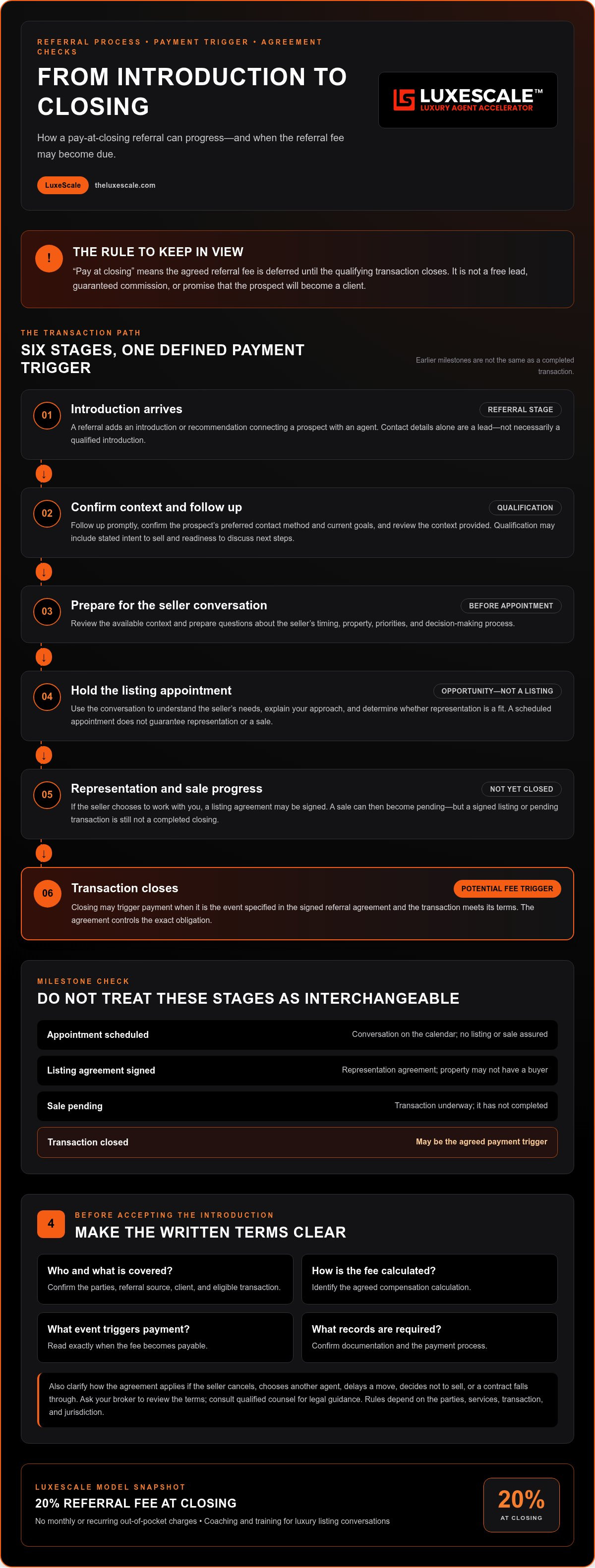
A referral is only one step in a longer process. A prospect may take a call, attend an appointment, sign a listing agreement, and still not complete a sale. Unless the agreement says otherwise, those earlier milestones aren’t the same as closing. The precise trigger and payment obligations depend on the signed terms and applicable rules.
Referral, lead, and listing appointment: what is the difference?
A lead is contact information, such as a seller’s name and phone number. A referral generally adds an introduction or recommendation connecting the prospect with an agent. Qualification can provide helpful context, such as the homeowner’s stated intent to sell and readiness to discuss next steps, instead of leaving you with only a name to pursue.
A listing appointment is a scheduled conversation with a prospective seller, not a secured listing. The homeowner still needs to decide whether to work with you. An appointment alone doesn’t mean a listing agreement has been signed or that a property will sell.
- Lead: Contact information to follow up on.
- Referral: An introduction or recommendation connecting a prospect and an agent.
- Listing appointment: A planned seller conversation that may create an opportunity, but doesn’t guarantee representation.
- Closed transaction: The completed transaction that may trigger payment under the referral agreement.
These terms describe different stages, so track them separately. Doing so helps you assess what the referring source delivered and whether the agreed payment condition has occurred.
When does a pay-at-closing referral fee become due?
The signed agreement should spell out the event that makes the fee payable. Review the key milestones separately:
- Appointment scheduled: The seller conversation is on the calendar, but no listing or sale is assured.
- Listing agreement signed: The seller has entered into a representation agreement, but the property may not yet have a buyer.
- Sale pending: A transaction is underway, but it hasn’t completed.
- Transaction closed: The parties have reached closing, which may be the agreed payment trigger.
Read the agreement for the details behind that sequence: which client or transaction is covered, how the fee is calculated, and what documentation or payment process applies. Brokerage roles can shape how referrals and commissions are handled. This Real estate broker overview offers general background on brokers, agents, and commissions, but it doesn’t replace reviewing the agreement and rules that apply to your situation.
How Pay-at-Closing Real Estate Referral Agreements Work
A referral arrangement has two tracks: the prospect’s path toward a transaction and the parties’ obligations under their agreement. With real estate referrals pay at closing, the process may move from introduction to qualification, appointment, representation, and, if the transaction closes under the agreed terms, payment. Clear documentation at each handoff helps prevent confusion if the seller’s plans change or the deal doesn’t close.
What to understand in the referral agreement
Before acting on an introduction, identify who is entering the arrangement, which referral source and client it covers, how the fee is calculated, and what event triggers payment. Confirm how the agreement defines the eligible transaction and what records the parties need to retain. Ask your broker to review the terms, and consult qualified counsel when you need legal guidance. A written agreement is more useful than assumptions made during a call.
Pay particular attention to situations that could change the outcome. A seller might cancel the appointment, choose another agent, delay a move, or decide not to sell. A transaction could also fall through after a contract is signed. The agreement should make clear how its terms apply in each case, rather than leaving the parties to infer whether a fee is due.
Rules can depend on the parties, services, transaction, and jurisdiction. For an example of regulatory guidance, review this guidance on RESPA and referral fees. It addresses a specific jurisdiction and isn’t a nationwide legal rule. Your broker and qualified counsel can help assess the requirements relevant to your arrangement.
What happens between the referral and closing?
Once the introduction arrives, follow up promptly and confirm the prospect’s preferred contact method and current goals. Before the appointment, review the context provided and prepare questions about the seller’s timing, property, priorities, and decision-making process. Use the conversation to understand the seller’s needs, explain your approach, and determine whether representation is a fit. Keep communication organized as plans develop.
If the seller chooses to work with you, follow your normal representation and transaction practices. The referral source doesn’t replace your role in advising the client, documenting the relationship, or managing the transaction. Record key milestones, such as the appointment, signed representation documents, changes in the seller’s plans, and closing status. These records help you compare the agreement with what actually occurred.
Qualification and appointment-setting can also shape an agent’s luxury pipeline. LuxeScale’s luxury real estate referrals guide offers broader context on building that pipeline. To see how LuxeScale connects agents with affluent sellers and schedules listing appointments, explore LuxeScale’s referral approach.
How to Evaluate Referral Quality, Fees, and Potential Return
A referral’s value depends on more than its fee. Weigh the prospect’s readiness, the context provided, the work required to follow up, and the terms that determine when you pay. Comparing those factors helps you see the trade-offs without assuming that a scheduled conversation will become a listing or a closed transaction.
Questions that reveal whether a referral is qualified
Look for specific, useful context: Why is the homeowner considering a sale? What timeline have they shared? Who will make the decision? What do you know about the property and the seller’s priorities? The answers help you prepare a relevant first conversation and estimate the follow-up effort involved.
“Exclusive” or “premium” is a label, not evidence of readiness. Ask what was actually learned and what next step the homeowner agreed to. Qualification gives you a stronger starting point, but it can’t ensure the seller will sign a listing agreement or close a sale.
Compare payment models without mistaking deferred fees for free leads
Each model affects when you pay and how much financial exposure you carry. Compare the structure, not just the headline fee:
| Model | When cost arises | What to assess |
|---|---|---|
| Upfront | Before a client or transaction exists | Budget exposure and what the payment delivers |
| Recurring | At scheduled intervals | Ongoing commitment, including periods without a closing |
| Pay at closing | When the agreement’s closing trigger occurs | Fee calculation, covered transaction, and payment obligations |
For a simple return estimate, use variables rather than assuming a particular commission or conversion rate. Let G represent the commission attributable to a closed transaction, r the referral-fee rate under the agreement, and E other applicable transaction expenses. If the fee is calculated as a share of that commission, the estimated amount remaining is G − (G × r) − E. Confirm the fee base and expenses before relying on the calculation. It’s an estimate, not a prediction of income.
LuxeScale charges a 20% referral fee at closing, with no monthly or recurring out-of-pocket charges. That clarifies the fee timing and recurring-cost structure, but you should still assess prospect fit, follow-up workload, and the agreement’s terms. For more criteria to use when comparing opportunities, consult this luxury referral partner buying guide.
Compliance and Risk Questions Agents Should Resolve Before Accepting Referrals
A referral fee can look simple on paper, but the applicable rules may depend on who pays and receives it, what services are involved, the transaction, and the jurisdiction. Don’t assume a familiar fee structure is permitted everywhere or that one rule answers every question. Before accepting real estate referrals pay at closing, have your broker review the arrangement and identify any issues that need qualified legal guidance.
Why national referral arrangements still require rule-specific review
Federal requirements and state licensing rules can apply differently depending on the arrangement. A brokerage-to-brokerage referral connected to real estate representation raises different questions from compensation tied to a settlement service, such as a mortgage or title service. The parties, services provided, and payment structure all matter. A general description of a referral model can’t determine how a particular agreement will be treated.
Use current guidance from relevant regulators and qualified counsel to assess the specific facts. Rules and interpretations can change, so legal explanations in educational material should be checked against authoritative sources. This section offers a review framework, not legal advice or a conclusion that a particular payment is lawful or prohibited.
Documentation and disclosures to discuss with your broker
Clear records support transparency and make it easier to match payment to the agreed terms. Before the referral moves forward, review the agreement and ask how your brokerage documents the introduction, client relationship, and any required disclosures. Keep the signed terms and transaction records together so the referral source and payment basis are easy to understand later.
- Parties and source: Who is referring the prospect, who will receive the referral, and which client or transaction is covered?
- Fee and trigger: How is compensation calculated, what event makes it due, and how is that event documented?
- Disclosure: What disclosures may apply to the client or other parties, and who is responsible for making and recording them?
- Transaction records: What documents show the referral, representation, transaction status, and any payment made?
- Changes or cancellation: How do the agreement and brokerage process address a changed plan, a canceled transaction, or a deal that doesn’t close?
Don’t rely on a verbal understanding to fill gaps in written terms. If the agreement’s fee basis, covered transaction, payment condition, or documentation process is unclear, resolve those points with your broker before proceeding. Keep the final agreement and related records in the appropriate brokerage file, following the practices that apply to your business.
LuxeScale qualifies affluent homeowners and schedules listing appointments for agents, with a 20% referral fee at closing and no monthly or recurring out-of-pocket charges. Review the arrangement through your brokerage’s compliance process, then explore LuxeScale’s referral approach.
How LuxeScale’s Pay-at-Closing Referral Model Supports Luxury Listing Growth
Building a luxury listing pipeline takes more than access to contact information. Agents need conversations with homeowners who are considering a sale and enough context to prepare for a listing discussion. LuxeScale identifies and qualifies affluent homeowners ready to sell, then schedules listing appointments for agents. That provides a more purposeful starting point than an unqualified contact alone, while the homeowner’s decision and transaction outcome remain with the people involved.
LuxeScale’s financial structure is clear: a 20% referral fee at closing, with no monthly or recurring out-of-pocket charges. Payment is tied to a completed transaction under the applicable agreement, not to the appointment itself. Assess the model against your likely follow-up workload, business capacity, and listing goals. A deferred fee is not a free lead or a promise of future commission.
From seller qualification to a prepared listing conversation
Qualification and a scheduled appointment give agents a clearer basis for preparation. Review the homeowner’s stated selling intent, consider the context provided, and plan questions that uncover priorities and timing. The appointment is still a conversation, not a secured listing. LuxeScale provides complementary coaching, training, and live video education to help agents prepare to work with luxury prospects and present their value. For practical preparation ideas, use this luxury listing appointment guide.
Preparation matters because affluent sellers may expect a thoughtful, well-informed discussion of their goals and property. Coaching and education can help agents sharpen their approach, communicate clearly, and enter the conversation ready to listen. They support your professional preparation, but they don’t determine whether a homeowner chooses to list with you or whether a transaction closes.
A practical next step for agents weighing the model
Before adding a referral source to your pipeline, evaluate four points: fee trigger, qualification, agreement clarity, and agent-market fit. Know what must happen before a fee is due. Understand what context accompanies an appointment. Review the written terms with your broker, and consider whether the prospect profile aligns with your experience, capacity, and luxury listing objectives.
This keeps the decision grounded in economics and service fit rather than attractive labels or assumed outcomes. A scheduled appointment can open a door, but your preparation, client relationship, and transaction work remain essential. If qualified affluent-seller opportunities and structured support align with your growth priorities, explore LuxeScale’s luxury listing referrals.
Build Your Next Growth Decision with Intention
Use your next referral decision to make your pipeline more deliberate. Set a clear standard for the opportunities you accept: the context you need to serve a prospect well, the terms you can explain confidently, and the capacity you can commit without diluting service to existing clients. Apply that standard consistently. A focused process helps you pursue business that fits your practice instead of chasing every new contact.
Track what you learn as opportunities progress. Note which introductions lead to productive conversations, what preparation they require, and where your follow-up process can improve. Over time, those records can help you refine your criteria and make more informed decisions about where to invest your professional attention.
Real estate referrals pay at closing can be one part of a broader strategy for balancing investment, agent time, and client experience. The right opportunity isn’t simply the one with the most appealing label. It’s one you understand, can support, and can assess against your goals.
If luxury listings are a priority, take the next step and explore LuxeScale’s luxury listing referrals. Build with purpose, stay selective, and keep moving toward the business you want to lead.
Frequently Asked Questions
Is a pay-at-closing real estate referral the same as a free lead?
No. With real estate referrals pay at closing, the fee is generally due only if the agreement’s specified closing condition occurs, but it remains a contractual obligation, not a free service. A seller’s contact details, for example, may lead to follow-up without any transaction. Read the terms to see how the fee is calculated and which transaction counts. An introduction alone doesn’t mean the homeowner will hire you or complete a sale.
Can real estate agents work with more than one referral source?
Often, yes, but first review each agreement, your brokerage’s policies, and applicable rules. Two sources could introduce the same homeowner, creating uncertainty about attribution or fee obligations. Check for exclusivity, restrictions on accepting other referrals, and how overlapping prospects are handled. Keep a dated record of each introduction and your follow-up. Consider your capacity, too: more sources help only if you can respond consistently and serve each prospect attentively.
What happens if a referred homeowner delays selling?
A delay doesn’t automatically establish that a closing-based fee is due, but the agreement determines whether any other obligation applies. If a homeowner postpones after an initial conversation, record the change in timing and agree on a suitable follow-up plan. Don’t treat the appointment as a committed listing in pipeline forecasts. If the prospect’s circumstances shift, use the agreement and brokerage procedures to guide next steps rather than assuming how compensation works.
Can a new real estate agent handle luxury seller referrals?
Yes, if the agent has the preparation, broker support, and capacity to serve the homeowner well. Before accepting an opportunity, practice explaining how you’ll develop a pricing recommendation, coordinate marketing, and keep the seller informed. Identify where you’ll rely on your brokerage’s transaction resources or an experienced mentor. A polished process can build credibility, but the homeowner decides whom to hire, and preparation can’t guarantee that choice.
How should an agent prepare before a referred listing appointment?
Review the information provided and identify what you still need to learn instead of arriving with assumptions. A homeowner’s target date, for instance, may depend on another move, family needs, or financial planning. Prepare open questions, bring relevant examples of your work, and outline how you’ll reach a pricing recommendation. Confirm practical details such as attendees and meeting format. Listen first, then tailor your proposed next steps to the seller’s priorities.
What should agents track when reviewing referral opportunities?
Track outcomes and the reasons behind them. Note whether a homeowner was unreachable, postponed, selected another agent, or decided against selling, and record the follow-up time involved. Compare these patterns across referral sources during regular business reviews. This can reveal where your approach needs adjustment, such as response consistency or appointment preparation, without treating one unusually successful or unsuccessful prospect as proof of a source’s overall value.
What happens if a referred seller chooses another agent?
Choosing another agent doesn’t by itself settle whether you owe a fee; the signed agreement’s definitions and coverage control. Review whether it addresses a later transaction involving the same referred homeowner, even if the original appointment didn’t lead to representation. Don’t infer the answer from the phrase “pay at closing” alone. Document the outcome, share relevant facts with your broker, and follow the agreement’s process for resolving attribution or payment questions.

Article by
Mark Coppens
Mark Coppens is the Founder and Chairman of LuxeScale and Co-Team Lead of Living Vogue | eXp Luxury. He is an active elite-level luxury agent and the author of the upcoming book, POWER POSITIONING: From Missiles to Mansions – Why People Really Buy, and is a nationally recognized speaker on luxury real estate, consumer psychology, marketing, and business growth.
A U.S. Army veteran with an MBA in Marketing, Mark has generated more than $1 billion in career sales and now leads one of the nation's fastest-growing luxury referral platforms, referring more than $2 billion in luxury real estate opportunities each month to partner agents across the United States. He specializes in helping real estate agents generate more listings, break into the luxury market, and build scalable businesses through qualified referrals, award-winning training, coaching, and proven systems. His practical, psychology-driven approach has helped agents across the country increase their income while attracting more affluent clients and building lasting, referral-driven businesses.