
Scaling a Luxury Real Estate Business: A Practical Growth Framework for 2026
What if the key to luxury growth isn’t more leads, but a better balance between qualified opportunities and the capacity to serve them? Scaling a luxury real estate business requires both. Without a repeatable operating model, new prospects can mean longer hours, inconsistent follow-up, and less time for the high-touch service affluent clients expect.
If luxury opportunities are difficult to source and qualify, you’re not alone. Building credibility with affluent homeowners takes consistency, and growth can strain your team before it strengthens revenue. The goal isn’t simply to do more. It’s to focus on the right prospects and protect the time needed to deliver a premium client experience.
This guide lays out a practical framework for sustainable growth in 2026. You’ll learn how to assess your readiness, improve listing quality, evaluate growth channels, and track performance without letting workload outrun capacity. You’ll also see how qualified listing appointments, training, and coaching can support a broader growth system.
Key Takeaways
- Measure growth by qualified opportunities and your capacity to deliver a consistent high-end client experience, not transaction volume alone.
- Use a repeatable listing process, from defining the target opportunity to delivering consistently, to protect agent time and improve prospect fit.
- Compare growth channels by prospect quality, time required, predictability, and operational demands before deciding where to invest effort.
- Identify the operational bottleneck, such as follow-up ownership or appointment capacity, before expanding your pipeline and workload.
- Build a focused approach to scaling luxury real estate business growth by pairing qualified seller appointments with the preparation and support needed for strong client conversations.
What Scaling a Luxury Real Estate Business Really Means
Scaling isn’t simply closing more deals. It means building a business that can generate qualified opportunities and serve clients consistently without requiring the agent to personally manage every task. A useful definition is: Scalable growth is the ability to increase qualified business while maintaining service quality and keeping workload within the team’s capacity.
That distinction matters in luxury real estate, where an opportunity can involve nuanced property details, high expectations, and a considered decision process. The Luxury Real Estate Overview provides context on how property characteristics and market dynamics shape the category. Your growth plan needs to account for those demands, not just aim for a larger pipeline.
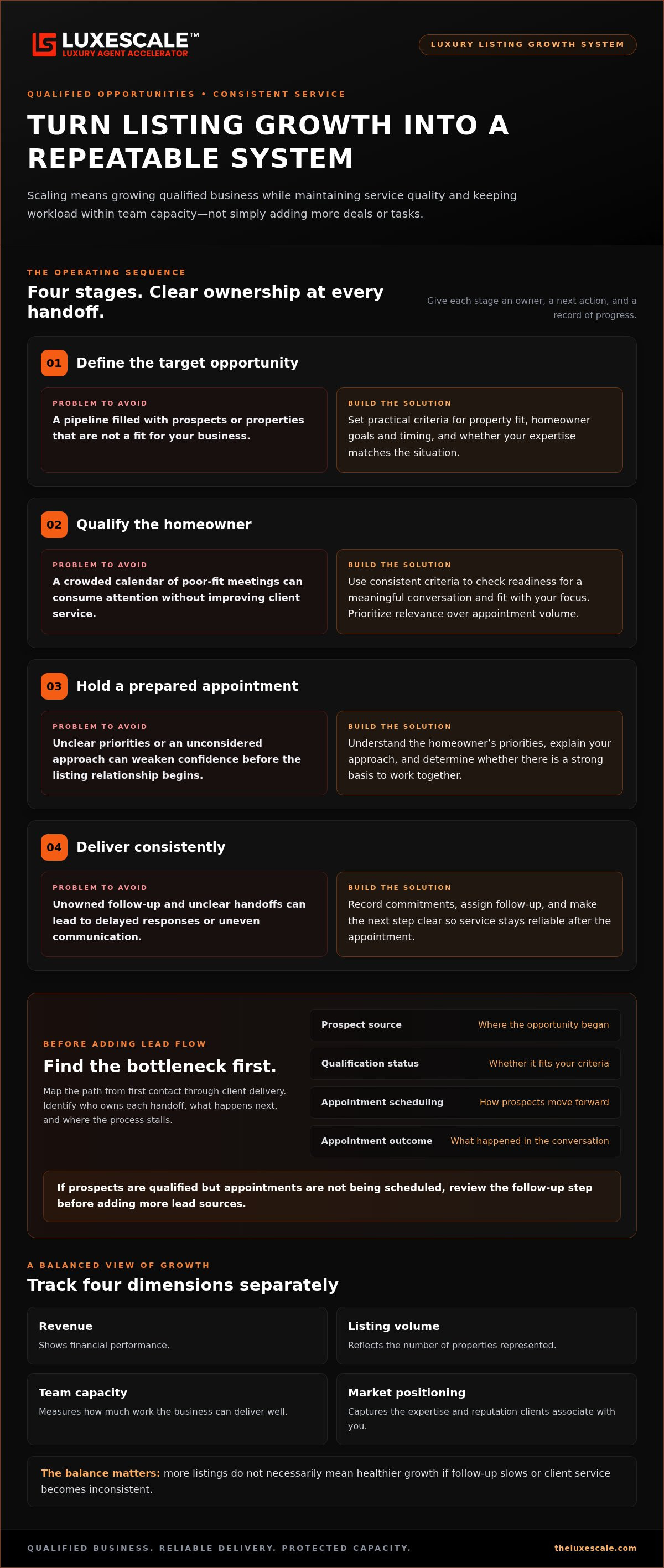
Track four dimensions separately. Revenue shows financial performance; listing volume reflects the number of properties represented; team capacity measures how much work the business can deliver well; and market positioning captures the expertise and reputation clients associate with you. These measures can move at different speeds. More listings don’t necessarily mean healthier growth if follow-up slows or client service becomes inconsistent.
How is scaling different from simply doing more business?
Doing more often means adding tasks to the agent’s personal workload: responding to every inquiry, preparing every presentation, and coordinating each client detail. Scaling requires repeatable processes and clear ownership. The agent might retain responsibility for relationship-building and negotiation while trained support handles defined administrative steps.
Without that structure, growth creates bottlenecks. A prospect waits too long for a response, an active client receives uneven communication, or appointments compete with preparation time. Before increasing lead flow, map the stages from first contact through client delivery. For each stage, identify who owns the handoff, what the next action is, and where the process stalls. The aim isn’t to make every client interaction uniform. It’s to make the underlying service reliable, so the agent can give personal attention where it matters most.
Why luxury growth depends on trust as well as opportunity
Affluent homeowners are choosing more than a listing agent. They’re weighing whether that professional understands their property, can communicate its value clearly, and will represent their interests with discretion and care. A qualified opportunity creates the conversation; credibility helps earn the client’s confidence. Make your professional positioning visible through informed preparation, relevant market knowledge, thoughtful questions, and a clear explanation of your proposed approach.
Trust also depends on consistency. If your marketing promises a high-touch experience but follow-up feels rushed, the gap can weaken confidence before the listing relationship begins. Build a service standard your team can deliver at every stage, while tailoring advice to the homeowner and property. For practical guidance on preparing for that pivotal conversation, read this luxury listing presentation guide.
In practice, scaling luxury real estate business growth means expanding opportunity in step with your ability to qualify prospects, build trust, and deliver the service your positioning promises. The next step is to turn that principle into a repeatable listing growth system.
Build a Repeatable Luxury Listing Growth System
A dependable pipeline turns promising prospects into well-prepared listing conversations, then into a consistent client experience. Use four stages: define the target opportunity, qualify the homeowner, hold the appointment, and deliver consistently. Give each stage a clear owner, next action, and record of progress. This makes the process easier to improve and less dependent on one agent remembering every detail.
- Define the target opportunity. Set practical criteria for the homeowners and properties your business is equipped to serve. Consider property fit, the homeowner’s goals and timing, and whether your expertise matches the situation.
- Qualify. Establish whether the prospect is ready for a meaningful conversation and whether the opportunity fits your focus. Consistent criteria help agents prioritize without making assumptions based on a single detail.
- Hold the appointment. Prepare to understand the homeowner’s priorities, explain your approach, and determine whether there’s a strong basis to work together.
- Deliver consistently. Record commitments, assign follow-up, and make the next step clear. A reliable handoff helps keep the experience polished after the appointment.
Qualification should come before appointment volume: a smaller number of relevant, well-prepared conversations can serve clients better than a crowded calendar of poor-fit meetings. This is especially useful when scaling luxury real estate business operations, because it protects agent attention and gives the team a consistent way to prioritize.
What should a luxury listing pipeline measure?
Track prospect source, qualification status, appointment scheduling, and appointment outcome separately. Look at how opportunities move between those stages, not just how many inquiries arrive. For example, if prospects are qualified but appointments aren’t being scheduled, review the follow-up step before adding more lead sources. Agree on shared definitions, such as what “qualified” means and when an appointment counts as held, so reporting reflects the same process across the team.
Document the next action after every meaningful interaction: who owns it, what needs to happen, and when it should be revisited. If a prospect moves from initial qualification to an agent appointment, pass along relevant context and any expectations already set. This reduces repeated questions and prevents follow-up from relying on memory. Review stage movement regularly, then adjust the process where prospects pause or drop away.
How do you make the listing appointment more repeatable?
Use a flexible discovery sequence, not a word-for-word script. Start with the homeowner’s goals and timing, explore what matters about the property, then explain how you would approach representation. Pre-framing the meeting establishes relevance and clarifies what the homeowner can expect. For more detailed appointment preparation, read this luxury listing appointment guide.
Repeatability comes from preparation and clear follow-through, not identical conversations. LuxeScale’s qualified luxury listing appointments complement an agent’s prospecting and client-service process.
Choose Growth Channels That Fit a Luxury Business
No single source of opportunity suits every agent. A referral network may fit an established practice with strong relationships, while agent-led prospecting can help build presence in a chosen segment. Marketing and qualified appointment referrals offer different forms of reach and consistency. The right mix depends on your reputation, available time, follow-up capacity, and the sellers you want to serve.
Compare channels using the same criteria. Inquiry volume alone can mislead: a high number of responses doesn’t establish seller readiness, property fit, or intent to meet. Look instead at the quality of conversations each source creates and the work required to move a prospect toward a listing appointment.
Prospect fit: Often strengthened by a personal introduction. Agent time: Ongoing relationship care and responsive follow-up. Predictability: Can depend on when contacts encounter a selling opportunity. Operational demands: Stay visible and make it easy for people to understand your luxury expertise.
Prospect fit: Shaped by how carefully you select and approach homeowners. Agent time: Direct research, outreach, and follow-up. Predictability: Tied to consistent agent activity rather than sporadic referrals. Operational demands: Requires a clear target profile and disciplined tracking.
Prospect fit: Influenced by audience, message, and offer relevance. Agent time: Planning and responding to inquiries. Predictability: Depends on maintaining and assessing the channel. Operational demands: Requires a process for qualifying responses rather than treating every inquiry as appointment-ready.
Prospect fit: Strengthened by defined qualification before an introduction. Agent time: Focused more on preparation and the listing conversation. Predictability: Depends on the referral process and its consistency. Operational demands: Requires clear handoffs and capacity to serve scheduled appointments.
How should agents compare luxury opportunity sources?
Review each source from first contact through appointment outcome. Record where prospects came from, whether they fit your target, how much agent follow-up they required, and whether they scheduled and attended. This separates raw inquiry counts from meaningful opportunities. It also shows whether a channel supports a repeatable pipeline or relies on occasional activity. Reassess the mix when your positioning or available capacity changes.
When can a referral partner support growth?
A referral partner can support growth when qualification standards are clear and the handoff provides relevant context, not just contact details. Directly scheduled listing appointments can reduce the agent’s prospecting burden, while the agent remains responsible for preparation and client service. Performance-based arrangements tie payment to completed outcomes. Compare the process with your operating model using this luxury real estate referral partner buying guide.
LuxeScale identifies and qualifies affluent seller opportunities and schedules listing appointments through a performance-based model with no monthly or recurring out-of-pocket charges. Its territorial exclusivity limits the number of participating agents in any one territory. Treat appointments as one channel in a balanced system, and make sure your team can follow through on every qualified conversation.
Prepare Your Team and Operations for Sustainable Growth
Before adding more opportunities, test whether your operation can absorb them without slowing follow-up or weakening the client experience. Capacity isn’t just the number of appointments an agent can attend. It also includes preparation, communication, handoffs, and the work required after a listing is secured. Sustainable growth requires enough pipeline capacity to create opportunities and enough service capacity to deliver on them well.
Use this readiness checklist to spot gaps before expanding:
- Follow-up ownership: Every new inquiry has a clear owner and next action, so prospects don’t depend on one person’s memory.
- Appointment capacity: Agents have room to prepare for and attend qualified seller conversations without displacing important client work.
- Client delivery: Active listings have defined communication and task responsibilities, including who handles each handoff.
- Reporting: The team records progress consistently enough to see where prospects pause and where client work is becoming congested.
Look for the constraint, not just the symptom. If response times slip, check whether ownership is unclear or follow-up competes with appointment preparation. If meetings are happening but client work feels rushed, delivery capacity may be the limit. Find where work accumulates and address that point before increasing activity. This makes scaling luxury real estate business operations a deliberate decision rather than a reaction to a fuller calendar.
For qualified affluent seller appointments, LuxeScale’s approach to luxury listing growth is one option within that plan.
Which business processes should be documented first?
Start with lead response, qualification, appointment preparation, and post-appointment follow-up. For each process, capture the trigger, the responsible person, the next action, and what information must pass to the next team member. Keep instructions short enough to use during active client work. A concise checklist or shared procedure is more useful than a lengthy document no one consults.
Documentation should clarify judgment, not replace it. A process can define what information to gather before an appointment while leaving the agent free to adapt questions to the homeowner. Review procedures when handoffs break down or team responsibilities change. That keeps standards practical as the business expands.
How can agents protect time for high-value client work?
Separate tasks that require the agent’s expertise from repeatable administrative work. When team roles allow, standardize or delegate steps such as organizing appointment details, recording next actions, and coordinating routine handoffs. Then protect dedicated time for qualified seller conversations, listing preparation, and ongoing client communication. Treat those blocks as core operating capacity, not leftover space in the calendar.
Check the balance regularly. If routine tasks keep displacing client-facing work, adjust responsibilities or simplify the process before taking on additional opportunities. Clear ownership and protected focus give the team a stronger base for growth while preserving the attentive service luxury clients expect.
Scale With Qualified Appointments and the Right Support
A growth channel works best when it fits the business behind it. Qualified seller opportunities can strengthen your pipeline, but appointments alone won’t create sustainable results. Agents also need the capacity to prepare, lead a confident conversation, and deliver on the service they promise. That’s how scaling luxury real estate business growth becomes an operating strategy, not simply an increase in activity.
How LuxeScale supports luxury market growth
LuxeScale identifies and qualifies affluent homeowners who are ready to sell, then schedules listing appointments for agents. This gives agents a defined source of seller conversations while leaving the agent responsible for the appointment, client relationship, and service delivery. The appointments are one component of a broader growth system, not a substitute for a clear conversion process or a strong client experience.
Complementary coaching, training, systems, and live video education help agents prepare for high-end conversations and work to convert qualified opportunities. This support helps agents refine how they present their expertise, establish relevance with homeowners, and guide the discussion. LuxeScale’s model is performance-based, has no monthly or recurring out-of-pocket charges, and limits participating agents by territory. These features describe the structure of the service and help agents assess how it fits their capacity and growth priorities.
What to do next to evaluate your growth path
Before adding appointments to your calendar, assess the operating model you’ve built. Can you prepare for each conversation without pushing aside current clients? Is there a consistent way to follow up and assess appointment outcomes? Can your team maintain the communication and attention your positioning promises if new listings result? Clear answers reveal whether your next priority is more qualified opportunity, stronger conversion, or additional service capacity.
Use a simple readiness check to make the decision practical:
- Appointment capacity: Identify how much room you have for preparation and seller conversations.
- Conversion process: Review how you build trust, explain your approach, and follow up after each appointment.
- Service readiness: Confirm that active and prospective clients can receive consistent communication and service.
- Support needs: Decide where coaching, training, or live video education could strengthen your preparation and conversations.
If capacity is tight, address the bottleneck before adding volume. If your service operation is ready but qualified seller conversations are inconsistent, scheduled appointments can help fill that gap. Choose the next step by weighing the opportunity against your current priorities, conversion approach, and ability to serve clients well. Explore LuxeScale’s luxury listing opportunities as part of your growth plan.
Make Your Next Growth Move Deliberate
The next stage of scaling luxury real estate business growth doesn’t have to begin with a major overhaul. Choose one constraint to address and one channel or process to refine. Set a clear review point, then assess whether the change improved opportunity quality, made better use of your time, or strengthened the client experience. Keep what works and adjust what doesn’t.
That disciplined approach lets you pursue growth without treating every opportunity as the right one. Your plan should reflect the business you want to build, the clients you’re best equipped to serve, and the day-to-day work you want to sustain.
Qualified luxury listing opportunities can support your next growth move when they fit your priorities and capacity. A deliberate plan and the right support can help you build a more focused, capable business.
Frequently Asked Questions
How do you scale a luxury real estate business?
Scale by increasing the number of suitable opportunities your business can handle, not by filling your calendar indiscriminately. Review recent seller conversations: which matched your expertise, and which were poor fits? Use that insight to sharpen your target profile and qualification criteria. Then choose one constraint to address, such as inconsistent appointment preparation or slow post-meeting follow-through, and monitor whether the change improves outcomes.
Can a solo real estate agent scale into the luxury market?
Yes. A solo agent can grow into the luxury market without immediately building a team. Start with a clear client profile and a credible way to explain your value to that audience. Protect time for preparation and client communication, and set a realistic limit on active work. If new appointments crowd out listing preparation, pause expansion until you restore that balance.
Do you need a team to grow a luxury real estate business?
No, a team isn’t a prerequisite. Before hiring, identify tasks that need the agent’s judgment, such as advising a seller on positioning, and tasks that follow a consistent procedure, such as organizing meeting materials. Delegating the latter can free time for client work. Add a role when a recurring bottleneck has a clear responsibility attached, not simply because the business feels busy.
What metrics should luxury real estate agents track while scaling?
Track whether opportunities progress, and compare results by source and time period. Note which channels lead to held appointments and which appointments develop into listing relationships. Also record the effort required at each step, including agent preparation and follow-up. This helps distinguish a channel that creates useful conversations from one that generates activity but consumes capacity without advancing business goals.
How can an agent build credibility with affluent homeowners?
Make your expertise specific to the homeowner’s property and priorities. Before a meeting, prepare relevant questions about the seller’s goals, decision timeline, and concerns. Then explain how your proposed approach responds to them. Avoid relying on broad claims about being a luxury specialist. A thoughtful, tailored conversation gives the homeowner a clearer basis for assessing your judgment and fit.
Is a performance-based referral model suitable for every agent?
No. Suitability depends on your business goals, capacity, and comfort with the arrangement’s terms. Consider how opportunities are qualified, what support helps you prepare, and how compensation is triggered and documented. Then compare those details with your conversion process and service readiness. A referral relationship is more likely to fit when it complements your existing plan rather than becoming your sole source of future business.
How can you grow luxury listings without increasing your workload indefinitely?
Protect your workload by deciding which responsibilities need your direct involvement and which can be simplified, templated, or assigned to someone else. For example, use a standard preparation checklist while keeping the seller conversation personal. Review your calendar alongside active client commitments before taking on new opportunities. If additional work reduces the attention you can give current clients, improve capacity before pursuing more volume.

Article by
Mark Coppens
Mark Coppens is the Founder and Chairman of LuxeScale and Co-Team Lead of Living Vogue | eXp Luxury. He is an active elite-level luxury agent and the author of the upcoming book, POWER POSITIONING: From Missiles to Mansions – Why People Really Buy, and is a nationally recognized speaker on luxury real estate, consumer psychology, marketing, and business growth.
A U.S. Army veteran with an MBA in Marketing, Mark has generated more than $1 billion in career sales and now leads one of the nation's fastest-growing luxury referral platforms, referring more than $2 billion in luxury real estate opportunities each month to partner agents across the United States. He specializes in helping real estate agents generate more listings, break into the luxury market, and build scalable businesses through qualified referrals, award-winning training, coaching, and proven systems. His practical, psychology-driven approach has helped agents across the country increase their income while attracting more affluent clients and building lasting, referral-driven businesses.