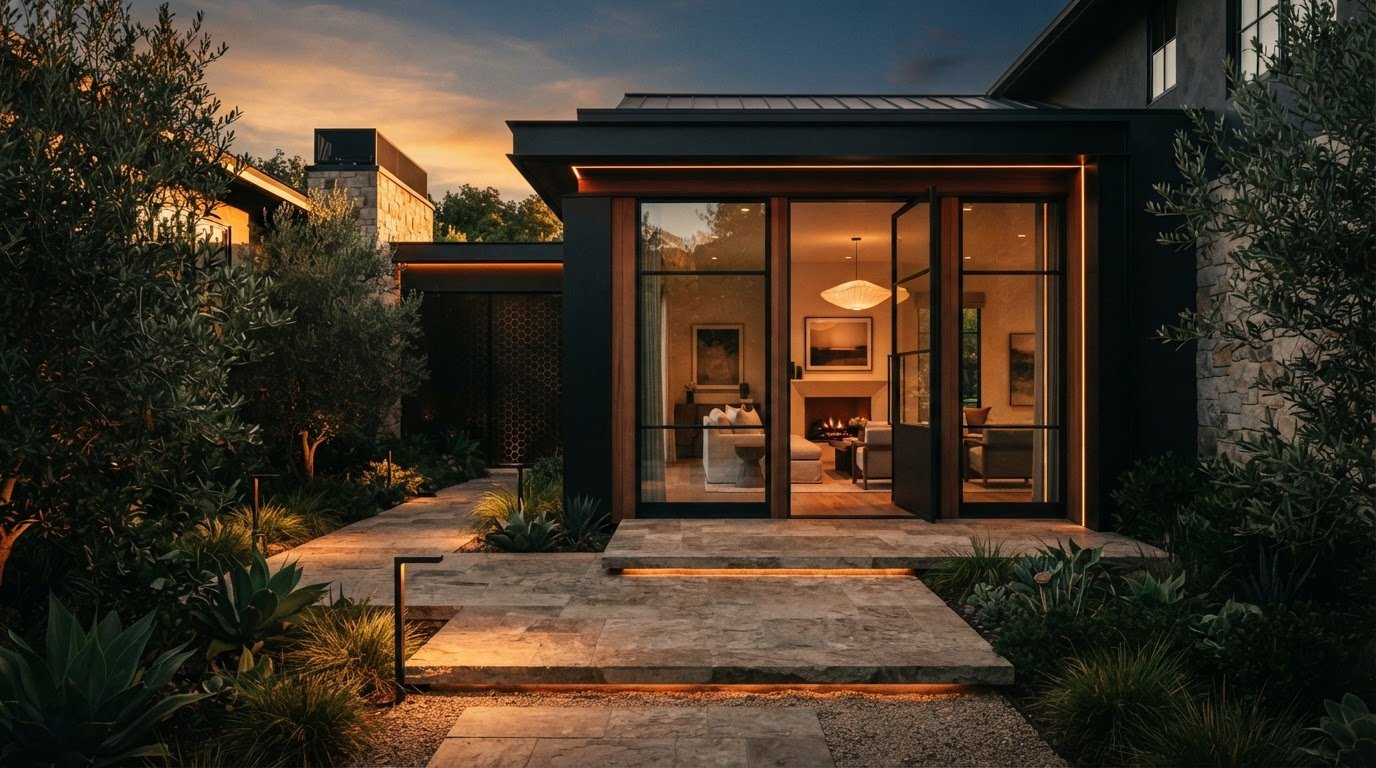
Warm Luxury Real Estate Listing Introductions: A Practical Guide
What if a luxury listing’s strongest opening isn’t a grand claim, but a detail that lets readers picture arriving home? Warm luxury real estate listing introductions begin with what makes a particular property distinctive: morning light across a courtyard, a garden set apart from the street, or glass doors that connect the living area to the outdoors. That detail creates a welcome, and the description that follows gives it context.
Listing copy can easily drift toward familiar phrases and stacked adjectives. A polished opening works best when it feels inviting without exaggeration and when every image is grounded in a real feature of the home. Draw readers in through the property itself, rather than making assumptions about who belongs there.
This guide shows you how to find a clear opening idea, shape it into a brief story, and check that the language stays accurate and supportable. You’ll also get a repeatable drafting and editing process, so each introduction feels specific to the home rather than interchangeable with the next.
Key Takeaways
- Separate the opening lines from the headline, full property description, and agent biography so each serves a clear purpose.
- Build warm luxury real estate listing introductions around one verified feature that helps readers understand what makes the home distinctive.
- Use a simple review to check whether an opening feels warm, specific, accurate, readable, and suited to its audience.
- Follow a four-step drafting process to turn property facts into a welcoming introduction, then edit out unsupported claims and excess adjectives.
- Connect thoughtful property marketing with a credible seller conversation, without implying that strong copy guarantees a particular outcome.
What Makes a Warm Luxury Real Estate Listing Introduction Work?
A listing introduction is the opening lines of a property description. Its job is to orient readers, establish what makes the home worth noticing, and invite them into the story. It isn’t the headline, which identifies or presents the listing; the full description, which supplies broader features and facts; or the agent biography, which introduces the professional representing the property. Each element has a distinct role.
For warm luxury real estate listing introductions, warmth comes from reader-aware language, not casual slang or extravagant praise. Start with a tangible property detail, then help readers picture the experience it creates. A courtyard framed by mature trees, for example, may feel set apart from the street. That is more inviting and informative than simply calling the property “stunning.”
A warm introduction makes a home’s specific qualities feel welcoming without asking the reader to accept claims the property can’t support. This is storytelling in a disciplined form: a real detail gives the opening a point of view, while accurate context keeps it credible. The art of storytelling can inform the approach, but the property itself should remain the source of the story.
What should a luxury listing introduction accomplish?
Lead with the home’s defining appeal before presenting secondary amenities. An opening focused on a light-filled gallery, a distinctive architectural line, or a layout that connects interior rooms to a terrace gives readers a clear first impression. It can suggest an experience without declaring what every buyer will value. The next sentence should move naturally into details that substantiate the opening.
For instance, “A sheltered garden creates a quiet transition from the entry to the main living spaces” is useful only if that garden and layout are genuine features. The opening sets the frame; the description provides the evidence.
Warm language versus generic luxury copy
Generic luxury copy often leans on words such as “stunning,” “exceptional,” or “one-of-a-kind” without showing what makes the home distinctive. Replace unsupported praise with a precise image or feature: “Tall windows draw afternoon light into the dining room” gives readers something to picture, provided the windows and light are accurately described. Keep the tone polished. A welcome can be graceful without sounding overly familiar.
Use this quick test before keeping an opening: Could the same sentence describe dozens of other homes? If so, give it a more specific anchor. Then check that the detail is verifiable, the language is easy to follow, and the invitation doesn’t assume the reader’s lifestyle or preferences. Warmth should come from the home’s character and the clarity of the writing, not from telling buyers what they ought to feel.
The strongest opening creates a smooth handoff: first, a distinctive detail; next, its relevance to the property experience; then, supporting facts. That sequence gives readers a reason to continue while keeping the description grounded. In luxury marketing, precision doesn’t diminish atmosphere. It makes the welcome believable.
Build a Luxury Listing Introduction Around the Home’s Real Story
A compelling opening doesn’t need to summarize every premium feature. It needs one verified point of difference, a clear sense of why that detail may matter to a reader, and a graceful path into the rest of the description. That structure keeps the story focused while giving the property room to speak for itself.
Lead with one verified differentiator, connect it to a possible experience, then invite the reader into the supporting details. This framework makes the opening purposeful without claiming that every prospective buyer will respond to the home in the same way.
Choose the strongest detail before drafting
Start with an evidence check, not an adjective. Review the listing facts, seller-provided information, and available photographs together. Look for a feature that distinguishes the home and can be described accurately, whether it’s an architectural element, an unusual layout, a particular setting, or a notable interior detail.
Then decide whether that feature belongs in the opening or later in the description. A long list of appliances and finishes may be useful, but it rarely provides a central story. Prioritize the detail that helps orient a reader; reserve supporting amenities for sections where they can be described clearly.
- Defining detail: Establishes the property’s character or how its spaces relate.
- Supporting feature: Adds useful context after the central idea is clear.
- Evidence: Confirms that the words match the listing information and visuals.
For example, if a home’s plan places the main living area beside a covered terrace, the opening might focus on that connection. It may interest readers who value indoor-outdoor flow, but the copy shouldn’t imply that everyone will. Keep buyer relevance plausible, not universal.
Make the opening feel inviting, not overproduced
Choose concrete nouns and active verbs. “A sculptural staircase turns toward the upper landing” gives readers a specific image, if the photographs and property details support it. By contrast, a cluster of words such as “breathtaking,” “impeccable,” and “unparalleled” may create a grand tone without conveying what is actually there.
Rhythm matters, too. A concise first sentence can establish the feature; a longer second sentence can explain how it relates to the home. Keep lifestyle language anchored to a real space or documented characteristic. “A separate study offers a defined place to work” is more grounded than promising an ideal work-life balance.
Before finalizing, compare each descriptive phrase with the available facts and visuals. If the photographs show a feature differently than the words suggest, revise the copy. A consistent narrative builds confidence because readers encounter the same property story across the listing’s text and images.
For agents strengthening the seller conversations and preparation behind a thoughtful listing experience, LuxeScale’s agent coaching and training can support continued development of high-end client skills.
How to Tell Whether a Luxury Listing Introduction Feels Warm or Generic
A polished sentence can still feel interchangeable. Test the draft against the property, not against how elevated the language sounds. The strongest warm luxury real estate listing introductions give readers a specific point of entry while keeping each claim easy to verify. The following comparison uses hypothetical examples for illustration, not descriptions of actual listings.
Illustrative comparison: A hypothetical home has a separate library with built-in shelves. “Discover an extraordinary residence of unmatched elegance” offers no clue what sets it apart. “A separate library, lined with built-in shelves, creates a quieter room apart from the main living areas” gives readers a concrete detail and a possible sense of its use. The second opening remains inviting without asserting that every buyer wants a library.
| Criteria | Weak signal | Stronger editing choice |
|---|---|---|
| Warmth | Grand praise with no human-scale detail | Describe a real feature in a welcoming, composed voice |
| Specificity | The sentence could fit nearly any high-end home | Name one verified architectural, layout, setting, or interior detail |
| Factual support | Promises or superlatives exceed the listing facts | Use claims supported by property information and visuals |
| Readability | Long, adjective-heavy phrasing obscures the point | Use direct verbs and a clear sentence structure |
| Audience fit | Assumes what a buyer values or who belongs there | Describe what the property offers; let readers decide its relevance |
Five signals that an opening needs another draft
Pause if the opening could describe almost any high-end property, piles several adjectives ahead of a concrete detail, or promises an experience the listing facts can’t support. Also reconsider language that repeats a familiar luxury cliché or makes a universal claim about buyer preferences. These are signs the sentence is selling an impression instead of introducing this particular home.
Unsupported claims weaken trust because they set expectations the rest of the listing may not meet. “Private,” for example, can imply more than a secluded-feeling room if the property facts don’t establish privacy. “Perfect for entertaining” assumes a use and preference. Replace such language with what can be seen or verified, then let readers form their own conclusions.
Edit for tone, clarity, and accuracy
Read the opening aloud. Stiff phrasing, repeated words, and promotional flourishes become easier to hear. Then assess it across five checks: warmth, property specificity, factual support, readability, and audience fit. If a sentence fails one check, revise it rather than adding more praise to compensate.
For a practical edit, underline every adjective and ask whether it adds information. Keep the ones that clarify a documented quality; remove the rest. Trade vague claims for confirmed details, and make sure the sentence describes the home rather than assigning it to a particular kind of person or household. The result should sound considered, not scripted.
One final test: remove the property’s name and read the opening again. If it still sounds like a template, it needs a sharper detail. If its central image depends on a fact the listing can’t support, choose another. A credible introduction welcomes a broad range of readers by presenting the property clearly, without deciding in advance who should be interested.
Write a Warm Luxury Listing Introduction in Four Practical Steps
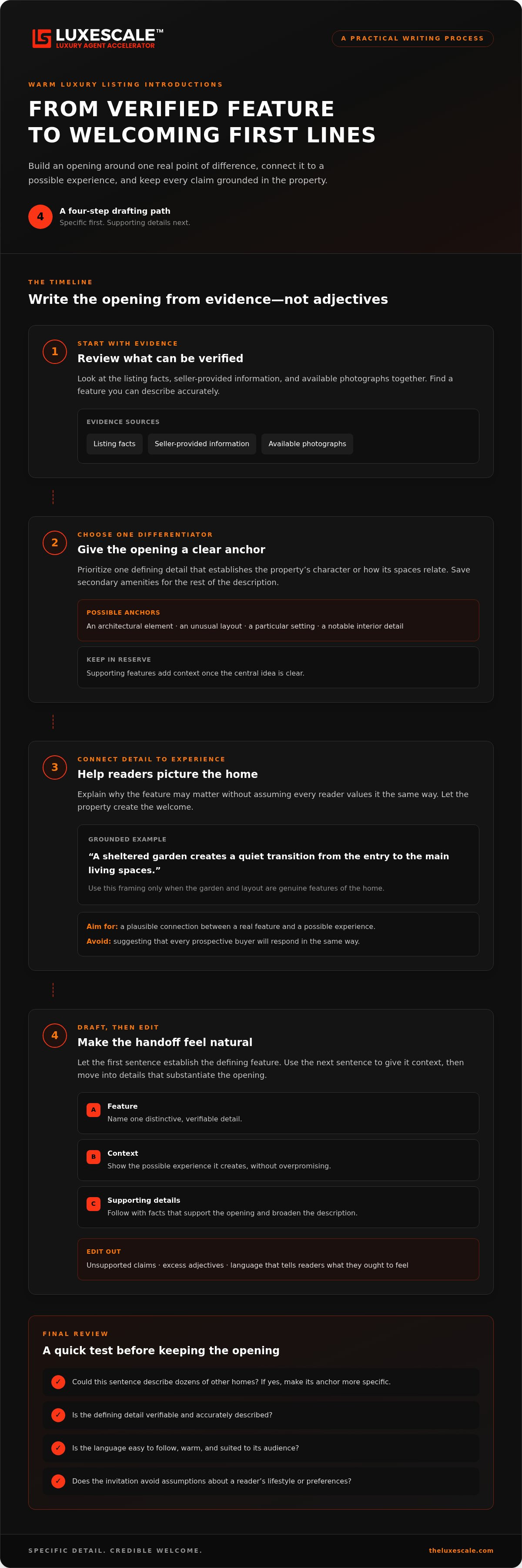
A repeatable workflow keeps the opening focused, even when a property offers many features worth describing. Move from evidence to a central idea, draft briefly, then edit with a clear accuracy check. These steps help you create warm luxury real estate listing introductions without turning the first lines into a catalogue of amenities.
- Review the facts. Gather confirmed property features, seller priorities, and the visual cues shown in the available photographs. Separate documented details from impressions. If the seller describes a room as “peaceful,” for example, look for property facts that explain the impression, such as its position away from the main living areas. Don’t present a subjective impression as an objective feature.
- Select the story. Choose one detail that can carry the opening: an architectural feature, a distinctive layout, a setting, or a notable interior space. Ask what it helps a reader understand about the home. Keep other selling points for later paragraphs. Trying to fit every amenity into the introduction usually blurs the property’s defining appeal.
- Draft the opening. Write two or three sentences. Start with the selected detail, connect it to a possible experience, then create a natural transition to supporting facts. Use active verbs and concrete nouns. The opening should invite readers onward, not tell them what they must value.
- Edit for warmth and accuracy. Remove details better suited to the full description. Verify each claim against the listing information and available documentation, then read the copy aloud. Revise stiff or overpromotional language until the sentences feel polished, welcoming, and easy to follow.
From property facts to a first draft
Use templates as prompts, not finished copy to publish unchanged. Replace each bracket with a verified detail, then revise the sentence so it sounds natural and fits the home:
- “[Architectural feature] gives the [room or space] a distinctive sense of [documented quality].”
- “With [confirmed layout or setting detail], the home connects [space] to [space], inviting a closer look at [relevant feature].”
- “At the heart of the home, [specific feature] draws attention to [verifiable detail].”
Illustrative example: Imagine a hypothetical home with a covered terrace directly off its living room. A prompt might become: “The living room opens onto a covered terrace, extending the main gathering space outdoors.” This example uses invented property details for illustration only. For an actual listing, use the facts and photographs for that home, and avoid implying that the arrangement suits every buyer.
A final edit before the listing goes live
Check that each descriptive phrase matches the property information and available documentation. Confirm that the opening doesn’t overstate a view, the privacy of a space, or the way rooms connect. Then make one final pass for tone: remove stacked adjectives, look for assumptions about who belongs in the home, and make sure the language remains inclusive and property-focused.
For the broader strategy behind reaching affluent clients, explore luxury real estate marketing guidance. Agents developing their high-end seller conversations can also explore LuxeScale’s agent support, including coaching and training.
Connect Strong Listing Copy With a Credible Luxury Seller Experience
A property introduction and an agent’s personal introduction serve different purposes. The listing copy introduces the home to prospective buyers. In a seller conversation, you introduce your approach: how you listen, prepare, and represent the owner’s priorities. The two should feel consistent, but they aren’t interchangeable. Thoughtful listing language can demonstrate care with details; it can’t replace a well-prepared conversation or guarantee a sale.
That distinction matters. A seller may want the home’s architectural character emphasized, or may see a particular layout as central to its appeal. Before shaping the marketing story, understand those priorities and connect them to details that can be accurately represented. Clear communication signals preparation and respect. It also gives you a sound basis for explaining why the property’s features merit attention, without promising a particular buyer response or transaction result.
Prepare to represent the property and earn seller confidence
Bring the seller’s perspective and the property’s documented strengths into alignment. If the owner values a carefully preserved interior feature, for instance, discuss how that detail can be presented accurately and where it fits in the broader description. This keeps the story connected to both the home and the person entrusting you to represent it.
Credibility grows through specifics: listening closely, distinguishing confirmed facts from interpretation, and explaining your choices plainly. Prepare the seller meeting with the same discipline you bring to the listing itself. The luxury listing presentation guide offers a related resource for organizing that seller-facing preparation.
Build a more consistent path to luxury listing conversations
Strong preparation matters most when it carries through every stage of an agent’s work, from the first seller conversation to the property’s public presentation. LuxeScale identifies and qualifies affluent homeowners who are ready to sell, then schedules luxury listing appointments. Its complementary coaching, training, and live video education support agents as they develop their high-end client skills.
Agents remain responsible for shaping listing copy around each home’s verified details. LuxeScale supports the work around those descriptions with qualified seller opportunities, scheduled appointments, and agent development. A thoughtful property story is one part of a credible seller experience, alongside attentive conversations and a clear approach to representing the home. Agents looking to sharpen their appointment preparation can use these luxury listing appointment strategies as a deeper resource.
Keep the standard consistent: listen to the seller, ground the marketing in the home’s real strengths, and communicate without overstatement. If you’re ready to strengthen the conversations behind your luxury listings, explore LuxeScale’s agent support and see how qualified seller opportunities, scheduled appointments, and agent development fit into your growth plans.
Make Your Next Listing Introduction More Intentional
The next property you represent will have its own character. Give yourself room to notice what makes it distinct before reaching for familiar luxury language. That pause can shape more than the opening: it sets a standard for how you present the home and communicate with its owner.
Use warm luxury real estate listing introductions as an opportunity to make care visible. A clear, well-supported story respects the property, the seller’s priorities, and the reader’s time. Keep refining that judgment with each listing, and let accuracy, not inflated claims, anchor your voice.
If you’re ready to build a stronger pipeline of luxury seller conversations, explore LuxeScale luxury listing appointment support. LuxeScale qualifies affluent homeowners who are ready to sell and schedules listing appointments, with complementary coaching, training, and live video education for agents.
Approach the next opportunity with focus and confidence. The right details, presented with care, can help you represent each home with greater intention.
Frequently Asked Questions
How long should a luxury real estate listing introduction be?
There’s no universal word count. Use enough space to establish the property’s central appeal, then move into the full description before the opening starts repeating details. A few carefully chosen sentences often work well, especially when a listing platform displays other information nearby. For example, if the first lines already describe the home’s entry and layout, save room-by-room features for later instead of crowding them into the introduction.
What should the first sentence of a luxury home listing say?
Lead with a distinctive, verifiable quality that gives readers a reason to continue. If a home has a double-height entrance, for example, describe that feature directly rather than opening with broad praise about prestige. The next sentence can add useful context, such as how the entry relates to the adjoining space, if that relationship is clear in the property information. Avoid assuming the feature suits every buyer’s preferences.
Should a luxury real estate listing introduction mention the price?
Usually, the opening can focus on the home rather than repeat a price already shown elsewhere in the listing. Whether price appears in the description depends on the platform and the seller’s marketing approach. Use the introduction to explain what distinguishes the property, not to make the price carry the story. If the listing format requires price information in its description, keep it accurate and separate from the opening’s narrative.
How do I make luxury listing copy sound warm without sounding casual?
Choose composed, reader-friendly language and details that help someone picture the property accurately. Warm luxury real estate listing introductions don’t need slang or overly familiar wording. For a room with a built-in window seat, describe the feature and its placement rather than declaring it “the perfect cozy escape.” Read the lines aloud, listen for salesy phrasing, and replace vague praise with precise details that match the property.
Can I use storytelling in a luxury listing description?
Yes, as long as the story comes from real property details. A distinctive staircase, a connected kitchen and dining area, or a documented architectural feature can give the description a narrative thread. Don’t invent a home’s history or promise a particular lifestyle without evidence. Keep the factual description clear, too, so evocative phrasing adds perspective without obscuring the rooms, features, or layout being offered.
Should a luxury listing introduction include keywords for search?
Use relevant property terms naturally when they accurately describe the home. If the listing has a documented feature such as a detached guesthouse, naming it clearly may help readers understand the offering as they scan. Avoid repeating the same phrase unnaturally or inserting terms that don’t fit the property. Search fields and platform behavior differ, so keep the introduction readable and consistent with the rest of the listing.
Can AI write a warm luxury real estate listing introduction?
AI can generate draft options, but an agent should treat them as starting points, not verified copy. Check every feature against source information, confirm that the wording matches the home, and remove invented details or claims that go beyond the evidence. Then review the result for clarity, inclusive language, and consistency with the full listing. A fluent sentence still needs human judgment before it represents a property to potential buyers.

Article by
Mark Coppens
Mark Coppens is the Founder and Chairman of LuxeScale and Co-Team Lead of Living Vogue | eXp Luxury. He is an active elite-level luxury agent and the author of the upcoming book, POWER POSITIONING: From Missiles to Mansions – Why People Really Buy, and is a nationally recognized speaker on luxury real estate, consumer psychology, marketing, and business growth.
A U.S. Army veteran with an MBA in Marketing, Mark has generated more than $1 billion in career sales and now leads one of the nation's fastest-growing luxury referral platforms, referring more than $2 billion in luxury real estate opportunities each month to partner agents across the United States. He specializes in helping real estate agents generate more listings, break into the luxury market, and build scalable businesses through qualified referrals, award-winning training, coaching, and proven systems. His practical, psychology-driven approach has helped agents across the country increase their income while attracting more affluent clients and building lasting, referral-driven businesses.