
5 factors that shape a million dollar listing agent’s take-home pay
A $60 million sales year can translate to about $1.6 million in commissions using a 2.7% commission assumption, but that isn’t the same as $1 million in take-home pay.
That distinction matters. Sales volume creates the opportunity, but commission terms and business costs shape the result. This article breaks down five factors that affect a million-dollar listing agent’s income: sales volume, brokerage splits, expenses, market knowledge, and business planning. You’ll see why the headline number does not tell the whole story and how each factor affects the path from a closed transaction to personal income.
Key Takeaways
- Separate sales volume and gross commission from personal take-home pay to understand what a strong production year actually delivers.
- Assess how your brokerage split and business expenses affect the income retained from each closing.
- Use local market knowledge to shape pricing, negotiation, and decisions about which opportunities best fit your business.
- Estimate the transaction volume your income goal requires, then account for how average sale prices and deal flow affect that target.
- Build a business plan around sustainable production, controlled costs, and a reliable pipeline rather than sales volume alone.
1.
At least 250 U.S. real estate agents are estimated to net $1 million a year. Another estimate puts the number earning more than $1 million at 500, including team leaders. These figures describe different income measures, so they aren’t interchangeable. A team’s production, an agent’s gross commission, and personal net income represent different outcomes.
A useful rule of thumb is $50 million in annual home sales to net $1 million. At a $1 million average sale price, that means 50 homes. At $200,000 per property, it means 250. These are planning examples, not guarantees: commission rates, brokerage splits, expenses, and team arrangements all affect the result. Start with the net-income goal, then work backward through expected retained commission and transaction volume.
That is gross commission, not take-home pay. Commission terms can differ by transaction, and commissions are often, but not always, divided equally between the seller’s agent and buyer’s agent.
Closings also take time. An agent may spend 30-45 days between writing an offer and closing, so a signed deal doesn’t immediately become available income. Budgeting for these costs matters when forecasting net earnings.
Top-agent sales volume shows the scale possible, not the typical result. The country’s top agent recorded more than $1.4 billion in sales volume in 2016, while the 250th-ranked agent exceeded $60 million. Those figures highlight how far production varies across real estate agents. Separately, the Internal Revenue Service says married couples filing jointly may exclude up to $500,000 in capital gains on the sale of a primary residence. That homeowner tax provision is distinct from an agent’s commission income.
To become a real estate agent in the U.S., meet the licensing requirements in the state where you plan to practice. Requirements vary by state.
Luxury agents must follow the legal, disclosure, and fair housing rules that apply to their transactions and location. Accurate property information and consistent, fair treatment are essential.
Agents win million-dollar listings through market expertise, professional relationships, and a clear listing proposition. They build trust by explaining their pricing strategy and showing how they will position a property.
For luxury listings, marketing should suit the property and its likely buyers. Strong presentation, professional photography, video, and targeted property exposure can support the strategy.
Licensing rules, property types, buyer demand, and pricing conditions differ by state and city. An agent’s market knowledge must match the specific area and clientele.
Luxury real estate can involve costly preparation, long sales cycles, negotiated commissions, and uneven deal flow. A business plan should account for these demands rather than treating each closing as immediate, predictable income.
2. Agent take-home pay after brokerage splits and expenses
Gross commission is only the starting point for calculating an agent’s income. This explains why sale price alone cannot predict what an agent keeps. Brokerage arrangements and business costs both affect the final amount.
A brokerage split determines how commission is divided between the agent and brokerage. In one example, a new agent keeps 50% after the brokerage’s cut, a typical agent keeps 70%, and a top producer keeps 90%. These are illustrative rates, not universal terms. An agent should model income using the actual split that applies to their business, then account for expenses before treating the remaining amount as personal earnings.
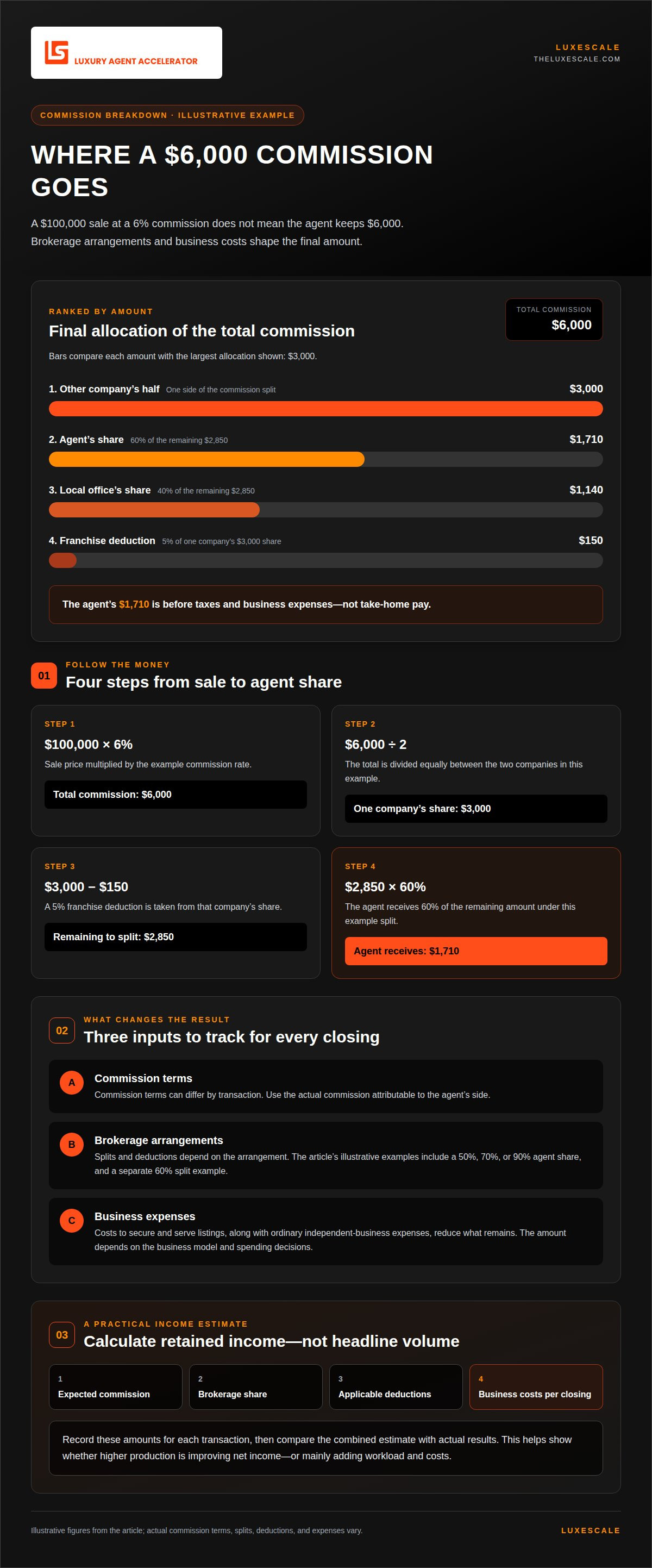
Consider a separate hypothetical sale: a $100,000 property sells with a 6% commission. The total commission is $6,000, divided equally between the two companies, leaving $3,000 for one company. A 5% franchise deduction from that company’s share leaves $2,850 to divide between the agent and local office. With a 60% agent-office split, the agent receives $1,710 before taxes and deductions, while the office receives $1,140.
The sequence matters. First, identify the commission attributable to the agent’s side. Next, apply any franchise deduction in the arrangement. Then calculate the agent’s share under the brokerage split. Finally, subtract business expenses to estimate take-home income. This keeps gross commission, brokerage payments, operating costs, and personal income distinct.
Expenses can include the resources needed to secure and serve listings, as well as ordinary costs of running an independent business. Their effect depends on the agent’s business model and spending decisions. Track expenses by category and compare them with closed transactions. This helps show whether higher production is improving net income or simply increasing workload and costs.
For planning, build a transaction-level estimate rather than relying on one headline commission figure. Record the expected commission, brokerage share, applicable deductions, and direct business costs for each closing. Then compare the combined estimate with actual results. A reliable selling plan depends on retained income, not just volume. Agents seeking more qualified luxury listing conversations can explore affluent listing opportunities as one potential addition to their pipeline.
3. Financial expertise and market intelligence
Selling a $1 million home takes more than polished presentation. Agents need to interpret local comparable sales, explain pricing choices, and manage negotiations with precision. Financial expertise helps connect a property’s features with buyer demand and current competition. Market intelligence supplies the evidence behind that judgment. Together, these skills help agents advise sellers clearly and protect credibility when expectations and offers differ.
Strong luxury agents combine property knowledge with disciplined communication. They understand how location, condition, design, and comparable properties influence perceived value. They explain how those factors shape a pricing strategy without presenting an asking price as a guaranteed sale price. Experience with high-value negotiations helps agents respond to offers, contingencies, and changing buyer interest. The key skill is turning detailed market information into practical advice for sellers.
Pricing starts with reviewing relevant properties, not assuming every luxury home commands a premium. Agents assess location, features, condition, recent comparable sales, and competing listings, then explain how the evidence supports their recommendation. Marketing should reinforce that strategy through professional presentation, accurate descriptions, and photography or video that highlights distinctive features. Each element should help qualified buyers understand the property’s value.
Market intelligence also means recognizing changing conditions. Agents can monitor comparable listings, buyer feedback, offer activity, and time on the market. If interest is limited, these signals can guide a discussion about presentation, access, or pricing. Success depends on interpreting the evidence together, rather than reacting to one showing or offer. A clear update gives sellers a reasoned basis for their next decision.
Financial guidance may also involve explaining tax considerations without acting as a tax adviser. The Internal Revenue Service permits a single home seller to exclude up to $250,000 in capital gains on the sale of a primary residence. An agent should distinguish that homeowner tax provision from commission calculations. Clear boundaries help keep transaction advice accurate while directing tax questions to the appropriate professional.
A practical workflow makes analysis consistent. First, define the property’s likely buyer profile and review relevant local comparables. Next, identify features that distinguish the home and support its positioning. Then present a pricing rationale and marketing plan based on those findings. Finally, reassess the strategy as buyer responses and competing properties change. This sequence helps agents make evidence-based decisions, explain trade-offs, and build seller confidence.
4. How many homes agents need to sell
The estimate depends on average sale price and the amount an agent retains after splits and expenses. At a median sale price of $400,000, one estimate puts the target at 125 homes in a year to reach $1 million in net income. That figure is a planning benchmark, not a universal quota. A different mix of prices, commissions, brokerage terms, and costs changes the number of closings required.
Use 125 as a production target to examine capacity, not as a standalone goal. Work backward from the desired income and map the transactions needed across the year. Then track listings secured, accepted offers, and completed closings separately. A home that enters the pipeline is not yet a closed sale, and a closing does not represent net income until the relevant deductions and expenses are accounted for.
Sale price changes the unit count. An agent whose business focuses on properties near $400,000 faces a different transaction workload than an agent serving a higher-priced segment. The useful comparison is not simply homes sold. It is the net contribution of each closing, alongside the time and operating effort it demands. Review those figures by property type and source of business to see which parts of the network produce sustainable results.
Production at team level requires another distinction. The top team in the country sold more than 1,200 homes in 2013, but team volume does not show what each agent earned. Team leaders may divide responsibilities, support staff, expenses, and commissions differently. For an individual agent, a personal plan should separate their own closings from team-wide sales, then identify how each transaction contributes to retained income.
A practical tracking system can turn the annual target into decisions. Record each prospect, listing appointment, signed listing, accepted offer, and closing in distinct stages. Compare completed transactions with the 125-home benchmark, then identify where opportunities stall. If listings are secured but few offers progress, refine pricing conversations and buyer follow-up. If the pipeline is thin, strengthen referral relationships and prospecting within the agent’s network.
Capacity matters as much as arithmetic. Each listing requires communication, preparation, negotiation, and transaction management. An agent planning around 125 annual closings must consider which tasks can be standardized and where direct attention affects service quality. Review the workload against actual closings and net results. That process helps distinguish a high-volume business from a profitable one, and turns a sales target into a more disciplined operating plan.
5. Income potential and business planning
The median annual income for a full-time Realtor is $54,000. At the other end, an estimate says an agent selling $60 million in homes could receive $1.6 million in commissions, using a 2.7% commission assumption. Those figures measure different outcomes, and commission income is not the same as personal take-home pay.
A business plan should turn an income goal into clear production assumptions. Record expected transaction values, commission income, brokerage deductions, and operating expenses. Compare those estimates with actual closings and retained income. If a projection depends on one unusually large deal, create another scenario with a broader transaction mix. This makes the numbers useful for operating decisions, not just aspirational targets.
Time to build a million-dollar listing business varies with market, experience, deal flow, and an agent’s ability to convert opportunities. A separate career framework describes years 3-5 as a period for developing a specialty, building a client base, and beginning to see consistent deal flow and larger transactions. These examples illustrate different paths, not a fixed timetable.
Plan around repeatable activity. Choose a market segment, build expertise in its properties and buyers, and develop client relationships that can generate future opportunities. Review pipeline stages, closed business, expenses, and net income regularly. If results diverge from projections, identify whether the gap involves lead volume, conversion, transaction value, or costs. Each cause calls for a different adjustment.
Cash-flow planning matters because a signed agreement and a completed transaction occur at different stages. Keep projected income separate from funds received, and account for business costs before assigning money to personal spending. A reserve plan can help manage periods with fewer closings, while pipeline reviews can reveal gaps early. Update assumptions using actual transaction records instead of relying on projections that no longer reflect your business.
Review recurring tasks, identify activities that support client service, and schedule consistent prospecting and follow-up. If luxury listings are central to your growth strategy, build your luxury listing pipeline with appointments that connect your expertise to potential sellers. Track the resulting conversations and closings against your financial plan.
LuxeScale: Luxury Listing Appointments
LuxeScale helps agents pursuing luxury-market growth through Luxury Listing Appointments, connecting them with affluent homeowners ready to sell. These appointments can support agents who have the market knowledge and service strategy to convert qualified seller conversations into listings. Affluent Seller Leads and Affluent Buyer Leads can also contribute to a pipeline, while accompanying award-winning training, coaching, systems, and support helps agents strengthen their approach.
Consider this next step when your business plan calls for more affluent seller conversations and you have capacity to serve new opportunities. Qualified appointments are most relevant when you’re ready to build luxury-market experience alongside your existing business, rather than relying on sales volume alone.
Contact LuxeScale to discuss Luxury Listing Appointments and how they may fit your growth plans.
Turn your growth plan into your next move
Choose a focused market, define the clients you want to serve, and build a pipeline that supports deliberate, consistent growth. Use actual business results to refine your approach as your experience develops.
If affluent clients are central to your plans, LuxeScale can support your business development with Luxury Listing Appointments and Affluent Buyer Leads, alongside award-winning training, coaching, systems, and support. These offerings give you a practical way to pursue new opportunities while strengthening the skills and processes behind your work. The right next step is the one that fits your market focus and capacity.
Take the next step at your pace. Contact LuxeScale to plan your growth and explore how its offerings could align with your goals. Your next stage of business begins with a clear decision and steady execution.
Frequently Asked Questions
Not necessarily. At a 2.7% commission assumption, $60 million in sales would generate about $1.6 million in gross commissions, not net income. The agent’s actual take-home depends on brokerage arrangements and business expenses. For example, an agent with higher operating costs or a smaller retained share could net substantially less than the gross figure. Treat sales volume and personal income as separate measures.
How likely is it to make this much?
Earning $1 million is an exceptional outcome, not a typical income benchmark. The median annual income for a full-time Realtor is estimated at $54,000, far below that target. The path depends on completed transactions, sale prices, commission terms, brokerage deductions, and expenses. Rather than assume a fixed probability, use your market and business records to assess the production and retained income the goal would require.
Estimates distinguish between agents who net at least $1 million and those whose earnings exceed $1 million before accounting for all costs. One estimate places the first group at least 250 agents in the United States; another estimates at least 500 earn more than $1 million, including team leaders. The difference reflects how income is defined, so the figures shouldn’t be treated as one precise count.
That amount is gross commission, not necessarily what an individual Realtor keeps. The agent’s brokerage split and business expenses affect retained income. Commission terms can also vary by transaction, so a sale price alone does not establish a guaranteed payment.
How much in sales volume do you need?
A common planning rule of thumb is $50 million in home sales to net $1 million. The number of transactions depends on average sale price: at $1 million per home, the example requires 50 sales; at $200,000 per home, it requires 250. Use those examples as starting assumptions, then account for your commission terms, brokerage split, expenses, and the share of each transaction you retain.
How much money do the best agents make?
There’s no single income figure for top agents because sales volume, commission terms, brokerage splits, and expenses differ. As an indicator of production rather than personal earnings, the top agent on the Wall Street Journal’s 2016 list recorded more than $1.4 billion in sales volume. That figure shows the scale of top-tier business, but it doesn’t reveal the agent’s net income after costs and deductions.
That is commission before brokerage splits and business expenses, not necessarily the agent’s take-home pay. The actual amount depends on the transaction terms. Consider the rate, the portion allocated to each side, and the agent’s brokerage arrangement.
What is the typical commission on a $1 million home sale, and how is it split?
These are estimates, not fixed terms. Commission is often, but not always, divided between the seller’s agent and the buyer’s agent; each agent’s brokerage arrangement then affects their retained share.

Article by
Mark Coppens
Mark Coppens is the Founder and Chairman of LuxeScale and Co-Team Lead of Living Vogue | eXp Luxury. He is an active elite-level luxury agent and the author of the upcoming book, POWER POSITIONING: From Missiles to Mansions – Why People Really Buy, and is a nationally recognized speaker on luxury real estate, consumer psychology, marketing, and business growth.
A U.S. Army veteran with an MBA in Marketing, Mark has generated more than $1 billion in career sales and now leads one of the nation's fastest-growing luxury referral platforms, referring more than $2 billion in luxury real estate opportunities each month to partner agents across the United States. He specializes in helping real estate agents generate more listings, break into the luxury market, and build scalable businesses through qualified referrals, award-winning training, coaching, and proven systems. His practical, psychology-driven approach has helped agents across the country increase their income while attracting more affluent clients and building lasting, referral-driven businesses.