
How Outsourced Listing Agent Prospecting Works
A full pipeline starts before the first listing conversation. Outsourced listing agent prospecting gives agents a structured way to identify potential sellers, conduct outreach, qualify interest, book listing appointments, and measure results. The goal is to turn time-consuming prospecting work into a focused process that creates more room for client conversations.
That work takes more than building a contact list. Effective prospecting depends on relevant homeowner research, thoughtful outreach, clear qualification criteria, and reliable follow-through. You still need to know which opportunities fit your business and whether the activity is leading to useful conversations.
This article explains the process, from identifying potential sellers to measuring results. You’ll learn what each stage contributes, what information helps you assess lead quality, and how booked appointments connect prospecting to business outcomes. With the process clear, you can decide where outsourced support fits your growth strategy.
Key Takeaways
- Strong prospecting starts with a carefully defined seller profile and research that prioritizes relevance over list size.
- Consistent, tailored calls and emails help begin conversations; follow-up keeps promising prospects from slipping through the cracks.
- Track each stage, from outreach and qualification to booked appointments, to see where the process is working and where it needs refinement.
- Clear qualification criteria help distinguish genuine listing potential from contacts who aren't ready for a meaningful conversation.
- Compare outsourcing models by how payment, lead qualification, appointments, and support align with your business goals; LuxeScale offers Luxury Listing Appointments for agents pursuing affluent sellers.
B2B prospecting research and list building
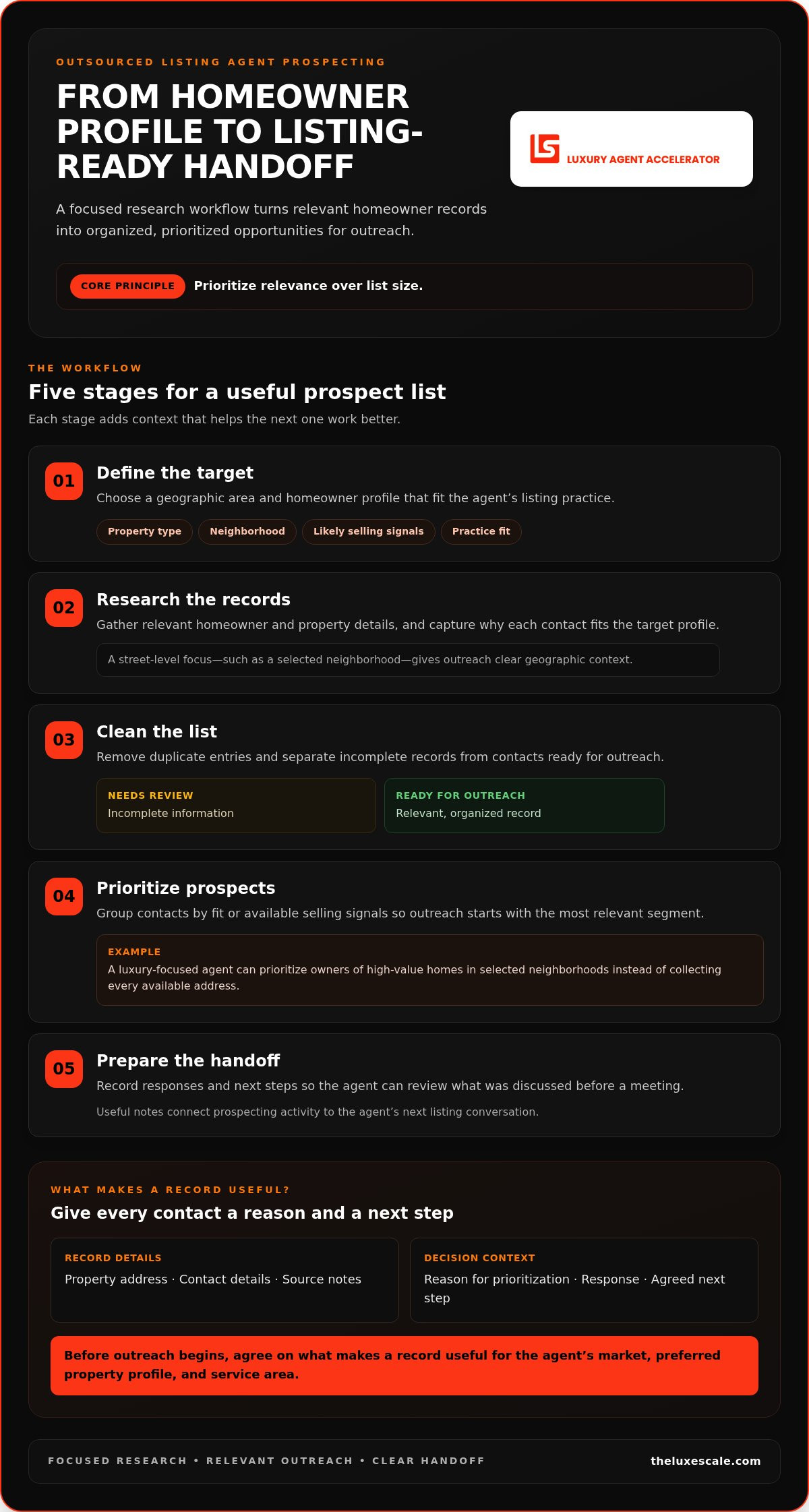
Outsourced listing agent prospecting begins by defining which homeowners are worth approaching. An agent can set a profile around property type, neighborhood, likely selling signals, and fit with the agent’s listing practice. For example, a luxury-focused agent might prioritize owners of high-value homes in selected neighborhoods rather than collecting every available address.
Research turns that profile into a workable list. A prospecting team can identify target areas, gather relevant homeowner and property details, remove duplicates, and organize records for outreach. Each entry should help answer a practical question: why might this homeowner be a relevant contact for this agent? A street-level focus, such as a chosen neighborhood, gives outreach a clear geographic context.
List building is not simply about increasing contact volume. Useful fields support the next step, such as the property address, contact details, source notes, and reason for prioritization. If an agent targets owners of larger homes, for instance, the research should reflect that criterion rather than mix unrelated property types into the same group.
Real estate agents can outsource research and list building, initial outreach by phone or email, basic qualification, follow-up organization, and appointment booking. They can also delegate the recording of prospecting activity, so they can focus on evaluating opportunities and holding listing conversations.
A clear workflow might move through these stages:
- Define the target: Choose a geographic area and homeowner profile, such as owners in a specific neighborhood with properties suited to the agent’s market.
- Research records: Gather relevant property and contact details, then note why each record fits the target profile.
- Clean the list: Remove duplicate entries and separate incomplete records from contacts ready for outreach.
- Prioritize prospects: Group contacts by fit or available selling signals, so outreach begins with the most relevant segment.
- Prepare handoff details: Record responses and next steps so the agent can see what was discussed before a meeting.
For example, an agent targeting luxury properties can separate owners who fit the listing profile from broader records. The outreach team can work that focused segment while the agent reviews responses and appointment context. This keeps research tied to a clear business objective.
Before outreach begins, agree on what makes a record useful. The agent’s market, preferred property profile, and service area shape the criteria. A focused list gives callers and emailers a relevant starting point, while documented notes help the agent judge whether prospecting is producing contacts aligned with the listing strategy.
Cold calling and cold email outreach
Once a prospect list is ready, outreach turns research into conversation. Calls let the team ask about a homeowner’s plans and listen for useful context. Email provides a written introduction and a simple way to respond. A campaign can use both channels, but each message should reflect the homeowner profile and reason for contact rather than sound like a generic pitch.
For U.S. prospecting calls and texts, account for the National Do Not Call requirements and the Telephone Consumer Protection Act (TCPA). Build screening, consent records, and a clear process for honoring opt-outs into campaign operations. Obligations depend on the contact method and circumstances.
A strong call opening identifies the caller and gives a relevant reason for reaching out. For example, a caller can explain that the agent works with sellers of luxury homes, then ask whether the homeowner is considering a move. The aim is to establish relevance and invite a response, not push a listing discussion before the homeowner is ready.
- Identify the purpose: State who is calling and why the homeowner is being contacted.
- Ask an open question: Invite the owner to share whether selling is on their horizon.
- Listen and record: Capture the response, timing, and any requested follow-up.
- Respect the answer: End the conversation appropriately when the owner declines further contact.
Email outreach needs the same discipline. A concise subject line should reflect the message, while the body should explain why the agent is reaching out and offer a straightforward next step. For instance, an email to an owner in a target neighborhood might introduce the agent’s local listing focus and ask whether a brief conversation about selling plans would be useful. Avoid unsupported claims about the home or presumed intent.
Calls and emails work best as coordinated touches, not disconnected activity. If a homeowner replies to an email, the caller should see that response before following up. If a call reaches voicemail, the next action should follow the agreed contact plan. Shared notes prevent repeated introductions and help the agent enter later conversations with context.
Review outreach quality as well as volume. A useful handoff records the contact channel, homeowner response, stated timing, and agreed next step. For example, “considering a move after a job change” gives the agent more context than “interested.” That record distinguishes a real conversation from an unanswered attempt, while consistent opt-out handling respects homeowner preferences.
Measuring outsourced prospecting results
Measure the full path from research to business outcome, not just calls made. A prospecting report should separate records reviewed, outreach attempts, live conversations, qualified seller opportunities, appointments booked, appointments held, signed listings, and closed transactions. These stages show where prospects move forward and where they drop away. Many calls but few conversations may point to contact-data or timing issues, while appointments that aren't held call for a closer look at confirmation and follow-up.
What is the difference between outsourced prospecting, lead generation, and appointment setting? Lead generation identifies potential sellers, prospecting researches and contacts them, and appointment setting schedules a meeting after interest is established. A provider may combine these functions, so define which outputs count as delivered opportunities.
Review conversion between stages rather than treating every activity as equal. Compare qualified conversations with appointments booked, then booked appointments with meetings held. Track listing agreements and closings separately, since those outcomes also depend on the agent’s presentation, market fit, and follow-up. Use consistent definitions: if one report calls a contact “qualified” after a brief reply, while another requires selling intent and timing, their totals aren't comparable.
Outsourced prospecting programs typically begin producing meaningful results within the first 60-90 days. Use that period to examine data quality, response patterns, and handoffs, rather than judging performance from one isolated week. A weekly review can flag immediate process issues; a broader period helps reveal whether changes to the target profile or outreach approach affect qualified conversations and appointments.
How do I choose a reliable outsourced prospecting company for real estate? Look for a process that defines target sellers, qualification criteria, appointment handoffs, reporting, and follow-up ownership. Ask for sample reporting that distinguishes attempted contacts from qualified opportunities and booked meetings.
What questions should I ask before hiring a listing agent prospecting service? Ask how it researches homeowners, records outreach and opt-outs, qualifies seller interest, and handles appointment changes. Clarify which metrics it reports and how often you’ll review them together.
What are the risks and drawbacks of outsourcing seller prospecting? Weak targeting can waste outreach, and inconsistent messaging can damage a homeowner’s first impression. Poor handoffs may also leave you without the context needed to continue a conversation, so review sample records and agree on qualification standards.
Use a shared scorecard with stage definitions, reporting cadence, and ownership of next steps. If an appointment is booked, for example, record whether it was held and what followed. This helps you assess pipeline quality, not just volume, and make specific adjustments to research, outreach, or qualification.
Qualifying opportunities and booking meetings
Qualification separates a homeowner who might sell from a contact who simply answered. A useful conversation establishes the owner’s interest, likely timing, property context, and preferred next step. For example, an owner considering a move after a job change may need a different follow-up from someone casually curious about home values. Capture context without pressuring the homeowner into an appointment.
Set qualification criteria before outreach begins. Define what counts as seller interest, what timing deserves an agent’s attention, and which property or location fits the agent’s business. Use the same criteria across callers so one person’s “ready” doesn’t mean another person’s “maybe.” Consistency makes appointment quality easier to assess and gives the agent a clearer picture before the meeting.
A prospecting team can ask focused questions and record the homeowner’s own answers. Useful details include whether the owner is considering a move, the timeframe they mentioned, and whether they agreed to speak with an agent. Avoid turning assumptions into facts. “Asked about selling this year” is more useful than an unsupported label such as “motivated seller.”
How can I outsource listing agent prospecting while maintaining CRM and follow-up quality? Agree on the fields, status labels, and handoff rules before prospecting starts. Have the team update your existing CRM with contact history, qualification notes, and a clear next action, then review records together for consistency.
Booking follows qualification. Once a homeowner agrees to meet, confirm the meeting’s purpose, the best contact details, and the agreed date and time. If the owner asks to speak later, record that preference rather than booking a meeting they haven’t accepted. A clear handoff lets the agent prepare without repeating basic questions.
- Interest: Record the homeowner’s stated reason for considering a move, if they provide one.
- Timing: Capture the timeframe in the homeowner’s words, such as “after the school year.”
- Fit: Note relevant property or location details against the agent’s target profile.
- Consent to meet: Distinguish an accepted appointment from a request for later follow-up.
- Next action: Assign who will confirm, attend, or reconnect, and record the agreed timing.
Review appointment outcomes as well as bookings. If an owner misses a meeting, record whether they requested a new time or stopped responding. If an agent finds that a scheduled contact lacks basic context, use that example to refine call notes or qualification criteria. Each outcome should improve the handoff rather than disappear into a status field.
For a luxury-focused agent, qualification should also reflect the intended listing profile. A homeowner may be interested in selling, yet fall outside the agent’s target area or property focus. Clear criteria prevent that mismatch from consuming meeting time and help reserve appointments for prospects whose needs align with the agent’s practice.
How much does outsourced real estate listing agent prospecting cost?
The price depends on the scope of the work, target market, research depth, outreach channels, qualification standards, and appointment handoff. A focused prospecting program has different operating needs from one covering a broader range of properties. Define the work first, then compare the payment structure with the deliverables.
Providers may structure prospecting around a fixed service period, completed activity, qualified opportunities, or booked appointments. These models allocate risk differently. A fixed arrangement makes the service scope central; activity-based terms focus on agreed work; outcome-based terms depend on clear definitions of a qualified lead or appointment. The contract should spell out what counts, when payment applies, and how cancellations or incomplete records are handled.
Compare more than the headline fee. A proposal covering homeowner research, calls, email, qualification, and meeting coordination differs from one covering only contact attempts. Ask whether reporting, follow-up notes, and appointment handoffs are included. Two offers may both promise prospecting, yet define a completed outcome differently: one as a conversation, another as an accepted meeting.
Build a comparison around the work your team needs:
- Scope: List the research, outreach, qualification, and scheduling tasks included.
- Targeting: Specify the locations and homeowner profiles the campaign will address.
- Qualification: Define seller interest, timing, and property fit in plain terms.
- Measurement: Identify the report fields used to distinguish attempts, conversations, and appointments.
- Payment trigger: Clarify whether charges relate to service activity or a defined outcome.
Next, estimate the internal costs outsourcing may change. An agent’s time spent cleaning records, calling homeowners, and documenting outcomes has an opportunity cost. Compare those hours with the external scope, then account for the time still needed to review handoffs and attend appointments. Outsourcing shifts defined tasks; it doesn’t remove the agent’s role in converting seller interest.
Assess value through pipeline quality, not appointment count alone. An appointment without seller intent or a fit with the target market may contribute little. Review qualified conversations, meetings held, listing opportunities, and the work required from your team. These measures help determine whether the scope supports your business priorities.
Before agreeing to terms, get the deliverables, payment trigger, reporting format, and cancellation process in writing. Clarify how opt-outs are recorded and how a homeowner who changes their mind is handled. Clear definitions reduce disputes and make performance reviews more useful.
If you’re evaluating a prospecting arrangement, explore a listing prospecting partnership and consider how its scope aligns with your growth goals.
LuxeScale: Luxury Listing Appointments
LuxeScale connects real estate agents with Luxury Listing Appointments and Affluent Seller Leads, making it a relevant option when you want more qualified conversations with potential sellers. The opportunities can complement your own prospecting, while accompanying award-winning training, coaching, systems, and support help you strengthen how you manage and convert them.
If your priority is building a luxury-focused pipeline and spending more time on listing conversations, explore how LuxeScale fits your business goals. Visit theluxescale.com or contact LuxeScale to learn more.
Make your next growth move with focus
Decide which seller conversations deserve more of your attention and what support fits your goals. Outsourced listing agent prospecting can help connect prospecting activity to a clearer pipeline while keeping your priorities and capacity in view.
For agents building relationships across the luxury market, LuxeScale offers Affluent Buyer Leads alongside its listing-focused opportunities. Consider how those leads fit your business-development priorities, then choose a next step that supports the practice you want to build.
Discuss prospecting with LuxeScale and explore a focused path toward your next growth opportunity. The right direction starts with a deliberate decision, and you can take that step with confidence.
Frequently Asked Questions
What does an outsourced listing agent prospecting service do?
It handles agreed prospecting work so agents can focus on seller consultations and listing strategy. The scope may cover identifying potential sellers, initiating conversations, assessing interest, and arranging introductions. For example, LuxeScale identifies and qualifies affluent homeowners ready to sell and schedules listing appointments. Agents then lead the client-facing conversation, prepare for the appointment, and determine how the homeowner’s needs align with their services.
How do outsourced prospecting services generate seller leads?
They use a defined seller profile to guide research and outreach, then identify homeowners who show interest in a possible sale. A useful lead is more than a name: it includes context that helps an agent decide how to continue the conversation. For example, a homeowner asking about selling an upscale property may be a stronger fit than someone with no stated selling interest.
How should agents measure the ROI and performance of outsourced listing prospecting?
Compare attributable closed business with the full cost of the prospecting program and the agent’s time spent handling opportunities. Track each lead’s source through appointment, signed listing, and closing, then review results over the same reporting period. If several appointments produce no listing agreements, examine the fit and agent handoff before judging outreach volume alone. Keep attribution rules consistent across lead sources.

Article by
Mark Coppens
Mark Coppens is the Founder and Chairman of LuxeScale and Co-Team Lead of Living Vogue | eXp Luxury. He is an active elite-level luxury agent and the author of the upcoming book, POWER POSITIONING: From Missiles to Mansions – Why People Really Buy, and is a nationally recognized speaker on luxury real estate, consumer psychology, marketing, and business growth.
A U.S. Army veteran with an MBA in Marketing, Mark has generated more than $1 billion in career sales and now leads one of the nation's fastest-growing luxury referral platforms, referring more than $2 billion in luxury real estate opportunities each month to partner agents across the United States. He specializes in helping real estate agents generate more listings, break into the luxury market, and build scalable businesses through qualified referrals, award-winning training, coaching, and proven systems. His practical, psychology-driven approach has helped agents across the country increase their income while attracting more affluent clients and building lasting, referral-driven businesses.