
How to attract affluent real estate clients with expertise
Affluent real estate clients aren’t won by polished listings alone. To understand how to attract affluent real estate clients, lead with investment insight, attentive service, and a clear command of the luxury market. High-net-worth buyers and sellers want advice that reflects their financial priorities, property goals, and broader plans.
Show that you can discuss a property as both a place to live and a considered investment, while communicating precisely and respecting each client’s time. Relevant credentials can support your credibility, and trusted relationships with attorneys and CPAs can lead to valuable introductions.
This article explains what affluent clients look for and how to present your expertise accordingly. Learn how investment-focused conversations, specialist knowledge, professional partnerships, and polished communication can build trust and make your value clear before a transaction begins.
Key Takeaways
- Recognize that affluent clients’ property decisions can reflect broader financial, lifestyle, and family priorities, then shape the conversation around their goals.
- Make your luxury-market expertise tangible by communicating a clear specialty and showing how it helps clients make informed decisions.
- Build trusted relationships with attorneys and CPAs through relevant, professional collaboration that can support thoughtful referrals.
- Use precise language and carefully chosen imagery to convey a property’s distinctive qualities without relying on generic luxury signals.
- Focus your visibility and professional connections where affluent clients already seek trusted advice, and make the next step clear.
1. Understanding affluent clients’ investment needs
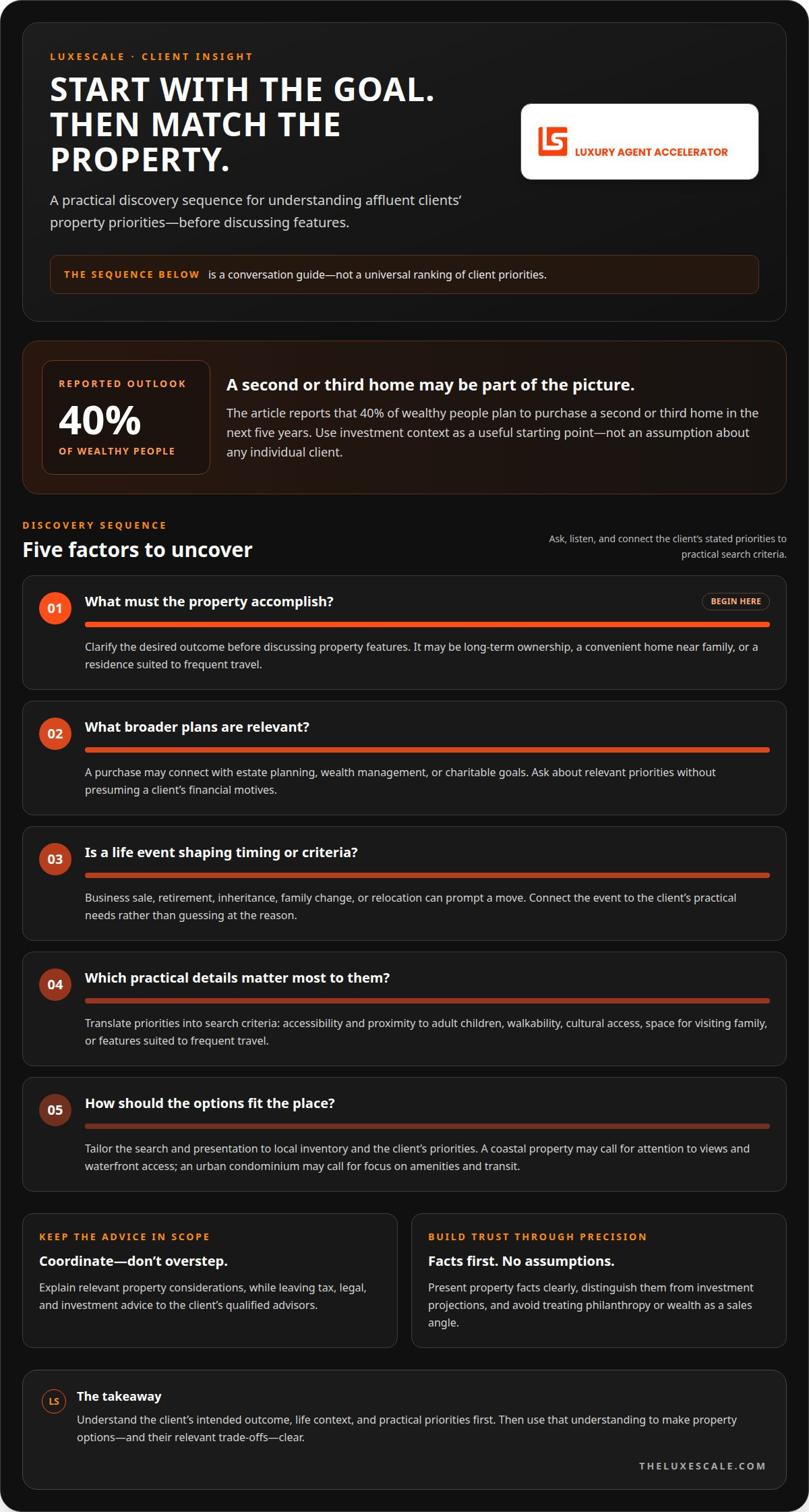
Affluent buyers and sellers often evaluate real estate alongside broader financial and lifestyle priorities. Some are retired or partially retired, while others are building portfolios, planning a move, or seeking a second home. A reported 40% of wealthy people plan to purchase a second or third home in the next five years. That makes investment context a useful starting point, not an assumption about every client.
Ask what the property needs to accomplish before discussing its features. A client might prioritize long-term ownership, a convenient home near family, or a residence suited to frequent travel. Another may be coordinating a purchase with estate planning, wealth management, or charitable goals. Clarify these priorities and explain relevant property considerations, while leaving tax, legal, and investment advice to the client’s qualified advisors.
Major life events can shape timing and property criteria. A business sale, retirement, inheritance, family change, or relocation may prompt a client to reconsider where and how they want to live. Someone moving closer to adult children, for example, may value accessibility and proximity more than rental potential. Connect the life event to practical search criteria, then present suitable options without assuming the client’s financial motives.
Charitable investing also deserves thoughtful attention. A client supporting a local nonprofit may want a property near community activities or a home that makes hosting gatherings easier. Someone pursuing meaningful activities into their 70s and beyond may prioritize walkability, cultural access, or space for visiting family. These examples help an agent ask better questions without treating philanthropy as a sales angle.
Make your marketing reflect this informed approach. A polished professional image combines accurate property details, restrained design, and photography that conveys scale, materials, and setting. Use a well-organized website, email, search, and social platforms such as LinkedIn or Instagram to share useful market context, property features, and clear next steps. Relevant information is more persuasive than luxury labels alone, and helps you attract affluent real estate clients through substance rather than spectacle.
In the United States, marketing must follow applicable advertising, fair-housing, and real estate rules. Keep property claims truthful, avoid language suggesting a preference for protected groups, and get appropriate permission to use client information and images. Ethical communication also means presenting limitations clearly, protecting confidential details, and distinguishing property facts from investment projections.
Adapt your approach to the market and property rather than relying on a single template. A coastal listing may call for attention to views and waterfront access, while an urban condominium search may focus on building amenities and transit. Tailor imagery, descriptions, and outreach to local inventory, neighborhood character, and the priorities buyers express.
How a professional can demonstrate expertise and credentials to affluent real estate clients
Affluent clients need evidence that you understand the demands of luxury transactions. A broad claim such as “luxury specialist” says little without examples. Define a focused area of expertise, such as historic estates, architect-designed homes, or high-end condominiums. Then explain how that knowledge helps clients assess property features, position a home, or make an informed decision.
Credentials can support your expertise, but present them accurately and in context. Name the professional designation or training you earned, identify the issuing organization, and explain its relevance to your work. Do not suggest that a credential guarantees an outcome. An agent with relevant negotiation training, for instance, can explain how preparation and clear communication support negotiations without promising a particular price or result.
Make your experience tangible through well-documented examples. With appropriate permission, describe a property challenge, the decisions involved, and the work completed. A case study might show how distinctive architecture shaped a property’s presentation, or how you coordinated a sale around a seller’s timing needs. Protect client privacy, remove identifying details when needed, and distinguish confirmed facts from opinion.
Use market knowledge as evidence, not as a slogan. Explain how building styles, neighborhood character, property condition, and buyer priorities affect listing strategy. A professional focused on historic homes, for example, can discuss preservation features and questions buyers commonly ask. Keep claims specific to the property and never present an estimate as a guaranteed outcome.
Make your profile a clear case for working with you. Align your website biography, presentation materials, and professional profiles around the same specialty. Include concise examples of your process, the properties you understand, and the decisions you help clients navigate. Consistent photography, typography, and descriptions reinforce a deliberate, credible position.
In a first conversation, demonstrate expertise by listening before recommending. Ask what the client values, clarify the decision they need to make, and explain your next step in plain language. If a seller is considering renovations before listing, outline the property factors informing your recommendation and separate market observations from assumptions. This shows sound judgment without overwhelming the client with jargon.
Consistency turns credentials into a recognizable professional position. Publish useful commentary on a defined market niche, contribute informed perspectives to relevant discussions, and keep examples current as your experience develops. For agents seeking a more structured way to build a luxury-market pipeline, explore affluent real estate lead support.
How professionals build partnerships with attorneys and CPAs to reach affluent real estate clients
Attorneys and certified public accountants can introduce real estate professionals to affluent prospects whose plans involve property. Strong relationships start with a clear understanding of each person’s role. You contribute property knowledge and transaction coordination; the attorney or CPA advises on legal or financial matters. Keeping those roles distinct makes collaboration focused and protects the client’s interests.
Start with a relevant professional connection, not a generic request for referrals. An agent specializing in historic properties, for example, could meet an estate-planning attorney whose clients are managing inherited homes. Explain the property questions you handle, the markets you know, and how you communicate with clients. Then ask what makes an introduction useful to that professional’s practice.
Offer practical value before seeking introductions. Share a concise market update, explain how property features affect buyer interest, or provide a real estate perspective for a client planning a move. Keep the information factual and relevant to the attorney’s or CPA’s work. Do not present property commentary as legal, tax, or investment advice.
Make referrals straightforward and respectful. Agree on a simple introduction process, such as an email connecting the client with you after the client gives permission. Respond promptly, explain the next steps, and keep the referring professional informed only as the client wishes. A seller considering an inherited property, for instance, may benefit from your help with its market positioning while an attorney handles legal questions.
Build consistency with useful follow-up. Arrange occasional conversations with attorneys and CPAs, share relevant market observations, and learn which property situations arise in their practices. Track introductions by month, year, and referring professional. This record helps you see which relationships are active, where follow-up is needed, and how to make outreach more deliberate.
Protect trust with disciplined communication. Never share a client’s financial details, legal concerns, or transaction plans with a referral partner without permission. Do not promise that a property will generate a particular return or solve a tax issue. If a client asks something beyond your expertise, clarify what real estate information you can provide and leave specialized advice to the appropriate professional.
Strong partnerships grow from reliability, not referral quotas. Thank professionals for introductions, communicate clearly with referred clients, and close the loop when the client permits it. An attorney who sees you handle a sensitive estate sale discreetly may feel more confident making a future introduction. Earned credibility can support a steady, relationship-based path to affluent prospects.
How professionals use appropriate language and imagery to connect with affluent real estate clients
Tailor service and communication to each client’s stated preferences, decision process, and schedule. Ask whether they prefer concise email updates, calls, or a shared transaction summary. A relocating executive, for example, may value a short property briefing before a scheduled call, while a seller may prefer updates after each showing. Confirming preferences early keeps communication useful and precise.
Describe the property rather than making assumptions about its buyer. Replace vague terms like “exclusive” with concrete details, such as a private garden, original millwork, or a thoughtfully designed home office. Explain how a feature functions: a separate guest suite may suit visiting family, while secure storage can meet a collector’s needs. Specificity earns attention without relying on status cues.
Use images to help prospective buyers understand a home’s layout and character. A planned photo sequence might show the entrance, main living area, kitchen, bedrooms, and outdoor space. Include features that distinguish the property, such as a restored staircase or a terrace overlooking a city park. Avoid edits that misrepresent room size, finishes, views, or condition.
Match each visual asset to its purpose. A floor plan helps viewers understand how rooms connect; a close-up can show stonework or custom cabinetry. For a waterfront home, images can show how indoor rooms relate to the shoreline. For an urban condominium, photographs of the unit’s windows, storage, and shared spaces can answer practical questions. Every image should clarify a real feature.
Keep written materials consistent across listing descriptions, email, and social posts. Use the same property names and factual details in every channel, adapting the length to the format. A social caption can highlight a feature and direct readers to a fuller description. A private client email can provide relevant property details and a clear next step.
Protect discretion in both language and imagery. Get appropriate permission before sharing a client’s name, personal belongings, or identifiable routines. Remove family photographs from listing images, for example, and avoid publishing details that reveal when a home is vacant. Respond to a private showing request professionally and specifically, without discussing the client’s plans publicly.
These choices work best as a deliberate communication system. Set expectations for updates, use accurate descriptions, and present visuals that answer likely buyer questions. A quiet, design-led property may call for restrained copy and room-focused photography; a home with extensive entertaining spaces may need images showing how the rooms connect. Tailor the presentation to the property and client so every interaction stays relevant.
5. Where do high-net-worth clients network and find real estate agents?
Affluent prospects may discover agents through trusted professional relationships, community events, online search, and property-focused content. Each route works differently: an introduction from an attorney begins with personal context, while a Google search starts with your public profile. Build visibility across channels while keeping your specialty and service message consistent.
Professional and civic gatherings can create natural opportunities for conversation. A business association reception, museum benefit, or nonprofit fundraiser may bring together people with shared community interests. Attend to contribute, not to turn every conversation into a pitch. If property comes up, ask what the person needs and offer a relevant next step, such as a market overview.
Existing clients and professional contacts can also make introductions. Attorneys and CPAs may connect clients with an agent when property decisions arise, while satisfied buyers or sellers can recommend someone they trust. Make introductions easy with a concise biography, a clear explanation of your market focus, and a simple way to arrange a conversation. Respect privacy and get permission before sharing contact details.
Online discovery matters when prospects want to assess an agent independently. A complete Google Business Profile, accurate brokerage biography, and focused website can explain your specialty and recent work. Use search terms naturally, such as “historic homes in Georgetown,” and provide useful pages about the areas you serve. Keep contact details, property descriptions, and credentials consistent across profiles.
LinkedIn and Instagram serve different purposes. LinkedIn can showcase professional analysis, market commentary, and connections with attorneys or financial professionals. Instagram can present property details through carefully selected photographs and short captions. A post about a restored townhouse, for example, can identify its architectural features and neighborhood context, then direct interested readers to a fuller description.
Private client events can deepen familiarity when they offer genuine value. A focused discussion about architecture or a guided preview of a distinctive property gives attendees a meaningful reason to engage. Keep invitations relevant, explain the event clearly, and avoid implying access or exclusivity you cannot deliver. Follow up personally with attendees who request more information.
Track which channels lead to meaningful conversations, not just views. Record whether an introduction came from a former client, an attorney, an event, or an online inquiry. Review those sources regularly and refine outreach around the channels that produce relevant opportunities. Explore ways to strengthen your luxury-market pipeline when you want a more structured path to qualified conversations.
LuxeScale
LuxeScale helps real estate agents build a path into the luxury market through affluent seller and buyer opportunities, including Luxury Listing Appointments. This can be a practical next step when you have the market expertise to serve affluent clients but want more qualified, appointment-ready opportunities.
Alongside leads and appointments, LuxeScale provides accompanying award-winning training, coaching, systems, and support. These resources help agents strengthen how they handle referred opportunities, from the first conversation through follow-up. The approach connects client acquisition with the skills and structure needed to manage each opportunity professionally.
If you’re ready to explore a more direct path to affluent real estate clients, check your territory with LuxeScale. Limited Areas Are Still Available.
Make your next move in the luxury market
Building a stronger luxury real estate business starts with a focused decision: identify the clients you are best positioned to serve, then create a consistent way to reach them. Treat each conversation as an opportunity to learn what matters, demonstrate sound judgment, and earn trust through clear, professional follow-through. That discipline turns your expertise into a deliberate growth strategy.
If you’re considering how to attract affluent real estate clients while strengthening your pipeline, LuxeScale can support your next stage of growth. Choose a next step that fits your goals and gives you room to focus on serving clients well. Contact LuxeScale today to discuss your approach and move forward with confidence.
Frequently Asked Questions
What do high net worth clients want?
High-net-worth clients want advice that reflects their priorities, reliable execution, and careful handling of sensitive details. Their needs differ: a relocating buyer may need a coordinated search, while a seller preparing an estate property may need clear communication with several decision-makers. Ask about the client’s preferred process, who should be involved, and what would make each decision easier. Then tailor updates and recommendations accordingly.
What marketing strategies can professionals use to attract affluent real estate buyers and sellers?
Use a connected marketing mix that demonstrates expertise and makes the next step clear. A detailed property page can support discovery, while an email update can deepen interest among people who have opted in. Share useful market commentary on professional social channels, then direct prospects to a relevant conversation or resource. Review which inquiries become substantive discussions and refine your message in response to their needs.
How can a professional service help build a luxury real estate brand and reputation?
Professional support can add structure to your positioning and client acquisition, while you remain responsible for delivering a credible experience. Qualified prospect introductions, for example, can help you prepare for a first conversation with relevant context. Coaching can also help refine how you explain your value. A strong reputation still depends on accurate communication, thoughtful follow-through, and service that matches your brand promise.
How can professionals build referral relationships with wealth managers, attorneys, and luxury businesses?
Build reciprocal trust by sharing useful expertise without making every interaction a referral request. A real estate agent might brief a wealth manager on how property decisions affect a client’s relocation timeline, then invite questions about the agent’s market focus. For a luxury business, a joint educational event can serve a shared audience. Agree on client consent and introduction etiquette, then follow up discreetly and professionally.
What credentials and experience do affluent clients look for in a real estate agent?
Clients may value relevant credentials, demonstrated luxury-market experience, and sound judgment. Make these concrete by presenting a clear specialty, explaining your role in representative transactions, and describing how you handled a specific challenge. A seller comparing agents, for instance, can assess whether each professional explains a tailored listing approach. Credentials support your case, but clear examples show how your expertise applies.

Article by
Mark Coppens
Mark Coppens is the Founder and Chairman of LuxeScale and Co-Team Lead of Living Vogue | eXp Luxury. He is an active elite-level luxury agent and the author of the upcoming book, POWER POSITIONING: From Missiles to Mansions – Why People Really Buy, and is a nationally recognized speaker on luxury real estate, consumer psychology, marketing, and business growth.
A U.S. Army veteran with an MBA in Marketing, Mark has generated more than $1 billion in career sales and now leads one of the nation's fastest-growing luxury referral platforms, referring more than $2 billion in luxury real estate opportunities each month to partner agents across the United States. He specializes in helping real estate agents generate more listings, break into the luxury market, and build scalable businesses through qualified referrals, award-winning training, coaching, and proven systems. His practical, psychology-driven approach has helped agents across the country increase their income while attracting more affluent clients and building lasting, referral-driven businesses.