
How to Build a Luxury Real Estate Brand from Scratch with Clarity
What if “luxury” isn’t a price point or a polished logo, but the experience your ideal clients trust you to deliver? Building a luxury real estate brand from scratch starts with defining what premium service means to a specific audience, then making that promise clear and consistent at every client touchpoint.
You’re right to use the word carefully. Luxury can mean discretion, deep market knowledge, thoughtful access, or a highly personal buying and selling experience. Define it around the people you want to serve and the value you can reliably provide, not generic signals of prestige.
This guide shows you how to identify your audience, shape a distinctive position, create meaningful client experiences, and keep your values consistent as you grow. Follow a practical sequence to turn a broad ambition into a credible brand clients can recognize, remember, and trust.
Key Takeaways
- Make your marketing memorable and consistent so prospective clients can recognize your value when they’re ready to buy or sell.
- Define your audience and brand purpose around prospective clients’ needs, not a narrow image of what luxury should look like.
- Build trust through genuine personal connection and experiences tailored to each client’s priorities.
- Identify what distinguishes your expertise and services, then express that difference clearly in your brand story.
- Document your standards and processes to maintain a consistent client experience as your business grows.
Why Is A Well-Executed Plan For Luxury Brand Building Important?
A clear plan connects your audience, marketing, and service standards. Use these steps to build recognition while leaving room to grow.
-
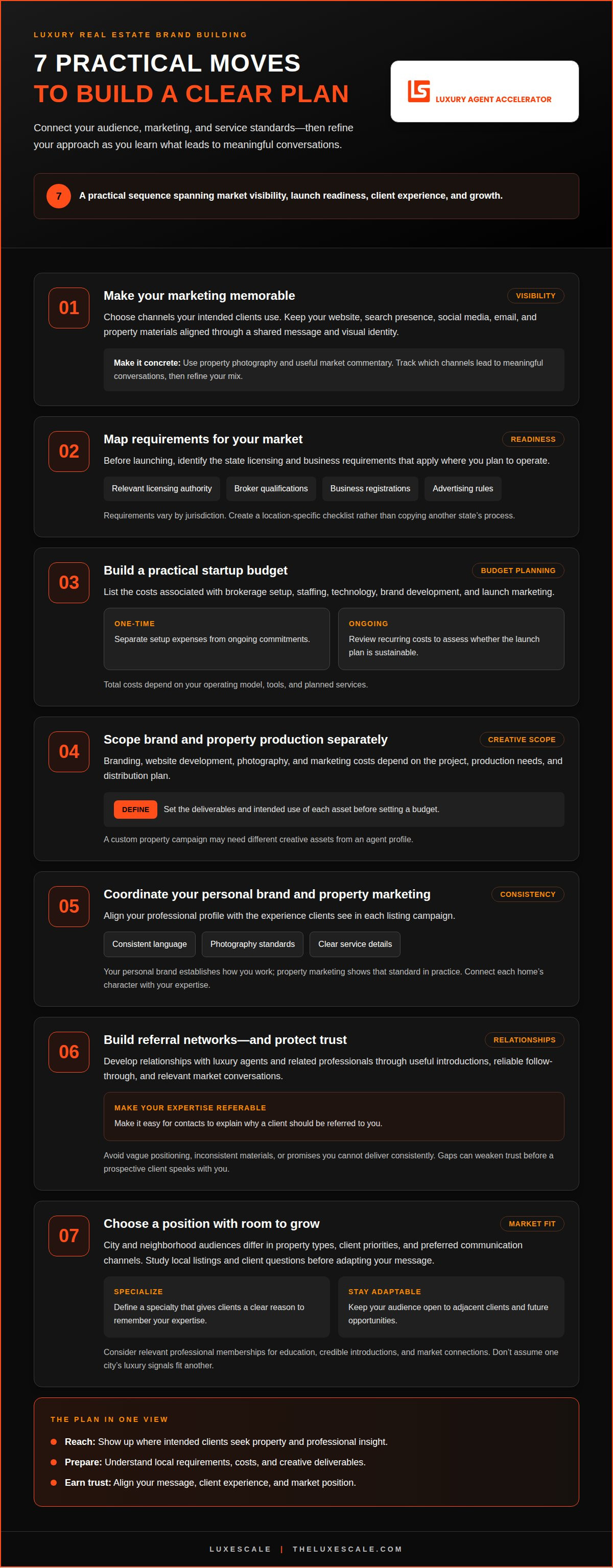
Create Memorable Marketing Across Effective Channels
Choose channels where your intended clients seek property and professional insight. A polished website, search presence, social media, email, and property materials can reinforce one another when they share the same message and visual identity. Use property photography and useful market commentary to make that message concrete. Track which channels lead to meaningful conversations, then refine your mix rather than spreading effort everywhere.
- Map the brokerage requirements for your market. Before launching, identify the state licensing and business requirements that apply where you plan to operate. Research the relevant licensing authority, broker qualifications, business registrations, and advertising rules. Requirements vary by jurisdiction, so create a location-specific checklist rather than copying another state’s process.
- Build a practical startup budget. List the costs associated with brokerage setup, staffing, technology, brand development, and launch marketing. Your total depends on your operating model, tools, and planned services. Separate one-time setup expenses from ongoing commitments to see whether your launch plan is sustainable.
- Scope brand and property production separately. Branding, website development, photography, and marketing costs depend on the project, production needs, and distribution plan. A custom property campaign, for example, may require different creative assets from an agent profile. Define the deliverables and intended use of each before setting a budget.
-
Coordinate Personal Branding and Property Marketing
Align your professional profile with the experience clients see in each listing campaign. Use consistent language, photography standards, and service details across your biography, property descriptions, and social posts. Your personal brand establishes how you work; property marketing shows that standard in practice. Review each campaign to ensure it connects the home’s character with your expertise.
-
Build Referral Networks and Avoid Launch Risks
Develop relationships with luxury agents and related professionals through useful introductions, reliable follow-through, and relevant market conversations. Make your expertise easy to describe, so contacts can refer clients for a clear reason. Avoid vague positioning, inconsistent materials, or promises you cannot deliver consistently. Each gap can weaken trust before a prospective client speaks with you.
- Choose a market position with room to grow. City and neighborhood audiences differ in property types, client priorities, and preferred communication channels. Study local listings and client questions before adapting your message; don’t assume one city’s luxury signals fit another. Consider professional memberships for relevant education, credible introductions, and market connections. Define a specialty, but keep your audience broad enough to include adjacent clients and future opportunities.
Defining a luxury brand’s vision, niche, and creative purpose
Choose a distinctive name, position, and visual identity that express the value you deliver. Building a luxury real estate brand from scratch starts with a defined audience, a credible service promise, and a creative purpose to guide your decisions.
-
Define the Brand Vision and Creative Purpose
Write a vision that describes the client experience you intend to create. You might focus, for example, on discreet guidance for buyers seeking architecturally significant homes. Connect your creative purpose to that promise so your photography, language, and client interactions feel coherent. A plan for building a luxury real estate brand from scratch should explain why your approach matters to clients, not just how the brand should look. Don’t choose a visual style solely because it appears in luxury trends.
-
Identify the Target Audience
Define the people you want to serve by examining their property goals, concerns, and decision-making preferences. A relocating executive may prioritize a smooth transition, while a seller may need precise market guidance. Use these differences to shape your audience without narrowing it to a job title or lifestyle. Research the channels your intended clients use, then tailor your message to their priorities. This gives your brand focus while leaving room to serve people with related needs.
-
Shape a Distinctive Voice and Service
Choose a voice that reflects how you work, then translate it into specific service behaviors. If your position emphasizes discretion, explain how you protect client privacy and handle sensitive details. If it promises market expertise, demonstrate that knowledge through relevant property context. Keep the tone consistent across your website, listing presentations, and client conversations. Polished language cannot make up for service that contradicts your promise, so ensure the client experience supports every claim.
- Build the name, positioning, and visual identity as one system. Choose a name that is easy to pronounce, remember, and connect with your market. State your positioning clearly, such as “strategic representation for waterfront sellers.” Select typography, color, and imagery that reinforce that message. Then review the identity on a mobile screen, in a property brochure, and on your agent profile. Each application should make the same positioning recognizable.
- Turn trends into deliberate action. Review changes in client expectations, property presentation, and communication habits. Decide which strengthen your vision instead of adopting every trend. A digital-first buyer journey may call for stronger virtual property materials, while a relationship-led niche may benefit from personal introductions. Choose strategies that support your service promise, then reassess them as client feedback or market conditions change.
If your niche is clear but seller conversations remain difficult to build, explore luxury market opportunities as a next step.
Personalisation and exclusive customer experiences
Design each client interaction around the person’s priorities, not a generic luxury script. Use these steps to build trust through expertise and thoughtful service.
- Learn the client’s definition of a successful outcome. Start with a focused conversation about goals, timing, privacy, and preferred communication. A relocating buyer may value school-area context and a streamlined search, while a seller may prioritize discretion and a carefully managed presentation. Record the details that shape decisions, then use them to guide the next interaction instead of relying on broad assumptions.
- Prepare expertise that answers the client’s actual questions. Before discussing a property, gather relevant details about its setting, design, condition, and market context. For a waterfront home, explain access, views, and how the surroundings shape the experience. Distinguish documented property information from your interpretation. This preparation makes recommendations more useful and grounds your guidance in the decision at hand.
- Personalize the property journey, not just the greeting. Match the information you share to the client’s needs. A buyer comparing architectural styles may appreciate a concise selection of relevant listings, while a seller may need a presentation plan that highlights a home’s distinctive features. Don’t send every client identical materials. Tailored choices make the process feel considered without adding unnecessary ceremony.
- Create recognition through genuine human interaction. Remember the client’s stated priorities and refer to them naturally in later conversations. If a buyer has emphasized a private workspace, explain how a property’s layout might meet that need. Follow through on promised details, communicate changes clearly, and give clients room to decide. Recognition comes from attention and reliable conduct, not scripted familiarity or extravagant gestures.
- Invest in service details that remove friction. Map the client journey from first inquiry through property evaluation and transaction milestones. Identify where clear preparation can reduce uncertainty, such as explaining what a showing involves or organizing property information in advance. Keep every touchpoint consistent with your service values. Don’t add elaborate steps unless they improve the client’s experience or decision-making.
- Use feedback to refine the experience. After an important interaction, invite specific feedback about communication, property information, and next steps. Asking “Was the comparison of these homes useful?” gives you actionable direction. Look for repeated questions or confusion, then adjust your process. Genuine connection builds trust, and responsive improvements show clients that their input shapes the service they receive.
Identifying brand differentiators
Use a structured comparison to identify what your expertise, client focus, and service approach uniquely contribute. A credible differentiator gives buyers a specific reason to remember your brand.
- Inventory the strengths you can demonstrate. List your relevant market knowledge, transaction experience, property expertise, and service capabilities. Connect each strength to a client benefit. For example, familiarity with historic homes could help buyers assess renovation considerations and neighborhood character. Avoid broad claims like “exceptional service” unless you can explain what clients will experience differently.
- Define the clients and services you serve best. Identify the buyer or seller needs that match your strongest expertise. You might represent sellers of architect-designed homes or guide buyers through a distinctive waterfront market. Be precise about your service and audience, but don’t make the niche so narrow that related clients cannot see a fit.
- Study competing brands’ positioning. Review local agents’ public profiles, listing presentations, and marketing messages. Note which clients they target, which services they emphasize, and how they describe their value. This research helps reveal crowded claims, such as “local expert,” and underused perspectives, such as deep knowledge of a specific architectural style. Use the findings to shape your own narrative, not imitate another agent.
- Translate your strongest difference into a client outcome. A differentiator should explain why your approach matters in a real decision. If you understand estate properties, show how that expertise informs property evaluation, seller preparation, or buyer guidance. If direct communication is your strength, explain how you keep clients informed at key moments. Specific outcomes make your brand promise easier to understand and assess.
- Build marketing strategies around proof. Support each claim with an example clients can recognize. A market guide can demonstrate local knowledge; a thoughtful property presentation can illustrate your standards. Use buyer questions, seller concerns, and client feedback to choose topics. Visual polish alone is not enough: show how your expertise improves the property search or selling experience.
- Test whether the distinction is clear. Ask a prospective client to describe your brand after reviewing your profile and a property campaign. If they remember only “luxury homes,” sharpen your audience, expertise, or service benefit. Repeat the review across your website, listing materials, and conversations. Consistency helps clients recognize the same differentiator at every touchpoint.
Turn your findings into a practical position: name the expertise that sets you apart, the clients you are best equipped to serve, and the services where it matters most. Real estate professionals can identify their brand differentiators by considering what sets them apart and which clients or services they specialize in. Make the distinction specific enough to guide examples and promises across your materials, yet clear to clients with related needs.
Research other agents’ target clients and marketing approaches to develop a distinctive brand narrative. Compare their choices with your strengths, then describe the difference in terms of the clients you serve and the service you provide. Check that your profile, presentations, and property marketing communicate the same focus, and refine the wording if the distinction is unclear.
Planning and maintaining luxury brand values
Turn your values into operating standards and use them to guide daily decisions. A documented approach helps protect your brand as the business grows.
- Translate each value into a visible standard. If discretion is central, define how your team handles private client and property information. If quality is a core value, set clear standards for listing materials, communication, and client handoffs. A value like “personal service” needs observable actions, such as preparing relevant property comparisons before a buyer meeting. Specific standards make abstract principles easier to deliver.
- Document the process behind the experience. Create a practical guide to recurring work, including seller onboarding, listing preparation, and transaction updates. A listing checklist, for example, can assign responsibility for photography, property details, and final marketing review. Revisit the process when a handoff fails or clients repeatedly ask for the same information. Clear documentation supports quality without relying on memory.
- Protect premium perception through pricing and promotions. Avoid routine, frequent discounts, which can weaken the sense of premium value. Instead, explain the service and expertise behind your offering. A focused seller presentation, for example, can clarify your preparation, communication, and marketing approach. Keep promotional decisions aligned with the standards clients associate with your brand.
- Audit public signals of your reputation. Review search results, social profiles, and review sites to see what prospective clients encounter. Compare those impressions with your stated values. If your brand promises responsive guidance but public feedback mentions missed updates, address the process gap. Monitor online mentions and discussions for recurring themes, and use them to guide improvements. Invite clients to share honest reviews after meaningful service milestones.
- Expand gradually and keep content focused. Before adding a market or service line, assess whether your processes can maintain the same quality. Publish useful articles or real estate-focused posts that demonstrate your expertise rather than chasing every social trend. A focused guide to evaluating historic properties, for instance, supports a specialty more clearly than broad, unrelated content. Growth should reinforce your identity, not dilute it.
- Use a regular review to keep values active. Revisit your standards after a completed transaction, a client concern, or a change in team responsibilities. Ask whether the actual experience matched the promise in your marketing. Record decisions and assign follow-up actions, such as revising a listing review or clarifying communication ownership. For agents ready to build a values-led seller pipeline, explore Luxury Listing Appointments.
LuxeScale: Luxury Listing Appointments
LuxeScale helps agents pursuing luxury-market growth connect with affluent homeowners ready to sell through Luxury Listing Appointments. These opportunities can support your positioning when you’re ready to apply your market knowledge and service standards to qualified seller conversations. LuxeScale also provides accompanying award-winning training, coaching, systems, and support to help agents develop their approach to referred opportunities. Affluent Buyer Leads and Affluent Seller Leads offer additional ways to build relevant client connections. This is a practical next step if your brand strategy is clear and you want to develop a pipeline aligned with luxury real estate. Contact LuxeScale to discuss the opportunities.
Put Your Brand Strategy Into Motion
The next phase of building a luxury real estate brand from scratch is turning your positioning into a reliable operating rhythm. Use each client interaction to demonstrate the experience your brand promises, then draw on feedback and market conversations to refine your approach. This keeps your brand responsive without changing its core values whenever a new trend appears.
Set a practical priority for the coming weeks, such as strengthening your seller pipeline or improving how you present your expertise to prospective clients. LuxeScale can support agents pursuing luxury-market opportunities with a focused next step. Contact LuxeScale to shape your brand and discuss how its opportunities and support may fit your growth goals.
Build deliberately, stay consistent, and let the quality of your work earn recognition over time.
Frequently Asked Questions
Everyone Throws Around The Word ‘Luxury’, But What Does It Actually Mean?
Luxury is the value a client experiences, not a label defined only by an asking price. A distinctive home may offer architectural significance, privacy, provenance, or an uncommon setting, while an affluent client may value discretion and informed representation. Consider both the property and the service expectations. Explain, for example, why a home’s design, setting, and ownership context matter to a buyer instead of relying on “luxury” as the whole pitch.
What defines a luxury real estate brand in the U.S.?
A luxury real estate brand is defined by a credible specialty and the standard of representation behind it. In the U.S., expectations vary by property type and audience, so don’t rely on a single national price cutoff to define your identity. Show how your knowledge applies to the homes you represent, explain your approach to client service, and ensure your public materials support the same position.
How to identify and research a target luxury real estate market?
Research a target market by comparing its property inventory, transaction patterns, and buyer priorities. Review active and closed listings by property type and condition, noting differences in presentation and selling timelines. Speak with local professionals and prospective clients to learn which needs are underserved. Then assess whether your expertise matches those needs. A market is a stronger fit when you can explain its properties and serve its clients credibly.
How to build credibility and attract high-net-worth real estate clients?
Build credibility by making your expertise visible and easy to assess. Publish useful analysis of property features, transaction considerations, and the market questions your intended clients face. Support claims with documented experience and client feedback, and explain your process before a client commits to working with you. Consistent follow-through matters too: timely updates and well-prepared answers demonstrate professionalism when decisions shape client trust.

Article by
Mark Coppens
Mark Coppens is the Founder and Chairman of LuxeScale and Co-Team Lead of Living Vogue | eXp Luxury. He is an active elite-level luxury agent and the author of the upcoming book, POWER POSITIONING: From Missiles to Mansions – Why People Really Buy, and is a nationally recognized speaker on luxury real estate, consumer psychology, marketing, and business growth.
A U.S. Army veteran with an MBA in Marketing, Mark has generated more than $1 billion in career sales and now leads one of the nation's fastest-growing luxury referral platforms, referring more than $2 billion in luxury real estate opportunities each month to partner agents across the United States. He specializes in helping real estate agents generate more listings, break into the luxury market, and build scalable businesses through qualified referrals, award-winning training, coaching, and proven systems. His practical, psychology-driven approach has helped agents across the country increase their income while attracting more affluent clients and building lasting, referral-driven businesses.