
How to Find Off-Market Luxury Properties and Assess Their Price
Finding off-market luxury properties takes a targeted approach: build relationships with agents and brokers, identify potential sellers through public records and tax rolls, and make discreet, well-qualified outreach. Under the National Association of Realtors’ Clear Cooperation Policy, a property publicly marketed by an MLS participant must be submitted to the MLS within one business day; office-exclusive listings can be shared privately with individual buyers.
The strongest opportunities often come from connecting with the right people before a home is broadly promoted, rather than waiting for a listing to appear. Early signs, such as an owner considering a move or a broker privately gauging buyer interest, can help focus your search, but they are not proof that a sale is planned.
This guide explains how to define your buying criteria, recognize potential seller signals, approach owners discreetly, and compare a property’s asking price with comparable sales and its condition. You’ll also learn which due diligence steps can reveal title, insurance, permitting, and documentation risks, helping you assess a private opportunity with a clearer view of its value and trade-offs.
Key Takeaways
- Build a focused outreach plan around the property types and locations that fit your buying criteria, and approach owners with discretion.
- Use public records to identify ownership details and possible signals of a future sale, then treat each signal as a lead to assess, not proof of intent.
- Assess value against comparable sales, property condition, and likely repair needs; a private sale does not automatically mean a lower price.
- Protect your position with thorough checks on title, permits, insurance, inspections, and any development restrictions before committing.
- Define your purchase criteria and prepare to demonstrate financial readiness so sellers and brokers can assess your interest efficiently.
Direct mail and homeowner outreach
A practical approach to how to find off-market luxury properties starts with a focused property brief, respectful outreach to owners, and relationships with agents. Luxury agents may share pocket listings through private buyer relationships or office-exclusive arrangements. Invitation-only platforms circulate opportunities within selected professional or buyer groups. Access depends on network rules and the seller’s marketing choice.
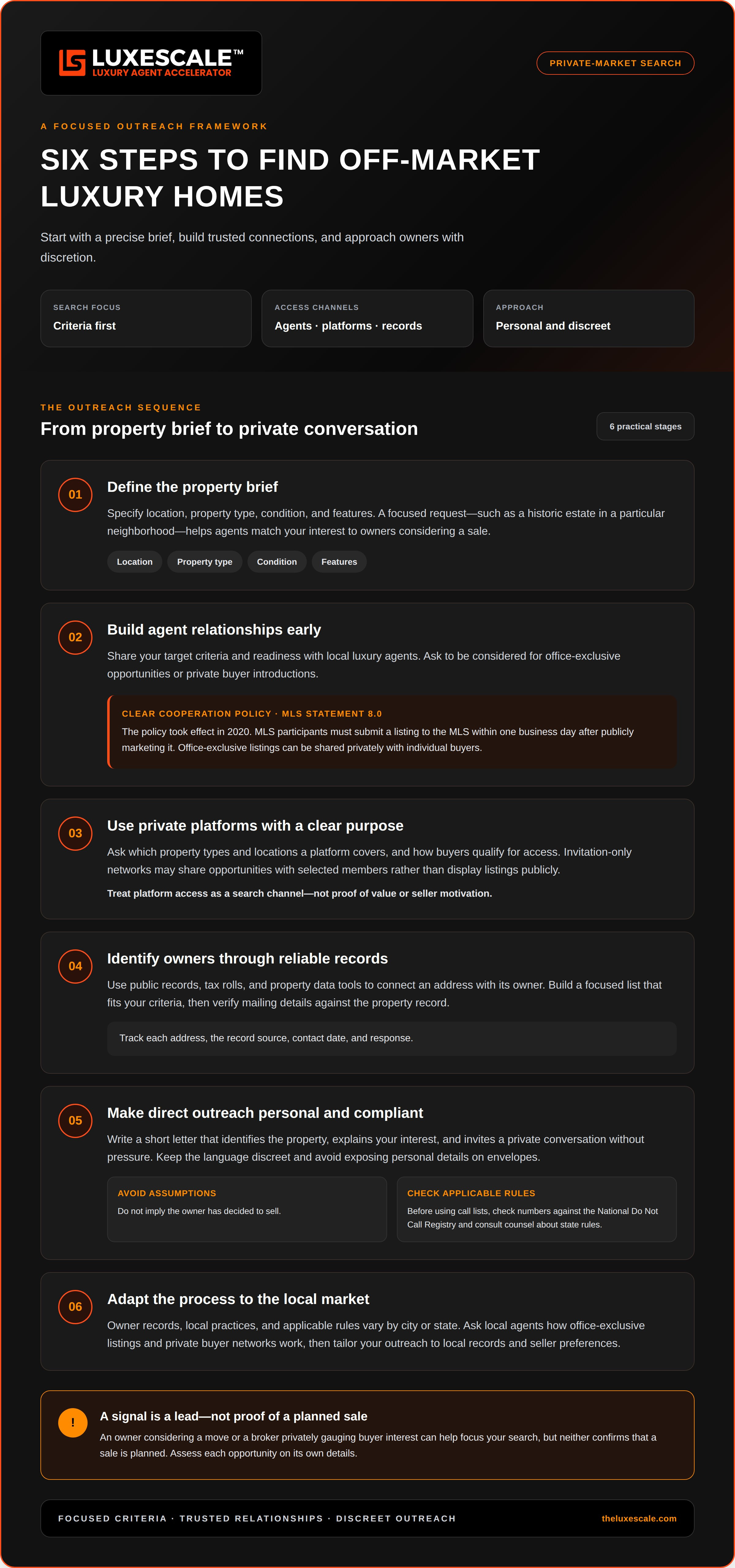
- Define the properties you want. Write down the location, property type, condition, and features that fit your search. For example, specify a historic estate in a particular neighborhood rather than asking for any luxury home. A precise brief helps agents and brokers match your interest to owners considering selling. It also makes your outreach relevant instead of impersonal.
- Build agent relationships before requesting private listings. Buyers learning how to find off-market luxury properties should share their target criteria and readiness with local luxury agents. Ask to be considered for office-exclusive opportunities or private buyer introductions. Under the National Association of Realtors’ Clear Cooperation Policy, MLS participants must submit a listing within one business day after publicly marketing it. The policy took effect in 2020 and is identified as MLS Statement 8.0. Office-exclusive listings can be shared privately with individual buyers.
- Use private platforms with a clear purpose. Ask which property types and locations a platform covers, and how buyers qualify for access. These networks may circulate details to selected members rather than display listings publicly. Treat access as a channel, not proof of value or seller motivation. Request available property details, then assess the opportunity before deciding whether to pursue it.
- Identify owners through reliable records. Public records, tax rolls, and property data tools can help connect an address with its owner. Create a focused list based on your criteria, such as large homes near a preferred school district. Verify that mailing details match the property record before sending anything. Track each address, record source, contact date, and response.
- Make direct-to-owner outreach personal and compliant. A short letter should identify the property, explain your interest, and invite a private conversation without pressure. Avoid implying the owner has decided to sell. Before using call lists, check numbers against the National Do Not Call Registry and consult counsel about applicable state rules. Keep direct-mail language discreet and avoid exposing personal details on envelopes.
- Adapt the approach to each market. Off-market searches differ by city or state because owner records, local practices, and applicable rules vary. Ask local agents how office-exclusive listings and private buyer networks work in that market. Tailor outreach to local record systems and seller preferences. A location-specific process is more useful than repeating one national script everywhere.
Due diligence and off-market deal risks
In the United States, pocket listings are subject to different rules depending on the listing arrangement and applicable requirements. The National Association of Realtors’ Clear Cooperation Policy requires MLS participants to submit publicly marketed listings within one business day; office-exclusive listings may be shared privately. The policy is not a universal disclosure code for every agent or transaction.
- Confirm the seller’s authority. Before discussing terms, establish who can legally sign for the property. For an estate sale, identify the authorized personal representative and request documentation showing their authority. If a trust or business owns the home, confirm the signer’s role. The name on marketing materials alone doesn’t establish authority to transfer ownership.
- Order an independent title search. Ask a title professional to identify open mortgages, tax liens, judgments, easements, and boundary disputes. A driveway that crosses a neighboring parcel, for example, may involve an easement affecting access. Resolve title concerns before making an offer, not after you’ve committed to a purchase timeline.
- Arrange your own inspection. Hire an independent inspector to assess the home’s structure, roof, major systems, and visible defects. A luxury estate may include additions or specialized equipment that need closer review. Don’t rely only on a seller’s agent’s suggested inspector. Use the inspection findings to understand repair scope and decide which terms belong in your offer.
- Verify permits and property records. Check with the local building department about major additions and systems. Confirm that required permits and inspections were recorded. An unpermitted guesthouse or remodeled wing can affect use, insurance, and future work. Compare those records with the property description and inspection report, then investigate discrepancies before proceeding.
- Assess environmental and ownership risks. Check the address on the FEMA flood map, and obtain insurance quotes for coastal, wildfire, or flood-zone homes before removing contingencies. Review title records for liens and easements. In a planned development, examine HOA and CC&R documents for rental limits, architectural controls, and pending assessments.
- Make the offer specific and protected. Include the proposed price, relevant contingencies, closing terms, and a clear description of included property or fixtures. Set inspection and document-review terms around unresolved concerns. For example, if the roof condition remains uncertain, preserve time to assess the inspection findings. Have a qualified real estate professional or attorney review terms for local requirements.
- Underwrite the information you actually have. Off-market homes can have less documentation or pricing transparency than market listings, and the asking price may exceed market value. Compare recent sales and repair needs before deciding your offer. For a distinctive waterfront estate, an independent appraiser with experience valuing that property type can help assess its features and condition.
Early seller signals in public records
- Start with a narrow property brief. Choose a target neighborhood, property type, and defining features before searching. For example, focus on historic homes near a specific waterfront district. This keeps the record search manageable and helps separate relevant owners from a broad list. Add the reason each property fits, such as its location, architectural style, or lot size.
- Search county property records by address. County assessor and recorder offices often provide records that help identify property ownership. Search addresses that meet your criteria, then note the owner’s name and the record date. A record can connect a property to an owner, but it doesn’t establish whether that owner is considering selling. Treat it as a research lead, not an invitation to assume intent.
- Use tax rolls to organize potential leads. Tax rolls and public property data tools can help organize addresses and ownership information. Match each entry against your location and property requirements. For instance, an owner’s mailing address may differ from the property address. Record that distinction carefully, since it can guide appropriate outreach without implying the owner plans to sell.
- Review changes in ownership records. Compare available records over time to understand the property’s ownership history. A recent transfer, for example, may explain why a property’s details differ across databases. It doesn’t prove the new owner wants to sell. Use the record to confirm that your contact information relates to the current owner before pursuing a conversation.
- Look for patterns, not a single supposed signal. A mailing address change or a new public record can have many explanations. Don’t label either as evidence of a planned sale. Instead, combine verified ownership details with a property’s fit for your brief. If a home meets your criteria, prepare a neutral introduction that gives the owner space to respond or decline.
- Keep a dated lead record. Track the property address, source, owner name, record date, and any outreach or response. A simple spreadsheet can show which details need refreshing and prevent repeated contact. For example, mark an address as “ownership checked” and note the county record used. Separate documented facts from your own interpretation of possible seller interest.
- Move from records to respectful contact. Once ownership details are organized, use a discreet, property-specific message rather than a mass solicitation. Mention the home’s location or a feature relevant to your interest. Avoid suggesting that public information reveals personal circumstances or a desire to move. This approach keeps the real estate conversation professional and gives the seller control over whether it continues.
Pricing and competition for off-market homes
- Set a value range before negotiating. Use recent closed sales as your starting point, not an owner’s asking price. Compare homes with similar location, size, condition, and distinctive features. A renovated historic home and an unmodernized one may not support the same value. Note how each difference affects your assessment, then define the price range you can justify.
- Adjust comparisons for meaningful differences. A comparable sale is useful only when its context fits the property. For a hillside estate, consider views, access, privacy, and usable land. For a waterfront home, examine shoreline access and exposure. Record each adjustment and its reasoning. This makes your analysis more defensible than relying on a broad neighborhood average.
- Separate privacy from a genuine discount. An off-market seller may accept a lower price, but privacy or exclusivity can also support a premium. The National Association of Realtors says 20% of transactions in some markets happen off the MLS. That figure doesn’t show whether private homes sell below or above comparable listings. Assess each property’s terms and condition independently.
- Measure competition through the seller’s process. Ask whether the owner is considering other buyers, reviewing proposals, or prioritizing a particular closing structure. A pocket opportunity can still attract several qualified buyers. If the seller values discretion, a clear proposal and controlled communication may matter. Don’t assume limited public exposure means limited buyer interest.
- Compare the private offer with listed alternatives. Select active and recently closed market listings that match the home’s location and features. Compare asking prices with completed sales, then account for repairs and differences in condition. For example, a private home needing substantial work may not be competitive with a turnkey listing at a similar price. Evaluate the full cost and trade-offs.
- Set a walk-away point before submitting terms. Use your comparable sales, repair scope, and intended use to establish a maximum offer. Keep that limit separate from emotional attachment to a rare property. If bidding competition rises, revise only when new evidence supports the change. A written rationale helps you respond consistently rather than chasing an asking price or another buyer’s offer.
Buyer readiness, proof of funds, and confidentiality
- Define your buy box in writing. Specify asset type, size, location, price range, and return target. For a primary residence, replace the return target with priorities such as privacy, architecture, or access. This concise profile helps agents and private networks identify relevant opportunities. It also prevents you from pursuing a property simply because it is exclusive.
- Prepare proof of funds before requesting introductions. Choose a document that demonstrates your purchasing capacity, such as a current financial institution letter or account statement. Share only the information needed to establish readiness. Redact unrelated account details where appropriate. A prepared buyer can respond promptly when an owner or agent offers a private viewing.
- Clarify how you plan to purchase. Decide whether you expect to use cash or financing, and organize the supporting documents. If financing is involved, have a lender’s preapproval information ready to present. For example, tell the agent whether your offer depends on financing. Clear terms help the seller assess your ability to proceed without unnecessary disclosure.
- Set confidentiality boundaries before receiving details. Ask how the agent or network handles property information, seller identity, and viewing arrangements. Keep private materials within the intended group. Don’t forward a floor plan, address, or seller details to other buyers without permission. A discreet process protects the owner’s privacy and preserves trust with the person providing access.
- Understand each network’s access process. Private buyer networks and invitation-only platforms may require registration, a defined search profile, or proof of funds. Ask what information the platform shares and how opportunities reach members. A multiple listing service serves a different role, as a private database built and shared by real estate professionals. Don’t assume every private opportunity appears there.
- Make your response process efficient. Keep a secure file with your buy box, financing documents, preferred contact method, and decision criteria. If an agent presents a property, identify what you need next, such as a viewing or available property documents. For a secluded estate, confirm your interest and timing directly rather than circulating details among informal buyer networks.
- Keep readiness distinct from commitment. Proof of funds shows capacity, not agreement to buy. Review the property’s condition, records, and proposed terms before deciding. For example, a buyer prepared to purchase a waterfront home can still require time to assess insurance and inspection findings. Communicate promptly, but don’t let private access replace sound evaluation.
LuxeScale: Luxury Listing Appointments
LuxeScale helps real estate agents connect with affluent homeowners ready to sell and schedule Luxury Listing Appointments. This is a natural next step when your off-market strategy needs a stronger pipeline of qualified seller conversations. Rather than relying only on public records and direct outreach, agents can use Affluent Seller Leads to focus on homeowners with potential selling intent. For agents building relationships with luxury buyers, Affluent Buyer Leads offer a complementary opportunity. Accompanying Award-Winning Training, Coaching, Systems, and Support help agents develop their approach and manage these opportunities with greater discipline. If you’re ready to strengthen your luxury-market pipeline, contact LuxeScale.
Turn a Prepared Search Into Your Next Opportunity
Knowing how to find off-market luxury properties gives you a starting point. The next step is turning that knowledge into consistent conversations with qualified buyers and sellers. Define your focus, then build relationships that support long-term growth instead of chasing every private opportunity.
For agents pursuing luxury-market growth, LuxeScale offers Luxury Listing Appointments and Affluent Buyer Leads, alongside Award-Winning Training, Coaching, Systems, and Support. These offerings can help you build a more focused pipeline and strengthen how you handle affluent client opportunities. The right next step depends on whether you want to develop seller conversations, buyer relationships, or both.
Contact LuxeScale to discuss your search and explore how its offerings fit your goals. Take the next step with a clear strategy and move forward with purpose.
Frequently Asked Questions
How do you find off-market homes?
Build relationships with agents who work in your target market, and tell them what kind of property you’re seeking. A disciplined way to learn how to find off-market luxury properties is to pair those conversations with focused owner research. Public property records can identify owners, while private buyer networks may circulate opportunities discreetly. Keep your criteria specific, and treat a lead as an opening for discussion, not proof that the owner plans to sell.
Is buying a house off-market cheaper?
Not necessarily. A seller may value a faster, private transaction, while another may expect a premium for discretion or exclusivity. Compare the proposed price with recent closed sales, then account for the home’s condition, features, and needed work. For example, a secluded property may seem attractively priced until deferred maintenance changes the total cost. The lack of public competition alone doesn’t make it a bargain.
What are off-market properties?
Off-market properties are homes offered for sale without broad public exposure through ordinary listing channels. An owner may discuss a sale privately with selected buyers, or an agent may circulate an office-exclusive opportunity. The term describes how a home is marketed, not whether it has been inspected, valued, or formally offered. Before making decisions, ask how the opportunity reached you and what property information is available.
Is it risky to buy off-market?
Buying off market can involve added uncertainty because buyers may have less public pricing context or fewer documents at the outset. That doesn’t make every private transaction unsafe, but it makes independent review essential. For example, confirm the seller can transfer the property and that the written offer reflects your agreed terms. Preserve appropriate inspection and document-review protections, and don’t let exclusive access replace careful evaluation.
What counts as an off-market luxury property?
An off-market luxury property is a high-end home offered privately rather than broadly promoted to the public. Luxury may reflect the property’s architecture, setting, privacy, amenities, or position in its local market, rather than a single nationwide price cutoff. A custom-designed home shared discreetly with a small buyer group could fit the description. Confirm the seller’s marketing arrangement, since “off-market” describes exposure, not one property type or value.
Where can buyers find off-market luxury homes for sale?
Buyers can learn about private opportunities through luxury agents, invitation-only property platforms, and direct conversations with owners. Public records can help identify owners of homes that match a focused search, while professional networks may connect buyers with privately shared opportunities. Ask agents how they distribute private listings and what buyer information they need. A clear property brief helps them recognize a relevant match.
How can I find luxury properties before they are publicly listed?
Build relationships with agents and brokers before you need a specific home. Share your preferred locations, property characteristics, and readiness to proceed so they can consider you for suitable private opportunities. According to the National Association of Realtors, MLS participants must submit publicly marketed listings within one business day. To hear about a property earlier, focus on private seller conversations and agent networks before public marketing begins.
How do off-market luxury home prices compare with public listings?
There’s no fixed price difference. A private home may be priced below comparable public sales, or the seller may seek more for privacy and exclusivity. Compare the proposed terms with closed sales of similar homes, not just active asking prices. Account for condition, distinctive features, and required improvements. For an unusual property, an appraisal from someone experienced with that type of home can provide a separate valuation perspective.

Article by
Mark Coppens
Mark Coppens is the Founder and Chairman of LuxeScale and Co-Team Lead of Living Vogue | eXp Luxury. He is an active elite-level luxury agent and the author of the upcoming book, POWER POSITIONING: From Missiles to Mansions – Why People Really Buy, and is a nationally recognized speaker on luxury real estate, consumer psychology, marketing, and business growth.
A U.S. Army veteran with an MBA in Marketing, Mark has generated more than $1 billion in career sales and now leads one of the nation's fastest-growing luxury referral platforms, referring more than $2 billion in luxury real estate opportunities each month to partner agents across the United States. He specializes in helping real estate agents generate more listings, break into the luxury market, and build scalable businesses through qualified referrals, award-winning training, coaching, and proven systems. His practical, psychology-driven approach has helped agents across the country increase their income while attracting more affluent clients and building lasting, referral-driven businesses.