
How to Get Higher Priced Listings by Guiding Seller Decisions
A higher asking price does not automatically produce a stronger sale. The answer to how to get higher priced listings is to recommend a price supported by comparable sales, current market conditions, the home’s features, and buyer demand. That gives you an evidence-based case to present, rather than a number chosen simply to win the appointment.
Sellers naturally want the strongest possible return, and agents want listings that reflect their expertise. But price also influences which buyers notice a home and how they respond. Pricing too high can limit early interest. A market-supported price can attract more relevant attention and help the seller negotiate from an informed position.
This article explains how list price affects buyer visibility and negotiating leverage, what to bring to a seller conversation, and how to respond when the seller’s target differs from your recommendation. The goal is to connect the property’s value and the seller’s priorities with the realities of the market in a calm, evidence-led discussion.
Key Takeaways
- Connect the recommended list price to comparable sales, property features, buyer demand, and current market conditions.
- Explain how pricing influences search visibility and early buyer interest before discussing the seller’s target.
- Build seller conversations around clear goals, market evidence, and a considered plan for responding to buyer feedback.
- Present a high-end home in a way that makes its distinctive features and value clear to qualified buyers.
- Look for a listing partner whose lead generation and professional support align with your luxury-market growth goals.
1. How listing price affects buyer visibility and negotiation
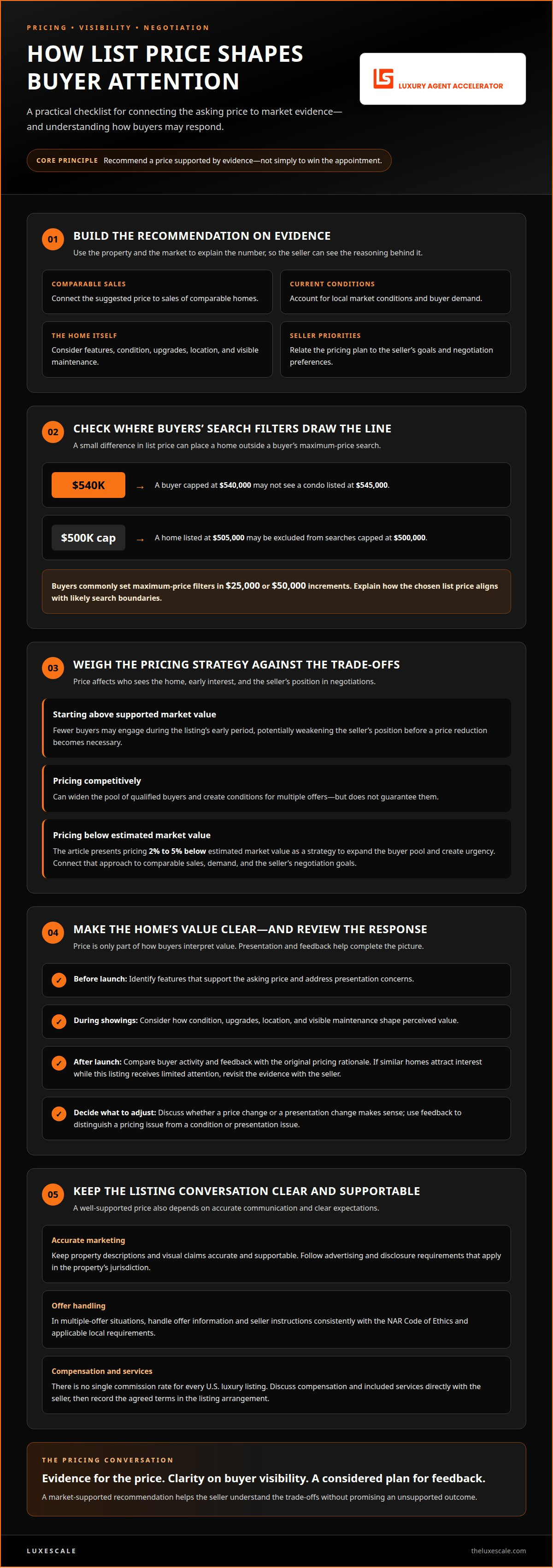
List price influences which buyers see a home, how quickly they respond, and the seller’s negotiating position. A new listing often draws its greatest attention early on. If the price starts above the home’s supported market value, fewer buyers may engage during that period, weakening the seller’s position before a reduction becomes necessary.
Search filters make small pricing differences consequential. A buyer who caps searches at $540,000 may not see a condo listed at $545,000. Buyers commonly set maximum-price filters in $25,000 or $50,000 increments, so agents should explain how the chosen figure aligns with likely search boundaries.
Competitive pricing can widen the pool of qualified buyers and create conditions for multiple offers, but it is not a formula for guaranteeing them. A home listed at $505,000 may be excluded from searches capped at $500,000. Conversely, pricing below estimated market value can increase visibility, but agents should connect that strategy to comparable sales, demand, and the seller’s negotiation goals.
Presentation affects how buyers interpret the price. A home’s condition, upgrades, location, and visible maintenance all shape perceived value during showings. Agents can identify the features supporting the asking price, address presentation concerns before launch, and use showing feedback to distinguish a pricing issue from a condition or presentation issue.
When marketing luxury real estate, keep property descriptions and visual claims accurate and supportable, and follow the advertising and disclosure requirements that apply to the property’s jurisdiction. In multiple-offer situations, the NAR Code of Ethics addresses an agent’s duties. Handle offer information and seller instructions consistently with those duties and applicable local requirements.
There is no single commission rate that fits every U.S. luxury listing. Discuss compensation and the services covered directly with the seller, then record the agreed terms in the listing arrangement. A clear explanation keeps the conversation focused on representation, marketing scope, and the seller’s priorities.
Build relationships with affluent homeowners and referral sources through consistent, relevant communication. For example, share a concise market update tailored to a homeowner’s neighborhood, follow through on promised information, and maintain professional relationships with referral partners. Demonstrate real estate knowledge in each interaction rather than making assumptions about a seller’s finances.
After launch, compare buyer activity and feedback with the original pricing rationale. If a listing receives limited attention while comparable homes attract interest, revisit the evidence with the seller and discuss whether a price adjustment or presentation change makes sense. A timely, evidence-led review can help protect negotiating leverage and move the property toward a viable contract.
Because buyers often use price as a first filter, homes priced competitively from the beginning can appear in more searches and attract more qualified interest. Pricing a home 2% to 5% below its estimated market value is presented as a strategy to expand the buyer pool and create urgency.
How a professional can help agents plan seller strategies for higher-priced listings
Marketing support can help real estate agents prepare a credible approach before meeting a prospective luxury seller. A professional can help shape the presentation, identify the homeowner’s priorities, and clarify how the agent will position the property. A seller focused on privacy, for example, may value a different discussion from one focused on timing. Understanding those goals makes the appointment more focused.
Local market conditions shape the strategy. Low inventory can strengthen seller leverage, while rising inventory shifts more negotiating power toward buyers. A professional can help agents interpret local activity and tailor their recommendations to the property and its likely audience. In an area where similar homes sell in under 10 days, a seller may have room to price slightly higher. The recommendation still needs to fit the home’s features and current demand.
A practical answer to how to get higher priced listings is to enter seller conversations ready to connect the homeowner’s goals with a thoughtful market position. Coaching can help agents explain the reasoning behind a recommendation and prepare for questions about pricing, presentation, and likely buyer response. That preparation can focus the discussion without promising an unsupported outcome.
Agents asking how to get higher priced listings can also use marketing support to create a consistent path from an introduction to a listing appointment. A clear presentation can explain how the agent will communicate the property’s features and respond to seller feedback. It should also make room for the seller’s concerns and priorities, so the plan feels specific to the home rather than like a standard pitch.
For agents seeking relevant seller conversations and a more structured preparation process, professional support for seller opportunities can complement their own market knowledge and client work.
What professional marketing strategies can help agents attract luxury home sellers?
Luxury sellers respond to a clear point of view, not a generic promise of exposure. Define a specialty, such as historic estates, waterfront homes, or architect-designed properties, and build your marketing around it. A consistent message across listing presentations, market updates, and professional profiles helps homeowners understand your expertise and the clients you serve.
Use useful market commentary to demonstrate judgment before asking for a listing. A short neighborhood brief, for example, can explain how inventory, buyer demand, and recent sales shape expectations for a distinctive home. Keep the analysis specific to the area and property type. A seller considering a waterfront property needs relevant insight, not broad claims about the luxury market.
Show the quality of your work through property examples and case-based storytelling. A presentation can explain how you positioned a home’s architectural details, prepared its launch, and communicated buyer feedback. Keep the story accurate and focused on your role. Avoid suggesting that one successful sale guarantees the same outcome for another seller.
Build a polished seller presentation with a deliberate sequence. Start with the homeowner’s priorities, then explain the likely buyer audience, proposed positioning, and how you will handle inquiries and showings. Include sample listing copy or a visual concept for a property with distinctive features. This makes your approach tangible before the seller decides on representation.
Professional photography and carefully written descriptions help a listing communicate its appeal. For a home with a dramatic entry, for example, the image sequence can introduce that feature before showing supporting spaces. Describe upgrades and amenities precisely. Represent a renovated kitchen accurately instead of using inflated language buyers may challenge during a showing.
Relationships also create a lasting path to seller conversations. Maintain thoughtful contact with past clients, local business owners, and professional referral sources by sharing relevant updates or inviting them to a property-focused discussion. A specific follow-up, such as sending a market note after a homeowner asks about selling, shows attentiveness without turning every interaction into a pitch.
Track which activities lead to meaningful conversations. Note whether a market briefing, referral introduction, or property-focused social post prompts a homeowner to request advice, then use that response to refine your next campaign. Consistent measurement helps you invest time in marketing that builds qualified seller relationships rather than pursuing broad attention without a clear connection to listing opportunities.
How can professional support help agents price and present high-end homes to win listings?
Pricing support helps agents turn property details into a case sellers can understand. Start with evidence, then connect it to the home’s condition, location, upgrades, and buyer demand. A custom-built residence, for example, may require comparisons that account for its design and features rather than a broad neighborhood average. This helps you explain both the recommended range and the factors that could influence buyer interest.
A comparative market analysis, or CMA, gives the discussion structure. One useful approach is to assess three to five closed sales from the prior 90 days within a half-mile radius, then explain where each property differs. In slower markets, the comparison period may extend to six months. A thorough CMA can include ten to twelve comparable properties, helping agents understand the range of evidence rather than relying on one standout sale.
High-end properties often require more careful comparisons. For a condo, relevant examples may include the same building or a genuinely comparable one, along with HOA dues, amenities, floor, and view. For a home with substantial upgrades, distinguish features buyers may value from improvements that do not necessarily add equal market value. This keeps the recommendation specific to the property.
Professional guidance also clarifies what a valuation does and does not establish. A CMA is an informal market estimate prepared by a real estate professional. An appraisal is a formal valuation conducted by a licensed appraiser. Online estimates may miss upgrades, neighborhood differences, or current market trends, so an agent can explain why property-specific evidence matters when a seller brings an automated figure to the listing meeting.
Presentation makes the pricing rationale visible. Organize the home’s strongest features into a clear narrative, choose images that accurately show the layout and finishes, and distinguish documented upgrades from subjective claims in descriptions. A hillside home’s views, access, and outdoor spaces, for example, can each be presented as distinct attributes, giving buyers a fuller picture than a generic luxury label.
Before the seller meeting, coaching can help you rehearse your recommendation, anticipate objections, and explain alternative pricing positions without overstating likely results. A concise presentation might show comparable sales, the property’s distinguishing features, and how current conditions inform the proposed range. This preparation keeps the conversation focused on evidence and seller priorities while demonstrating a disciplined approach to pricing and presentation.
What to look for in a luxury listing partner
A strong luxury listing partner offers a defined process, not just a polished pitch. In an initial conversation, assess how they identify affluent homeowners, qualify seller interest, and arrange listing appointments. Ask how each step relates to your market and practice. A clear explanation helps you judge whether the relationship supports your business goals.
Look for market judgment grounded in property-specific evidence. A capable partner should help you discuss comparable sales, local inventory, property condition, and buyer demand without presenting an asking price as guaranteed. A waterfront home and a renovated city residence, for example, may require different buyer profiles and positioning. The approach should account for those distinctions.
Evaluate the quality of the seller opportunity, not only its headline value. A useful introduction provides enough context to prepare for a meaningful discussion while respecting the homeowner’s privacy. Clarify the seller’s goals, motivation, timeline, and expectations. That preparation helps you assess fit instead of treating every appointment as equally qualified.
Training and coaching matter when they improve practical conversations. Look for support that helps you present a pricing recommendation, respond to a seller’s preferred number, and explain trade-offs calmly. For instance, coaching can help you frame two pricing positions around comparable evidence and buyer reach. The goal is better judgment, not a script that ignores the home or seller.
A partner’s process should make follow-through more consistent. Look for a repeatable way to prepare for appointments, capture seller feedback, and track next steps. After a meeting, for example, record the seller’s priorities and agreed follow-up, then use those details in the next conversation. A dependable process helps prevent important context from being lost.
Review the working arrangement before committing. Understand how referrals are handled, what responsibilities remain with you, and how compensation is structured. With a performance-based arrangement, clarify when the fee applies and which transaction triggers it. Clear terms help you assess the economics without mistaking a referral for a guaranteed closing.
Finally, look for alignment with your market and capacity. An agent focused on luxury homes needs relevant seller conversations and support suited to those opportunities. If you want a more structured path to qualified listing conversations, explore professional listing support and assess how it fits your growth strategy.
LuxeScale: Luxury Listing Appointments
LuxeScale connects agents with Luxury Listing Appointments and Affluent Seller Leads, creating a practical next step for building more qualified seller conversations. These opportunities let you focus on discussing the homeowner’s goals, property, and pricing strategy.
Accompanying Award-Winning Training, Coaching, Systems, and Support helps agents strengthen how they prepare for appointments and guide seller decisions. LuxeScale also offers Affluent Buyer Leads, supporting agents who want to develop relationships across both sides of the luxury market. Consider this support when your growth plan calls for relevant opportunities and a more structured approach to conversion.
If you’d like to explore whether LuxeScale fits your professional goals, contact LuxeScale.
Turn your next seller conversation into a growth opportunity
Understanding how to get higher priced listings is an ongoing practice: establish a clear market position, strengthen seller conversations, and apply what you learn from each opportunity. Decide what support would help you pursue that approach consistently, whether you’re developing seller relationships or preparing to convert a listing appointment.
LuxeScale offers Luxury Listing Appointments and Affluent Buyer Leads, alongside Accompanying Award-Winning Training, Coaching, Systems, and Support. Consider how those opportunities and resources fit your current business priorities, your local market, and the kind of professional growth you’re pursuing. A focused strategy gives you a stronger foundation for the conversations ahead.
Contact LuxeScale to discuss your strategy and identify a practical next step for your business. Your next high-value listing opportunity can begin with a more deliberate plan.
Frequently Asked Questions
How can a professional help real estate agents win higher-priced property listings?
LuxeScale can help agents pursue higher-priced listings by qualifying affluent homeowners who are ready to sell and scheduling direct listing appointments. Free Training & Coaching helps agents prepare to establish credibility and guide a focused conversation about a seller’s goals and next steps. The referral model is pay-at-closing: agents pay a 25% referral fee only when a deal closes. This can suit agents seeking structured access to luxury seller opportunities.
What professional support can help agents compete for expensive homes?
Look for support that combines relevant seller opportunities with preparation for high-stakes conversations. LuxeScale’s Pay-At-Closing Referral Network uses targeted outreach and screens prospects for motivation, intent, timing, financial readiness, and overall fit. Free Training & Coaching helps agents strengthen their approach with affluent clients. Availability is limited by territory. Check Your Territory, limited areas are still available.

Article by
Mark Coppens
Mark Coppens is the Founder and Chairman of LuxeScale and Co-Team Lead of Living Vogue | eXp Luxury. He is an active elite-level luxury agent and the author of the upcoming book, POWER POSITIONING: From Missiles to Mansions – Why People Really Buy, and is a nationally recognized speaker on luxury real estate, consumer psychology, marketing, and business growth.
A U.S. Army veteran with an MBA in Marketing, Mark has generated more than $1 billion in career sales and now leads one of the nation's fastest-growing luxury referral platforms, referring more than $2 billion in luxury real estate opportunities each month to partner agents across the United States. He specializes in helping real estate agents generate more listings, break into the luxury market, and build scalable businesses through qualified referrals, award-winning training, coaching, and proven systems. His practical, psychology-driven approach has helped agents across the country increase their income while attracting more affluent clients and building lasting, referral-driven businesses.