
How to Handle Objections From Luxury Sellers With Care
A seller’s objection isn’t a cue to push harder. It’s a chance to understand what’s shaping the decision. Knowing how to handle objections from luxury sellers means listening without becoming defensive, acknowledging the concern, and asking thoughtful questions before responding.
Luxury sellers may weigh more than the asking price or marketing plan when choosing whether to list. Hesitation can reflect concerns about timing, trust, privacy, or whether an agent’s approach suits the property and their goals. A polished pitch won’t resolve those concerns unless you first understand what’s behind them.
This guide explains how to acknowledge objections, ask open-ended questions to uncover the underlying issue, and use relevant evidence instead of pressure. It also covers responses to questions about listing prices and comparative market analyses, while keeping the conversation focused on the seller’s priorities. The goal is a clear, credible discussion that helps both sides choose an appropriate next step.
Key Takeaways
- Thank sellers for raising concerns, then give them space to explain before you respond.
- Use open-ended questions to distinguish the stated objection from the concern driving it.
- Match your response to the issue, whether it involves trust, timing, need, or money.
- Support your recommendations with relevant evidence that connects to the seller’s priorities.
- When a seller questions your pricing analysis, stay curious and explain the reasoning behind your recommendation.
Acknowledging objections with gratitude
Begin with the seller’s actual concern, not a defense of your recommendation. A measured response keeps the conversation moving forward and turns an objection into an opportunity to understand what matters most.
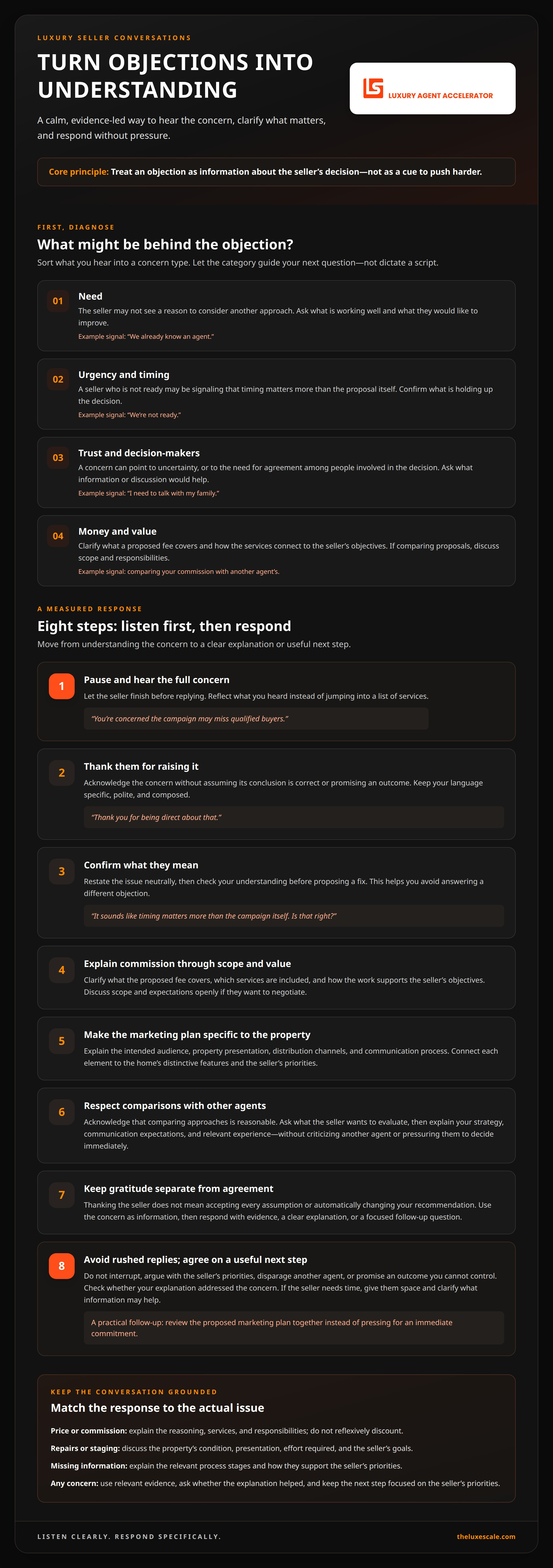
- Pause and listen to the full concern. Let the seller finish before responding. If they say, “I’m not sure this marketing plan reaches the right buyers,” don’t cut in with a list of services. Give them your attention, then reflect what you heard: “You’re concerned the campaign may miss qualified buyers.”
- Thank them for raising it. A simple “Thank you for being direct about that” recognizes the concern without accepting a conclusion you haven’t examined. Keep your tone composed and your language specific, communicating politely and without prejudice, preconceived notions, threats, or promises.
- Confirm the meaning before proposing a fix. Restate the concern in neutral terms, then ask if you understood correctly. For example: “It sounds like timing matters more than the campaign itself. Is that right?” This quick check helps you avoid answering a different objection from the one the seller raised.
- Explain commission through scope and value. Clarify what your proposed fee covers, how the work supports the seller’s objectives, and which services are included. If the seller wants to negotiate, discuss scope and expectations openly instead of dismissing the concern or promising an outcome you can’t support.
- Present marketing as a tailored plan. Explain the intended audience, property presentation, distribution channels, and communication process. Link each element to the home’s distinctive features and the seller’s priorities. For example, describe how the presentation will foreground architectural details the seller considers essential.
- Respect a seller interviewing multiple agents. Acknowledge that comparing approaches is reasonable, then ask what they want to evaluate. Explain your strategy, communication expectations, and relevant experience directly, without criticizing another agent or pressuring the seller to decide immediately.
- Keep gratitude distinct from agreement. Thanking a seller doesn’t mean accepting every assumption or automatically changing your recommendation. It means treating their concern as useful information, then responding with evidence, a clear explanation, or a focused follow-up question.
- Avoid defensive or rushed replies. Common mistakes include interrupting, arguing with the seller’s priorities, disparaging another agent, or promising an outcome you can’t control. Acknowledge the specific concern first, clarify what would address it, and agree on a sensible next step before moving toward a decision.
Objection handling and its role in sales
In real estate sales, objections can arise during an initial call or contract negotiations. Treat them as information about the seller’s decision process, then respond to the specific issue rather than pushing for agreement. A useful approach to how to handle objections from luxury sellers starts by identifying what decision the concern is holding up.
- Identify the type of concern. Sort what you hear into need, urgency, trust, or money. “We’re not ready” may signal a timing concern, while “I need to talk with my family” may point to the need for agreement among decision-makers. The category should guide your next question, not dictate a script.
- Listen for the decision behind the words. A seller who says, “We already know an agent,” may be happy with that relationship or may not see a reason to consider another approach. Ask what’s working well and what they’d like to improve. Their answer will show whether there’s a relevant issue to address.
- Check whether information is missing. Some objections indicate that the seller doesn’t yet understand a recommendation or its implications. If they question your listing process, explain the relevant stages and how each supports their priorities. Instead of repeating your pitch, provide the detail that can move the conversation forward.
- Handle concerns about repairs and staging through trade-offs. Ask which improvements worry the seller, then discuss how the property’s condition, presentation, required effort, and the seller’s goals affect the decision. For example, distinguish a repair that could affect buyer confidence from a staging choice intended to show how a room can be used.
- Respond to price concerns without reflexively discounting. If a seller compares your commission with another agent’s, clarify the services and responsibilities in each proposal. Then connect your recommended scope to the seller’s objectives. A fee objection calls for a clear explanation, not an automatic concession that changes the service being discussed.
- Address competing options professionally. A seller may prefer an existing agent, cite another proposal, or question the timing. Ask what matters most in the comparison, then explain your approach against those criteria. Keeping the discussion centered on the seller’s priorities is a practical part of how to handle objections from luxury sellers.
- Agree on a useful next step. After responding, ask whether your explanation addressed the concern. If the seller needs time, give them space and clarify what information could help them decide. A practical follow-up might be reviewing the proposed marketing plan together instead of pressing for an immediate commitment.
Handled well, objections help agents assess fit and keep selling conversations grounded in the seller’s priorities. For a broader approach to building luxury market growth, connect each conversation to a clear, relevant next step.
Open-ended questions to uncover underlying concerns
Ask questions that let sellers explain their priorities in their own words. Their answers often reveal what information or decision could move the conversation forward.
Explore Pricing and Market-Timing Concerns
Ask what the seller wants the listing price to achieve and what information supports their expectation. If they want to wait for a better market, explore what conditions they’re waiting for and how they’d recognize a change. Compare their goals with the comparative market analysis, then explain the factors behind your recommendation without presenting a future market shift as certain.
Address Privacy, Security, and Showings
Ask which part of the showing process concerns the seller: access, visitor information, scheduling, or public exposure of the home. Then discuss practical arrangements that address those priorities, such as coordinating showing times and agreeing on how access will be managed. Don’t dismiss privacy concerns or promise absolute security. Focus on specific measures and the seller’s preferences.
- Invite the full explanation. Try, “What matters most as you decide whether to list now?” or “What would need to change for selling to feel like the right move?” These open-ended prompts uncover priorities without steering the seller toward a predetermined answer. Listen for the difference between the stated reason and the concern beneath it.
- Clarify what waiting means. If a seller hopes for a better market, ask what signal would change their decision and what they’d do if it didn’t appear. Explore their desired timing, plans for the property, and concerns about acting now. This turns “later” into clearer decision criteria.
- Negotiate through priorities, not pressure. Ask which terms matter most, then identify how your proposed approach could address them. A seller might prioritize privacy over broad exposure, or flexibility over a specific launch date. Summarize the trade-offs, invite their response, and don’t treat silence as agreement.
- Use evidence that fits the concern. Once you understand the issue, share relevant market information, tailored case studies, or a clear explanation of your approach. Ask whether the information addresses the concern before adding more detail. A targeted response keeps the discussion focused and helps the seller assess the recommendation against their goals.
Treat an objection as an opening to continue the conversation, not a reason to end it. Use open-ended questions to understand what the seller means and uncover the underlying concern. Keep your questions neutral and avoid assuming what the seller is thinking. A price objection, for example, may mean something different from the words used, so ask what’s behind it before offering information or a recommendation.
You might ask what would need to change for the seller’s priority to rise within the next 6-12 months. The answer can clarify whether the hesitation is about timing, price, or another consideration, without assuming which issue matters most. Then reflect the concern in your own words and invite correction. This gives the seller room to explain, and helps keep the discussion grounded in what they actually need to decide.
Reinforcing the prospect’s perceived value
If a seller wants an unusually high asking price, acknowledge the goal and explain how your recommendation relates to the property’s features, comparable sales, and available market evidence. Ask which outcome matters most, then discuss the trade-offs between the seller’s target and your recommended strategy.
- Define value from the seller’s perspective. Ask what a successful sale would make possible. Someone planning a move may prioritize timing, while another seller may care most about preserving a property’s distinctive character. Understanding that priority helps you frame your recommendation around what the seller actually values, rather than relying on a generic pitch.
- Connect each recommendation to a stated priority. If the seller values discretion, explain how the proposed communication and showing approach addresses that concern. If they prioritize broad buyer exposure, describe the marketing elements intended to support it. Make the connection explicit: “You said privacy matters, so let’s focus on how access will be coordinated.”
- Use evidence that fits the property and concern. Select relevant market research, customer references, social proof, or case studies that speak to the seller’s question. For a distinctive estate, explain how the example relates to its setting, features, or likely buyer audience. Don’t treat an unrelated success story as proof of a specific outcome.
- Explain the reasoning behind a high asking price. Ask what the seller is using as a reference, then compare that view with the property’s relevant features and available market evidence. For example, distinguish a home’s design features from assumptions about what buyers will pay. Explain where your recommendation aligns with the evidence and where it points to a different position.
- Make the value concrete before discussing next steps. Summarize the work involved in the proposed plan, such as property presentation, buyer outreach, and communication. Tie each element to a priority the seller has raised. This gives them a clear basis for assessing the recommendation instead of relying on broad claims about premium service.
- Check whether the explanation addresses the concern. Ask, “Which part of this approach feels most relevant to your goals?” or “What still feels unresolved?” Listen for a specific gap, then respond to it. Don’t assume silence means agreement. Give the seller time to consider the information before deciding how to proceed.
A value-led conversation makes the rationale clear from the start. The seller can weigh your recommendation against their objectives, while you keep the discussion grounded in evidence, priorities, and a clearly explained plan.
Match the evidence closely to the seller’s concern and your proposed solution. Relevant market research, customer references, and case studies tailored to the seller’s needs can support an explanation of how your approach addresses the issue. Ask which evidence feels relevant, and clarify its limits so the recommendation stays grounded rather than overstated.
How should agents respond when luxury sellers question the listing price or comparative market analysis?
Use the seller’s challenge to clarify the evidence, assumptions, and goals behind your recommendation. Reviewing the comparative market analysis together can keep the conversation focused on the property and its market context.
- Ask what part of the analysis feels inaccurate. Invite the seller to identify a comparable sale, property feature, or assumption they question. For example, they may believe a renovated kitchen supports a higher price. Pinpointing the disagreement lets you address their reasoning instead of repeating the entire analysis.
- Confirm the seller’s target and its purpose. Ask what the desired asking price is meant to accomplish. A seller may be testing the market, planning a purchase, or assigning particular value to a distinctive feature. Understanding the objective helps you discuss strategy without treating the price as an argument to win.
- Review comparable properties using consistent criteria. Explain why each property was selected and how its location, condition, design, and sale context relate to the home. If the seller points to a more impressive estate, discuss the differences that affect the comparison. Don’t present a property as a direct match when important features differ.
- Separate verifiable facts from expectations. Identify what the analysis shows, such as recorded sale details, and distinguish it from a forecast of what a future buyer might offer. If the seller expects a buyer to pay more for a particular feature, ask what supports that expectation. Keep your recommendation transparent rather than implying certainty.
- Explain the trade-offs of the proposed asking strategy. Describe how the chosen position may affect the type of buyer response the seller seeks, then connect that discussion to their timing and priorities. If the seller prefers a higher starting point, agree on what signals would prompt a review. Set expectations without promising a sale price or timeline.
- Invite the seller to test the recommendation. Summarize the strongest evidence on both sides, then ask what would make the pricing decision feel well supported. If you disagree about a comparable, revisit its relevance and explain whether it changes the overall analysis. This makes the discussion a structured decision rather than a contest.
- Document the agreed rationale and next step. Recap the chosen pricing approach, the evidence considered, and any planned review point. For example, note that the seller wants to revisit the strategy after discussing a particular comparable. A clear recap keeps later conversations anchored in the same reasoning.
For agents building a stronger luxury listing pipeline, explore luxury listing opportunities and apply a disciplined pricing conversation from the first appointment.
LuxeScale: Luxury Listing Appointments
LuxeScale’s Pay-At-Closing Referral Network connects real estate agents with qualified luxury listing appointments. LuxeScale qualifies affluent homeowners ready to sell and schedules direct listing appointments, giving agents a practical opportunity to apply a thoughtful approach to seller conversations.
Agents also receive accompanying award-winning training, coaching, systems, and support. These resources can help you refine how you respond to seller concerns, explain your recommendations, and guide conversations with greater structure. Affluent Buyer Leads are also available for agents developing relationships across the luxury market.
To discuss how LuxeScale can support your luxury real estate growth, contact LuxeScale.
Turn each seller conversation into a stronger next step
Learning how to handle objections from luxury sellers is a practical discipline, not a script to recite. After each appointment, note which concern shaped the conversation, what information helped, and where the seller still needed clarity. Use those observations to sharpen your questions and make future recommendations more relevant.
That reflection can also help you decide where to focus your business development. If you want to strengthen your approach to luxury sales while building meaningful opportunities, connect your next steps to the support and qualified referrals available through LuxeScale. Choose a clear priority, such as refining seller conversations or developing your pipeline, then take a focused next step.
Contact LuxeScale to discuss your sales and consider how the right support can fit your goals. Take the next step with confidence, and keep building a more deliberate luxury practice.
Frequently Asked Questions
What is objection handling?
Objection handling means understanding and responding to a prospect’s reason for hesitating. It isn’t about overcoming every concern or forcing a decision. If a seller questions an agent’s experience with a distinctive property, for example, the agent can clarify what expertise the seller expects and respond with relevant examples. The aim is to support an informed choice while establishing whether the working relationship is a good fit.
What are the main types of objections?
The main types of objection concern need, urgency, trust, and money. A need objection questions whether an agent’s approach addresses the seller’s problem; urgency concerns timing; trust concerns confidence in the agent; and money concerns the fee or perceived value. One comment can involve several categories. A seller hesitant about commission, for instance, may also be unsure whether the proposed marketing plan justifies the expense.
What objections do luxury home sellers commonly raise when choosing a real estate agent?
Luxury sellers may question an agent’s pricing rationale, marketing plan, experience with comparable properties, communication approach, or handling of privacy and showings. They may also compare commission proposals, interview multiple agents, or prefer to list later. These concerns reflect different priorities, so don’t treat them as one generic objection. A seller focused on discretion, for example, may need details about coordinating showings more than a broader marketing pitch.

Article by
Mark Coppens
Mark Coppens is the Founder and Chairman of LuxeScale and Co-Team Lead of Living Vogue | eXp Luxury. He is an active elite-level luxury agent and the author of the upcoming book, POWER POSITIONING: From Missiles to Mansions – Why People Really Buy, and is a nationally recognized speaker on luxury real estate, consumer psychology, marketing, and business growth.
A U.S. Army veteran with an MBA in Marketing, Mark has generated more than $1 billion in career sales and now leads one of the nation's fastest-growing luxury referral platforms, referring more than $2 billion in luxury real estate opportunities each month to partner agents across the United States. He specializes in helping real estate agents generate more listings, break into the luxury market, and build scalable businesses through qualified referrals, award-winning training, coaching, and proven systems. His practical, psychology-driven approach has helped agents across the country increase their income while attracting more affluent clients and building lasting, referral-driven businesses.