
How to Transition from Residential to Luxury Real Estate Marketing
Luxury real estate isn’t residential marketing with a higher price tag. A successful transition from residential to luxury real estate calls for sharper market positioning, a clear understanding of affluent buyers, and discreet, coordinated service. The shift is strategic, not cosmetic.
You already know how to build relationships and guide clients through major decisions. What changes is the level of personalization: affluent clients expect you to understand a property’s distinctive value, communicate precisely, and anticipate needs without adding friction. Treat the transition from residential to luxury real estate as a focused business shift, not simply broader advertising or more polished listing photos.
This guide explains how to build that approach step by step. You’ll learn to define luxury in your market, strengthen the skills and service standards high-end clients expect, position listings around their distinctive appeal, and create a repeatable plan for generating qualified opportunities. With a deliberate strategy, the transition from residential to luxury real estate can follow a clear path grounded in expertise, trust, and consistent execution.
Key Takeaways
- Define luxury by your local market and a property’s distinctive value, not by price alone.
- Map the licensing requirements in your state, then choose additional education that strengthens your market knowledge and credibility.
- Plan your transition costs around the business activities you need to build, from positioning and marketing to relationship development.
- Develop the ability to interpret high-end market data, explain pricing, and deliver discreet, well-coordinated service.
- Account for a smaller buyer pool and a property’s unique appeal when shaping pricing and marketing strategies.
What qualifies a property as luxury real estate in the U.S?
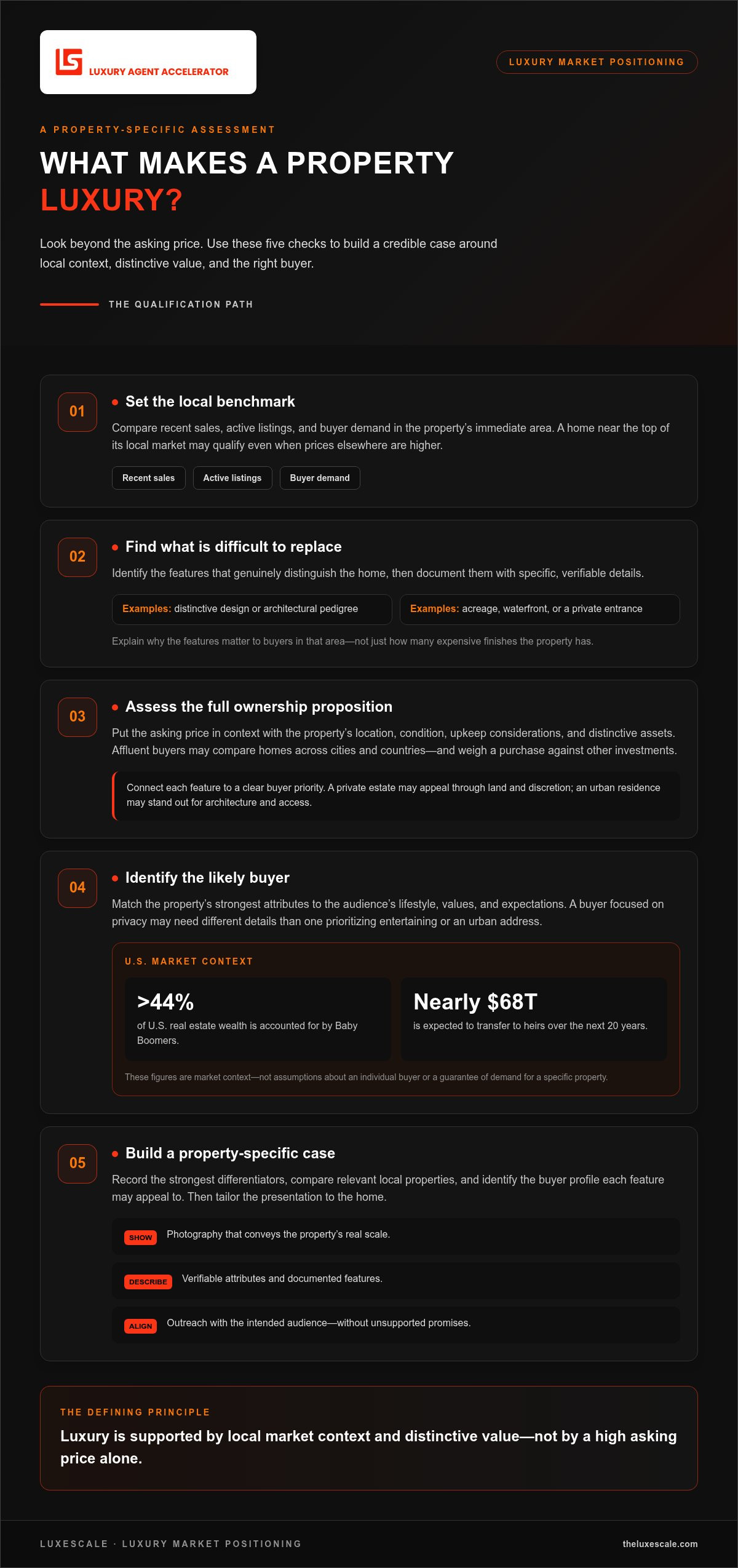
- Define luxury relative to your local market, not a single national price cutoff. Compare a property with recent sales, active listings, and buyer demand in its immediate area. A home near the top of its local market may qualify even if prices elsewhere are higher. Consider scarcity, location, architecture, land, and privacy together. This local benchmark gives you a defensible starting point for identifying luxury inventory and setting client expectations. It also helps you explain why a property belongs in the segment based on market context, not asking price alone.
- Assess what makes the property difficult to replace. Distinctive design, significant acreage, a waterfront setting, a private entrance, or recognized architectural pedigree can set a home apart. Document these features with specific details, such as the architect’s name, the views, or the connection between indoor and outdoor spaces. Don’t rely on a long list of expensive finishes. Explain why the features matter to buyers in that area and how they shape the property’s appeal. This turns an inventory of details into a clear account of the home’s distinguishing value.
- Evaluate the full ownership proposition, not just the asking price. Affluent buyers may compare homes across cities and countries, then weigh a purchase against equities, businesses, or other investments. Present the property’s location, condition, upkeep considerations, and distinctive assets in that broader decision context. A private estate, for example, may appeal through its land and discretion, while an urban residence may stand out for its architecture and access. Connect each feature to a clear buyer priority, without assuming every affluent client values the same things.
- Identify the likely buyer and tailor the marketing accordingly. Luxury positioning depends on aligning every touchpoint with an audience’s lifestyle, values, and expectations. A buyer seeking privacy needs different property details than one prioritizing entertaining or an urban address. Baby Boomers account for more than 44% of real estate wealth in the United States, while nearly $68 trillion is expected to transfer to heirs over the next 20 years. Treat these figures as market context, not assumptions about an individual buyer or a guarantee of demand for a particular property.
- Build a property-specific case before calling a listing luxury. Record its strongest differentiators, compare relevant local properties, and identify the buyer profile each feature may appeal to. Then tailor the presentation to the home: photography should convey its real scale, copy should describe verifiable attributes, and outreach should suit the intended audience. For example, position a gated residence around documented privacy features, not unsupported promises. This disciplined assessment helps distinguish genuine luxury from a high asking price and gives your marketing strategy a credible foundation.
What licenses and certifications are needed to specialize in luxury real estate?
- Separate practice authority from luxury expertise. Luxury specialization is a market focus, not a credential that replaces your real estate license. Start with the license and professional status relevant to your work in your state. Review your state real estate regulator’s guidance alongside your brokerage’s compliance procedures. This clarifies which activities you can perform, how you can represent clients, and what supervision applies to your role.
- Map the rules to your intended role. Write down the work you plan to do, such as representing sellers, advising buyers, or marketing properties. Compare those activities with your state’s licensing guidance and your brokerage’s policies. Ask your managing broker to clarify any differences between your current role and the responsibilities you’re targeting. Keep the guidance with your professional records so your transition plan reflects your actual scope of practice.
- Evaluate credentials by curriculum, not prestige alone. A course or designation can support your development, but its value depends on what it teaches and how you apply it. Look for relevant instruction in luxury market analysis, property valuation, negotiation, client confidentiality, and high-touch transaction coordination. Compare the curriculum, assessment method, and continuing education expectations. Choose training that addresses a specific skill gap rather than collecting initials that don’t strengthen your client work.
- Build proof of competence through practical learning. Pair formal education with supervised experience and focused market study. For example, prepare a pricing analysis for a distinctive property, then explain how its features compare with local alternatives. Practice discussing absorption rates and buyer requirements at higher price points. Review each exercise with an experienced broker or mentor. This develops practical judgment and gives you clear examples of your process when prospective clients ask about your readiness for the luxury market.
- Make credentials part of a broader credibility plan. Update your professional profile with relevant education, but support each claim with specific work. Describe the market knowledge you’ve developed, the property types you understand, and how you handle discretion and coordination. Keep records of completed courses and renewals, and revisit your learning plan as your target market changes. A credential can signal preparation; consistent analysis, careful communication, and sound brokerage practices show how you serve clients.
How much does it cost to transition into luxury real estate sales?
- Build a cost plan around your current business. There’s no single transition budget that fits every agent. Start by listing the resources you already have, including a professional website, photography contacts, market data access, and client relationships. Then identify the gaps between your current residential practice and your target luxury segment. An agent with polished listing materials may prioritize market education, while someone entering a new area may need local research and relationship-building. Your budget depends on those specific needs.
- Separate essential investment from optional upgrades. Create categories for education, marketing, networking, technology, and transaction support. For each, note the activity, its purpose, and how you’ll assess its value. A property-specific presentation, for example, could require professional photography, floor plans, and copywriting. A market-entry plan might instead prioritize attending local events and studying luxury inventory. This comparison helps direct resources toward capabilities your target clients will notice.
- Price each marketing decision by its scope. A listing campaign can involve photography, video, staging, print materials, digital placement, and private outreach. The property’s features and intended audience determine which elements make sense. A waterfront estate may need detailed imagery of its setting, while a design-led city home may benefit from architectural photography. Request itemized estimates for work you plan to outsource, and compare deliverables rather than choosing solely by the lowest quote.
- Account for time and opportunity cost. Luxury expertise requires sustained attention to local inventory, buyer preferences, pricing context, and professional relationships. Track the hours you spend studying a market, preparing a presentation, or attending an event. If you reduce time spent on existing business, include that trade-off in your plan. For example, reserve time for luxury research without disrupting active client commitments. This makes the transition’s operational cost visible, even when it doesn’t involve an invoice.
- Review spending against clear milestones. Set practical checkpoints, such as completing a market analysis, publishing a refined property presentation, or establishing relationships with relevant professionals in your area. At each review, compare planned and actual spending, then assess whether the activity created useful knowledge, qualified conversations, or stronger marketing assets. Avoid increasing promotion simply because luxury listings appear more expensive. A disciplined plan connects every investment to a specific capability or business-development objective.
This context can inform your client conversations and broader service planning. Luxury agents should understand how their local market fits into a global context and be able to discuss relative value. Assets transferred to an irrevocable trust do not receive a step-up in income tax basis, which affects capital-gains taxation on future property sales and depreciation deductions.
A floor plan can help buyers plan furniture and appliance placement in a luxury home. For clients moving into a new home, an inventory can help them identify items to buy, set up, or adjust. Planning daily consumables, food, and cleaning supplies can make the adjustment period easier. Furniture assembly and children’s school enrollment can also be arranged in advance.
What experience and skills do luxury real estate agents need
- Build on transaction experience, then deepen local expertise. Strong residential skills remain useful: listening carefully, negotiating, tracking details, and guiding clients through decisions. Add focused knowledge of the luxury inventory in your target area. Study distinctive property types, local demand, and how buyer expectations vary. A rural estate and a city penthouse, for example, call for different questions about access, maintenance, privacy, and daily use. Record those distinctions in a market notebook and update it as listings change.
- Interpret market data in context. Don’t present a statistic without explaining what it means for a particular property. Compare current conditions with previous market cycles, and consider how interest rates may affect affluent buyers’ decisions. Track absorption rates at higher price points, then connect inventory movement to pricing psychology. If a property attracts limited interest, explain whether its positioning, condition, or buyer pool may be influencing activity. Clear interpretation helps clients understand the evidence behind your advice.
- Explain value beyond a comparable-sales spreadsheet. Prepare pricing recommendations using similar properties and current buyer requirements, then identify where the comparison falls short. A home’s architecture, setting, privacy, or unusual amenities can affect its appeal in ways standard comparisons miss. Develop a concise explanation of each adjustment you make. Also place the local market in a broader global context, showing how a property’s location and features compare with alternatives buyers may consider elsewhere.
- Deliver discreet, consultative service. Luxury clients often value privacy, timely communication, and thoughtful coordination. Agree on communication preferences early, share sensitive information carefully, and prepare for meetings with relevant property details. Anticipate practical needs, such as arranging a viewing around the client’s schedule or coordinating access with household staff. A calm presence matters during negotiations. Explain things directly, outline next steps, and avoid creating unnecessary urgency or exposing private details.
- Coordinate confidently with the client’s advisory circle. A significant property decision may involve a private banker, wealth advisor, or family office. Understand your role, communicate relevant real estate information clearly, and respect each advisor’s expertise. For instance, provide property details and market context to help the client’s team evaluate the purchase, without presenting yourself as their financial or legal advisor. Strong coordination also means tracking decisions, documenting agreed next steps, and keeping communication discreet.
- Turn each transaction into a repeatable learning process. After a showing, negotiation, or closing, review what the buyer prioritized and which information helped them decide. Compare your original analysis with the outcome, then refine your market notes and client process. A useful development plan might pair regular study of higher-price inventory with practice presenting pricing recommendations. This combination builds judgment and communication skills, helping you serve sophisticated clients with greater precision over time.
How do luxury real estate commissions and pricing compare with standard residential sales
- Separate the property’s asking price from the agent’s compensation. A higher sale price doesn’t automatically determine the compensation structure. For each transaction, review the proposed terms, the services involved, and how responsibilities are allocated. Compare those details with your standard residential practice rather than assuming luxury sales follow a fixed formula. This keeps the conversation precise and connects compensation to the work required for that property.
- Define the service scope before discussing compensation. A luxury listing may call for bespoke marketing, private showings, tailored property materials, and coordination with other professionals. Identify which tasks you’ll handle and which require outside resources. For example, a remote estate may involve more detailed viewing logistics than a centrally located home. A written scope helps you assess the work and explain your proposed terms clearly.
- Price the home for its specific buyer pool. Standard residential pricing often relies heavily on comparable sales, but luxury properties can be harder to match directly. Account for the home’s uniqueness, the smaller buyer pool, and its emotional value. Compare similar properties, then explain where meaningful differences affect your recommendation. An architecturally distinctive home, for instance, may attract buyers for qualities that nearby sales don’t fully capture.
- Connect pricing recommendations to current buyer requirements. Present relevant comparable properties alongside the features buyers are actively seeking. Explain how condition, location, privacy, design, or other distinctive attributes influence the property’s position. If the closest comparable lacks a key feature, state that limitation and explain its effect on your analysis. This helps sellers understand the reasoning behind a recommended price instead of relying on an unexplained figure.
- Prepare for a longer, more selective marketing process. A narrower buyer pool can change how you plan exposure, showings, and follow-up. Build a strategy around the property’s likely audience and the seller’s priorities. Discuss how you’ll evaluate interest and respond if feedback suggests the positioning needs adjustment. Keep the pricing strategy tied to market evidence, not simply the seller’s emotional attachment or the home’s original purchase price.
- Make every recommendation easy to evaluate. Summarize your pricing rationale, marketing scope, and compensation terms in clear language. Show how each element supports the property’s positioning and the client’s objectives. For agents developing their luxury pipeline, strengthen your luxury-market business development with a focused next step. A disciplined presentation helps keep high-stakes conversations grounded in value, responsibilities, and a deliberate plan.
Keep the final recommendation grounded in this broader view: comparable sales are useful context, but they don’t capture every quality that shapes a luxury property’s appeal. Explain how its distinctive attributes, smaller pool of potential buyers, and emotional value inform the position you recommend. This makes the asking price easier to assess alongside the marketing scope and compensation terms, without treating a single comparison as a complete answer.
LuxeScale: Luxury Listing Appointments
LuxeScale helps agents build a luxury pipeline through Luxury Listing Appointments and Affluent Seller Leads. If you’ve developed your market knowledge but need qualified opportunities to apply it, these introductions can support your next business-development step. Agents looking to reach affluent buyers can also access Affluent Buyer Leads.
The transition requires more than premium marketing. LuxeScale pairs opportunities with accompanying award-winning training, coaching, systems, and support to help you strengthen your approach as you work with luxury prospects. Consider this option when you’re ready to pursue affluent clients while continuing to develop the service and market expertise discussed above.
Contact LuxeScale to discuss the next step in your luxury real estate growth.
Make Your Next Move With a Focused Plan
Turn your ambition into deliberate action. Choose the market you want to serve, identify the expertise you still need to build, and set a practical goal for your first luxury opportunity. The transition from residential to luxury real estate is a professional shift you can approach with discipline, clear positioning, and consistent relationship-building.
When you’re ready to develop that pipeline, LuxeScale offers Luxury Listing Appointments, Affluent Buyer Leads, and accompanying award-winning training, coaching, systems, and support. These resources can connect your market-development efforts with opportunities to work with affluent clients.
Contact LuxeScale to discuss your transition and decide on a practical next step for your business. Your luxury practice can grow one well-chosen opportunity at a time.
Frequently Asked Questions
How does selling residential real estate differ from selling luxury homes?
Luxury sales call for more individualized planning around the property, seller priorities, and the buyer’s decision process. An owner, for example, may want showings coordinated around household routines, while a buyer may need time to compare a property with other investments. Set expectations early, agree on communication preferences, and prepare a tailored presentation. In a standard residential sale, a familiar marketing and showing process may meet the client’s needs.
How can agents find and attract luxury home buyers and sellers?
Build visibility through relationships and useful expertise, not broad claims of luxury specialization. Share thoughtful analysis of distinctive homes, explain market shifts in plain language, and maintain referral relationships with professionals who serve affluent households. A well-prepared discussion of a property’s design, ownership considerations, and likely buyer profile, for example, can demonstrate your judgment. Follow up consistently, protect prospects’ privacy, and make every conversation relevant to their real estate goals.

Article by
Mark Coppens
Mark Coppens is the Founder and Chairman of LuxeScale and Co-Team Lead of Living Vogue | eXp Luxury. He is an active elite-level luxury agent and the author of the upcoming book, POWER POSITIONING: From Missiles to Mansions – Why People Really Buy, and is a nationally recognized speaker on luxury real estate, consumer psychology, marketing, and business growth.
A U.S. Army veteran with an MBA in Marketing, Mark has generated more than $1 billion in career sales and now leads one of the nation's fastest-growing luxury referral platforms, referring more than $2 billion in luxury real estate opportunities each month to partner agents across the United States. He specializes in helping real estate agents generate more listings, break into the luxury market, and build scalable businesses through qualified referrals, award-winning training, coaching, and proven systems. His practical, psychology-driven approach has helped agents across the country increase their income while attracting more affluent clients and building lasting, referral-driven businesses.