
Luxury Home Valuation Appointment Setting: Documents and Booking
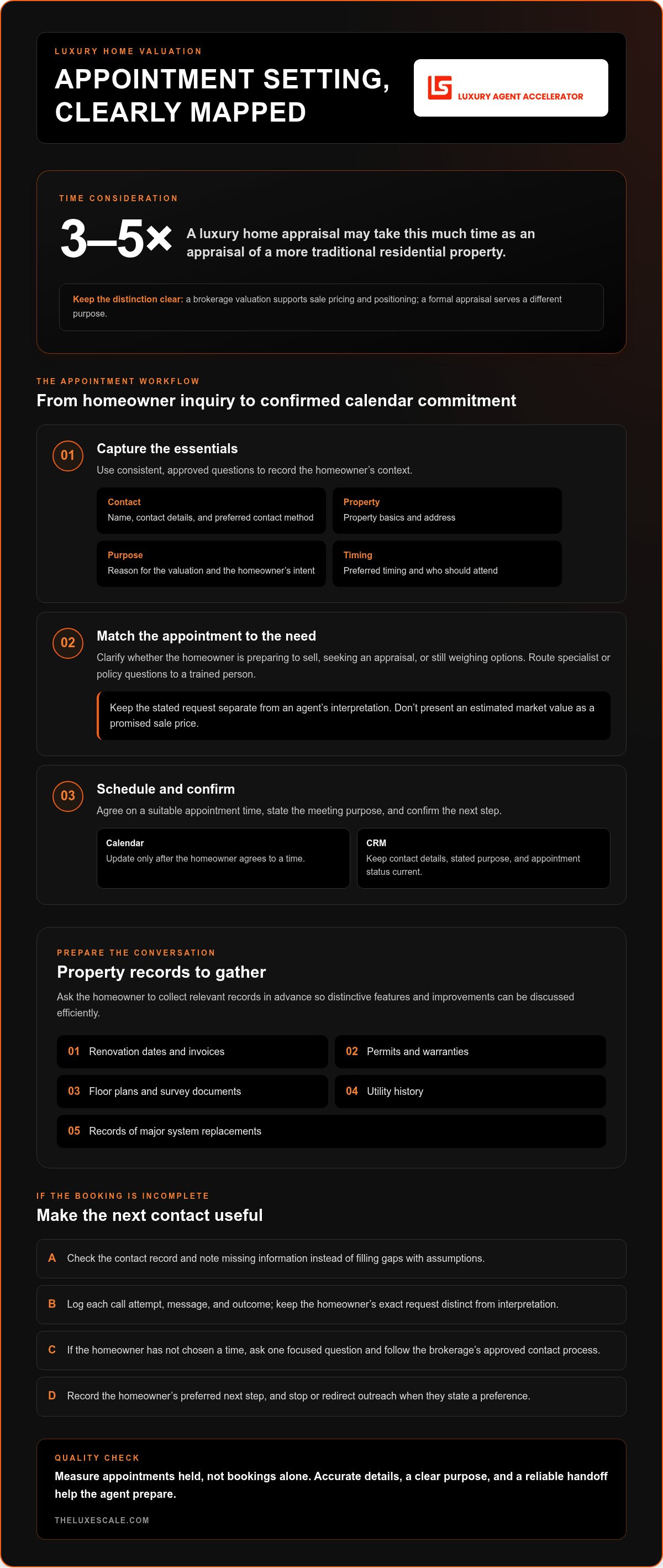
A luxury home valuation appointment setting process should capture the homeowner’s contact details, property basics, reason for the valuation, and preferred timing, then schedule and confirm a suitable appointment. Ask the owner to gather renovation dates, invoices, permits, warranties, floor plans, survey documents, utility history, and records of major system replacements. A brokerage valuation supports sale pricing and positioning, while a formal appraisal serves a different purpose.
That distinction matters because the appointment should fit the homeowner’s needs. A consistent intake process clarifies whether they’re preparing to sell, seeking an appraisal, or still weighing their options. It also gives the real estate professional useful context before the conversation, without presenting an estimated market value as a promised sale price.
This guide explains which property records can support a valuation, what appointment-setting services typically handle, and how to follow up after a missed call or incomplete booking. Clear questions, accurate calendar records, and a reliable handoff help protect the quality of each opportunity, not just the number of appointments on the schedule.
Key Takeaways
- Separate a brokerage valuation for sale planning from a formal appraisal, then align the appointment with the homeowner’s purpose.
- Use consistent intake questions to capture the property context, the seller’s intent, and the right next step.
- Keep follow-up activity aligned with the calendar and CRM, and assess performance by appointments held rather than bookings alone.
- Allow for a more involved visit: a luxury home appraisal may take 3 to 5 times as much time as an appraisal of a more traditional residential property.
- Review renovation and property records in advance so distinctive features and improvements can be discussed efficiently.
Appointment-setting service responsibilities
A disciplined appointment-setting process turns a homeowner inquiry into a clear, appropriately routed calendar commitment. For luxury home valuation appointment setting, the essential steps are asking approved questions, recording accurate details, and confirming what happens next.
Setting Homeowner Appointments
Setting a homeowner appointment means arranging a conversation between a prospective seller and the real estate professional who can address their request. A confirmed time, clear purpose, and accurate property details help the agent prepare a relevant discussion. For example, a homeowner considering a listing needs a different conversation from someone seeking an appraisal for lending.
Qualifying Valuation Leads
Agents qualify valuation leads by clarifying the homeowner’s intent, property context, timing, and preferred contact method. Ask whether the owner is exploring a future sale, preparing to list, or seeking information for another purpose. The answers help match the inquiry to the right professional and appointment. Use consistent, approved questions and routing rules rather than assumptions about the homeowner’s circumstances.
How can agents qualify leads for luxury home valuation appointments? Ask about the property, the reason for the valuation, the owner’s timing, and who should attend. Record the answers accurately, then route specialist or policy questions to a trained person.
Generating Valuation Appointments
Effective appointment generation connects a relevant homeowner inquiry with a clear invitation to discuss the property. Agents can build a pipeline through seller referrals, real estate relationships, and outreach based on a homeowner’s expressed interest. Each approach works best when the conversation establishes a practical next step, such as reviewing sale positioning or discussing a potential listing.
What are effective ways to generate luxury home valuation appointments? Start with relevant seller inquiries, referrals, and targeted conversations, then offer a clear meeting purpose and a straightforward way to choose a time. Track whether appointments are held, not just added to the calendar.
A well-run appointment-setting service ensures a reliable handoff. Keep the customer relationship management system and calendar up to date so the assigned agent can see the appointment status, contact details, and stated purpose. If the homeowner changes the time, update both records. This reduces conflicting information and helps the agent prepare.
Before expanding appointment coverage, test common failure cases, including incomplete contact details, unclear valuation requests, and unavailable calendar slots. Decide how each case should be routed, recorded, or followed up. Measure held appointments alongside bookings, because a crowded calendar alone doesn’t show whether sellers connected with an agent.
Fair treatment is part of responsible inquiry handling. The U.S. Department of Housing and Urban Development states that federal Fair Housing Act protections apply when people rent or buy housing. Don’t infer protected characteristics from a caller’s name, voice, or neighborhood. Route questions about accommodations, steering, complaints, or policy to trained staff rather than improvising an answer.
Handling missed calls and incomplete bookings
A missed call or incomplete booking needs a defined follow-up process, not an improvised response. Homeowners may have limited time to discuss a property, so every call attempt, message, and outcome should leave a useful record for the next agent.
First, check whether the inquiry created a contact record. If so, review the caller’s name, number, property address, reason for calling, and preferred contact method. If information is missing, record the gap instead of making an assumption. For example, “requested valuation, timing not discussed” gives the next agent a reliable starting point.
For a missed call, follow the brokerage’s approved contact process. A concise return message can identify the agent, explain the reason for calling, and invite the homeowner to choose a convenient time. Don’t include private property details in a message someone else might hear or read. If the caller responds by text or email, record the channel and the homeowner’s stated next step.
- Log each call attempt and the resulting status.
- Keep the homeowner’s exact request separate from an agent’s interpretation.
- Record whether the person asked for a callback, a valuation discussion, or no further contact.
- Update the calendar only after the homeowner agrees to an appointment time.
An incomplete booking often stops at a specific point: the homeowner shares contact details but doesn’t choose a time, or selects a time without confirming the property address. Note where the process stopped. Then ask one focused question, such as, “Would you prefer a call to discuss the property, or an in-person valuation conversation?” A clear choice is easier to answer than a broad request to reconnect.
Keep follow-up measured and relevant. If a homeowner doesn’t respond, use the brokerage’s approved cadence rather than sending repeated messages without context. Each follow-up should add value, such as clarifying the appointment’s purpose or explaining how to complete the booking. Stop or redirect outreach when the homeowner states a preference, and record that instruction.
Review outcomes by status, not just call volume. Distinguish missed calls, returned calls, incomplete bookings, scheduled appointments, and appointments that were held. That view helps a real estate team spot friction, such as unclear booking questions or inconsistent handoffs. Agents focused on converting qualified seller interest into scheduled conversations can explore luxury listing appointment support as a related option.
How do real estate agents set appointments with luxury homeowners?
Agents set appointments by connecting a homeowner’s stated goal with a relevant property conversation. They begin with the inquiry, clarify whether the owner is exploring a sale, and explain what the meeting will cover. In most regions, luxury homes represent the top 5%-10% of the market, so a generic script can miss details that shape buyer appeal.
First, establish who owns the property and who should join the discussion. If a spouse, co-owner, or authorized representative is involved, include them in scheduling where appropriate. Ask what prompted the request, whether the owner has a preferred meeting format, and what timing works. Focus on their objectives, not assumptions based on the home’s appearance or address.
Next, explain the appointment’s purpose in practical terms. An agent might say, “We’ll discuss the home’s distinctive features, current market context, and possible sale positioning.” This sets expectations without presenting an estimate as a promised sale price. If the homeowner needs a lender-required appraisal, clarify the request and route it appropriately instead of treating it as a listing presentation.
Before confirming, gather information that helps the agent prepare. A concise intake can capture:
- The property address and the owner’s preferred contact method.
- The reason for requesting a valuation conversation.
- Notable features, recent upgrades, or custom construction.
- The owner’s intended timing and preferred appointment format.
Then offer a clear scheduling choice. Present available appointment windows and ask which works for the homeowner. Confirm the date, time, location or meeting format, attendees, and best contact details. If the homeowner isn’t ready to meet, record their preferred next step instead of pressing for an immediate commitment.
Prepare for the appointment based on the property, not just its price category. Review recent comparable sales and active listings, noting differences in condition, location, design, and buyer appeal. Where nearby comparable sales are limited, a relevant comparison may be several miles away. Pending transactions can also indicate current market momentum when that information is available.
Finally, make the handoff specific. Give the agent the homeowner’s stated goals, property context, and questions raised during scheduling. A short briefing lets the agent open with relevant details, such as how a renovated guesthouse or custom kitchen may affect buyer interest. This makes the appointment more useful for both the homeowner and the agent.
What information is needed to schedule a luxury property valuation?
To schedule a useful valuation visit, collect the property address, homeowner’s contact details, appointment purpose, and preferred timing. Note the property’s major features and any records the owner can share. A complete intake gives the professional context before the visit and helps distinguish a sale-planning conversation from another valuation need.
Start with the basics: confirm the address, the best way to reach the owner, and who will attend. Ask what prompted the request and whether the owner has a target decision date. Record the answer in the homeowner’s words. “Considering a listing after a renovation” is more actionable than a broad label such as “interested seller.”
Next, invite the homeowner to gather relevant records. They can share what’s available before the visit or have it ready to discuss. Useful materials include:
- Renovation dates, contractor invoices, and permits.
- Floor plans, survey documents, and utility history.
- Warranty details and specifications for major systems.
- Records of major system replacements.
- Receipts and contractor or interior designer details for significant improvements.
These records help explain a feature’s scope, timing, and workmanship. An invoice, for example, can clarify what a kitchen renovation included, while a warranty can document coverage for a high-value installation. System specifications identify the equipment serving the property. A floor plan helps explain the layout and distinguish finished living areas from other spaces.
Ask about distinctive features that may not be obvious from the street or listing photographs, such as custom millwork, a guest residence, specialized lighting, or extensive landscaping. Record each feature and any supporting document the owner mentions. This gives the professional a focused agenda and helps identify details for closer discussion during the visit.
Keep the booking record concise and useful. Separate homeowner-provided information from details still to discuss, and attach or note available documents in the appropriate record. Confirm the appointment time, address, attendees, and preferred contact method. The appointment can still be scheduled if records aren’t ready; note which materials the homeowner plans to bring or share later.
Finally, record the owner’s expectations for the meeting. They may want to understand sale positioning, discuss improvements, or review how the property compares with current market activity. That purpose guides preparation without treating any document or feature as a guaranteed value increase. A clear record keeps the valuation conversation specific to the home and the owner’s decision.
How long does a luxury home valuation appointment take?
A luxury home valuation appointment needs enough time to understand the property, review its distinctive features, and discuss the homeowner’s goals. A luxury home appraisal may require 3 to 5 times as much time as an appraisal of a more traditional residential property. That comparison concerns appraisal work, not a fixed duration for every agent’s valuation meeting.
The time required depends on the appointment’s purpose. A conversation about sale positioning may focus on the home’s condition, location, features, and recent comparable activity. A detailed appraisal has a different scope. The professional may need time to review the property and relevant market evidence, so the conversation can vary in scope.
Property complexity also shapes the visit. A large estate with custom construction, multiple structures, or high-value installations calls for more discussion than a home with fewer distinctive features. The agent may need to understand how the owner uses those spaces and which features matter to prospective buyers. A guest residence, for example, raises different questions from a standard finished basement.
Preparation can help the appointment run smoothly. If floor plans, renovation records, system specifications, and warranties are ready, the professional can connect improvements with the areas being reviewed. If the owner needs time to locate an invoice or explain a major replacement, the conversation may take longer. Records provide context, but they don’t replace an inspection or market analysis.
Access is another practical factor. The appointment may include detached structures, outdoor amenities, or mechanical spaces. Clear access lets the professional assess those features without interruptions. If the homeowner wants to discuss several renovations, identify them in advance and gather related documents together.
Keep the appointment’s purpose in view. A brokerage valuation helps guide sale pricing and positioning, while a formal appraisal may serve a lender or another formal need. Each requires a different conversation and scope of work. An estimate of likely market value reflects a particular moment; it isn’t a promise of the eventual sale price.
For scheduling, reserve time that fits the property’s complexity and the homeowner’s questions. Confirm the appointment format, property access, attendees, and any records the owner plans to share. Avoid filling the calendar so tightly that a detailed discussion must be cut short. Teams building a steady flow of luxury seller conversations can explore luxury listing appointment opportunities.
LuxeScale: Luxury Listing Appointments
LuxeScale connects real estate agents with Luxury Listing Appointments and Affluent Seller Leads, helping them build a presence in the luxury market. For agents with a clear appointment process, these opportunities can support a stronger pipeline, especially when finding affluent homeowners ready to sell is a challenge.
Agents also receive accompanying award-winning training, coaching, systems, and support to help them work through referred opportunities. The focus stays on the conversations that matter: understanding a homeowner’s goals, presenting relevant market context, and determining whether a listing relationship makes sense.
If you’re ready to explore luxury listing opportunities, contact LuxeScale to learn more.
Build Your Next Luxury Listing Opportunity
Make your appointment process a deliberate part of your growth strategy. A clear handoff leaves more room to focus on the homeowner’s goals and the expertise behind a thoughtful listing conversation. Refine your intake and follow-up so every opportunity has a defined next step.
When you’re ready to develop more conversations in the luxury market, LuxeScale offers Luxury Listing Appointments and Affluent Buyer Leads. Its accompanying award-winning training, coaching, systems, and support help agents work through referred opportunities with a structured approach. The right opportunity can create a meaningful opening, while your preparation and judgment guide the relationship from there.
Explore whether LuxeScale aligns with your approach to luxury home valuation appointment setting and business development. Contact LuxeScale to discuss appointment setting and consider how luxury opportunities could fit your growth plans. Take the next step with clarity and keep building toward the market you want to serve.
Frequently Asked Questions
Real Estate Appointment Setting Service: In-House, Outsourced, or AI?
The right appointment-setting model depends on inquiry volume, team capacity, and how much judgment each conversation requires. In-house staff bring brokerage-specific context but need time to provide consistent coverage. Outsourced setters can add capacity while following agreed scripts and routing processes. AI may support structured intake, while nuanced questions benefit from a trained person. Compare options by the quality of completed handoffs and held appointments, not calendar entries alone.
Should brokerages use human or AI appointment setters?
Use human setters when calls require careful listening, context, or judgment; consider AI for routine, structured intake. A hybrid workflow can handle a homeowner’s basic request first, then pass questions about sale readiness, property complexity, or policy to a trained agent. Before adopting either model, test a scenario such as a caller seeking a lender-required appraisal rather than sale guidance. The response should identify the request and route it appropriately.
What is a luxury home valuation appointment?
A luxury home valuation appointment is a scheduled discussion or property visit to help an owner understand the home’s likely market position. It gives a prospective seller a chance to discuss property-specific considerations, buyer appeal, and possible sale strategy with a real estate professional. The goal is to give the owner a clearer basis for their next decision, such as whether to explore listing preparation or continue gathering information.
How do luxury home valuation appointments work?
The appointment typically begins with the homeowner’s goals, then moves to a property-focused conversation and relevant market context. The agent may ask what prompted the inquiry and what the owner hopes to decide next. Someone weighing a move after a major life change, for example, may need a different conversation from an owner exploring a future sale. The meeting should end with a clear next action, such as reviewing sale timing.
What should homeowners prepare before a luxury home valuation appointment?
Prepare the spaces and people needed for a focused discussion. Make key areas accessible, including distinctive rooms, outdoor features, and major systems. If several owners share the decision, consider having them attend or agree on questions beforehand. A short list of priorities can keep the conversation useful, such as whether to improve a feature before listing or how the home’s design may appeal to buyers. A clean, well-lit property also makes its features easier to assess.

Article by
Mark Coppens
Mark Coppens is the Founder and Chairman of LuxeScale and Co-Team Lead of Living Vogue | eXp Luxury. He is an active elite-level luxury agent and the author of the upcoming book, POWER POSITIONING: From Missiles to Mansions – Why People Really Buy, and is a nationally recognized speaker on luxury real estate, consumer psychology, marketing, and business growth.
A U.S. Army veteran with an MBA in Marketing, Mark has generated more than $1 billion in career sales and now leads one of the nation's fastest-growing luxury referral platforms, referring more than $2 billion in luxury real estate opportunities each month to partner agents across the United States. He specializes in helping real estate agents generate more listings, break into the luxury market, and build scalable businesses through qualified referrals, award-winning training, coaching, and proven systems. His practical, psychology-driven approach has helped agents across the country increase their income while attracting more affluent clients and building lasting, referral-driven businesses.