
Luxury real estate client sources, workflows, and follow-up
Referrals remain a major source of real estate clients: 43% of U.S. home buyers found their agent through a friend, neighbor, or relative. A luxury real estate agent’s client acquisition system should make referrals repeatable while creating other routes to qualified buyers and sellers.
That starts with a clear niche and a reliable process, not simply more marketing. Consistent outreach, thoughtful follow-up, and a strong professional presence help turn interest into conversations with potential clients.
This article explains where luxury real estate clients come from, how to build workflows around those sources, and why specialization matters. You’ll also learn how to follow up effectively and avoid common acquisition mistakes, so you can focus on relationships that support your growth.
Key Takeaways
- Build a repeatable workflow for each lead source, from first contact through qualification and follow-up, so promising opportunities don’t depend on memory.
- Strengthen repeat and referral business by staying engaged with past clients and tracking which relationships lead to new opportunities.
- Review AI-generated marketing for accuracy, Fair Housing compliance, and relevance to your local market before publishing.
- Sharpen your niche by identifying whom you serve, what they need, and why your approach fits their goals.
- Use a CRM to organize conversations and follow-up sequences; purchased leads may take 5-12 touchpoints before converting.
1. Repeatable marketing and client acquisition workflows
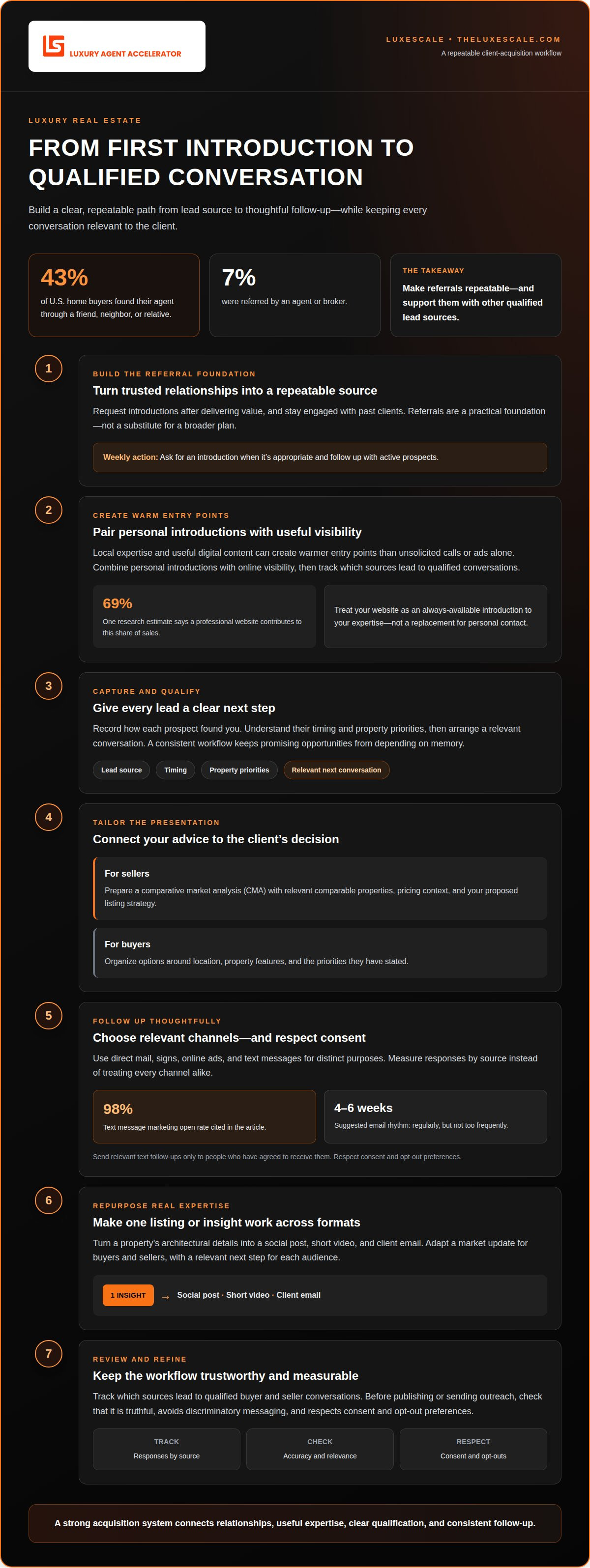
A luxury real estate client acquisition workflow turns attention into qualified conversations through clear, repeatable steps. In the United States, 43% of home buyers found their agent through a friend, neighbor, or relative. Another 7% were referred by an agent or broker. Those figures make referrals a practical foundation, not a substitute for a broader plan.
Which strategies can outperform cold calling and paid advertising? Referral-building, local expertise, and useful digital content create warmer entry points than unsolicited calls or ads alone. Pair personal introductions with online visibility, then track which sources lead to qualified buyer and seller conversations.
A luxury real estate agent client acquisition system brings together lead sources, a defined niche, qualification, client presentations, follow-up, and performance reviews. Give each stage a clear next action. Record how a prospect found you, understand their timing and property priorities, then arrange a relevant conversation.
Build a weekly workflow around a small set of repeatable actions. Request introductions after delivering value, publish a neighborhood update, and follow up with active prospects. A professional website can support that process: one research estimate says it contributes to 69% of sales. Treat the site as an always-available introduction to your expertise, not a replacement for personal contact.
Make client presentations specific. For sellers, prepare a comparative market analysis (CMA) explaining relevant comparable properties, pricing context, and your proposed listing strategy. For buyers, organize options around location, property features, and stated priorities. A concise presentation connects your advice to the client’s decision.
Use direct mail, signs, online ads, and text messages for distinct purposes. A neighborhood postcard can introduce a recent listing; a sign can prompt local inquiries; an online ad can direct prospects to a useful property or market page. Send relevant text follow-ups only to people who have agreed to receive them. Measure responses by source rather than treating every channel alike.
Repurpose each listing and market insight into several formats. Turn a property’s architectural details into a social media post, a short video, and a client email. Adapt a market update for buyers and sellers, then give each version a relevant next step. This keeps your content grounded in real expertise instead of producing disconnected posts.
What advertising and solicitation rules apply to luxury real estate agents in the United States? Keep advertising truthful, avoid discriminatory messaging, and respect consent and opt-out preferences during outreach. Apply these principles to signs, online ads, direct mail, and texts, and review content before publishing or sending it.
New agents can start by connecting with people they already know to build a client list, while combining referrals with digital marketing. A digital presence can serve as an initial listing presentation, giving prospects an early view of the agent’s expertise. Text message marketing has a 98% open rate, making relevant follow-up a useful part of the workflow. AI can turn a neighborhood market update into multiple short videos for different social media platforms. Send marketing emails regularly, but not too frequently, likely once every 4-6 weeks.
2. Customer growth and transaction-volume claims
Growth becomes measurable when you distinguish audience activity from actual client relationships. A real estate agent may gain Instagram followers without generating qualified conversations, signed clients, or completed transactions. Track each stage separately, then compare results by lead source and time period. This shows whether an activity supports revenue or simply attracts attention.
Repeat business can shape transaction volume over time. Among U.S. Realtors with 16 or more years in the business, 40% said more than half of their business came from repeat clients. Use that finding as a reason to maintain client relationships after closing, not as a forecast for your own results. A past buyer, for example, may later become a seller or introduce a new prospect.
Use a consistent measurement process. Record each inquiry and its source, then note whether it becomes a qualified conversation, a client relationship, and a closed transaction. Review those stages together. If Instagram attracts attention but few qualified conversations, adjust the audience or content. If personal introductions generate fewer inquiries but more completed transactions, protect time for relationship-building.
How do luxury agents measure lead conversion, client acquisition cost, and ROI? Calculate conversion by comparing leads that reach a defined milestone, such as a qualified meeting or signed client, with total leads from that source. Divide the acquisition spending you can attribute to a source by new clients to calculate acquisition cost. Compare transaction income with that spending to assess ROI.
Keep attribution consistent. Include marketing activity, labor, and tools you can reasonably assign to a source, and apply the same accounting method across channels. Separate active opportunities from closed transactions so a busy pipeline isn’t mistaken for realized income. Review results by source, client type, and transaction stage, then decide whether to refine, maintain, or pause an activity.
Pair volume with quality. A high number of inquiries can consume time when prospects lack a clear need, timeline, or fit with your specialty. Track how many conversations advance and where promising prospects stall. If qualified sellers often delay after an initial meeting, for example, refine your presentation and follow-up before increasing outreach.
Finally, use the numbers to guide practical decisions, not to make unsupported growth claims. Compare performance across consistent reporting periods, note changes in lead sources, and document what changed in your process. Agents seeking a more structured listing pipeline can explore a focused approach to listing opportunities.
3. Common client-acquisition mistakes
A costly mistake is treating every inquiry as a qualified prospect. A luxury buyer browsing a listing may have different needs from a seller preparing to move. Record each person’s goals, timing, preferred locations, and next step. This straightforward qualification process helps you focus your expertise on relevant conversations instead of sending the same pitch to everyone.
Another misstep is prioritizing audience size over business outcomes. A polished Instagram account can attract attention without generating serious buyer or seller conversations. Track what happens after each post: inquiries, meaningful conversations, and appointments. If a property tour gets likes but no questions, test a clearer caption or more useful call to action before posting more often.
What privacy, compliance, and reputational risks affect luxury client acquisition? Mishandling personal information can damage trust, while inaccurate or discriminatory messaging can create compliance and reputational concerns. Share client information only as needed for the task, and review marketing language before publication.
AI can speed up content production, but unchecked drafts can undermine local credibility. Review every AI-generated market update for accuracy, Fair Housing compliance, and local relevance before publishing. Confirm that a neighborhood description reflects the area, for example, and remove unsupported claims about who belongs there or which buyers should consider it.
Broad, generic messaging is another preventable mistake. A seller deciding whether to list needs different information from a buyer comparing properties. Create separate materials for each audience, then tailor the next conversation to the prospect’s stated priorities. A seller presentation might focus on pricing context and preparation, while a buyer discussion centers on location and property needs.
Weak follow-up can waste an otherwise promising lead. After an initial conversation, record the prospect’s question and agree on a relevant next action. If a seller wants time to consider a listing strategy, send the promised market information instead of a generic sales message. Following through shows organization and makes the next interaction useful.
Finally, don’t promise transaction volume based on attention metrics or a handful of successful deals. One high-value closing does not establish a predictable pipeline. Separate confirmed transactions from active prospects, record the source of each opportunity, and review the pattern before changing your marketing strategy. This keeps growth decisions grounded in actual business activity.
A practical quality-control routine can catch these mistakes early. Before sending a campaign, check its audience, factual claims, use of client information, and next step. When reviewing results, compare lead quality and pipeline progress, not just views or inquiries. Consistent review helps protect trust while improving how you generate and convert opportunities.
4. Niche specialization
Trying to serve everyone makes it harder to explain why clients should choose you. A clear niche helps buyers and sellers recognize your expertise and gives your marketing a consistent focus. Start with three questions: whom do you serve, what do they need, and why are you suited to help? Use specific answers to shape your positioning rather than relying on broad claims about luxury service.
Define your audience by meaningful characteristics, not assumptions. You might focus on buyers seeking historic homes, sellers of architect-designed properties, or clients moving within a particular community. Then identify the decisions they face. A seller may need guidance preparing a distinctive property for market, while a buyer may value detailed knowledge of a neighborhood’s housing stock.
Your specialization should reflect demonstrated knowledge. Choose a market or property type you can discuss precisely, then use examples in your presentations and content. Explain features that distinguish a mid-century home, for instance, or describe considerations when listing a waterfront property. Specific expertise builds trust because prospects can see how your knowledge applies to their goals.
Make your niche visible wherever prospects encounter your business. Align your website description, social media profiles, listing materials, and client conversations around the same audience and value. If you serve buyers and sellers of historic homes, publish useful information about preservation features, property evaluation, and local inventory. A consistent message makes your focus clear to prospects who find you through Google or an introduction.
Use client feedback and real conversations to refine your positioning. Note recurring questions, which property types lead to productive discussions, and where your experience has helped clients make decisions. If prospects repeatedly ask about a particular neighborhood, create a focused resource to attract relevant conversations. Keep your niche specific enough to be memorable but broad enough to support your business.
Specialization also improves qualification. When an inquiry arrives, compare the person’s goals with your stated expertise before proposing a next step. A buyer seeking a property type you know well may need a tailored search conversation. A seller whose home fits your market focus may benefit from a listing discussion grounded in relevant examples. This alignment directs your time and marketing toward clients you can serve effectively.
Review your positioning as your experience develops. Revisit the three questions, assess whether your content attracts the right prospects, and adjust your audience or message when conversations reveal a stronger fit. A disciplined niche gives your client acquisition system a clear identity, helping the right buyers and sellers understand what you know and why it matters to their decisions.
5. Purchased leads and CRM follow-up
Purchased leads need a defined follow-up process, not a single generic message. Most purchased real estate leads require 5-12 touchpoints before converting. Use that range to plan thoughtful, relevant contact rather than treating one unanswered call as a final outcome.
What CRM and marketing automation tools are best for luxury real estate agents? Choose a CRM that tracks lead sources, conversation history, next actions, and follow-up sequences. The right setup supports your workflow, including initial responses and reminders, without replacing personal advice.
What should you track? Record how each lead arrived, whether the prospect is a buyer or seller, their priorities, and the agreed next step. A seller seeking guidance on a distinctive property, for example, needs different follow-up from a buyer comparing locations. Keep notes factual, concise, and useful for the next conversation.
Qualify high-net-worth buyers and sellers by exploring their goals, timing, location, property requirements, and decision process. Ask focused questions, then listen for what shapes their plans. A buyer may prioritize privacy and architectural style; a seller may need advice on timing and presentation. Qualification should clarify fit and readiness, not rely on assumptions about appearance or status.
Build a sequence in which every follow-up has a purpose. After an initial inquiry, acknowledge the stated need and suggest a relevant conversation. If a buyer asks about a property, send useful details and follow up with related options only when they match the buyer’s criteria. For a seller, share the information promised during your discussion, then set a clear next action.
Use automation to support consistency, not to make every exchange sound identical. Set reminders for personal follow-up and organize separate sequences for buyers, sellers, and early-stage prospects. Before sending a templated message, review the lead record and personalize it with a detail from the conversation. This makes automation more relevant and protects service quality.
AI can help draft follow-up emails based on earlier conversations. Review each draft for accuracy, tone, and client-specific details before sending. Correct an outdated property preference, for instance, or remove language promising information you haven’t prepared. Record the final interaction in your CRM so future advice reflects the actual exchange.
Review the pipeline regularly. Identify leads with no recorded next action, stalled conversations, and sources that produce serious opportunities. Then refine the sequence or qualification questions. To strengthen your luxury pipeline, explore a more structured path to qualified opportunities.
Identify leads with an action due, stalled conversations, or changed needs, then decide whether a personal check-in makes sense. Keep the reason for each next step clear, so follow-up reflects what the prospect has said rather than continuing without purpose.
Real estate agents can use a CRM to track leads, automate initial responses, and create follow-up sequences. Use these tools to stay organized while ensuring each response reflects the individual record and conversation. When a prospect replies, update the record and adjust the next action. If there’s no reply, make the next contact useful and considerate. Regular review keeps follow-up attentive and relevant.
LuxeScale: Luxury Listing Appointments
LuxeScale helps agents seeking qualified luxury opportunities through Luxury Listing Appointments, Affluent Seller Leads, and Affluent Buyer Leads. Consider this support when your growth plan calls for a more consistent connection to affluent prospects, while you focus on qualification, client conversations, and transactions.
These opportunities work best alongside a clear niche and disciplined follow-up. LuxeScale also provides accompanying award-winning training, coaching, systems, and support to help agents develop their approach and manage referred opportunities. It’s a practical next step for agents ready to strengthen the pipeline they’re building through relationships and marketing.
Visit theluxescale.com to learn more about working with LuxeScale.
Make your next growth decision deliberate
Your next move doesn’t need to be a complete reset. Identify where progress slows, then test one focused adjustment. You might refine how you introduce your expertise, improve the handoff from first conversation to appointment, or give more attention to a source that fits your business goals. Keep the change specific enough to evaluate through actual client conversations and transactions.
Building a luxury real estate agent client acquisition system is an ongoing business decision, not a one-time marketing project. As your clientele and priorities evolve, revisit what you want your pipeline to support and which opportunities deserve your attention. An outside perspective can help you decide where to focus next.
Contact LuxeScale to discuss your acquisition system and explore a considered next step for your luxury real estate business.
Frequently Asked Questions
Where do clients actually come from?
Luxury real estate clients often come through trusted relationships, professional introductions, and property-related online research. A past client might introduce a colleague preparing to move, while an attorney may know someone facing a major property decision. Make introductions easier by clearly describing the clients and properties you serve. Then follow up with relevant information rather than treating every connection as an immediate sales opportunity.
Which lead generation channels work best for luxury real estate agents?
The strongest channel reaches your intended clients with credible, relevant expertise. A well-produced property feature can help prospects assess your presentation style, while an educational email can address a seller’s concerns before a listing conversation. Match each channel to a specific audience and purpose. Before investing more time, review the quality of resulting conversations, not just views or clicks.
How can agents build a referral network with wealth managers, attorneys, and luxury brands?
Build relationships before asking for introductions. Learn what wealth managers, attorneys, and luxury businesses prioritize, then share useful real estate context that complements their work. For example, offer a concise market briefing they can pass along when a client raises a property question. Be clear about your niche, respect client confidentiality, and follow up personally after introductions. Consistent professional value gives referral partners a reason to remember your expertise.

Article by
Mark Coppens
Mark Coppens is the Founder and Chairman of LuxeScale and Co-Team Lead of Living Vogue | eXp Luxury. He is an active elite-level luxury agent and the author of the upcoming book, POWER POSITIONING: From Missiles to Mansions – Why People Really Buy, and is a nationally recognized speaker on luxury real estate, consumer psychology, marketing, and business growth.
A U.S. Army veteran with an MBA in Marketing, Mark has generated more than $1 billion in career sales and now leads one of the nation's fastest-growing luxury referral platforms, referring more than $2 billion in luxury real estate opportunities each month to partner agents across the United States. He specializes in helping real estate agents generate more listings, break into the luxury market, and build scalable businesses through qualified referrals, award-winning training, coaching, and proven systems. His practical, psychology-driven approach has helped agents across the country increase their income while attracting more affluent clients and building lasting, referral-driven businesses.