
Luxury Real Estate Negotiation Tactics for Price and Terms
A higher asking price does not automatically create stronger leverage. For sellers, the best starting point is a defensible price informed by comparable sales, current inventory, and the property’s distinctive features. The right luxury real estate negotiation tactics depend on how those factors shape buyer demand and the seller’s room to negotiate.
It is natural to focus on the offer price, but a strong deal also depends on the buyer’s ability to close and the terms attached. This guide explains how to assess market leverage, choose a pricing position, evaluate buyer strength, and use silence without letting negotiations drift. You will also learn how an agent can keep communication professional, understand the other party’s priorities, and shape a strategy around your goals. The aim is a clear, informed position on price and terms, not a hard-line approach that weakens the deal.
Key Takeaways
- Use comparable sales, active inventory, and days on market to judge whether the seller or buyer has more leverage.
- Set a clear price position, then weigh closing dates and contingencies alongside the offer amount.
- Assess a buyer’s financing strength and ability to close, not just the headline price.
- After an offer or counteroffer, allow the other party time to respond instead of negotiating against yourself.
- Work with an agent to keep discussions professional and align each move with your priorities.
1. Using comparable sales and inventory to assess market leverage
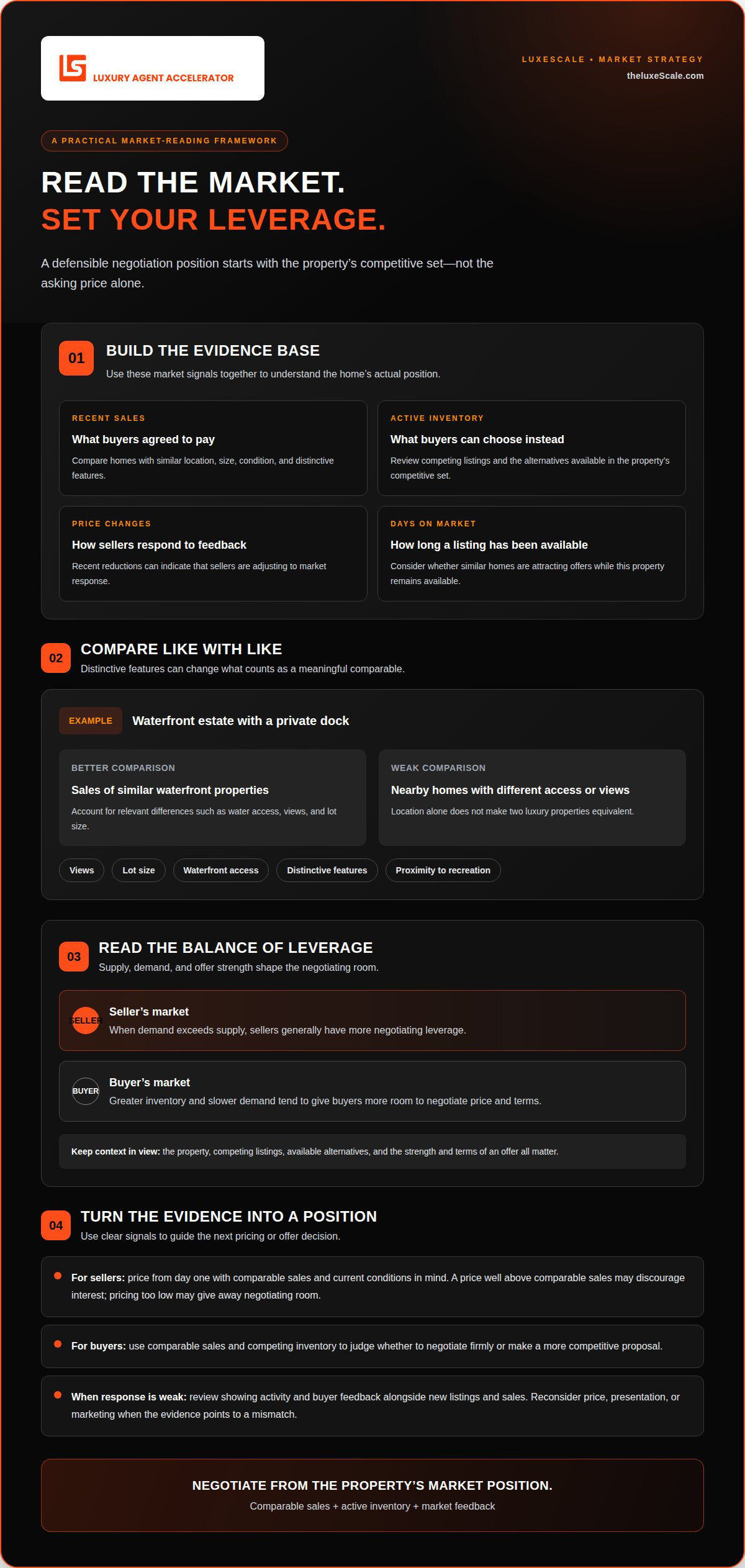
Start with recent sales of homes that share the property’s location, size, condition, and distinctive features. Compare a waterfront estate with other waterfront properties, not simply nearby homes with different access or views. Account for meaningful differences, such as a private dock, expansive lot, or renovated kitchen. This creates a defensible price range for sellers and helps buyers judge whether an asking price reflects current market conditions. An agent can explain which differences matter most.
In a seller’s market, where demand exceeds supply, sellers generally have more negotiating leverage. In a buyer’s market, greater inventory and slower demand tend to give buyers more room to negotiate price and terms. The right approach depends on the property, competing listings, and offer strength. An offer’s appeal can depend on its terms and the alternatives available, so buyers should assess the property’s competitive set.
Build a focused market picture using comparable sales, active inventory, and recent price changes. Recent sales show what buyers have agreed to pay; active listings show the alternatives available to them. Price reductions can indicate that sellers are responding to market feedback, while days on market show how long a property has been available. An agent can use these details to shape a pricing position or offer around the home’s competitive set, rather than relying on the asking price alone.
Luxury properties call for comparisons that account for setting and features. Homes in exclusive neighborhoods may offer views and expansive lots, so location alone does not make two properties equivalent. Compare views, lot size, waterfront access, and proximity to recreational areas where relevant. For example, a buyer considering a home with a private dock should focus on sales with similar waterfront features, not treat every large home as a direct match. This makes the price analysis more precise.
For sellers, accurate pricing from day one helps position a listing for qualified buyers. An asking price well above comparable sales may discourage interest; pricing too low may give away negotiating room. Review showing activity and buyer feedback alongside new listings and sales. If the response is weak, reconsider whether the price, presentation, or marketing approach fits current conditions. Make each adjustment in response to a clear signal, not guesswork.
Time on market can make that review more useful. If a listing remains available while similar properties attract offers, buyers may be resisting the price or presentation. Before changing an offer or listing strategy, compare price reductions, competing inventory, and recent sales. Buyers can use the same evidence to decide whether to negotiate firmly or make a more competitive proposal. The goal is to understand the available evidence and negotiate from the property’s actual market position.
2. How aggressive should I be when negotiating a luxury home price?
Match your opening position to the seller’s alternatives, the home’s condition, and your own spending limit. An offer far below asking may test flexibility, but it can undermine cooperation if the seller sees no credible basis for it. Before submitting, set your maximum and identify which terms you can adjust, such as closing timing, inspection scope, or included furnishings.
For buyers, effective negotiation pairs a defensible price with terms that address the seller’s practical concerns. A flexible closing date may matter to an owner who is relocating, while a strong financing profile can strengthen an offer without raising its price. State your request clearly, explain your reasoning, and thank the seller for considering it. Avoid demands that do not align with the property or your priorities.
Contingencies protect buyers, so removing one should be a deliberate decision about risk. A financing contingency can protect you if lending falls through; an appraisal contingency can address a low valuation. An appraisal gap commitment may reassure a seller, but commit only funds you can cover if the appraisal falls below the purchase price. Waiving an appraisal contingency can strengthen an offer while exposing you to that shortfall.
Inspection terms also shape negotiations. Shortening an inspection period from ten days to seven or five days can signal urgency, but leaves less time to evaluate findings. If an inspection identifies costly repairs, request specific repairs or a closing credit rather than treating every item as a deal-breaker. A credit lets the buyer manage the work, while the seller avoids coordinating contractors before closing.
Legal and disclosure requirements in the United States depend on the property and applicable jurisdiction. Put agreed terms and relevant disclosures in the transaction documents, and have an attorney review contract language if legal questions arise. Written commitments keep negotiations grounded in what the parties have agreed, rather than assumptions from calls or showings.
At closing, the final walkthrough lets the buyer assess whether the property remains in the agreed condition. It does not replace the earlier inspection. Use it to spot changes since that review, such as an item removed despite an agreement to include it. Resolve discrepancies through the contract process before completing the transaction.
For agents working to build a luxury seller pipeline, Luxury Listing Appointments can connect listing strategy with qualified seller conversations. Strong offers still depend on tailoring price and terms to the buyer’s finances, the seller’s priorities, and the risks each party can accept.
3. Assessing buyer financing strength and ability to close
A strong offer is only as reliable as the buyer’s ability to close. Sellers should assess the proposed price alongside financing, contingencies, timing, and the buyer’s readiness. Cash and financed offers can carry different risks, but neither is automatically stronger. The key question is whether the buyer’s resources and terms support the proposed transaction.
Review the financing picture before weighing competing offers. A lender preapproval shows that a buyer has started the financing process, while proof of funds can help establish resources for a cash purchase or down payment. Ask the buyer’s real estate agent for details that help assess the offer, including the financing structure and remaining steps. For example: “Please provide an update on financing progress and the buyer’s planned timeline.”
Earnest money can signal commitment because the buyer places funds into the transaction under the offer’s terms. A larger deposit may make an offer more compelling, but it does not replace careful review of financing and contingencies. Sellers should weigh the deposit alongside the buyer’s ability to meet deadlines and complete the purchase. Buyers should choose an amount they can support and understand how the contract handles the funds.
Comparable sales can help buyers shape an offer that fits the property and current market conditions. Local sales and absorption rates can support a proposed price or a strategic offer. For sellers, the same information helps show whether a buyer’s price and requests reflect the market or call for a counteroffer. A real estate agent can connect the property’s features and recent comparable sales to the offer’s overall strength.
Prepare for common requests before offers arrive. Buyers may ask for inspection or financing contingencies, repairs, or concessions. Sellers can decide which requests affect their bottom line and which terms they might adjust, such as the closing date. An offer with a lower price but workable timing may better suit a seller’s priorities than a higher offer with terms that complicate the move.
Set negotiation goals before responding. Sellers can define their preferred net proceeds, closing timeline, and acceptable contingencies; buyers can establish a maximum price and identify essential protections. Compare each proposal with those priorities instead of reacting only to the headline figure. If financing depends on an appraisal, consider how the price compares with recent sales and what happens if the valuation is lower.
Finally, assess the buyer’s ability to follow through, not just their stated intent. A buyer who can explain the financing plan, respond to document requests, and meet agreed deadlines offers a clearer path to closing. The seller’s agent can organize the offer details, identify outstanding questions, and negotiate terms that protect the seller’s priorities while considering the buyer’s ability to perform.
4. Using silence after an offer or counteroffer
After submitting an offer, pause rather than negotiating against yourself. The seller needs time to review the price, conditions, and personal priorities; repeated calls can add pressure without improving your position. Confirm receipt, then give the seller room to respond. Silence works best as space for a decision, not as a threat or substitute for clear communication.
Before sending a counteroffer, compare it with your goals and the property’s comparable sales. A seller should weigh the proposed proceeds against the preferred timeline and any attached conditions. A buyer should check the counter against their budget and reasons for buying. For example, if the seller’s price is firm but the closing date creates a problem, negotiate timing instead of making an unsupported price demand.
The first number can anchor the discussion, so base it on evidence. A seller’s asking price sets an opening position, but comparable sales and buyer response show whether that position is sustainable. A buyer can counter with a reasoned price tied to similar properties or a specific concern. Strong luxury real estate negotiation tactics replace arbitrary figures with clear reasoning both parties can assess.
Counteroffers can reset the price discussion. If a seller responds in small, deliberate increments, those moves may signal a limit; buyers should weigh that signal against their own maximum. Similarly, a buyer making a modest increase should explain what changed, such as adjusting a condition or aligning the closing date. Each move should offer a meaningful exchange, not a concession made just to keep talking.
Use the pause to assess the full proposal, not just its headline price. Compare the counteroffer’s timing, contingencies, inclusions, and repair requests with your priorities. A seller might accept a lower figure if the closing terms work, while a buyer might value furnishings or flexibility more than another price reduction. This approach keeps the discussion focused on what each side can trade.
When the other party goes quiet, do not assume rejection or invent a deadline. Check the offer’s stated response period and use the agreed channel to communicate. If the proposal stalls, an agent can send a concise follow-up asking whether the seller needs clarification or additional information. This keeps the conversation professional and leaves room for a genuine answer.
Silence should not conceal a decision. Once you receive a counteroffer, respond clearly: accept it, propose a specific revision, or decline. If you are selling, document each agreed change in the transaction paperwork; if you are buying, make sure the revised terms match your understanding. A calm pause followed by a precise response protects both the relationship and the negotiation.
5. Agent advocacy and negotiation strategy
Effective agent advocacy starts before the first offer. The agent and client define priorities, acceptable trade-offs, and the point at which they would walk away. A seller might value a particular closing timeline more than a slightly higher price. A buyer might protect inspection terms rather than exceed a comfortable budget. Clear goals keep counteroffers strategic instead of reactive.
Leverage often follows urgency. The party under less pressure to complete a deal can usually hold a stronger position, while time on market and price reductions may reveal a seller’s flexibility. An agent can connect these signals with the client’s timeline. For example, if a seller needs more time after closing, an agent might explore post-close occupancy rather than focus only on price.
Good representation also means understanding what the other party values. A seller may feel emotionally attached to the home or have a sale timeline shaped by tax planning. A buyer may care most about privacy, lifestyle, or a distinctive feature. An agent can listen for those priorities and tailor proposals accordingly. A flexible closing date may serve a relocating seller better than a small increase in the offer.
Keep communication factual and professional. An agent can provide an objective buffer, use comparable sales to support a position, and prevent frustration from turning into combative language. If a counteroffer stalls, a concise follow-up can invite clarification or identify an unresolved term. Prompt, thoughtful responses keep discussions moving without pressuring either side into a rushed decision.
Strong advocacy also means knowing when not to concede. Before negotiations begin, the agent and client can establish a walk-away point and identify flexible terms. If a buyer’s counter exceeds the agreed budget, the agent can recommend holding firm or stepping away. If a seller’s offer review reveals a stronger backup offer, that alternative may preserve leverage if the primary agreement stalls.
Rapport should support sound decisions, not replace them. An agent can acknowledge the seller’s priorities, explain the buyer’s reasoning, and frame a counteroffer around workable solutions. For example, if the parties disagree on price, adjusting the closing timing or included furnishings may help bridge the gap. The agent’s role is to serve the client’s interests while keeping negotiations grounded in evidence and achievable terms.
Agents building a stronger luxury-market position can develop a more strategic seller pipeline alongside their negotiation approach.
LuxeScale: Luxury Listing Appointments
LuxeScale provides Luxury Listing Appointments for agents building a stronger presence in the luxury market. Qualified seller conversations give you opportunities to put a deliberate negotiation strategy to work. LuxeScale also provides Affluent Buyer Leads and Affluent Seller Leads, alongside Award-Winning Training, Coaching, Systems, and Support.
These services fit agents whose next growth priority is connecting with affluent buyers or sellers and improving how they convert those opportunities. LuxeScale’s qualified luxury appointments and accompanying training, coaching, and systems complement the pricing, offer review, and client advocacy strategies covered above, helping you focus on high-value real estate work.
Contact LuxeScale to discuss how its offerings fit your goals.
Put your next negotiation into motion
Your next luxury sale is an opportunity to make negotiation a disciplined practice, not a series of improvised reactions. Set a clear objective before discussions begin, then connect each decision to that objective. This approach makes luxury real estate negotiation tactics part of your professional standard, helping you stay composed as priorities shift and new information emerges.
For agents, the next step is creating more opportunities to apply sound judgment with affluent clients. LuxeScale supports that goal with qualified luxury buyer and seller appointments, training, coaching, systems, and support. Check your territory to see whether a place is available, then take a deliberate step toward growing your luxury business.
Contact LuxeScale to discuss your sale, and move forward with a clear strategy and confidence in your next negotiation.
Frequently Asked Questions
What is the single most effective negotiation tactic for sellers?
Set a credible asking price and support it with clear evidence. Among luxury real estate negotiation tactics, disciplined pricing helps attract qualified interest without giving away value. Sellers can also decide in advance which terms matter most, such as timing or included furnishings. That preparation makes it easier to respond consistently when offers arrive, rather than conceding under pressure or treating every buyer request as equally important.
How aggressive should I be when negotiating a luxury home price?
Be firm about your priorities and measured in your opening position. An offer should reflect the home’s condition, competing options, and your willingness to proceed, not simply aim for the lowest possible figure. For example, a buyer who values a particular property feature can explain how it supports their proposed terms. A seller can respond with a specific rationale, maintaining a professional tone while leaving room for agreement.
Should buyers always ask for repairs after an inspection?
No. Buyers should focus repair requests on inspection findings that materially affect the property or their plans, not every cosmetic imperfection. For example, a safety concern or major system issue deserves more attention than a minor finish flaw. Buyers can request a repair or propose a credit, then weigh the seller’s response against the cost, timing, and importance of the issue before deciding whether to continue negotiations.
What’s the biggest mistake people make in negotiations?
A common mistake is making a concession or threat without deciding what outcome it is meant to achieve. A buyer who raises an offer just to keep the conversation going can exceed their limit; a seller who issues an ultimatum without intending to follow through can undermine their credibility. Before responding, identify the purpose of the proposed move and what you will do if the other party declines. Consistent decisions build trust.
How do luxury home buyers determine a fair offer price?
Compare the home with recent sales that are genuine alternatives, then account for meaningful differences in condition, setting, and features. A property with a private dock, for example, should be compared with sales that have similar waterfront characteristics. Buyers can also review active listings to understand the current options. A fair offer connects these comparisons with the buyer’s priorities and the specific terms they are prepared to accept.
How much below asking price can you offer on a luxury property?
There is no universal discount for every luxury property. The asking price, comparable sales, current alternatives, condition, and time on market all inform a defensible offer. Buyers should connect any reduction to those factors and provide a clear rationale. A large reduction without supporting evidence may undermine cooperation; even an offer near asking may need carefully considered terms if inspection or financing concerns remain.
What terms besides price can buyers negotiate on luxury homes?
Buyers can propose terms for the closing date, contingencies, repairs, and which furnishings or fixtures will remain. They can also discuss a seller rent-back or post-close occupancy if the seller needs more time after closing. Each request should address a practical need and appear clearly in the written offer. For example, furnishings may matter more to a buyer seeking a turnkey home than a small purchase-price adjustment.
How should sellers negotiate offers on high-end real estate?
Evaluate each offer as a complete proposal, not just a price. Consider financing, contingencies, buyer readiness, timing, and requested inclusions alongside the seller’s priorities. If a strong offer has a difficult closing date, a counteroffer can address timing rather than price. Communicate promptly and clearly, and record agreed changes in writing. This helps sellers compare proposals consistently and identify terms that support a smoother transaction.

Article by
Mark Coppens
Mark Coppens is the Founder and Chairman of LuxeScale and Co-Team Lead of Living Vogue | eXp Luxury. He is an active elite-level luxury agent and the author of the upcoming book, POWER POSITIONING: From Missiles to Mansions – Why People Really Buy, and is a nationally recognized speaker on luxury real estate, consumer psychology, marketing, and business growth.
A U.S. Army veteran with an MBA in Marketing, Mark has generated more than $1 billion in career sales and now leads one of the nation's fastest-growing luxury referral platforms, referring more than $2 billion in luxury real estate opportunities each month to partner agents across the United States. He specializes in helping real estate agents generate more listings, break into the luxury market, and build scalable businesses through qualified referrals, award-winning training, coaching, and proven systems. His practical, psychology-driven approach has helped agents across the country increase their income while attracting more affluent clients and building lasting, referral-driven businesses.