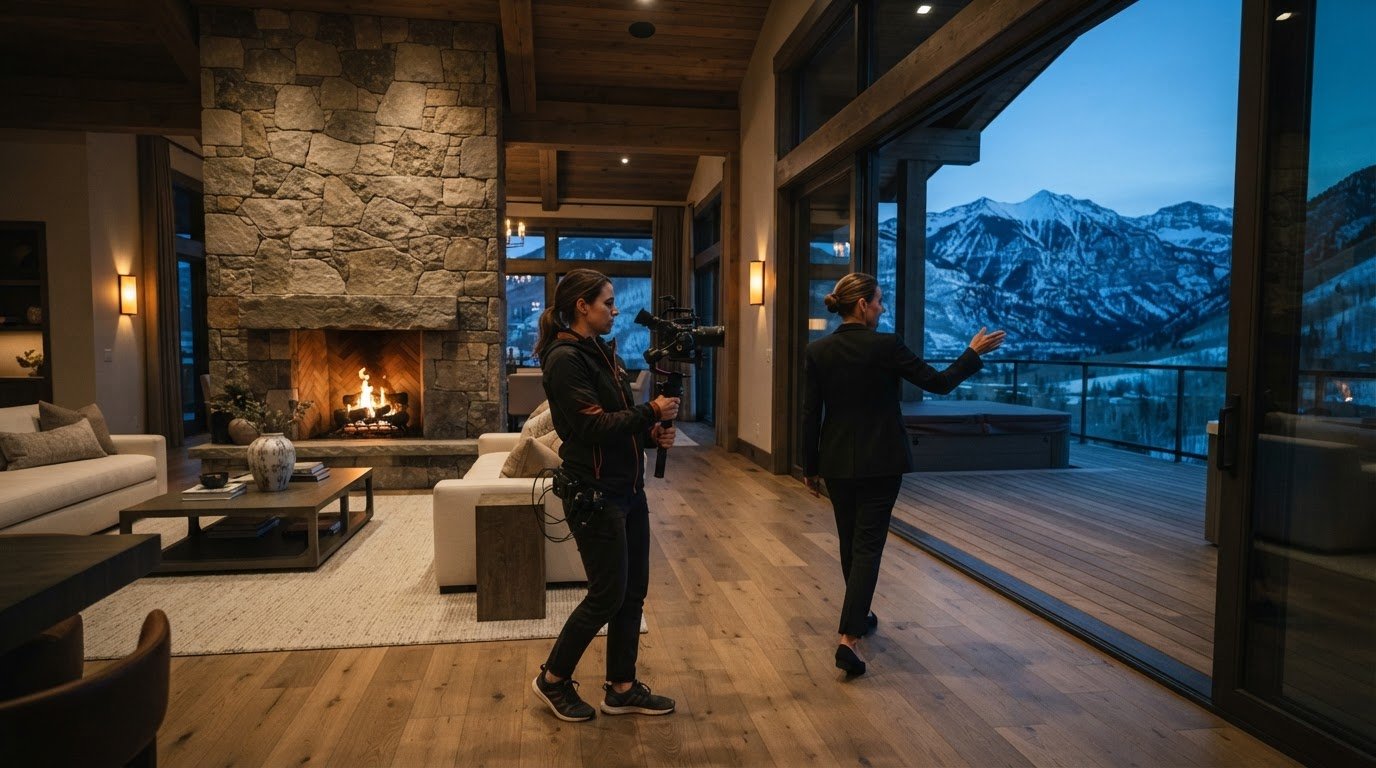
Marketing plan for a multi-million dollar listing, tailored to its price
A luxury marketing tier can allocate 5% or more of potential gross commission income to marketing, while the mix of media, market evidence, virtual tours, and video should reflect the listing’s specific strengths.
A higher asking price does not automatically call for more marketing. A strong marketing plan for a multi-million dollar listing is selective: invest in the elements that position the home, reach qualified buyers, and support the asking price with clear evidence.
This guide explains how to shape media outreach, build a data-led listing conversation, use 3D tours and cinematic video, and scale the marketing budget to the property. You’ll see how to prioritize the tactics that fit, rather than treating every listing as if it needs the same campaign.
Key Takeaways
- Build media outreach around the property’s distinctive story, and coordinate coming-soon promotion with the launch.
- Use local market evidence and relevant brokerage experience to support pricing and strengthen listing conversations.
- Make a 3D tour available so prospective buyers can explore the home remotely on their own schedule.
- Use a focused cinematic walkthrough to communicate the property’s layout, character, and standout features.
- Choose marketing investment by listing tier, then prioritize the channels most relevant to the home and its likely buyers.
1. Digital public relations and media outreach
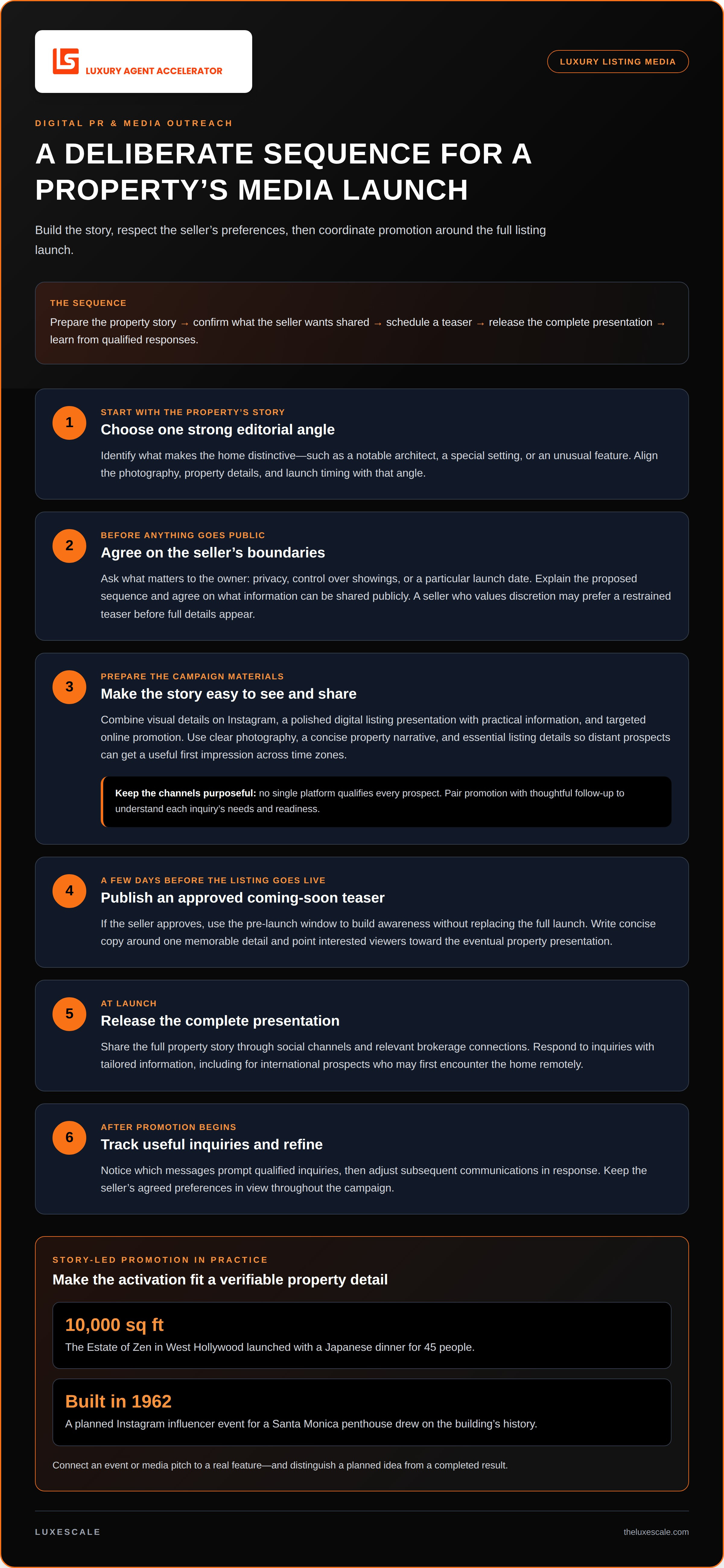
Digital public relations can connect the property’s story with audiences interested in architecture, design, lifestyle, and the local market. Identify its strongest editorial angle, such as a notable architect, distinctive setting, or unusual feature. Then align the photography, property details, and launch timing with that angle.
To reach qualified buyers, combine Instagram, a polished digital listing presentation, and targeted online promotion. Instagram can showcase visual details and introduce the home to relevant audiences; a complete listing presentation gives interested buyers practical information. No single platform qualifies every prospect, so pair promotion with thoughtful follow-up to understand each inquiry’s needs and readiness.
Consider the seller’s priorities before the campaign goes live. They may value privacy, control over showings, or a particular launch date. Ask what matters, explain the proposed sequence, and agree on which information can be shared publicly. A seller who prioritizes discretion, for example, may prefer a restrained teaser before the full property details appear. Clear expectations help keep the campaign aligned with the owner’s wishes.
Use a few days before the listing goes live to publish a coming-soon social promotion, if the seller approves. That window can build awareness without replacing the full launch. Develop concise copy around one memorable detail, then direct interested viewers toward the eventual property presentation. The Estate of Zen in West Hollywood offers a concrete example of story-led promotion: the 10,000-square-foot home’s launch included a Japanese dinner for 45 people.
That example also shows how an event can express a property’s character, rather than simply attract attention. A planned Instagram influencer event for a Santa Monica penthouse drew on its history: the building was originally built in 1962. Connect an event or media pitch to a verifiable feature, and avoid presenting an idea as a completed result. Accurate framing protects credibility with sellers and prospective buyers.
To reach international buyers, make the digital presentation easy to share across time zones and professional networks. Lead with clear photography, a concise property narrative, and essential listing details. Circulate the presentation through social channels and relevant brokerage connections, then respond to inquiries with tailored information. This gives distant prospects a useful first impression before they arrange a conversation or visit.
Coordinate outreach in a deliberate sequence: prepare the property story, confirm the seller’s preferences, schedule the teaser, and release the complete presentation at launch. Track which messages prompt qualified inquiries, then refine subsequent communications in response. A focused media angle and a respectful seller process give every channel a purpose, rather than scattering attention across disconnected promotions.
2. Using market data and brokerage experience in listing conversations
A productive listing conversation connects the seller’s expectations with evidence from the property’s competitive market. Compare relevant closed sales, active listings, and withdrawn or expired properties. Explain how condition, location, design, and buyer demand affect positioning. Brokerage experience adds context by helping interpret why a comparable property attracted interest, stalled, or changed its approach. Present the evidence clearly, distinguishing observed market facts from professional judgment.
For an expired listing, follow-up is most useful when every conversation offers something concrete. Review the property’s previous presentation, compare it with current competition, and prepare specific examples of changes that could sharpen its positioning. Avoid criticizing the former approach. A seller who has already experienced a disappointing result is more likely to engage with a practical discussion grounded in the home’s features and current buyer response.
In the United States, luxury property promotion must comply with applicable fair housing and advertising requirements. Keep descriptions truthful, avoid language that signals a preference for or exclusion of protected groups, and base audience selection on the property and legitimate buyer interests. Apply consistent standards to listing copy, direct mail, events, and digital campaigns so promotion stays focused on the home, not personal characteristics.
Position a multi-million-dollar property by weighing comparable sales, competing inventory, condition, distinctive features, and the seller’s goals. Use the evidence to explain where the home sits in its market and connect the proposed price to a clear positioning strategy. A renovated home with unusual architecture, for example, may call for a different narrative from a similar-sized property that needs updates. The comparison should clarify value, not rely on prestige alone.
Exclusive broker events can give selected agents a focused opportunity to experience a property and understand its strongest selling points. Keep the invitation and presentation aligned with the home’s character, and equip attendees with accurate details they can relay to suitable clients. Direct mail can complement that outreach: a 6x11 oversized postcard format is one documented strategy. Use the space for a strong property image, a concise feature-led message, and a clear next step.
Measure performance by linking campaign activity to meaningful buyer responses. Track inquiries by channel, qualified conversations, showing requests, and follow-up outcomes. Compare those results with campaign resources and the listing’s progress, rather than treating impressions alone as proof of return. A concise report can show which audience or message generated useful engagement and where to adjust the next outreach. Agents seeking a more consistent flow of listing conversations can explore luxury listing appointment opportunities.
3. 3D virtual tours
A 3D virtual tour lets buyers explore a property remotely, 24 hours a day, seven days a week. Unlike a set of still images, an interactive tour lets viewers move through connected spaces and understand how rooms relate. That context helps a distant buyer assess the home before deciding whether an in-person visit makes sense.
Plan the tour around how a buyer experiences the property. Start at the entrance, then guide viewers through the main living areas, kitchen, bedrooms, and outdoor spaces. Keep the route logical so the tour communicates the home’s flow instead of jumping between unrelated rooms. A clear sequence also helps buyers revisit important spaces later.
Prepare the property before the camera arrives. Coordinate with the seller to clear visible surfaces, open curtains, and remove temporary obstacles from key walkways. Check that lighting is consistent and doors allow an uninterrupted path. A crowded doorway, for example, can obscure how the entry connects to the main living area; a clear sightline makes that transition easier to understand.
Make sure the tour reflects the property’s layout. Include connecting halls, stairways, and transitions between indoor and outdoor areas, not just the most dramatic rooms. If the home has a separate guest suite or a large terrace, make those spaces easy to find. Buyers can then assess practical details as well as visual appeal.
Review the finished tour as a buyer would. Visit every room, check that transitions feel coherent, and confirm that the presentation accurately represents the home. A tour should clarify spatial relationships, not replace accurate listing details or an in-person viewing. If a room seems smaller because of its place in the sequence, adjust the route or footage to give viewers a more useful perspective.
Connect the tour to the property’s digital listing presentation and make it easy to open and navigate. Give it a clear label, place it near the main property information, and let viewers return to it after reviewing other details. This simple sequence helps buyers move from discovery to a more informed assessment without having to search for the virtual tour.
Use engagement as a planning signal, not as a substitute for buyer qualification. If a prospect asks about a specific room or circulation route, respond with relevant property details and arrange the next appropriate conversation. For sellers, explain how the tour supports remote exploration while preserving the role of private showings. A considered 3D experience makes the home easier to understand across distance and schedules.
4. Cinematic walkthrough videos
A cinematic walkthrough gives a property a visual narrative, not just a room-by-room record. For a professional marketing tier, the recommended finished video is 1 to 2 minutes long. That limit encourages deliberate choices: establish the home’s setting, show how key spaces connect, and reserve screen time for features that distinguish the property. A tight edit keeps the story focused without turning the film into a feature inventory.
Create professional listing photography and video tours by planning the shoot around the home’s strongest assets. Before filming, identify the central story, such as architectural character, entertaining spaces, or a striking view. Prepare a shot sequence that moves logically through the property. This gives the photography and video a shared visual direction while letting each format serve its own purpose.
Preparation determines what the camera can communicate. Work with the seller to clear distracting surfaces, arrange furnishings, and prepare featured rooms for filming. If the home’s appeal centers on indoor-outdoor living, for example, capture the transition from the main room to the terrace as one purposeful sequence. A planned route helps viewers understand how the property feels to move through, rather than seeing disconnected images.
During filming, use measured movement and intentional framing. Give an architectural detail, such as a long sightline or distinctive staircase, time to register before moving to the next scene. Avoid repeating angles when another room or feature would advance the story. Natural transitions matter too: moving from the entry into a central living area can communicate scale and flow more clearly than a fast montage.
Editing should preserve accuracy as well as atmosphere. Choose scenes that represent the property faithfully, keep transitions coherent, and ensure music or text supports rather than overwhelms the home. Review the finished cut against the actual rooms and features. If a sequence makes a space seem disconnected or obscures the relationship between rooms, revise it before release.
Use the finished film where prospective buyers encounter the listing, including its digital presentation and social promotion. LuxeScale notes that listings with video receive significant engagement and inquiries. Treat that figure as a reason to prioritize video, not as a guarantee for an individual property. Track which channels generate relevant conversations, rather than treating views alone as the measure of a useful campaign.
Effective video distribution extends beyond presenting an individual property. For instance, a targeted homebuyer event video script can generate dozens of qualified leads in a single week, while consistent geographical farming helps build local seller awareness over time. These examples point to broader uses for video in luxury real estate: a script can support an exclusive event, while repeated local exposure helps agents remain visible to prospective sellers. Keep the property walkthrough focused squarely on the home, and align its distribution with the broader purpose of each marketing campaign.
5. Tiered marketing strategies by listing price
A property’s price helps set the campaign’s scale, but it shouldn’t dictate every tactic. A practical tier framework links marketing investment to potential gross commission income (PGCI), then prioritizes channels that suit the property, likely buyers, and seller’s goals. This makes the budget more intentional than applying the same package to every listing.
For listings priced under $500,000, the essential tier allocates 1% to 3% of PGCI to marketing. A professional tier allocates 3% to 5% of PGCI. For luxury listings priced at $2 million or more, the suggested allocation is 5% or more of PGCI. These figures are planning guidelines, not fixed dollar budgets; PGCI and the listing’s needs shape the amount.
Which channels work best for high-end listings? Use a coordinated mix of digital exposure, strong property presentation, and direct outreach to relevant buyer networks. Prioritize channels according to the home’s features and the audiences they can reach, then assess the quality of the inquiries.
A luxury-tier campaign should justify its larger allocation through deliberate choices. A home with distinctive architecture, for example, may benefit from editorial-style storytelling and polished visual assets. A property with extensive grounds may need a presentation that clearly communicates its outdoor spaces. Choose each channel for a defined purpose, rather than adding tactics simply because the listing price is high.
What is a typical marketing budget for a luxury home listing? The tiered guideline is 5% or more of potential gross commission income for listings at $2 million or above, rather than one universal dollar amount. The allocation depends on PGCI and how the campaign is designed around the individual property.
Treat presentation as a distinct part of the plan. Before photography or showings, identify the home’s strongest first impression and remove distractions that compete with it. Simplify a formal living room to emphasize its proportions, for example, or arrange outdoor seating to show how a terrace can be used. Tailor staging to the property’s style and the buyer experience the campaign needs to convey.
Review spending by purpose as the campaign develops. Separate costs for creative production, distribution, and targeted outreach, then compare each investment with relevant responses, such as qualified inquiries or showing requests. If a channel attracts attention but little meaningful engagement, adjust its role before increasing exposure elsewhere. This keeps the strategy responsive without mistaking activity for impact.
Agents building a stronger pipeline of high-value listings can explore luxury listing opportunities.
An essential marketing plan is recommended for real estate listings priced under 500k. Keep the plan focused on the property’s strongest selling points, choosing presentation and outreach that fit the likely audience rather than relying on a broad package.
For luxury listings, allocate 5-10%+ of potential gross commission income to marketing. Match that larger investment to purposeful creative production, distribution, and targeted outreach, then use the response to refine the campaign as it progresses.
LuxeScale: Luxury Listing Appointments
LuxeScale helps real estate agents build a stronger luxury pipeline through Luxury Listing Appointments and affluent seller leads. These qualified, appointment-ready opportunities are designed for agents ready to grow their listing conversations and take a deliberate approach to high-end prospects.
For agents seeking demand from the other side of a transaction, Affluent Buyer Leads provide another avenue to develop luxury-market business. Accompanying Award-Winning Training, Coaching, Systems, and Support helps agents strengthen their process for working with referred opportunities.
These services support the marketing principles in this guide: thoughtful positioning, informed conversations, and campaigns tailored to each property. Contact LuxeScale to discuss building your luxury real estate business through qualified referrals.
Turn your next listing into a growth opportunity
Before your next listing appointment, identify what the seller values most: privacy, qualified interest, or a clear market position. Use that priority to shape the campaign brief and set a review point for assessing buyer response. As the campaign develops, use relevant feedback to refine the message and guide your next decisions.
Building a luxury pipeline also means creating more opportunities to apply that discipline. LuxeScale offers Luxury Listing Appointments and Affluent Buyer Leads, supported by Accompanying Award-Winning Training, Coaching, Systems, and Support. These opportunities can help agents develop their presence in the luxury market while strengthening how they work with prospects.
Contact LuxeScale to plan your listing and take a deliberate next step toward your luxury real estate goals.
Frequently Asked Questions
Do I need to do everything on this list for every property?
No. Choose tactics according to the property’s story, the seller’s priorities, and the buyers you want to reach. For a home where privacy comes first, for example, agree on what can be disclosed before choosing public-facing promotion. Treat every tactic as a decision, not a standard checklist: keep what serves the listing’s goals and leave out anything that adds activity without a clear purpose.
How long should a real estate listing marketing plan be?
Keep the plan concise and easy to execute. Identify the intended audience, core message, selected channels, approval responsibilities, launch sequence, and how results will be reviewed. A short plan that assigns responsibility for each action is more useful than a long document with no clear ownership. Update it if seller priorities or campaign responses change.
Include the seller’s communication preferences, approved property details, audience profile, channel choices, budget allocation, launch responsibilities, and measures for assessing response. Add an approval process for copy and creative materials. For example, specify who approves a revised description before it appears in a new campaign.

Article by
Mark Coppens
Mark Coppens is the Founder and Chairman of LuxeScale and Co-Team Lead of Living Vogue | eXp Luxury. He is an active elite-level luxury agent and the author of the upcoming book, POWER POSITIONING: From Missiles to Mansions – Why People Really Buy, and is a nationally recognized speaker on luxury real estate, consumer psychology, marketing, and business growth.
A U.S. Army veteran with an MBA in Marketing, Mark has generated more than $1 billion in career sales and now leads one of the nation's fastest-growing luxury referral platforms, referring more than $2 billion in luxury real estate opportunities each month to partner agents across the United States. He specializes in helping real estate agents generate more listings, break into the luxury market, and build scalable businesses through qualified referrals, award-winning training, coaching, and proven systems. His practical, psychology-driven approach has helped agents across the country increase their income while attracting more affluent clients and building lasting, referral-driven businesses.