
No Upfront Cost Real Estate Leads: Compare Fees and Tradeoffs
A lead with no upfront fee can still carry a substantial cost after closing. Many pay-at-closing companies take 25-40% of an agent’s commission, and some take as much as 50%. No upfront cost real estate leads may be worthwhile when the fee, lead quality, and eligibility terms align with your business, but delaying payment doesn’t remove the tradeoff.
It makes sense to value the chance to pursue new business without recurring out-of-pocket charges. The key is to compare the full cost against what you receive and the work required to convert a referral. This article breaks down pay-at-closing leads alongside other no-upfront-cost options, explains the benefits and drawbacks of each, and shows how eligibility standards can shape your choices. You’ll have a clearer basis for deciding which model fits your cash flow, conversion process, and growth goals.
Key Takeaways
- Compare the total commission share and payment timing, not just whether a lead has an upfront fee.
- Weigh the cash-flow advantage of pay-at-closing referrals against the commission you give up when a transaction closes.
- Eligibility standards can affect which agents qualify and whether a lead model fits their market, experience, and follow-up capacity.
- Paid advertising and subscriptions shift more of the cost and conversion risk to the agent, while offering a different level of control over lead generation.
- For agents pursuing luxury listings or affluent buyers, consider how qualified appointments and supporting coaching fit into your growth plan.
Are Pay-at-Closing Real Estate Leads Worth It?
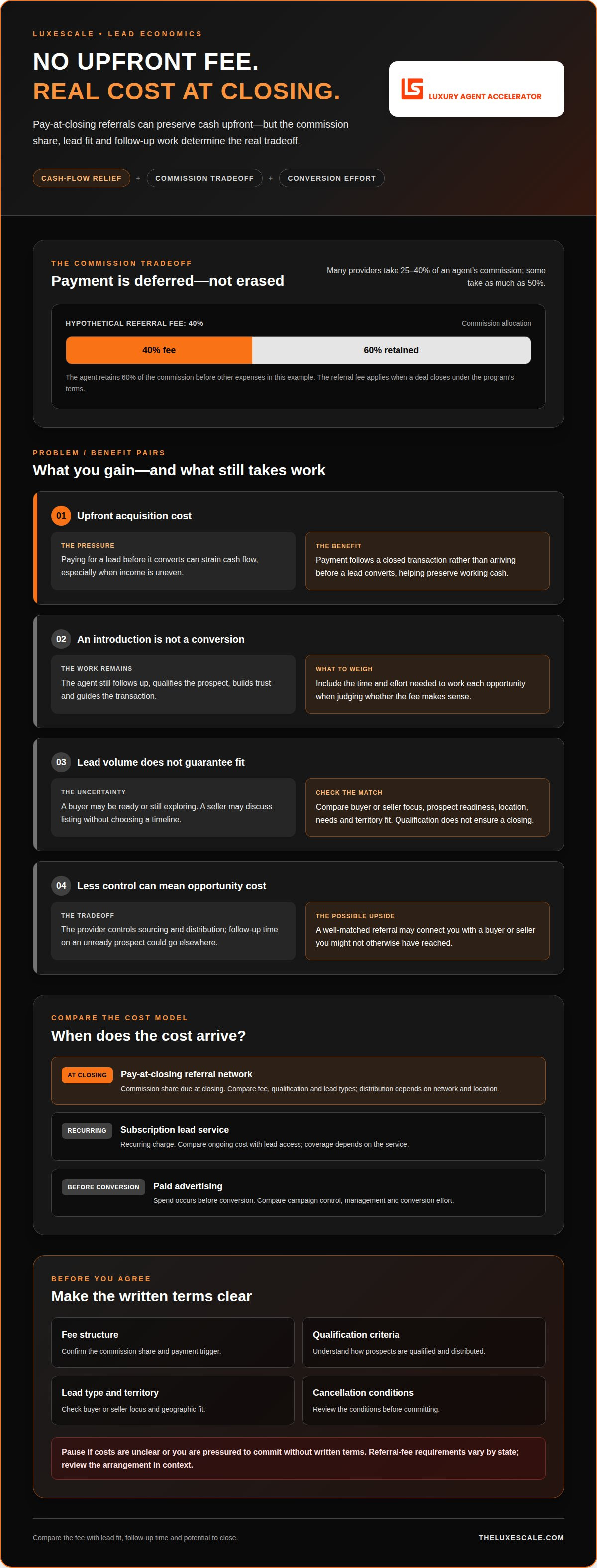
Pay-at-closing leads can reduce cash-flow pressure, but the referral fee lowers your commission after a successful transaction. Many providers take 25-40% of an agent’s commission, and some take as much as 50%. A 30% share, for example, is a meaningful tradeoff: there’s no upfront lead charge, but the fee applies when a deal closes.
Whether real estate referral fees are legal depends on the arrangement and applicable state rules. Requirements vary by state, so review the fee structure and transaction terms in context.
Compare referral programs by more than the fee percentage. Look at how opportunities are distributed, how prospects are qualified, whether the program serves buyers or sellers, and whether its territory fits your business. Qualification standards can help determine which opportunities you receive, but a prospect’s timing and readiness can still vary.
Platforms like LuxeScale provide valuable benchmarks to assess, particularly for lead distribution and follow-up processes. Review how a network routes opportunities, what response process it expects, and whether its lead types suit your business. For any program, read the written fee terms, qualification criteria, cancellation conditions, and payment trigger before agreeing. Pause if costs are unclear or you’re pressured to commit without written terms.
| Option | Fee structure | Distribution and coverage | Best comparison point |
|---|---|---|---|
| Pay-at-closing referral network | Commission share due at closing | Depends on network and location | Fee, qualification, lead types |
| LuxeScale-style platform | Review its referral terms | Assess routing and geographic fit | Profile, follow-up, distribution |
| Subscription lead service | Recurring charge | Depends on service coverage | Ongoing cost versus lead access |
| Paid advertising | Spend occurs before conversion | Depends on campaign targeting | Control, management, conversion effort |
Buyer and seller opportunities vary by network and territory. One program may suit an agent seeking buyer inquiries, while another may better fit a seller-focused strategy. Compare how each program qualifies prospects and whether its coverage fits your business. A large network alone does not ensure relevant opportunities or a completed transaction.
Pay-at-closing referrals can suit agents who want to preserve cash upfront and find that the referral fee fits their business economics. Compare the written terms, opportunity type, distribution process, and follow-up required before choosing a program to secure consistent no upfront cost real estate leads.
Advantages and drawbacks of pay-at-closing leads
The main advantage is timing: payment follows a closed transaction rather than arriving before a lead converts. That can preserve cash for an agent building a pipeline. The tradeoff is the commission share. For a hypothetical referral fee of 40%, the agent retains 60% of the commission before other expenses. The value depends on whether the opportunity would otherwise have reached that agent.
A referral program also means less control over how prospects are sourced and distributed. The agent handles follow-up, qualification, and client service. A buyer may be ready to act or still exploring; a seller may discuss listing without choosing a timeline. Conversion takes time and effort, and the fee applies only when the agreement’s closing conditions are met.
Consider the tradeoffs across the working relationship:
- Cash flow: No lead payment comes due before closing, but the eventual commission share can be substantial.
- Acquisition effort: The provider supplies an introduction; the agent still builds trust, qualifies the prospect, and guides the transaction.
- Lead fit: Buyers and sellers may differ in readiness, location, and needs. A referral’s fit affects how much follow-up it requires.
- Business planning: A listing-focused agent may value seller leads, while a buyer-focused agent may prioritize purchase inquiries.
Lead volume alone does not predict results. Two agents receiving similar referrals may see different outcomes because of their markets or follow-up processes. A prompt response can start a conversation, but it cannot establish a prospect’s motivation or ensure a closing. Include the time required to work each opportunity when assessing the fee terms.
There is an opportunity cost, too. Time spent following up with a prospect who is not ready could go toward an existing client, a listing appointment, or the agent’s own prospecting. A well-matched referral, however, may introduce a buyer or seller the agent might not otherwise have reached. The fee provides access, not a guaranteed transaction.
Pay-at-closing referrals may suit agents who can manage variable conversion and prefer to defer acquisition costs. They may be a poorer fit for agents who need full control over prospecting or cannot take on more follow-up. Compare the fee with the opportunity’s fit, the time required, and its potential to close, then decide whether the model supports your growth plans.
Benefits of leads with no upfront cost
A pay-at-closing model changes when an agent pays for a referral. Rather than paying to acquire a lead before a conversation begins, the agent pays a referral fee if the transaction closes under the program’s terms. For newer agents with uneven income, deferring that cost can help preserve working cash for business needs such as client meetings or marketing.
Consider a seller inquiry from a referral program. The agent follows up, learns about the seller’s plans, and decides whether the opportunity fits their services. If the seller lists and the transaction closes, the fee is tied to that result. If it does not close, the agent has not paid an upfront lead charge under this model. The agreement defines the exact payment trigger.
This arrangement can make lead generation more accessible to agents who do not want another fixed expense. An agent or brokerage can try a referral channel without taking on a recurring subscription. That may help when an agent’s marketing pipeline fluctuates or recognition in a new market takes time to build. The model defers acquisition costs, but does not remove the work of converting a prospect.
There’s a practical workflow benefit, too. A referral can introduce an agent to a buyer or seller outside their existing sphere. The agent can then:
- Respond: Make contact and establish the prospect’s immediate priorities.
- Qualify: Understand the person’s needs, readiness, and preferred next step.
- Serve: Provide relevant guidance and maintain communication through the transaction.
- Reconcile: Apply the written referral terms when the agreed closing condition occurs.
A motivated buyer may need help evaluating homes, while a seller may first want to discuss listing goals. These are distinct paths. A referral channel offering both types of prospects can complement an agent’s existing business development, provided they can serve each lead type effectively.
The model can encourage agents to focus on service and conversion instead of paying for every inquiry in advance. It does not eliminate follow-up, time commitments, or the possibility that a lead will not transact. Map the payment trigger to your brokerage’s transaction process and understand how the referral fee affects commission proceeds. This makes the cash-flow benefit clear without confusing deferred payment with free acquisition.
In short, the benefit is timing and access: an agent can pursue a referral without paying before it converts, then pay according to the closing terms. The best fit is an agent who can respond consistently, qualify prospects carefully, and account for the fee when a transaction closes.
Eligibility standards for no-upfront-cost leads
Eligibility depends on each referral program’s terms, not on a single industry-wide standard. A program may assess an agent’s service area, transaction experience, preferred lead types, and follow-up capacity. For example, a buyer-focused agent may be a better fit for a program distributing purchase inquiries than one centered on sellers.
Start with territory. A program may limit referrals by geography, so the agent’s location and target markets affect fit. Understand whether referrals cover the areas you serve or extend beyond them. Geographic fit matters because distance can affect availability for showings, listing appointments, and ongoing client service.
Next, review professional and brokerage requirements. A program may request an agent profile, brokerage affiliation, transaction background, or service details before distributing opportunities. These details help determine where an agent fits in its network. For example, buyer experience may support routing purchase inquiries, while a seller-focused profile may better match listing prospects.
Operational capacity matters, too. A referral has little value if an agent cannot respond or manage follow-up. If you already have active clients, consider how you will handle timely contact, qualification, and tracking for additional opportunities. Understand the program’s response expectations and whether you can meet them consistently.
Before joining, assess these criteria in the written agreement:
- Lead type: Identify whether the program distributes buyer leads, seller leads, or both.
- Location: Confirm how service-area boundaries affect referral access.
- Payment trigger: Define the transaction event that requires payment and what counts as successful completion.
- Agent obligations: Understand follow-up, reporting, and communication expectations.
- Account status: Review how changes in brokerage, coverage, or availability affect participation.
Pay close attention to the payment trigger. “Only pay at closing” describes timing, but the agreement should define which transaction qualifies and how the referral is attributed. Understand how the program treats a referred buyer who purchases a different property or a seller who lists after an initial conversation. Clear definitions help prevent disputes over attribution.
Eligibility is about fit as well as acceptance. An agent seeking seller opportunities may not benefit from them if they lack capacity for listing consultations. Likewise, an agent building a buyer pipeline should consider whether the referral process fits their schedule and working style. Match lead type, territory, and follow-up capacity before committing. That helps real estate agents choose a program they can serve effectively, rather than treating access alone as success.
How do no-upfront-cost real estate leads compare with paid advertising and subscription services?
These models differ in when you pay, how much control you have, and who handles lead generation. With a pay-at-closing referral, the cost is tied to a completed transaction. Paid advertising requires spending before an inquiry becomes a client. A subscription charges for access over a billing period, whether or not every opportunity converts.
Advertising gives agents more control over campaign messages, audience, and geographic targeting. For example, an agent promoting a listing can tailor the creative to that property and its neighborhood. But the agent also manages the campaign and pays for exposure before knowing which inquiries will become clients. Results depend on campaign choices, audience response, and follow-up.
A subscription shifts the decision from campaign management to access terms. The agent pays for continued participation, then works the leads provided under the service’s model. This creates a recurring expense that may be easier to budget than a referral fee tied to a closing. But the subscription remains a cost during quiet periods or when inquiries do not match the agent’s preferred market.
Pay-at-closing referrals defer that cost. Agents receive introductions without an upfront acquisition charge, then share commission after a qualifying transaction closes. This can help preserve cash, but agents have less control over how prospects are generated and distributed. They may also spend time following up with a contact who never transacts.
Compare the models across practical operating factors:
- Cash-flow timing: Advertising is funded before conversion; subscriptions recur; referral costs depend on the agreed closing trigger.
- Control: Advertising lets agents shape campaign targeting. Subscription and referral providers determine more of the access and distribution process.
- Workload: Campaigns require setup and monitoring; referrals require prompt follow-up; subscriptions require agents to work the leads they receive.
- Cost predictability: A subscription creates a recurring obligation. Advertising spend depends on campaign choices, while referral costs vary with closed transactions.
- Lead fit: Targeted campaigns can reflect an agent’s chosen audience. Provider-distributed leads depend on qualification and geographic coverage.
For example, an agent launching a listing campaign may value control over the message and geographic focus. An agent protecting cash flow may prefer to defer acquisition payment, while accepting a commission share after closing. A subscription may suit an agent who wants ongoing access and can budget for recurring charges. Each model still requires prospect qualification and follow-up.
Choose by matching the payment structure to your cash reserves, marketing capacity, and preferred level of control. Agents seeking a performance-based route into affluent markets can explore luxury-market lead opportunities.
LuxeScale
LuxeScale helps agents pursue affluent-market opportunities through qualified seller and buyer referrals, including Luxury Listing Appointments. Its performance-based model charges a 20% fee at closing, with no monthly or recurring out-of-pocket charges. That structure may suit agents weighing deferred acquisition costs against a commission share. Accompanying award-winning training, coaching, systems, and support help agents work referred opportunities with a deliberate process. Consider this approach if your growth strategy targets affluent homeowners and buyers, and you’re prepared to follow up and serve those prospects.
For a straightforward conversation about whether this model fits your goals, contact LuxeScale.
Choose a Lead Strategy That Fits Your Next Move
Match your growth goals with the opportunities you can serve well. If you’re pursuing affluent-market business, consider how Luxury Listing Appointments and Affluent Buyer Leads align with your focus, and whether Accompanying Award-Winning Training, Coaching, Systems, and Support fits your working approach.
The right no upfront cost real estate leads model should fit your pipeline, follow-up capacity, and priorities, not just your preferred payment timing. A clear conversation about those factors can help you assess whether LuxeScale’s approach makes sense for your business.
Contact LuxeScale about lead options and take a considered next step toward the business you want to build.
Frequently Asked Questions
Should You Try No-Upfront-Cost Leads?
No upfront cost real estate leads may suit agents whose cash-flow priorities and follow-up capacity fit a referral-based model. Before participating, weigh the referral terms, opportunity type, territory, and time needed to serve prospects. An agent focused on listings, for example, should prioritize opportunities that match seller representation rather than choosing a program on payment timing alone.
Do I have to accept every lead?
There is no single acceptance rule for every referral program; the terms determine how agents handle opportunities. Before joining, understand whether you can decline a lead outside your service area or expertise and what happens next. An agent focused on listings, for example, may not be the best match for a buyer inquiry. Clear expectations help you manage workload and maintain a pipeline that fits your practice.
Do you require me to sign a contract?
LuxeScale’s terms include No Contract. Agents are not required to sign a contract to participate. But no contract does not remove the referral terms. Understand the program details, including what triggers a referral payment and how a referred transaction is attributed. That clarity helps you make an informed decision before working with a referral network.
How does the pay-at-closing model work?
The agent pays a referral fee only after the agreed transaction closes. At LuxeScale, the model is No Monthly Fees, Pay Only When You Close, with a 25 % referral fee and No Contract. For example, an agent can receive a referred opportunity and work with the prospect without a monthly program charge. The referral fee becomes due when the transaction meets the program’s closing terms.
How will I be receiving the leads?
LuxeScale provides qualified luxury client appointments and buyer and seller opportunities through its referral program. It schedules listing appointments with affluent homeowners who are ready to sell. Rather than building a prospect list from scratch, agents receive direct appointments with potential clients. Follow-up and client service remain part of the agent’s role.
What real estate lead generation services have no upfront cost?
Pay-at-closing referral networks are one option. Agents can also generate prospects through personal referrals, brokerage relationships, or their own outreach, though those approaches require time and consistent effort. The models differ in who sources prospects, how opportunities are distributed, and whether payment depends on a closing. Compare these mechanics with your business goals, not just the initial cash outlay.
How do pay-at-closing real estate lead programs work?
A referral program connects an agent with a prospective buyer or seller, and the agent follows up to assess fit and provide representation. If the prospect completes a qualifying transaction, the agent pays the agreed referral fee. A seller appointment, for example, may lead to a listing that later closes, while an initial conversation alone may not trigger payment. The agreement defines attribution and qualifying events.
What commission or referral fees do no-upfront-cost lead services charge?
Fees vary by program and may be calculated as a share of the agent’s commission after closing. LuxeScale charges a 25 % referral fee only when the transaction closes. Compare the percentage with the payment trigger, how referrals are attributed, and whether the terms apply to a specific lead or later transactions with that client. Those details show the actual financial effect of the arrangement.

Article by
Mark Coppens
Mark Coppens is the Founder and Chairman of LuxeScale and Co-Team Lead of Living Vogue | eXp Luxury. He is an active elite-level luxury agent and the author of the upcoming book, POWER POSITIONING: From Missiles to Mansions – Why People Really Buy, and is a nationally recognized speaker on luxury real estate, consumer psychology, marketing, and business growth.
A U.S. Army veteran with an MBA in Marketing, Mark has generated more than $1 billion in career sales and now leads one of the nation's fastest-growing luxury referral platforms, referring more than $2 billion in luxury real estate opportunities each month to partner agents across the United States. He specializes in helping real estate agents generate more listings, break into the luxury market, and build scalable businesses through qualified referrals, award-winning training, coaching, and proven systems. His practical, psychology-driven approach has helped agents across the country increase their income while attracting more affluent clients and building lasting, referral-driven businesses.