
Pay-per-closing real estate leads: understand the fees and billing
No upfront bill does not mean a lead is free. With pay-per-closing real estate leads, an agent pays a referral fee only after a transaction closes. The key is to understand how the fee affects your commission and what terms apply before you accept a referral.
This performance-based structure aligns payment with closed business, but reduces the commission you retain when a deal closes. The details matter: fee terms, the closing trigger, territory eligibility, and the support behind each opportunity all shape whether the model fits your business.
This guide explains how the process works, what to review in an agreement, and how pay-at-closing referrals compare with other approaches. You’ll also see when this model may fit and where to weigh its trade-offs. LuxeScale’s Pay-At-Closing Referral Network provides qualified luxury client appointments, with free training and coaching included.
Key Takeaways
- Assess whether paying after a closing fits your cash flow and business goals, not just the appeal of avoiding upfront lead costs.
- Understand which transaction event triggers billing and how the referral fee affects the commission you keep.
- Review how territory approval, lead qualification, and follow-up expectations shape the opportunities you receive.
- Compare referral-based leads with other ways to generate business, weighing control, effort, and potential long-term value.
- Consider whether repeat relationships and referrals could make a lead source valuable beyond its first closing.
Are pay at closing leads ever useful?
These referrals may suit agents who value qualified opportunities and cash flow over retaining the full commission. Their value depends on conversion, the client relationship, and the referral fee.
Long-Term Value and Repeat Referrals
A referral can create value beyond its first closing if the client relationship leads to future business or introductions. That potential differs from a one-time lead purchase: ongoing relationships can contribute to an agent’s pipeline. Still, evaluate the original referral on its own economics. Treat future business as a possible benefit, not an assumption that makes an unworkable fee worthwhile.
Upfront Payments Versus Closing Fees
Upfront payments place acquisition costs on the agent before a transaction succeeds. With a closing-based referral, the fee is payable only after a deal closes. This changes payment timing, not the need to assess your net commission.
Referral Fees, Terms, and Lead Costs
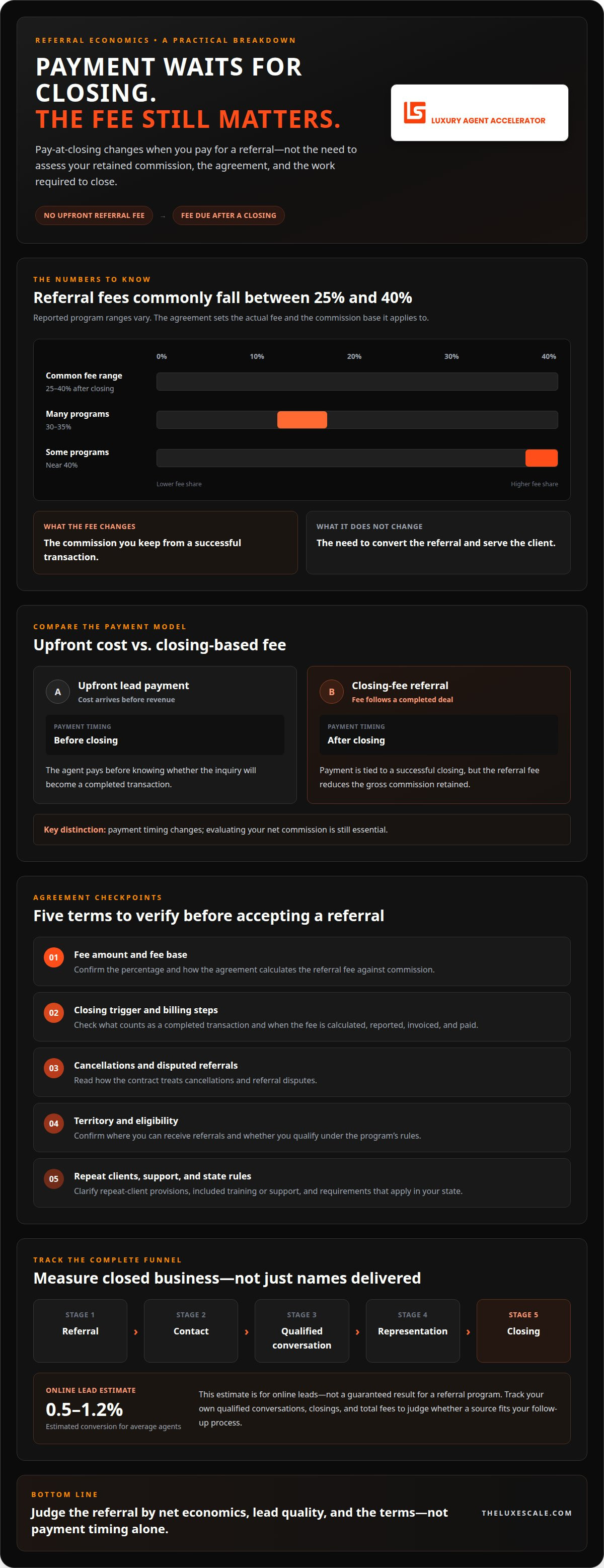
Pay-at-closing platforms commonly charge referral fees in the 25-40% range after closing; reported ranges also place many programs at 30-35%, with some near 40%. Zillow Flex and OpCity are named programs in this category, but fee terms, eligibility, and support depend on each program’s agreement. Agents should distinguish a closing-triggered fee from any upfront payment and read how the contract defines a completed transaction.
Referral-fee contracts set the amount, payment trigger, and treatment of cancellations or disputed referrals. State rules can affect which referral arrangements are permitted, so the relevant state requirements matter alongside the contract. To assess quality and cost, track qualified referrals, conversion to closings, and total fees against closed business.
| Option | Payment timing | Key consideration |
|---|---|---|
| Upfront lead payment | Before closing | Cost arrives before revenue |
| Closing-fee platform | After closing | Referral fee reduces gross commission |
| Zillow Flex | Set by program terms | Review eligibility and agreement details |
| OpCity | Set by program terms | Review fee and included agent support |
| Repeat referrals | Depends on referral arrangement | Consider relationship value over time |
Compare the fee trigger, prospect qualification, included support, and net cost per closing.
Advantages and disadvantages of pay-at-closing leads
Paying after a completed transaction changes when referral costs are due, not the work of converting buyers and sellers. Compare the models by cash flow, control, and the commission you retain.
Advantages of Pay-at-Closing Leads
The main advantage is timing: an agent pays a referral fee after a successful closing rather than paying for each inquiry upfront. This can preserve cash for other operating needs while a referral moves through the pipeline. For an agent building a business, payment is tied to a completed transaction instead of an unconverted contact.
Support can add value beyond the introduction. Compare the training, prospect qualification, and follow-up expectations included with a referral service, as these can affect the time needed to convert each opportunity. With LuxeScale, free training and coaching are included alongside qualified appointments, helping agents prepare to serve affluent clients.
Disadvantages of Pay-at-Closing Leads
A closing-based fee reduces the commission retained from a successful transaction. Assess that net amount against the effort required to serve the client. Paying only after closing avoids an upfront referral charge, but does not eliminate the fee.
Agents also have less control over how a referral is generated and routed. A referral network sets its process and territory rules, while the agent handles timely follow-up and client service. Qualification matters: time spent on prospects who are not ready or a good fit can weaken the economics. Review eligibility and program terms to determine whether the opportunities match your target market.
With pay-per-lead plans, agents pay for each lead; with pay-at-closing programs, the referral fee is due after a transaction closes. Referral fees are often calculated as a share of commission, so the agreement’s fee base and closing trigger matter.
Before joining, review the fee percentage, payment trigger, territory eligibility, referral terms, and rules for cancellations or repeat clients. Clarify how the agreement treats a buyer who later becomes a seller. State requirements also matter: referral arrangements depend on applicable jurisdiction and contract terms.
Measure quality through the stages from referral to contact, qualified conversation, representation, and closing. Then compare total referral fees with closed transactions, not just the number of names delivered. Online leads are estimated to convert at 0.5-1.2% for average agents, so conversion tracking helps reveal whether a source suits your follow-up process.
- Cash flow: Identify when payment becomes due.
- Economics: Calculate retained commission after the referral fee.
- Quality: Track qualified conversations and closed transactions.
- Terms: Review territory, eligibility, and repeat-client provisions.
Agents focused on affluent buyers and sellers can also consider a performance-based lead approach as part of their pipeline strategy.
Billing cycle
A closing-based lead arrangement connects the referral fee to a completed real estate transaction. The agreement controls when that fee is calculated, reported, invoiced, and paid, so the billing cycle begins with the contract, not with an advertisement or initial buyer inquiry.
Think of the process in three stages: referral, closing, and reconciliation. First, the agent receives a referral and records its source. Next, the transaction progresses through the usual client-service process. Finally, the closing details are matched against the agreement’s fee terms. The sequence is straightforward, but clear records matter at every stage.
From referral to transaction record
At referral, document the date, source, client, and applicable territory. These details help establish which opportunity the agreement covers. If a buyer later becomes a seller, the contract’s attribution terms determine whether the later transaction is linked to the original referral. Keep the referral record with the client file instead of relying on memory when closing approaches.
As the transaction advances, update its status in your existing recordkeeping process. An opportunity that has not closed is not the same billing event as a completed sale. Recording milestones such as client representation, contract activity, and closing helps distinguish active opportunities from transactions ready for fee reconciliation.
Closing, calculation, and payment
At closing, identify the amount the agreement uses as its fee base. A referral fee may be defined as a share of gross commission, but the contract must specify how that share is calculated. Gross commission, broker splits, team splits, and other deductions are different figures. Check whether the agreement uses gross commission or another defined amount.
Then match the completed transaction to the referral record and calculate the fee under the written terms. The agreement should identify the payment trigger and how to submit closing details. It also determines whether the agent, brokerage, or another party handles payment. Do not confuse a closing-triggered referral fee with a recurring advertising charge.
- Before accepting a referral: Save its source, date, territory, and client details.
- During the transaction: Keep status records current and preserve the referral connection.
- After closing: Apply the contract’s fee base and follow its reporting process.
Reconciliation matters when a transaction changes course. A cancellation, delayed closing, or later buyer-to-seller relationship can affect whether a fee applies. The written agreement governs these situations, including any reporting deadline or dispute process. Keep closing statements and referral documentation together so the brokerage can trace the calculation from the original introduction to the completed transaction.
For agents, this cycle separates the timing of a referral from the timing of payment. A buyer may close well after the initial introduction; a closing-based arrangement ties the referral fee to the later transaction. Reviewing the contract before accepting a referral clarifies the trigger, calculation method, required records, and payment process.
How pay-at-closing real estate leads work
The model connects a prospective client with an agent, then ties the referral fee to a completed transaction. The process runs from program approval through client follow-up and closing.
The Pay-at-Closing Lead Process
First, the referral network sets its eligibility requirements and territory rules. Once eligible, an agent may receive a buyer or seller opportunity that fits the program’s criteria. The agent then follows up, assesses the prospect’s needs, and manages the relationship through the transaction. Unlike a lead purchased upfront, the referral fee is due only if a qualifying transaction closes.
That timing does not mean the referral network completes the sale for the agent. The agent remains responsible for client communication, representation, and transaction management. For example, a referral may begin with a seller who needs a listing conversation. The agent’s follow-up turns the introduction into a potential listing, while the agreement determines whether a later closing qualifies for a fee.
Lead routing and territory eligibility determine who receives each opportunity. A referral network may assign referrals according to its coverage rules and participating agents. Brokerages can also affect participation, since an agent’s firm may need to handle or approve the arrangement. Before referrals begin, understand how opportunities are assigned and recorded.
Getting Started With a Pay-Per-Closing Lead Provider
A provider can guide agents through program eligibility, territory review, referral terms, and the steps for receiving opportunities. Agents should understand the fee trigger and lead-handling expectations before joining. Some programs may also require weekly or monthly accountability calls with program managers, so those commitments belong in the operating plan.
After approval, establish a repeatable handoff process. Record each referral’s source, assigned agent, and current status. Then make prompt contact, determine whether the prospect’s needs fit your business, and keep the opportunity’s progress visible. This creates a clear path from platform referral to client relationship, without confusing an inquiry with a completed transaction.
For example, an agent could track a seller referral through initial contact, a listing discussion, representation, and closing. Each stage shows where follow-up succeeds or stalls. That information helps assess whether the referral flow matches the agent’s capacity and market focus. It also gives the brokerage a clearer view of active referrals and pending obligations.
Before accepting a referral, connect its details to the written program terms. Confirm the territory, source, eligibility, and assigned agent within the brokerage’s process. At closing, the same record helps link the transaction to its original referral. The referral fee is not due upfront, but agents still invest time in assessing and serving each prospect.
The key takeaway is operational: eligibility establishes access, responsive follow-up develops the relationship, and clear records link the eventual closing to the referral.
US Companies Offering Pay-Per-Closing Real Estate Leads
In the United States, Zillow Flex and OpCity are examples of programs associated with referral-based leads. Their names alone don’t tell you whether a program suits your market. Compare each program’s eligibility, territory approval, referral terms, agent support, and billing trigger before deciding. Those details determine how the arrangement fits your brokerage and sales pipeline.
Start by separating a lead platform from the fee model. A platform supplies or routes opportunities; the agreement defines when a referral fee becomes due. Zillow Flex and OpCity should therefore be assessed through their program terms, not treated as interchangeable options. Eligibility and support can differ, and each agent’s brokerage may affect participation.
- Zillow Flex: Review program eligibility, territory access, and the event that triggers a fee.
- OpCity: Examine referral terms and the support available to participating agents.
- Other referral platforms: Compare their written fee basis, lead assignment process, and payment trigger.
- Direct lead-generation arrangements: Determine whether payment is due upfront or after a transaction closes.
For each program, map the process from eligibility to payment. First, establish whether your territory and brokerage can participate. Next, identify how a referral is assigned and what qualifies as an accepted opportunity. Then review the fee calculation, closing trigger, reporting process, and rules for repeat clients. These steps reveal differences before a referral enters your active pipeline.
Program support also deserves a practical comparison. Ask what support is part of the arrangement, whether training is included, and whether accountability calls form part of participation. The supplied market information notes that some programs may require weekly or monthly accountability calls. That commitment affects an agent’s schedule, even though it doesn’t change the fee trigger.
Use a consistent scorecard rather than relying on brand recognition. Record territory fit, prospect qualification, brokerage compatibility, support, fee basis, and reporting requirements. Then compare each program with your follow-up capacity and target clients. A strong fit connects referrals to the transactions your business can serve, while clear records link each closing to its original opportunity.
For agents pursuing affluent buyers or sellers, the relevant question is whether a referral model aligns with the clients they want to serve. Explore a performance-based lead approach as one option for building that pipeline.
LuxeScale
LuxeScale helps agents pursue affluent real estate opportunities through referrals and scheduled listing appointments. Its offerings include Luxury Listing Appointments, Affluent Buyer Leads, and Affluent Seller Leads. Accompanying Award-Winning Training, Coaching, Systems, and Support helps agents develop their approach to these opportunities and strengthen their conversion process.
If you’re considering a closing-based referral model, consider whether qualified affluent-client appointments and structured agent support fit your target market and business goals. LuxeScale’s Pay-At-Closing Referral Network may be a natural next step if you want to build relationships with affluent buyers or sellers while refining your approach.
Contact LuxeScale to discuss whether its approach aligns with your real estate business.
Choose a lead strategy that supports your next stage
Your next decision is about fit. Consider which clients you want to serve, how you prefer to build relationships, and what kind of support helps you convert opportunities. A lead source should complement your business direction, not simply add activity to an already crowded pipeline.
Use that perspective when assessing pay-per-closing real estate leads. This model may suit an agent comfortable with referral terms and client follow-through, while another approach may better match different priorities. Choose a model you can work consistently and evaluate against the business you intend to build.
If affluent-market growth is part of that direction, take a focused next step. Contact LuxeScale to discuss lead strategy and how its approach could fit your goals.
Build with intention, and let each opportunity move you closer to the practice you want.
Frequently Asked Questions
How does the pay-at-closing model work?
A referral network introduces a prospective client to an agent, and the agent pays a referral fee if the agreed transaction closes. The agreement determines which client and transaction count as referrals. For example, if a referred buyer later purchases a property, the agent’s records help link that closing to the original introduction. A transaction that does not close generally does not meet a closing-based trigger, but the contract defines the precise conditions.
Pay Per Close Leads in Real Estate: Are They Worth It?
These referrals may be worthwhile when the completed business justifies the referral fee and the agent can serve the prospect effectively. Look beyond appointment volume: assess how closely prospects match your target client, how much follow-up they require, and whether the relationship aligns with your practice. A transaction that produces little retained value can make a convenient referral arrangement a poor fit.
Are pay-at-closing leads worth the referral fee?
They’re worth considering when the fee provides access to opportunities that would otherwise take substantial effort to generate. Compare the commission you retain with the time spent qualifying and serving referred clients. Then consider whether the relationship could lead to repeat business or introductions. Those possibilities can add value, but the decision should still make sense based on the original transaction alone.
Do I have to accept every lead?
Whether you can decline a referral depends on the program agreement and referral process. The terms set the rules for assignments, acceptance, territory, and client conflicts. Read them before referrals begin. If a prospect does not match your expertise or capacity, follow the written process to understand the appropriate next step and whether declining affects participation.
How can I start owning my lead generation instead?
Build repeatable relationships that create direct introductions, such as consistent follow-up with past clients and professional contacts. Track which activities produce conversations and clients, then invest effort in the channels that fit your business. LuxeScale offers a different route: its Pay-At-Closing Referral Network provides qualified luxury opportunities, with a 25% referral fee only when a deal closes. It also includes free training and coaching.
What are pay-per-closing real estate leads?
Pay-per-closing real estate leads are buyer or seller referrals supplied through a program that charges an agent after a qualifying transaction closes. Unlike a charge for each incoming contact, the fee is tied to a defined closing event. The agreement explains how the provider identifies a referral, which transaction qualifies, and how the fee is calculated. These definitions matter when a client’s needs change during the relationship.
How do pay-per-closing real estate lead programs work?
A program typically establishes agent eligibility and territory rules before routing referrals. The agent then follows up, determines whether the prospect’s needs are a fit, and manages any resulting client relationship. If an eligible transaction closes, the agreement governs reporting and payment. For instance, a brokerage may document the referral source to link a later closing with the original introduction.
What fees do pay-per-closing real estate lead companies charge?
Referral networks generally charge a fee tied to commission after a qualifying closing, but the rate and calculation method vary by program. The contract should define the fee base, payment trigger, and treatment of team or brokerage arrangements. Do not assume every program calculates the fee the same way. When the fee is a share of commission, the amount you retain depends on the transaction economics.

Article by
Mark Coppens
Mark Coppens is the Founder and Chairman of LuxeScale and Co-Team Lead of Living Vogue | eXp Luxury. He is an active elite-level luxury agent and the author of the upcoming book, POWER POSITIONING: From Missiles to Mansions – Why People Really Buy, and is a nationally recognized speaker on luxury real estate, consumer psychology, marketing, and business growth.
A U.S. Army veteran with an MBA in Marketing, Mark has generated more than $1 billion in career sales and now leads one of the nation's fastest-growing luxury referral platforms, referring more than $2 billion in luxury real estate opportunities each month to partner agents across the United States. He specializes in helping real estate agents generate more listings, break into the luxury market, and build scalable businesses through qualified referrals, award-winning training, coaching, and proven systems. His practical, psychology-driven approach has helped agents across the country increase their income while attracting more affluent clients and building lasting, referral-driven businesses.