
Premium Property Referral Agreement: Understand Fees and Terms
A premium property referral agreement sets the terms for one real estate professional or referral service to introduce a client to another in exchange for compensation. In a real estate transaction, the agreement is between the referring and receiving brokers of record. A sample agreement may set an initial term of three years from its effective date, unless it ends earlier.
The fee matters, but so do the terms around it. Clear language defines when compensation is earned, how a partner referral is handled, and what happens to a referred client after the agreement ends.
This guide explains what these agreements cover, how term and termination provisions work, and how to define client protection periods. It also outlines the details to address when arranging a partner referral, from the initial introduction through closing.
Key Takeaways
- Identify who is referring the client and who is receiving the referral, then define when compensation is earned.
- Understand how the agreement’s term, early termination conditions, and surviving obligations can affect future transactions.
- Clarify how partner referrals are documented, including which brokerage remains responsible if a referred client changes agents.
- Set a clear client protection period so the agreement explains which later transactions remain covered.
- Use specific client details, payment terms, and notice provisions to make the agreement easier to administer.
What is a Referral Agreement?
A real estate referral agreement records how one professional or referral service introduces a client to another for compensation. In a brokerage transaction, the agreement is between the referring and receiving brokers of record. It should identify the client, the qualifying transaction, and the conditions for earning a commission.
Residential, commercial, and luxury referrals share the same basic structure, but property details and client needs vary. A tailored agreement can specify the client, property type, and transaction covered, helping both parties identify which introduction the document protects.
U.S. referral fees can face legal limits in particular settings. In Florida, an apartment property manager or owner may pay an unlicensed tenant a finder’s or referral fee of no more than $50 per transaction, according to the Florida Legislature.
State licensing rules vary, so an agreement should identify the licensed brokers and their brokerages. The referring and receiving brokers of record are the parties to a real estate referral agreement. Who may receive compensation depends on the applicable state rules and referral arrangement.
An unlicensed person may receive a referral fee in a limited circumstance: Florida allows an apartment property manager or owner to pay an unlicensed tenant no more than $50 per transaction. That example does not establish a general rule for unlicensed referrals across the United States.
Set out payment terms before making a referral. Specify the payee’s legal name, the event that earns the commission, how the amount is calculated, and the payment method. For example, distinguish a fee payable after closing from one triggered by an introduction alone.
Invoice schedules and payment deadlines belong in writing too. One sample agreement calls for broker invoices every 30 days and payment within 30 days after the client receives an invoice. These are sample terms, not a universal real estate deadline; set the actual schedule in the signed agreement.
Tie commission timing to a defined transaction event. A sample real estate referral agreement makes the fee payable only when the referred client’s transaction closes, unless the parties agree otherwise in writing. State which brokerage issues the payment and who receives it.
Tax reporting depends on the payer, payee, and payment structure. Keep the signed agreement, invoice, payment date, gross amount, and payee details together to support accurate accounting and any applicable reporting obligations.
Common disputes include disagreement over whether the client was referred, whether a closing qualifies, how the commission is calculated, or when payment is due. A signed agreement, dated referral record, invoice, and payment ledger each serve a distinct purpose: documenting the terms, establishing the introduction, requesting payment, and tracking settlement. Parties may also execute agreements electronically under sample terms recognizing the U.S. Federal E-SIGN Act of 2000.
Agreement term and termination
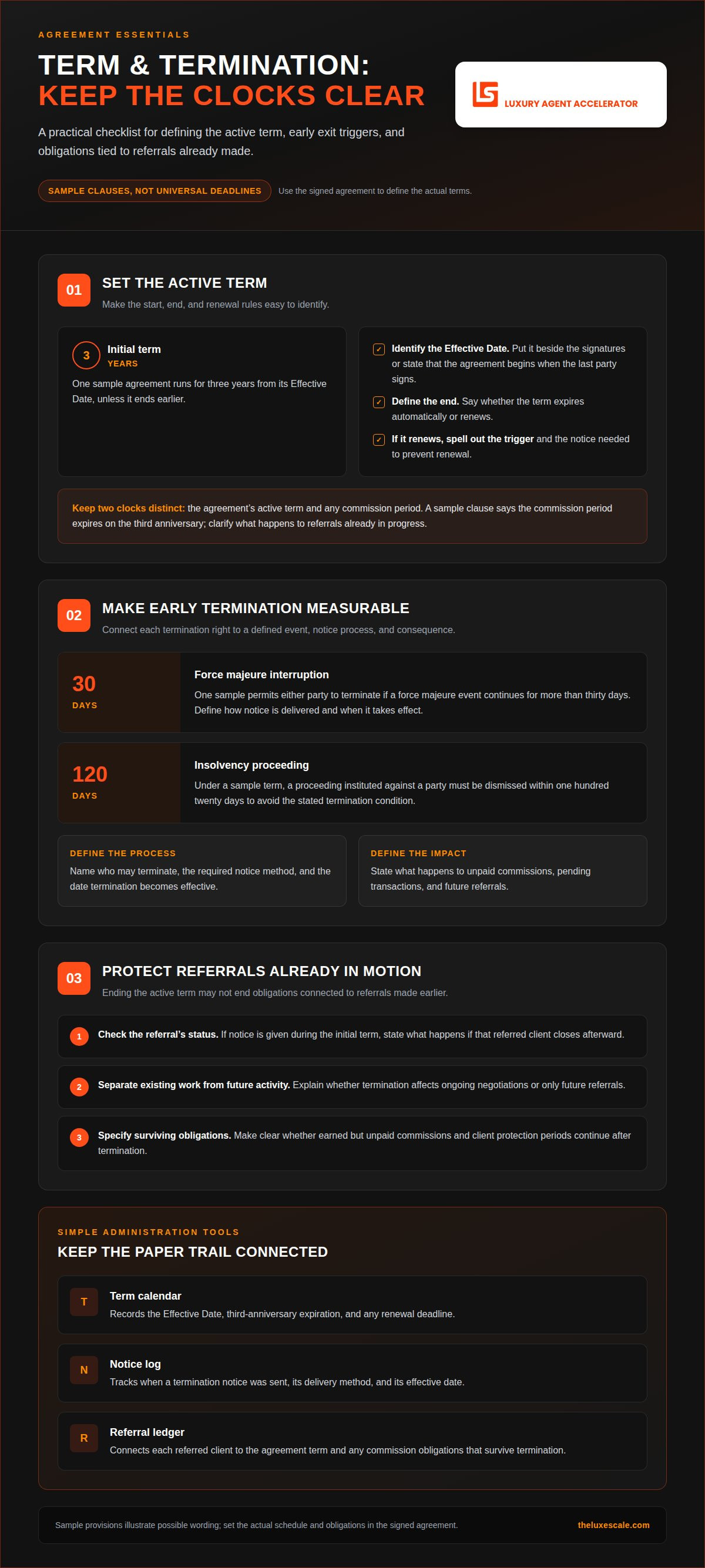
A referral agreement needs a clear start date, end date, and termination process. One sample sets an initial term of three years from the Effective Date, unless terminated earlier, and provides that the commission period expires on its third anniversary. These clauses define the agreement’s active period, but may not end obligations tied to referrals already made.
Make the Effective Date easy to identify. State it beside the parties’ signatures or specify that the agreement begins when the last party signs. Then explain whether the term ends automatically or renews, including the renewal trigger and notice needed to prevent renewal. Clear dates distinguish current referral activity from matters governed by surviving terms.
Early termination clauses should identify the event, the party entitled to act, and the required notice method. A sample agreement allows either party to terminate if a force majeure event continues for more than thirty (30) days. The clause connects termination rights to a defined interruption, rather than leaving the parties to debate whether ordinary delays qualify. Specify how notice must be delivered and when it takes effect.
Financial distress can also affect an agreement. Under a sample term, an insolvency proceeding instituted against a party must be dismissed within one hundred twenty (120) days to avoid the stated termination condition. The clause gives the parties a measurable trigger and a defined opportunity for dismissal. Read it alongside provisions covering commissions earned before termination, pending transactions, and client protection periods.
For a practical review, use these tools:
- Term calendar: Records the Effective Date, third-anniversary expiration, and any renewal deadline.
- Notice log: Tracks when a termination notice was sent, its delivery method, and its effective date.
- Referral ledger: Connects each referred client to the agreement term and any commission obligations that survive termination.
Before signing, connect each termination event to its consequences. For example, if a party gives notice during the initial three-year term, explain what happens if a referred client closes afterward. Separately state whether termination affects unpaid commissions, ongoing negotiations, or only future referrals. This distinction can reduce disputes about obligations that began before the end date.
Agents building a luxury pipeline can explore Luxury Listing Appointments as a route to qualified listing opportunities.
When drafting a premium property referral agreement, keep the active term and any subsequent commission periods distinct from one another. The agreement’s initial term is typically three (3) years from its effective date unless terminated earlier, while the commission period may also expire on the third anniversary of that date. Keep those periods clear when describing what happens to referrals already in progress. The contract can state whether a qualifying referral made during the term remains eligible for a commission after the term ends, and how any pending transaction will be handled. It can also identify the records the parties should retain to verify the referral date and transaction status. Consistent wording across the term, commission, and termination provisions helps clarify which obligations continue and which apply only while the agreement is active.
Business and partner referral agreements
A business referral agreement sets the terms for one party to introduce potential customers to another in exchange for a commission or other benefit. In real estate, the agreement is between the brokers of record at the referring and receiving brokerages. This identifies who can commit each brokerage and who manages the referral through the transaction.
A practical template may come from a brokerage’s agreement resources or an applicable industry association. Use it as a starting point, then tailor it to the referral relationship, client, and transaction. Clarify the parties, referral details, compensation trigger, fee calculation, and any client protection provisions. A premium property referral agreement works best when its terms reflect what each party is expected to do.
Define the compensation trigger precisely. Under a sample agreement, the referral fee is payable only after a successful closing involving the referred client, unless the parties agree otherwise in writing. The sample calculates compensation as a percentage of the gross commission received by the receiving brokerage. Put the agreed percentage and any written exception in the signed document.
Address reassignment in advance. If the receiving brokerage assigns the referred client to another agent within the same brokerage, the sample agreement keeps the receiving brokerage responsible for the referral fee. That way, an internal change of agent does not erase the original referral relationship. Record the introduction date, client identity, receiving brokerage, and assigned agent.
North Carolina builder referrals require particular attention to documentation. Form 770, titled Confirmation of Compensation, may document disclosure of a builder referral fee. Paragraph 4(f) of the recently released version of Form 201 addresses a buyer agent’s receipt of a builder referral fee. A Buyer Agency Agreement does not address compensation a builder pays an agent for referring a buyer.
For a builder referral in North Carolina, use a written referral agreement that describes the services and states the amount and timing of payment. The buyer agent must disclose an expected builder referral fee before the buyer enters a construction contract with the builder. Written disclosure is recommended, but not required. Some states may require a signed buyer agency agreement to collect a referral fee, so the agreement’s role depends on the transaction and state rules.
- Referral agreement template: Structures the parties’ commitments and compensation terms.
- Referral log: Records each client introduction and links it to the receiving brokerage.
- Form 770: May document disclosure of a builder referral fee in North Carolina.
Treat each referral as a documented business action, not an informal handoff. Keep the signed agreement with a dated referral record, then retain transaction records showing whether the client closed. This gives the brokerages a consistent basis for tracking obligations and resolving questions about the referral.
Client protection period
A client protection period defines how long a referral remains covered after an introduction or the agreement’s end. In a sample agreement, the period runs for a stated number of months from the agreement date and covers transactions the referred client enters into while represented by the receiving brokerage. Connect the term to the named client, brokerage, and covered transaction rather than broadly referring to future business.
State the protection trigger in plain language. Specify whether coverage begins when the referring brokerage sends the client’s details or when the receiving brokerage acknowledges the referral. Then define a covered transaction, such as a purchase involving that client and brokerage. This helps distinguish a documented introduction from a client relationship that already existed independently.
Protection can continue beyond termination. A sample agreement states that Section 7 remains in effect until the second anniversary of the date of termination. That survival clause preserves the section after the rest of the agreement ends. Read it alongside the client protection period: one provision may define the covered window, while another preserves the relevant obligations after termination.
Confidentiality, exclusivity, and client relationship clauses address different risks. A confidentiality clause identifies client information the parties may use or disclose and limits its use to the referral relationship. An exclusivity clause specifies the client or transaction covered and whether another referral source is excluded. A client relationship clause explains how the receiving brokerage handles the referred client and records the referral.
If a referred buyer works with the receiving brokerage after termination, the agreement should clarify whether a resulting transaction falls within the protection period. It should also address changes in assigned agents, since the relationship may continue within the same brokerage. Specific client details and dated records help distinguish this case from an unrelated introduction.
Useful tools make these terms easier to administer:
- Client referral register: Records the client’s identity, referral date, introducing party, and receiving brokerage.
- Protection-period calendar: Tracks the agreement date, termination date, and the second-anniversary date tied to surviving Section 7 obligations.
- Transaction cross-check: Connects a later transaction to the original referral record and relevant agreement terms.
Keep the agreement and related records consistent. Differences in the client’s name, referral date, or receiving brokerage can lead to disputes about whether protection applies. A consistent record traces the introduction, identifies the relevant transaction, and supports applying the agreed terms.
What terms should a premium property referral agreement include?
A strong agreement identifies the referring and receiving brokers of record, their license numbers, and contact information. It should also describe the referred client clearly, including their name and details that distinguish the introduction from other prospects. Specific records help connect a later transaction to the correct referral.
State the compensation formula and payment trigger directly. Specify whether the fee is a percentage of the receiving brokerage’s gross commission and whether payment depends on closing. Explain who invoices whom, who receives the funds, and how reassignment affects responsibility. Put any exception in writing.
Set out the agreement’s time limits: the effective date, initial term, renewal process, and termination method. Then state the duration of the client protection period and which transactions it covers. A separate survival clause should identify obligations that continue after termination. Each provision has a distinct purpose.
Include a process for addressing breach. A sample agreement gives a party thirty (30) days after written notice to cure a breach. Specify how notice must be delivered, where it should go, and when it takes effect. That process gives both parties a record of the issue and the opportunity to address it within the stated period.
Some agreements also address chargebacks. One sample states that commission fees may be subject to chargeback for orders for prospects 90 days or more after the relevant period. Define the event that triggers a chargeback, the calculation, and how the parties document the adjustment. Keep the clause tied to the transaction and records it covers.
For builder referrals in North Carolina, a written agreement should describe the referral services and specify how much and when the agent will be paid. Some states may require a signed buyer agency agreement to collect a real estate referral fee. Electronic execution can also be addressed: a sample agreement permits electronic signatures complying with the U.S. Federal E-SIGN Act of 2000.
- Agreement checklist: Helps confirm the parties, client details, payment terms, dates, and notice process appear in the document.
- Referral register: Connects each named client to the introduction date and receiving brokerage.
- Transaction ledger: Tracks closing, invoices, commission payment, and any documented adjustment.
Use these records together, not as substitutes for clear contract language. Explore Luxury Listing Appointments to build a focused pipeline of premium listing opportunities.
Include as much detail about the referred client as possible to distinguish the introduction. Under the sample notice clause, registered-mail notice is considered delivered two days after deposit with the postal service.
LuxeScale
LuxeScale helps real estate agents build a luxury-market pipeline through Luxury Listing Appointments and Affluent Seller Leads. These opportunities suit agents focused on connecting with affluent homeowners ready to sell. Agents working with high-end buyers can also access Affluent Buyer Leads, supported by accompanying award-winning training, coaching, systems, and support.
Turn to LuxeScale when you’re ready to pursue qualified opportunities while staying focused on client relationships and transactions. The accompanying education and support help agents strengthen their approach to referred prospects and build confidence in the luxury market.
Contact LuxeScale to discuss the opportunities that fit your business goals.
Turn clear terms into a stronger pipeline
A well-built premium property referral agreement does more than document a handoff. It sets expectations that support productive partnerships and focused growth in the luxury market. Treat each referral as the beginning of a professional relationship, with clear terms to guide both sides toward a successful transaction.
For agents seeking new opportunities, LuxeScale offers Luxury Listing Appointments and Affluent Buyer Leads, alongside award-winning training, coaching, systems, and support. These resources can help you build relationships with affluent clients and strengthen your approach to the luxury market.
Use the agreement as a deliberate foundation, then decide what opportunity best aligns with your business goals. Contact LuxeScale about referral terms and take the next step with confidence.
Frequently Asked Questions
What is a premium property referral agreement?
A premium property referral agreement documents how real estate brokerages handle a client introduction and any resulting compensation. For an affluent seller, it can identify the client, referring brokerage, receiving brokerage, and specific opportunity covered. “Premium” describes the market or client focus, not a separate agreement type. The agreement’s value comes from matching its written terms to the actual referral arrangement.
How are referral fees calculated for luxury real estate transactions?
The agreement sets the calculation method. A sample model bases the fee on a percentage of the gross commission the receiving brokerage earns from the transaction, rather than the property’s sale price. Before signing, define the commission base and how adjustments are handled. For example, clarify whether the calculation uses the brokerage’s commission actually received at closing.
How do agents and brokerages document and pay referral fees?
Brokerages can create a clear audit trail by keeping the signed agreement with a dated referral record, transaction details, closing confirmation, invoice, and payment record. The referral record should connect the introduced client to the referring and receiving brokerages. The agreement should identify the payee, payment trigger, and deadline. A brokerage can then match the invoice to the closed transaction before recording the disbursement.
What tax reporting applies to real estate referral payments?
Tax reporting depends on the payer, payee, and payment structure. Keep the signed agreement, invoice, payment date, gross amount, and payee details together to support accounting and applicable reporting obligations.

Article by
Mark Coppens
Mark Coppens is the Founder and Chairman of LuxeScale and Co-Team Lead of Living Vogue | eXp Luxury. He is an active elite-level luxury agent and the author of the upcoming book, POWER POSITIONING: From Missiles to Mansions – Why People Really Buy, and is a nationally recognized speaker on luxury real estate, consumer psychology, marketing, and business growth.
A U.S. Army veteran with an MBA in Marketing, Mark has generated more than $1 billion in career sales and now leads one of the nation's fastest-growing luxury referral platforms, referring more than $2 billion in luxury real estate opportunities each month to partner agents across the United States. He specializes in helping real estate agents generate more listings, break into the luxury market, and build scalable businesses through qualified referrals, award-winning training, coaching, and proven systems. His practical, psychology-driven approach has helped agents across the country increase their income while attracting more affluent clients and building lasting, referral-driven businesses.