
Real Estate Agent Income Plateau: How Much Agents Make
A real estate agent income plateau can persist even when an agent is closing deals. U.S. REALTORS® had median gross income of $59,200 in 2025, but gross income isn’t the same as take-home pay. Transaction volume, commission splits, and business expenses all affect what an agent keeps.
It’s reasonable to expect more transactions to mean more income. But deal count is only part of the equation: the commission generated by each transaction and the share retained after brokerage costs matter too. That’s why a busy year doesn’t always translate into the income growth an agent expects.
This article explains how transactions shape gross commissions, why take-home income can differ, and which business levers agents can work on. You’ll see how production, expenses, and access to stronger opportunities fit together, so you can identify where income growth may be stalling and what a more scalable approach could involve.
Key Takeaways
- Assess how transaction volume and commission structure combine to shape gross income, rather than relying on deal count alone.
- Separate gross commissions from take-home income by accounting for brokerage splits, business costs, and taxes.
- Identify growth strategies that focus on stronger opportunities, effective systems, and improved conversion.
- Use national income statistics as context, while recognizing how work patterns and market conditions shape individual results.
- Consider how experience can influence production and income, and where new opportunities may help sustain progress.
Transaction volume and gross commission income
Transaction volume influences gross commission income, but the value and terms of each closing matter too. Understanding both helps explain why more activity doesn’t always mean higher income.
Transaction Volume and Gross Commission
Transaction volume is the number of completed transaction sides an agent handles during a period. Each side can generate commission, so closing more transactions can increase gross commission income. But the commission earned per side varies by transaction and the agent’s agreed compensation. A useful income review tracks both completed sides and gross commission per side, rather than counting listings or deals alone.
In 2025, the typical U.S. REALTOR® completed 9 transaction sides. That figure gives agents a reference point for production, not an income target that applies to every market. A listing may require substantial work before closing, and an accepted offer does not itself produce completed-sale income. Tracking closed sides separately from active listings helps distinguish pipeline activity from realized commission.
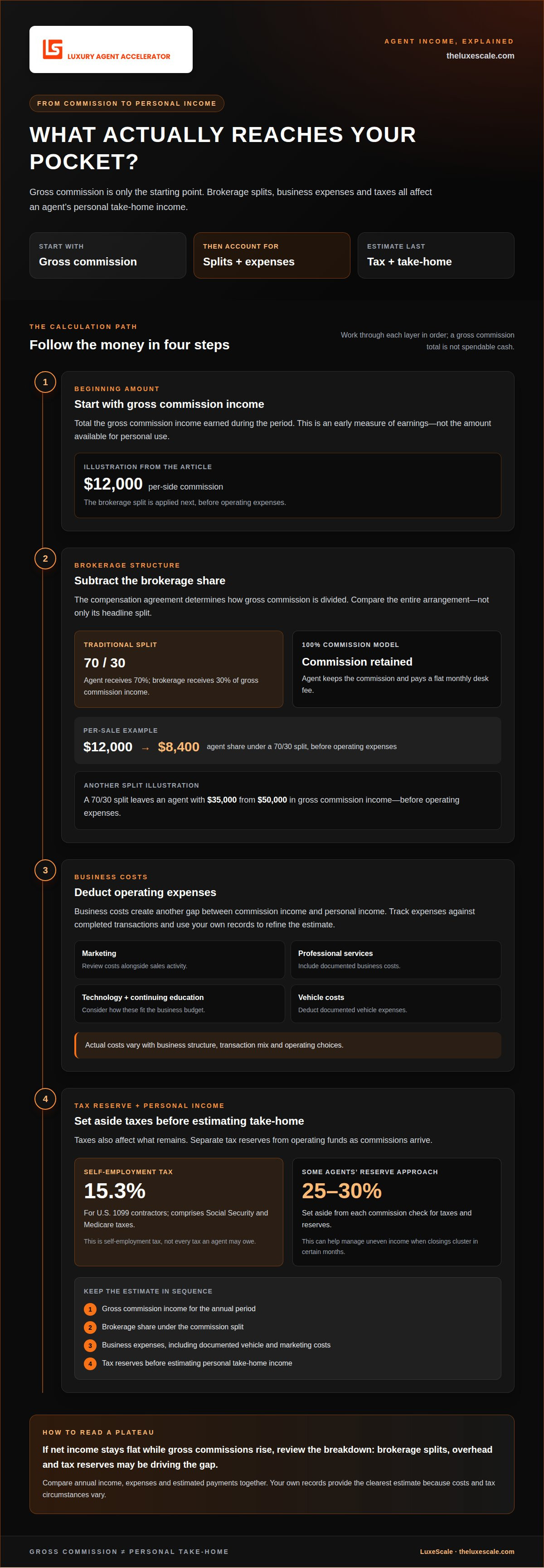
Consider a transaction generating $12,000 in per-side commission. Under a 70/30 commission split, the agent receives $8,400 before operating expenses. The same transaction volume can produce different gross income because commissions and compensation arrangements vary. Review those variables together to see whether a plateau comes from too few closings, smaller commissions, or the share retained.
Market and business models also affect what volume can produce. A 70/30 split leaves an agent with $35,000 from $50,000 in gross commission income, before operating expenses. That example shows why gross commission income is not equivalent to take-home income. State and local market conditions may shape transaction values and opportunity, while brokerage agreements determine how gross commission is divided.
Transactions Needed for an Income Increase
An agent needs enough additional completed sales to generate $25,000 in added annual income at the amount retained per sale. This calculation matters because transaction count alone doesn’t show how much income each closing contributes.
Use this simple calculation: divide the desired income increase by the amount retained from each completed sale, then round up to a whole transaction. If that retained amount changes, the required volume changes too. A target based on gross commission will differ from one based on income after the brokerage split, and both will differ from take-home income after expenses and taxes.
For a broader benchmark, an agent retaining $7,000 per sale would need approximately 14 transactions to reach $100,000 in gross commission income. That example addresses a total-income target, not a $25,000 increase. Keep the starting point clear, then evaluate average retained commission and completed transaction volume to set a practical production target.
Estimated agent take-home income
Gross commission income is only an early measure of an agent’s annual earnings. Brokerage splits, operating expenses, and taxes reduce the amount available as personal income. For a useful estimate, separate these deductions instead of treating gross commissions as take-home pay. The order matters: calculate the brokerage share first, then account for business costs and taxes.
Brokerage structure changes the share retained from each transaction. A traditional 70/30 split gives the agent 70% of gross commission income and the brokerage 30%. A 100% commission model works differently: the agent keeps the commission and pays a flat monthly desk fee. Compare the full structure, not just its headline split.
Operating expenses create another gap between commission income and personal income for the average U.S. real estate agent. Marketing, professional services, technology, and continuing education can also affect an individual business budget. Track expenses against completed transactions to see which costs support real estate sales and which deserve closer review.
Taxes also affect what remains. Self-employment tax for U.S. 1099 contractors is 15.3%, comprising Social Security and Medicare taxes, according to the Internal Revenue Service. That figure covers self-employment tax, not every tax an agent may owe. An agent’s tax position depends on income and circumstances, so avoid treating a gross commission total as spendable cash. Separate tax reserves from operating funds as commissions arrive.
A practical estimate follows a clear sequence:
- Start with gross commission income for the annual period.
- Subtract the brokerage share under the agent’s commission split.
- Deduct business expenses, including documented vehicle and marketing costs.
- Reserve funds for taxes before estimating personal take-home income.
Actual costs vary with business structure, transaction mix, and operating choices. Use your own records to refine the estimate.
Some agents set aside 25-30% of each commission check for taxes and reserves. That approach can help manage uneven income, especially when closings cluster in certain months. Review annual income, expenses, and estimated payments together. If net income stays flat while gross commissions rise, the breakdown can reveal whether splits, overhead, or tax reserves are driving the gap.
Strategies for increasing agent income
Income growth can come from more completed transactions, stronger conversion, or a better share of commission. The Bureau of Labor Statistics projects 3% employment growth for U.S. real estate brokers and sales agents from 2024 to 2034. That outlook describes employment, not an individual agent’s income. Build a growth plan around controllable factors: lead quality, time allocation, transaction follow-through, and brokerage structure.
Start by identifying where opportunities stall. Track inquiries, appointments, signed clients, and closed transactions as separate stages. If interest produces conversations but few appointments, refine qualification and follow-up. If appointments don’t become clients, review preparation and client needs. Cold real estate leads are estimated to convert at 1-3%, so a pipeline strategy should distinguish cold prospects from warmer referrals and active opportunities.
Next, evaluate the commission split alongside production expectations. Some brokerages use graduated splits, where an agent’s share may increase to 60/40 or 70/30 after revenue targets. A higher percentage can improve retained commission, but the threshold and terms determine whether it benefits a particular agent. Compare the structure with expected volume and support, rather than choosing based on the split alone.
Joining a real estate team may provide access to shared systems, lead flow, and administrative support, but it can also mean sharing commission and following team processes. Hiring an assistant adds compensation and management demands, with the risk that increased capacity may not generate enough additional business. Evaluate both choices by comparing the time they free up with the income or operating resources they require.
Protect prospecting time before adding overhead. Review a typical workweek and identify tasks that repeatedly interrupt client development, such as scheduling, document organization, or routine follow-up. An assistant may handle appropriate administrative work, while the agent stays focused on licensed real estate sales activities and client conversations. A team may fit better when you need shared coverage or a defined operating structure.
- Measure conversion at each pipeline stage, not only total lead volume.
- Compare commission percentage, performance thresholds, and team support together.
- Estimate whether added capacity can create enough completed business to justify its demands.
Continuing education and a current license support professional development, but neither replaces a clear acquisition and conversion strategy. Choose training that addresses a measurable business constraint, such as appointment conversion or client follow-through. Then compare results over a consistent review period. If activity rises without more closings or retained commission, adjust the strategy before expanding costs.
U.S. real estate agent income statistics
National income statistics offer context, but they don’t predict an individual agent’s earnings. Compare figures by occupation, year, and measurement before using them as benchmarks.
Income Changes With Experience
Experience-related income statistics compare agent earnings across career stages. U.S. REALTORS® with 16 or more years of experience had median gross income of $88,500 in 2025, while those with two years or less earned $8,100 annually. The difference highlights how production can vary across experience groups, but it doesn’t establish experience alone as the cause. Use these benchmarks to frame business planning, not to forecast personal income.
Other figures measure different groups or income categories. U.S. real estate sales agents had a median annual wage of $56,320 in May 2024, while real estate brokers had a median annual wage of $72,280 in May 2024. These labor statistics distinguish sales agents from brokers, and wages from gross REALTOR® income. A brokerage role, business expenses, and commission structure can affect how closely an individual’s earnings align with either measure.
Market Conditions and Local Competition
Market conditions affect how many transactions agents can close, while home prices influence the potential commission from each sale. Competition also shapes access to listings and clients. An agent in a high-price market may earn more commission per transaction, but income still depends on completed business, negotiated compensation, and brokerage terms. Compare opportunities with actual production, not home values alone.
National data captures broad patterns, not each local market’s economic conditions. The Bureau of Labor Statistics projects 3% employment growth for U.S. real estate brokers and sales agents from 2024 to 2034. That projection concerns employment growth, not individual earnings or local demand. Competition, transaction mix, and the supply of available listings can create different results from one area to another.
For additional context, U.S. real estate brokers and agents combined earned about $28 per hour at the median in May 2024. That hourly figure differs from annual income measures because agents’ workloads and transaction timing can vary. Real estate income may be irregular, with weeks or months between sales. Read each statistic alongside its time period and population.
Use a consistent comparison process:
- Match the statistic to the role, such as sales agent or broker.
- Check whether it measures wages, gross income, or gross commission income.
- Keep the reporting year and period attached to each figure.
- Compare national sources with local listings, prices, and completed transactions.
These distinctions make income statistics more useful. A median describes the midpoint of a group, not the expected result for every agent. Pair the right benchmark with transaction records and local economic conditions to identify whether production, market access, or compensation structure deserves closer attention.
How does real estate agent income change with years of experience?
Real estate income often changes as agents build transaction experience, strengthen client relationships, and refine business practices. Available figures show wide differences between career stages, but experience alone doesn’t determine earnings. Production, transaction mix, brokerage arrangements, and market access also shape results.
In 2023, U.S. Gross commission income can vary widely among REALTORS® at different career stages. REALTORS® with 16 or more years had median gross commission income of $87,200 that year. These figures compare groups and measure gross commission income, not take-home pay. They show how sharply production can differ across experience levels.
Longer careers don’t automatically produce higher incomes for every agent. In 2023, 40% of U.S. members with more than 16 years of experience made more than $100,000. That leaves a majority of this experienced group below that threshold. Use the statistic as context, then review your own closed business and retained commission to identify what experience is producing.
Career-stage benchmarks can help set practical priorities:
- Early practice: Build consistent client communication and transaction follow-through.
- Developing practice: Identify which lead sources and client segments produce completed business.
- Established practice: Review whether current systems and compensation structures support the next growth stage.
Agents with four to ten years of experience typically see their incomes stabilize in higher brackets. Stability can reflect a more established business, but it can also signal a ceiling if production and income stop advancing. Compare annual results across similar periods, separating completed transactions from pending opportunities. That distinction helps pinpoint whether the constraint is prospecting, conversion, or transaction execution.
Brokerage compensation can also shift with experience. Traditional commission splits commonly range from 50/50 for new agents to 80/20 or 90/10 for experienced agents. The split affects the agent’s share, but the best comparison also considers the opportunities and support attached to the structure. Evaluate how compensation and production combine before treating tenure as the main lever.
For an experienced agent seeking a new growth path, a stronger luxury-market pipeline may offer a way to pursue higher-value opportunities. Explore luxury listing opportunities as one possible direction for developing the next stage of your business.
LuxeScale
LuxeScale helps agents address income stagnation by connecting them with affluent real estate opportunities and business-development support. Luxury Listing Appointments, Affluent Seller Leads, and Affluent Buyer Leads help agents build a pipeline focused on high-end clients. Award-winning training, coaching, systems, and support complement those opportunities and help agents strengthen their conversion approach.
This may suit agents who have the experience to serve affluent clients but want a more structured path to those opportunities. It also lets agents consider lead access and professional development together, rather than treating income growth as a transaction-count problem alone.
If you’re ready to discuss how LuxeScale can support your growth, contact LuxeScale.
Build your next stage of growth
A plateau in real estate agent income is a useful prompt to reassess where your business is constrained. Decide which change deserves attention first: the opportunities entering your pipeline, your conversion process, or how you allocate time. A focused priority gives you a clearer basis for evaluating progress than adding activity without a defined purpose.
Then choose a growth path that fits the business you want to build. LuxeScale connects agents with luxury-market opportunities and provides accompanying training, coaching, systems, and support. If you’re ready to discuss how that approach could align with your goals, contact LuxeScale to discuss your goals.
Income growth takes deliberate choices and consistent execution. Set your next priority, strengthen your approach, and take the next step with confidence.
Frequently Asked Questions
How Much Do Real Estate Agents Make?
Real estate agent earnings vary with completed sales, compensation arrangements, expenses, and work patterns. One reported U.S. median annual pay figure was $58,960 in 2024. Compare that with care: income sources may measure wages, gross income, or commissions differently. An agent assessing personal earnings should distinguish closed transactions from pending deals and account for brokerage terms and operating costs before comparing results with a national benchmark.
What are the most common reasons real estate agents reach an income plateau?
Common causes include inconsistent prospecting, weak follow-up, low conversion, and relying on too few sources of business. A plateau can also develop when an agent’s workload grows but time shifts toward administrative tasks instead of client development. Look for patterns in the pipeline: if conversations don’t become appointments, qualification or follow-up may need attention; if appointments don’t progress, the issue may lie later in the sales process.
How do commission rates, brokerage splits, and transaction fees affect agent take-home income?
They determine how much of a closing’s commission remains after business obligations. The negotiated commission and brokerage split shape the agent’s share, while transaction-related charges may reduce it further. Because fee arrangements vary, read the brokerage agreement and transaction statements together. For example, compare the amount credited to the agent with the final amount received, then separate recurring business costs from charges tied to a specific closing.
How do top-producing agents grow income through referrals, teams, and repeat clients?
They build repeatable relationships rather than relying on one source of new business. A past client may refer someone with a similar need, while a team can coordinate coverage and divide responsibilities according to each member’s strengths. Keep referral sources and client origins organized, then stay in useful contact after a transaction closes. That follow-through supports future conversations without turning every interaction into an immediate sales pitch.
What strategies help real estate agents break through an income plateau?
To address a real estate agent income plateau, identify the stage where business is being lost before adding more activity. Review a recent group of prospects: Did they respond, book, proceed, or close? Choose one weak stage and improve the relevant process, such as qualification or follow-up. Then assess whether the change improves progression through the pipeline. This focused approach directs time toward the constraint instead of expanding overhead prematurely.

Article by
Mark Coppens
Mark Coppens is the Founder and Chairman of LuxeScale and Co-Team Lead of Living Vogue | eXp Luxury. He is an active elite-level luxury agent and the author of the upcoming book, POWER POSITIONING: From Missiles to Mansions – Why People Really Buy, and is a nationally recognized speaker on luxury real estate, consumer psychology, marketing, and business growth.
A U.S. Army veteran with an MBA in Marketing, Mark has generated more than $1 billion in career sales and now leads one of the nation's fastest-growing luxury referral platforms, referring more than $2 billion in luxury real estate opportunities each month to partner agents across the United States. He specializes in helping real estate agents generate more listings, break into the luxury market, and build scalable businesses through qualified referrals, award-winning training, coaching, and proven systems. His practical, psychology-driven approach has helped agents across the country increase their income while attracting more affluent clients and building lasting, referral-driven businesses.