
Real Estate Listing Referrals for Agents and Local Partners
The most resourceful real estate referral programs pair qualified introductions with trusted partners, clear agreements, and reliable follow-up. Even guaranteed real estate listing referrals are opportunities to earn a client’s business, not a substitute for strong service and conversion. 43% of U.S. buyers found their agent through a referral from a friend, neighbor, or relative.
It makes sense to seek a dependable source of referrals: the right introduction can connect you with clients who are ready to talk. But a network works best when its partners serve compatible clients without competing for the same transaction, and everyone understands the terms from the start.
This guide explains how referral networks connect buyers and sellers with agents, what to evaluate when choosing partners, and how informal introductions differ from formal referral arrangements. You’ll also see where qualified seller appointments fit into a focused growth strategy, helping you assess opportunities by client fit, service quality, and follow-through.
Key Takeaways
- Understand how referral networks connect clients with agents whose market knowledge and services fit their needs.
- Choose partners who share your service standards, values, and client base without competing for the same business.
- Set clear expectations for referrals, communication, and compensation, and account for applicable compliance requirements.
- Build a stronger network through consistent communication, reciprocal introductions, and dependable follow-through.
- Compare referral options by lead fit and the support provided, including LuxeScale’s luxury listing appointments, affluent leads, and accompanying training and coaching.
How referral networks match buyers and sellers with agents
Referral networks connect clients with agents whose market, availability, and service approach suit their needs. To assess a referral channel, find out how introductions are generated, what the agent pays, and what the agreement actually commits to.
Comparing Referral Channels
Zillow and Realtor.com are lead-generation platforms; agent-to-agent networks rely on professional relationships and client fit. A program advertising guaranteed real estate listing referrals should be assessed by its written definition of a qualified referral, delivery area, commitment period, and fee terms. Texas agent-to-agent referral fees commonly range from 20% to 35% of the receiving license holder’s commission.
Potential partners include agents in other markets, relocation professionals, and businesses that serve similar clients without competing for the same transaction. Compare how each channel qualifies prospects and handles introductions rather than assuming every inquiry is a likely listing.
Availability and Referral Commitments
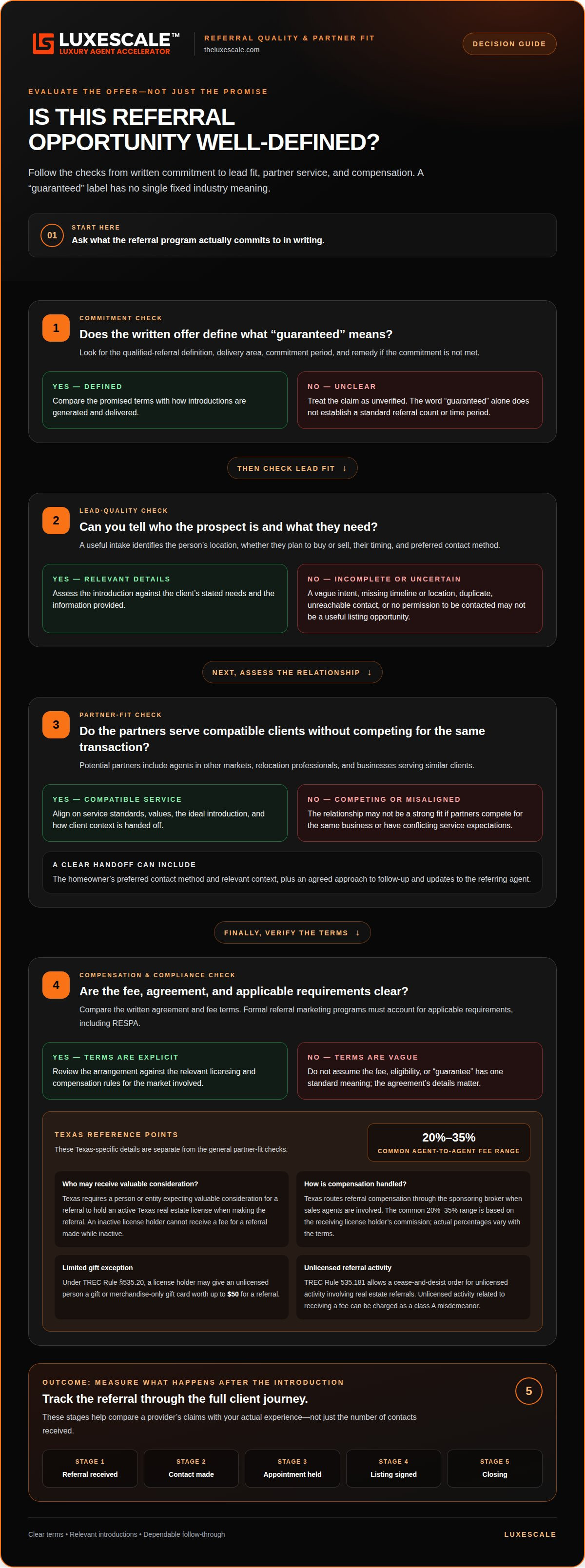
A provider’s market coverage and participating agents determine where its services operate. There is no universal referral count or time period: compare the written commitment, geographic boundaries, definition of a qualified lead, and remedy if the commitment is not met. “Guaranteed” is not a standard industry term with one fixed meaning, so read the details.
Eligibility varies by program. Agents may need to meet a network’s coverage, service, and participation criteria. Texas also has a separate licensing rule for people or entities receiving compensation for referrals.
A real estate referral agent connects a person with an active agent when the original agent cannot serve that client. In Texas, a person or entity expecting valuable consideration for a referral must hold an active Texas real estate license when making it, under Texas Occupations Code §1101.002. A license holder on inactive status cannot receive a fee for a referral made while inactive.
Texas also routes referral compensation through the sponsoring broker when sales agents are involved. Under TREC Rule §535.20, a license holder may give an unlicensed person a gift or merchandise-only gift card worth up to $50 for a referral. TREC Rule 535.181 allows the Texas Real Estate Commission to issue a cease-and-desist order for unlicensed activity involving real estate referrals. Unlicensed activity related to receiving a fee can be charged as a class A misdemeanor.
Are guaranteed listing referrals legal under federal and state rules? Referral arrangements must comply with applicable requirements, including RESPA for formal referral marketing programs. Texas separately requires an active license for a person or entity expecting valuable consideration for a referral.
VIP Realty’s referral-agent information highlights REALTOR dues and MLS fees as overhead to distinguish from referral compensation. Compare those obligations with the broker’s support and the agreed referral split; referral percentages vary with the terms, commonly falling between 20% and 35%.
Choosing partners based on trust and service quality
Choose partners whose client service aligns with yours and whose introductions fit your market. A clear qualification process helps you focus on prospects with relevant real estate needs rather than incomplete contact details.
Offer Risks and Red Flags
Risk increases when an offer uses “guaranteed” without defining the commitment, qualifying criteria, or remedy. Ask what counts as a delivered referral, which markets are covered, and how duplicates or unreachable contacts are handled.
Be wary of pressure to pay before the terms are clear, vague claims about a homeowner’s intent, or no way to assess lead quality. A seller inquiry without a timeline, location, or permission to be contacted may not be a useful listing opportunity.
Provider Claims and Referral Quality
Compare claims with the written agreement, sample lead details, and stated qualification criteria. For Clever referrals, assess each homeowner introduction based on the information provided, such as location, selling intent, and preferred contact method. Don’t assume every inquiry is equally ready.
Track each lead from receipt through contact, appointment, signed listing, and closing. These stages show where a provider’s claims match your actual experience.
Trust shows up in the details. Before forming a partnership, compare how each agent communicates with clients, follows up, and hands off introductions. For example, agree that the referring partner shares the homeowner’s preferred contact method and relevant context, while the receiving agent records the next action promptly.
Build referral relationships with partners who serve the same homeowners or buyers without competing for the same transaction. Relocation professionals may meet clients planning a move, while agents in other markets may need a trusted local realtor for a client’s destination. Define the ideal introduction before asking a partner to send one.
Start qualification with a short intake: confirm the person’s location, whether they plan to buy or sell, their timing, and how they prefer to be contacted. Record the details consistently. If a homeowner wants market guidance but has no immediate plans, classify the conversation accurately instead of treating it as a ready listing appointment.
When choosing a partner, consider service standards and shared values as well as lead fit. Ask how the partner communicates after an introduction, whether they update the referring agent, and how they handle a client who is not ready. These behaviors show whether the relationship supports the client experience or simply passes along contact information.
A practical scorecard can track the lead source, information provided, successful contact, appointment outcome, and client feedback. Review the record with your partner during regular business check-ins. If introductions repeatedly miss the agreed profile, refine the criteria together. If they convert well, identify which client needs and handoff practices helped.
Apply the same standard when comparing referral providers. A strong fit means the provider’s audience, homeowner screening, and agent expectations suit your capacity and market. Documented criteria and consistent follow-through are useful evidence; broad promises alone do not show whether referrals will serve your clients well.
Informal and formal referral agreements
A referral relationship may begin with a simple introduction or a documented business arrangement. Choose the structure based on how often professionals exchange clients, whether compensation is involved, and how clearly both parties can manage each transaction.
Informal arrangements: keep the handoff clear
An informal partnership can work when local professionals refer clients occasionally and expect reciprocal introductions. For example, an agent and a relocation professional can exchange business cards, provide card holders, and explain which clients each serves. A direct introduction with the seller’s preferred contact method gives the receiving agent useful context.
Agree on practical boundaries before the first handoff. Decide which markets and client needs are a fit, how the receiving agent will follow up, and whether they’ll notify the referring partner when contact occurs. These steps support the client experience without turning a casual relationship into a managed program.
Formal arrangements: document the terms
Written terms help professionals manage recurring referrals, compensation, and accountability. Define a referral, explain how to handle duplicate introductions, specify when compensation is earned, and describe how the receiving agent reports progress. Identify the responsible broker where applicable and align the agreement with the transaction process.
Referral percentages depend on negotiated terms. Real estate referral fees can range from 20% to 35% of the receiving agent’s commission. Agent-to-agent referrals across markets commonly use 25% to 35% of the commission. Define whether the agreed share applies to the commission actually received, rather than leaving the calculation open to interpretation.
Before signing, walk through a sample transaction. If one agent introduces a seller who later lists with another professional, identify what triggers payment and who records it. Clarify what happens if the seller does not proceed, changes agents, or completes a different transaction. Concrete examples can reveal gaps before competing expectations arise.
Formal referral marketing programs need more management and resources than informal arrangements. Set up a process to record the source, share status updates, resolve disputes, and review whether introductions match the intended client profile. A simple handoff record helps partners distinguish a genuine opportunity from a name passed along without context.
Plan for compliance when drafting the agreement. Agents considering formal referral marketing programs should ensure they comply with RESPA. Keep compensation terms transparent among the relevant professionals and involve the appropriate broker. A written process also helps identify business relationships that need closer review.
Start by documenting the referral definition, client handoff, communication expectations, and compensation terms. Review the arrangement after completed transactions and clarify any ambiguous language. This supports a consistent seller experience while helping professionals maintain trust, protect their business interests, and make each referral relationship useful.
Building a referral network
A productive network grows through consistent service, deliberate outreach, and follow-through. Identify the clients you serve best, then connect with professionals who encounter them at different decision points. A clear client profile helps partners recognize when an introduction is a good fit.
Past clients are a strong foundation. The National Association of Realtors’ 2025 Member Profile reports that referrals from past clients accounted for a median of 21% of Realtors’ business. Repeat clients and past-client referrals together represented about 41% of the typical Realtor’s business. Make those relationships active sources, not names stored and forgotten.
Client recommendations can continue after the transaction. In the NAR 2025 Profile of Home Buyers and Sellers, 91% of buyers said they would use their agent again or recommend them. The same profile reports that 62% recommended their agent within a year of buying. Build a simple post-closing routine that invites feedback and stays useful after move-in.
Organize your contacts before expanding outreach. A suggested A-tier past-client and sphere database often contains 30 to 50 people. Group contacts by relationship, location, and likely needs, then record the last meaningful interaction. This makes it easier to personalize communication instead of sending every member the same generic update.
Maintain a practical cadence: send a local market activity report to past clients and your sphere quarterly, and share one local market insight weekly. A chart about neighborhood inventory or pricing gives an update a clear purpose. Add a short explanation of what the information could mean for homeowners considering a move.
Make reciprocity visible. When a client needs a partner’s expertise, refer them to that partner and let the partner know. Consistent communication keeps the relationship active and gives both professionals a chance to close the loop. For example, an agent can introduce a relocating client to a trusted local professional and share the client’s preferred handoff details.
Review the network as it grows. Track each source, introduction, appointment, and outcome in a simple record, then note which relationships produce the best client fit. Among agents with 16 or more years of experience, referrals accounted for roughly 28% of business in the NAR 2025 Member Profile. Use that benchmark as context, not a target; strengthen the practices that earn repeat trust in your own market.
Build momentum with personal follow-up and useful local information. Buyers who received excellent service may become future advocates, while community professionals may meet sellers before they actively search. A reliable system makes each conversation easier to tailor, measure, and improve.
Which companies offer guaranteed seller listing referrals to real estate agents?
Providers generally fall into three groups: agent referral networks, real estate lead platforms, and services that qualify seller prospects and schedule listing appointments. The labels can overlap, so compare what the agent actually receives. It could be contact information, a conversation with stated selling interest, or a scheduled appointment. Those are distinct deliverables.
Agent-to-agent networks pass clients between professionals, often when the referring agent cannot serve a particular market. An agent may receive a seller who is moving elsewhere and refer the homeowner to a professional familiar with the destination. Before accepting the introduction, the receiving agent should understand the client’s needs and the referral terms.
Lead platforms typically connect agents with people who have expressed interest in real estate services. A platform lead is not automatically a listing appointment: the agent may still need to make contact, establish selling intent, and secure a meeting. Before treating platform leads as guaranteed opportunities, compare qualification steps, exclusivity, market coverage, and the payment trigger.
Appointment-focused services may screen and schedule before passing a seller introduction to an agent. A handoff, for example, might include the homeowner’s location, preferred contact method, and requested meeting time. Check whether a delivered appointment means confirmed attendance or simply an event added to the calendar. That difference affects the value of the commitment.
Don’t choose a provider based on its headline promise alone. Request the written definition of a qualified seller referral, the markets served, the commitment period, and the process for missed or unsuitable introductions. Compare those terms with your capacity to respond and serve the homeowner. Value depends on fit, not volume alone.
“Guaranteed” does not establish a standard referral count across the industry. The number and period depend on each provider’s written terms, market availability, and definition of a qualifying referral. The commitment is meaningful only when the agreement explains what counts, when it is delivered, and what remedy applies if the terms are not met.
For a practical comparison, record each provider’s criteria in the same format:
- Lead type: contact, screened seller, or scheduled listing appointment.
- Coverage: the specific state, local market, and agent participation requirements.
- Commitment: the promised volume and period, as written in the agreement.
- Economics: how and when any referral compensation is calculated and paid.
Use those details to distinguish a referral source from a genuine listing opportunity. The seller’s motivation, location, timing, and willingness to meet all affect whether an introduction can develop into a client relationship.
LuxeScale: Luxury Listing Appointments
LuxeScale connects agents seeking luxury-market growth with Luxury Listing Appointments and Affluent Seller Leads. These services suit agents seeking qualified seller opportunities while focusing their time on client conversations and service. Agents can also access Affluent Buyer Leads and accompanying award-winning training, coaching, systems, and support to strengthen how they manage referrals.
LuxeScale’s model is a practical next step if your growth plan centers on affluent buyers and sellers and you’re ready to follow up and build trust throughout the transaction. Referrals come with training and systems to help agents convert opportunities, rather than relying on introductions alone.
To explore whether LuxeScale fits your business goals, visit LuxeScale online.
Turn referral strategy into your next growth move
Your next growth decision is about focus. Treat guaranteed real estate listing referrals as a potential entry point, not as the measure of a lasting business relationship. Ask whether the opportunity aligns with the clients you serve, the expertise you want to build, and the way you want your business to grow.
Choose one priority for the next phase of your business, then make your next step serve it. You might refine the kind of client you want to attract, improve how you handle introductions, or explore a path into the luxury market. A deliberate choice helps you direct your attention and assess future opportunities against a clear business goal.
If you’re ready to discuss referral opportunities and your growth goals, contact LuxeScale about referrals. Take the next step with clarity and build toward the business you want.
Frequently Asked Questions
What are the most resourceful referral programs?
The most useful programs combine relevant introductions with a practical handoff and support for agents. Agent-to-agent networks can help when clients need representation in another market. For luxury-focused agents, LuxeScale provides Luxury Listing Appointments, Affluent Buyer Leads, and accompanying training, coaching, systems, and support. Compare programs by their qualification process, appointment format, territory terms, and the tools agents receive to serve referred clients.
Can I pay to receive more leads than other agents?
Payment alone does not guarantee priority or a larger share of leads. LuxeScale provides qualified appointments exclusively to the agent assigned to a territory, and territory availability is limited. Before joining a program, understand how it assigns agents, defines exclusivity, and handles referrals when a territory is unavailable.
How can I attract referrals?
Make it easy for clients and professional contacts to understand whom you can help. For example, tell a past client about the property type or buyer situation you specialize in, then give them a simple way to introduce someone with that need. Acknowledge introductions and deliver a consistent client experience. Clear expertise and thoughtful follow-through give people a specific reason to recommend you.
How do you structure a referral agreement?
Set out the referral definition, parties, compensation terms, payment trigger, communication expectations, and process for resolving duplicate or disputed introductions. Include an example, such as a seller introduced by one agent who later signs with another. Identify the responsible brokers where applicable and ensure formal referral marketing arrangements comply with RESPA. Clear written terms explain what happens at each stage of a transaction.
What does a guaranteed real estate listing referral mean?
It means the provider commits to a defined seller referral or appointment under stated conditions; it doesn’t mean the homeowner will sign a listing agreement. The commitment’s meaning depends on what the provider counts as delivery. LuxeScale specifies a minimum of 6 and maximum of 8 qualified luxury client appointments per member each month. Read the criteria to understand what qualifies as an appointment.
How do guaranteed real estate listing referral programs work?
Programs define the referral, identify eligible agents, and deliver introductions or appointments according to their terms. LuxeScale uses a 23-step qualification system that screens prospects for motivation, intent, timing, financial readiness, and fit. Agents then handle the client conversation and listing process. Review how a program documents delivery and what support accompanies referrals so you can plan your follow-up and client service.
What are the costs, fees, or commission splits for guaranteed listing referrals?
Terms depend on the referral program and agreement. LuxeScale’s model has No Monthly Fees, follows Pay Only When You Close, charges a 25 % referral fee only when a transaction closes, and has No Contract. The fee is tied to a completed transaction, not an upfront payment. Compare any program’s written compensation terms, including the calculation basis and payment trigger, before accepting referrals.
What contract terms, exclusivity rules, and cancellation policies apply?
The answer depends on the program’s written terms. Review the agreement period, renewal language, notice requirements, exclusivity boundaries, and treatment of pending referrals if participation ends. LuxeScale has No Contract and assigns referrals exclusively within a territory, with limited territory availability. Don’t assume every provider follows the same cancellation rules; understand the specific terms before participating.

Article by
Mark Coppens
Mark Coppens is the Founder and Chairman of LuxeScale and Co-Team Lead of Living Vogue | eXp Luxury. He is an active elite-level luxury agent and the author of the upcoming book, POWER POSITIONING: From Missiles to Mansions – Why People Really Buy, and is a nationally recognized speaker on luxury real estate, consumer psychology, marketing, and business growth.
A U.S. Army veteran with an MBA in Marketing, Mark has generated more than $1 billion in career sales and now leads one of the nation's fastest-growing luxury referral platforms, referring more than $2 billion in luxury real estate opportunities each month to partner agents across the United States. He specializes in helping real estate agents generate more listings, break into the luxury market, and build scalable businesses through qualified referrals, award-winning training, coaching, and proven systems. His practical, psychology-driven approach has helped agents across the country increase their income while attracting more affluent clients and building lasting, referral-driven businesses.