
Real estate referral fee calculator: Calculate what you owe
A real estate referral fee isn’t automatically a prohibited kickback. In the United States, federal RESPA permits referral arrangements between licensed real estate agents, while the Consumer Financial Protection Bureau says RESPA prohibits kickbacks and unearned fees for referrals to settlement service providers. A real estate referral fee calculator can estimate the amount by multiplying the commission on the referred side by the agreed referral percentage.
It’s reasonable to want a clear figure before a transaction closes. To calculate a real estate referral fee, use the commission earned on the referred side, not the home’s sale price alone. Then account for the referral agreement and the receiving agent’s brokerage split.
This guide explains the calculation, walks through sample figures, and clarifies the distinction between a brokerage referral and a prohibited settlement-service kickback. You’ll also learn what a written referral agreement should cover and how a pay-at-closing referral arrangement can fit into an agent’s business model.
Key Takeaways
- Base the estimate on the commission for the referred side, rather than applying the referral percentage directly to the home’s sale price.
- Account for the referral deduction before calculating the receiving agent’s brokerage split to avoid overstating take-home commission.
- A written referral agreement can clarify the fee, parties, client, and terms before the referral proceeds.
- Referral percentages can vary, so the agreed rate and the commission actually earned are central to the final amount.
- See how qualified affluent seller opportunities and coaching may support agents building a luxury-market business.
Calculating a referral fee from sale price and commission
Calculate the fee from the commission earned on the referred side, not automatically from the full sale price. The key inputs are the final sale price, that side’s commission rate, and the referral percentage set in the agreement.
Sale Price and Commission Inputs
A referral-fee estimate uses the sale price and commission rate for the side represented by the receiving agent. This matters because the total commission for both sides may differ from the commission earned on the referred side.
If the agreement instead sets the referred side’s rate at 3%, use that rate for the referral calculation. A realtor commission calculator needs these figures and the agreed referral percentage. It may also need the second-side rate when both sides are represented.
Gross and Net Commission Amounts
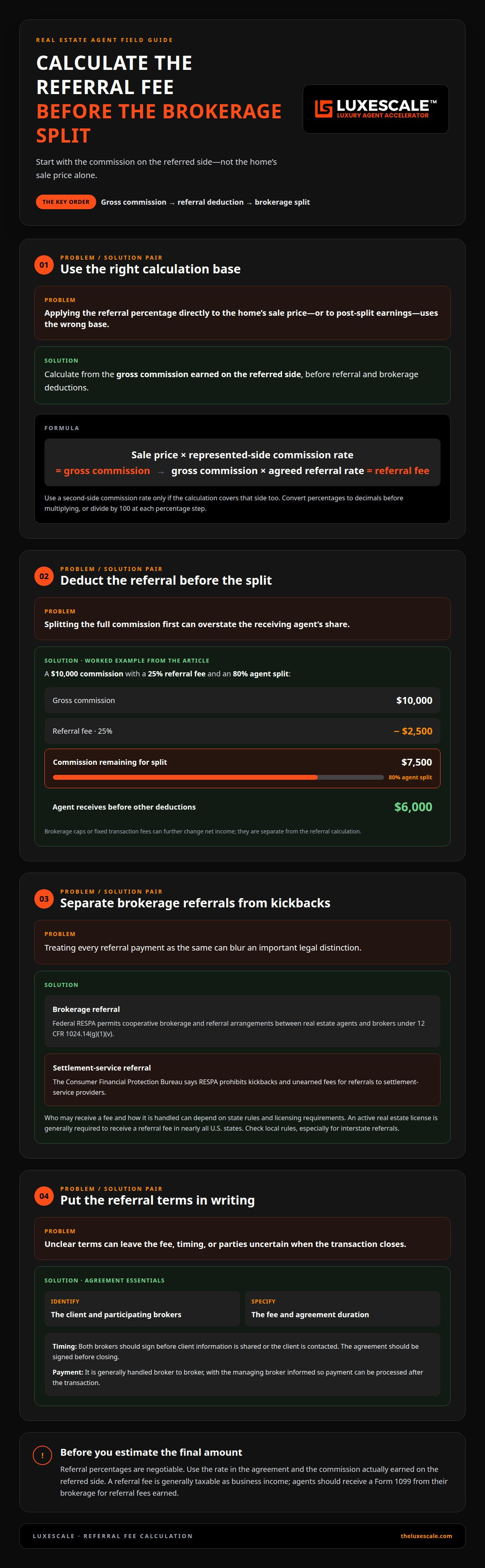
Gross commission is the amount earned before deductions. Net commission is what remains after applicable referral and brokerage charges. The distinction matters because a percentage-based referral fee is generally calculated from gross commission, before the receiving agent’s brokerage split.
A calculator that starts with an agent’s post-split earnings uses the wrong base for this calculation.
Use this sequence: multiply the relevant sale price by the commission rate, then multiply that gross commission by the referral percentage. For a $500,000 sale with a 3% commission on one side, gross commission is $15,000. A 20% fee on $20,000 in commission is $4,000, leaving $16,000 to split.
The referral deduction comes first; applying the split to the full $15,000 would overstate the receiving agent’s share. Brokerage caps or fixed transaction fees can further change net income, so distinguish those deductions from the referral calculation.
To use a calculator, enter the sale price, the commission rate for the represented side, and the referral percentage in the agreement. Add a second-side rate only if the calculation covers that side too. A referral fee is generally taxable as business income, and agents should receive a Form 1099 from their brokerage for referral fees earned.
Is a real estate referral fee legal?
In the United States, referral fees between licensed real estate agents can be permitted, but the arrangement matters. The key distinction is between brokerage referrals and payments for settlement-service referrals.
Referral Fees Before Brokerage Splits
If the referral fee is deducted before the brokerage split, calculate the receiving agent’s share from the commission remaining after that fee. Applying the split to the full commission would overstate the agent’s earnings.
For example, a $10,000 commission less a 25% referral fee leaves $7,500. With an 80% commission split, the agent receives $6,000 before other deductions. A commission calculator should reflect the referral deduction first.
Referral Agreements and Broker Payments
A referral agreement records the client, fee, participating brokers, and agreement duration. Clear written terms establish how the referral will be handled before the transaction closes.
Both brokers should sign the agreement before the referring agent shares client information or contacts the client. Specify how long the agreement remains in effect, and sign it before closing. Payment is generally handled broker to broker, with the managing broker informed so payment can be processed after the transaction.
Local Rules for Referral Fees
State rules and licensing requirements affect who may receive a referral fee and how brokers handle it. This is especially important when the referring and receiving agents work in different states.
An active real estate license is generally required to receive a referral fee in nearly all U.S. states. For an interstate referral, the referring agent generally needs an active license in their own state, but not necessarily in the state where the transaction takes place. Some states also prohibit broker rebates by law.
Federal RESPA permits cooperative brokerage and referral arrangements between real estate agents and brokers under 12 CFR 1024.14(g)(1)(v). The Consumer Financial Protection Bureau states that RESPA prohibits kickbacks or unearned fees for referrals to settlement-service providers. A payment for a brokerage referral is distinct from a prohibited payment tied to settlement services.
Local policies and the written agreement affect the amount and payment process. Referral percentages are negotiable, and broker policies may influence the final terms. Distinguish a brokerage referral from a settlement-service referral before calculating agent commission.
Discount brokers may structure their services differently, and a lower-cost model can involve service trade-offs. Sellers may handle photography, marketing, advertising, and open houses themselves. These differences concern the brokerage service arrangement, not whether a separate referral payment complies with applicable rules.
Referral fee calculation formula
Calculate a referral fee from the commission earned on the referred side. The formula is: sale price × commission rate × referral percentage.
A real estate referral fee calculator applies the inputs in sequence. First, multiply the sale price by the commission rate to find gross commission. Then multiply that amount by the referral percentage. Convert each percentage to a decimal before multiplying, or divide by 100 at each percentage step.
At a 20% referral rate, the referring brokerage receives $3,750. Subtracting that fee leaves $15,000 before the receiving brokerage’s split and other deductions.
If the agreement specifies a flat referral amount instead of a percentage, use that amount rather than applying a percentage to gross commission. The agreement sets the method, and the amount due depends on the commission actually earned from the transaction.
- Calculate gross commission using the sale price and the commission rate for the represented side.
- Subtract the referral percentage or flat fee, then any team, lead, or optional miscellaneous percentage deductions.
- Apply the brokerage portion, limited to the smaller of the calculated share or the remaining cap amount.
- Subtract transaction and other fixed fees from the remaining amount.
This sequence keeps the referral calculation separate from the later net-income estimate. A franchise or royalty charge may follow the referral deduction, while a brokerage cap can limit the brokerage portion. The compensation plan determines which additional deductions apply. Counting a deduction twice would understate the agent’s estimated proceeds.
A listing-side example also shows why the represented side matters. If a sale price is $450,000 and the commission rate for that side is 3%, gross commission is $13,500. Don’t calculate from both sides unless the agreement or estimate covers both.
Use a spreadsheet or commission calculator to model the transaction, keeping gross commission, referral payment, brokerage share, and final net amount distinct. Check each rate against the relevant agreement and compensation plan. This makes it easier to trace the estimate from sale price to the amount remaining after deductions.
Sample fee calculations
Sample calculations show how the referral rate affects the amount remaining after a transaction. Start with gross commission for the represented side, then apply the agreed referral percentage and brokerage split.
Consider a $400,000 sale with a 3% commission on one side. Gross commission is $12,000.
Changing only the referral rate changes both figures.
These comparisons isolate the referral percentage. A real transaction may also include a franchise fee, team deduction, brokerage cap, or fixed transaction charge. Keep these amounts separate from the referral-fee calculation because they affect net income, not the referral amount. Otherwise, an agent may mistake a post-deduction figure for gross commission.
A commission rate can also change the starting amount. On a $400,000 selling price, a 2.5% commission for one represented side produces $10,000 in gross commission. At a 25% referral rate, the fee is $2,500, leaving $7,500 before the brokerage split. If the applicable agreement uses a different rate, recalculate gross commission before applying the referral percentage.
The seller’s total real estate commission and the receiving agent’s referral calculation aren’t automatically the same. A transaction may involve separate commission arrangements for the listing side and buyer’s side. Calculate each represented side independently, and combine the amounts only if the referral agreement applies to both.
For a quick comparison, keep the inputs consistent: sale price, commission rate, referral percentage, and commission split. Change one input at a time to see its effect.
Before treating the result as the agent’s final earnings, apply the brokerage’s actual split and any other applicable deductions. The calculation estimates commission distribution; the agreement and compensation plan determine the amounts owed.
Typical and negotiable real estate referral fee percentages
A 25% referral percentage is widely described as a standard rate for U.S. agent-to-agent referrals. Actual terms can differ: reported ranges include 20% to 35% or higher, while HousingWire reports referral fees ranging from 25% to 40%.
These ranges are reference points, not mandatory rates. Real estate referral fees are usually negotiable, and the final percentage depends on the agreement between the referring and receiving brokers. Both parties should clearly define the fee basis, including which side’s gross commission applies.
Lead quality and market conditions can influence the negotiated percentage. A referral involving a qualified prospect or a strong likelihood of a transaction may have different terms from one that provides little context. The work involved, brokerage policies, and expected client relationship can also shape negotiations.
Calculate the impact before agreeing. The receiving agent’s net share will be lower after the brokerage split and other deductions.
That difference matters when comparing percentages. Use the same commission base for each estimate so the comparison remains meaningful.
Treat the written agreement as the controlling record of the negotiated percentage and payment terms. Specify whether the fee applies to gross commission for one represented side or another defined amount. Clear wording reduces the risk of applying a percentage to the total commission when the agreement covers only one side.
When assessing a proposed rate, compare the fee with the expected commission and the work attached to the referral. A 25% percentage on a modest commission can produce a smaller payment than a lower percentage on a larger commission. The transaction’s actual gross commission, not the sale price alone, determines the fee under a commission-based arrangement.
Estimate more than the referral payment. Include the receiving agent’s commission split and applicable brokerage deductions to see what remains. This gives both brokers a consistent basis for discussing the terms.
LuxeScale
LuxeScale helps real estate agents build a stronger pipeline of affluent clients. If you’re evaluating referral economics alongside your next growth opportunity, its Luxury Listing Appointments, Affluent Seller Leads, and Affluent Buyer Leads can connect your business with luxury-market prospects. Accompanying Award-Winning Training, Coaching, Systems, and Support helps agents develop their approach to referred opportunities.
These calculations help you assess how a referral fee affects commission. If you want qualified luxury opportunities alongside support to help you convert them, LuxeScale’s Pay-At-Closing Referral Network offers a practical next step.
For a straightforward conversation about growing your pipeline, contact LuxeScale.
Turn the Numbers Into a Stronger Growth Plan
Use a real estate referral fee calculator as one part of a broader business decision. The right opportunity should fit your market focus, client-service approach, and capacity to convert qualified prospects. A clear compensation plan gives you a firmer basis for deciding which referrals support your goals.
For agents building a luxury-market pipeline, LuxeScale offers Luxury Listing Appointments and Affluent Buyer Leads, supported by Award-Winning Training, Coaching, Systems, and Support. These offerings connect lead generation with practical development, helping you approach opportunities with a more structured plan.
Your next step can be a focused conversation about the kind of growth you’re pursuing and how referral opportunities fit. Contact LuxeScale to discuss your needs, and take the next step toward a more deliberate pipeline.
Frequently Asked Questions
Is the referral fee taken before or after the broker split?
In a typical agent-to-agent arrangement, the referral fee is deducted from the receiving side’s gross commission before the receiving agent’s brokerage split. The brokerage calculates the remaining commission after the referral payment, then applies the agent’s split. The written agreement and brokerage compensation plan determine the terms, so keep the referral deduction separate from later brokerage charges when reviewing a closing statement.
What is a Standard Referral Fee?
A 25% share of the receiving side’s gross commission is commonly described as the standard agent-to-agent referral fee in the United States. It’s a reference point, not a mandatory rate. Brokers can negotiate a different percentage or use a flat amount, depending on their arrangement. The written agreement should identify the fee basis and payment terms so both brokerages calculate the same amount when the transaction closes.
How do you calculate a real estate referral fee?
Multiply the commission earned on the referred side by the agreed referral percentage. For a quick check, convert the percentage to a decimal and multiply it by gross commission. If the agreement sets a flat fee, use that amount instead. Keep the sale price, commission rate, and referral rate distinct: applying the referral percentage directly to the sale price uses the wrong calculation base.
What is the typical real estate referral fee percentage in the U.S.?
A 25% referral fee is widely described as a typical U.S. agent-to-agent rate. Reported arrangements commonly fall within a 20% to 35% range or higher, depending on the lead and market. HousingWire reports a range from 25% to 40%. These figures describe reported practices, not a fixed rule. The percentage in the signed agreement controls the calculation for that referral.
Is a real estate referral fee calculated before or after commission splits and expenses?
Calculate a commission-based referral fee from gross commission, before the receiving agent’s brokerage split. Then apply the split and account for applicable expenses or other deductions separately. This order distinguishes the referral amount owed between brokerages from the receiving agent’s eventual net earnings. A compensation plan may include caps or fixed charges, so record each deduction on its own line in the estimate.
How do you calculate a referral fee from the gross commission on a home sale?
Multiply the gross commission for the referred side by the agreed percentage. Use only the commission covered by the referral agreement, not automatically the total commission from both sides.
Are real estate referral fees negotiable, and what factors affect the rate?
Yes. Real estate referral percentages are negotiable between the parties, and the written agreement should capture the final terms. Relevant considerations include the referred prospect’s quality and readiness, the expected work involved, brokerage policies, and the market. Compare proposed rates using the same gross-commission basis; otherwise, estimates may appear different simply because they use different commission amounts or sides of the transaction.
What rules govern real estate referral fees between agents and brokers in the U.S.?
Federal RESPA rules permit cooperative brokerage and referral arrangements between real estate agents and brokers under 12 CFR 1024.14(g)(1)(v). The Consumer Financial Protection Bureau says RESPA prohibits kickbacks or unearned fees for referrals to settlement-service providers. State licensing rules also matter: an active real estate license is generally required to receive referral fees in nearly all states. A written broker-to-broker agreement records the parties and terms.

Article by
Mark Coppens
Mark Coppens is the Founder and Chairman of LuxeScale and Co-Team Lead of Living Vogue | eXp Luxury. He is an active elite-level luxury agent and the author of the upcoming book, POWER POSITIONING: From Missiles to Mansions – Why People Really Buy, and is a nationally recognized speaker on luxury real estate, consumer psychology, marketing, and business growth.
A U.S. Army veteran with an MBA in Marketing, Mark has generated more than $1 billion in career sales and now leads one of the nation's fastest-growing luxury referral platforms, referring more than $2 billion in luxury real estate opportunities each month to partner agents across the United States. He specializes in helping real estate agents generate more listings, break into the luxury market, and build scalable businesses through qualified referrals, award-winning training, coaching, and proven systems. His practical, psychology-driven approach has helped agents across the country increase their income while attracting more affluent clients and building lasting, referral-driven businesses.