
Standard Real Estate Referral Fee Percentage: Typical Rates and How They’re Set
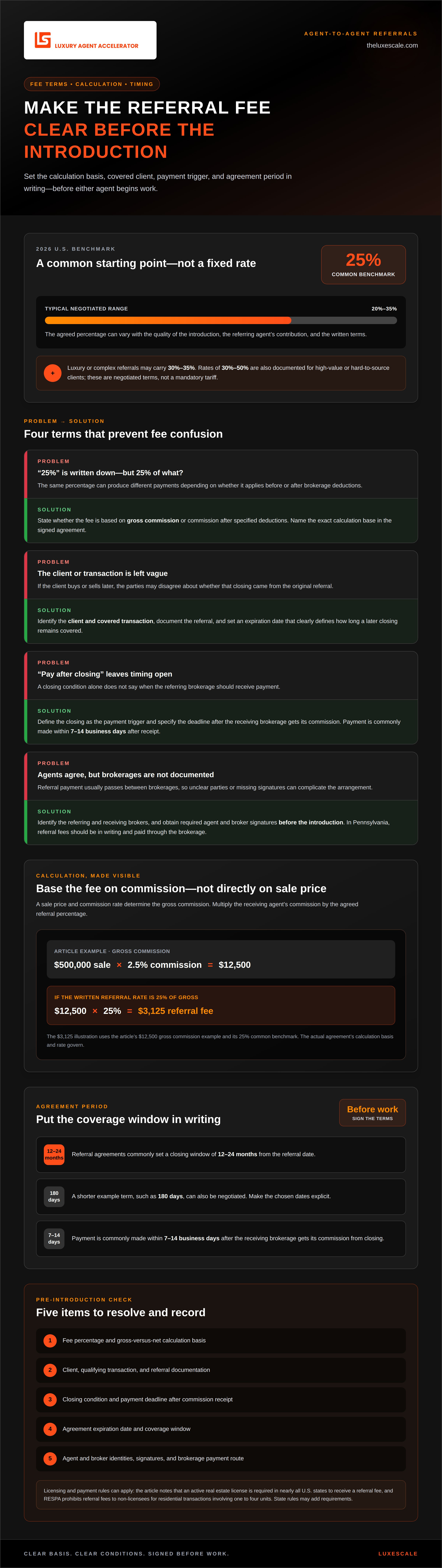
A 25% referral fee is a common benchmark in the United States, though the standard real estate referral fee percentage in 2026 can range from 20% to 35%. The fee is generally calculated from the receiving agent’s gross commission, not the property’s sale price.
That benchmark is a useful starting point, not a fixed rate. The agreed percentage can vary with the quality of the introduction, the referring agent’s contribution, and the terms in the referral agreement.
This guide explains how agents negotiate the fee, calculate it from gross commission, and account for transaction details that affect the final amount. Clear terms spell out what is owed, when payment is due, and how the arrangement works if the deal closes.
Key Takeaways
- Put the referral terms in a signed agreement before either agent begins work, including the fee basis, payment conditions, and expiration date.
- Clarify whether the percentage applies before or after brokerage deductions; that distinction changes the amount used in the calculation.
- Referral value depends on the introduction: a qualified, ready-to-act client can support different terms than a name and contact detail alone.
- Account for the brokerage split when estimating what remains for the receiving agent after the referral payment.
- For agents building a luxury pipeline, LuxeScale connects qualified affluent seller opportunities with Luxury Listing Appointments and accompanying training, coaching, systems, and support.
What Is the Typical Real Estate Referral Fee Percentage in 2026?
A 25% referral fee is a common U.S. benchmark in 2026, with typical rates ranging from 20% to 35% of the receiving agent’s commission. The agreed percentage affects the commission available after brokerage splits, so the fee basis matters as much as the rate.
Referral Fees and Commission Splits
A referral fee is a negotiated share of commission paid for introducing a client to a receiving agent. The agreement may base the share on gross commission before the brokerage split or on net commission after specified deductions. These methods produce different payments, even when they use the same percentage.
For example, a $500,000 sale with a 2.5% referred-side commission produces $12,500 in gross commission. State the calculation basis in writing.
Calculating Fees from Gross Commission
To calculate a referral fee on gross commission, multiply the receiving agent’s commission by the agreed percentage. The fee is not calculated directly from the home’s sale price, although the price and commission rate determine the gross commission.
Calculating the fee on gross commission gives both brokerages a clear starting figure at closing.
When Fees Exceed the Standard Range
Referral fees can rise when an introduction is highly qualified, difficult to source, or tied to a high-value or complex transaction. Luxury and complex referrals may carry 30% to 35%; negotiated rates of 30% to 50% are also documented for high-value or hard-to-source clients.
A higher rate reflects the referral’s value and the referring agent’s contribution, not a mandatory industry tariff. The receiving agent should consider the likely commission, expected service demands, and whether the written terms apply the percentage before or after brokerage deductions.
Referral Types and Fee Comparisons
Buyer, seller, and commercial referrals may have different negotiated terms because the transactions, commission structures, and referral work can vary. The percentage does not automatically change by client type; the agreement defines the fee basis and payment conditions.
A referral fee compensates the referring brokerage for an introduction. An agent-to-agent commission split, by contrast, divides compensation for work within a transaction. Lead-generation fees follow their own agreements, so these arrangements are not interchangeable. The Consumer Financial Protection Bureau says RESPA permits cooperative brokerage and referral payments between agents and brokers only when all parties act in a real estate brokerage capacity.
In nearly all U.S. states, an active real estate license is required to receive a real estate referral fee. RESPA also prohibits paying referral fees to non-licensees for residential transactions involving one to four units, and state rules may add requirements. Route the arrangement through the appropriate brokerage and document its terms before making the referral.
Referral agreements and fee calculation basis
A referral agreement records how the referring agent and receiving brokerage will handle a client introduction. Before work begins, define the fee basis, qualifying transaction, payment trigger, and agreement period.
Questions for Referral Agreements
Questions about a referral agreement clarify how payment works and what conditions preserve each party’s claim. Resolve these points before introducing the client:
- Does the percentage apply to gross commission or commission after specified deductions?
- Which client and transaction does the agreement cover, and how will the referral be documented?
- Does payment depend on closing, and when must the receiving brokerage pay after receiving commission?
- What expiration date applies if the client buys or sells later?
- Do both agents and their brokers need to sign?
Clear answers help prevent disputes about whether a later transaction resulted from the original referral. They also establish how to calculate the fee and when the referring agent’s claim ends.
Negotiating and Documenting Agreements
Agents negotiate the rate and terms, then put them in a written, signed agreement before either agent starts work. Specify the fee, calculation basis, payment conditions, expiration date, and agent and broker signatures.
Referral agreements commonly set a closing window of 12 to 24 months from the referral date. The written period determines whether a later closing remains covered. A shorter example term, such as 180 days, can also be negotiated; the agreement should make the chosen dates clear.
Set the payment trigger precisely. Referral fees are contingent on the referred transaction closing, and brokerages commonly pay one another rather than listing the referral payment as a separate seller charge. Payment is commonly made within 7 to 14 business days after the receiving brokerage gets its commission from closing. A clear deadline helps both brokerages reconcile the transaction.
Broker-to-broker documentation matters because payment usually passes through the brokerages. The referring and receiving agents should identify their respective brokers and obtain the required signatures before making the introduction. In Pennsylvania, referral fees should be in writing and paid through the brokerage.
For a specific form example, California Association of REALTORS Form RFA bases the fee on the receiving broker’s total gross compensation on the client’s side, before the broker’s internal split. It also allows a flat dollar amount instead of a percentage. This is why the agreement should specify the calculation base, not just the rate.
Negotiate based on the introduction and each party’s responsibilities, then record every agreed term in one signed document. If the client’s transaction falls within the stated period and closes, the written payment conditions govern the referral fee.
Typical agent-to-agent referral fee percentages
Agent-to-agent referral fees in the United States are negotiated, not set by a single required percentage. A common benchmark is 25% of the receiving agent’s commission, while negotiated rates typically range from 20% to 40%. The broader range reflects differences in the referral source, lead readiness, transaction complexity, and the sending agent’s contribution.
For many standard referrals, 20% to 35% is a practical range to consider. The lower end can fit a cold introduction with limited details. A pre-qualified client who is ready to act can support a higher rate, because the receiving agent starts with useful context and a stronger opportunity to serve.
Neither state licensing law nor a National Association of REALTORS rule sets a mandatory national referral percentage. Agents negotiate the fee and record it in their agreement. The percentage alone does not define the arrangement: the agreement should also state whether the fee applies to gross or net commission, which transaction qualifies, and what happens if the client closes later.
- Peer-agent referrals: Frequent reciprocal referrals between peer agents may use 15% to 20%, reflecting an ongoing exchange rather than a one-way introduction.
- Retiring-agent handoffs: A client transition from a retiring agent commonly carries a 30% referral fee, with the handoff providing an established relationship and transaction context.
- Competitive markets: Agents may offer 30% or 35% to attract referrals when several receiving agents are competing for the same opportunity.
- Luxury or complex referrals: A hot, luxury, or complex referral may carry 30% to 35%; high-value or hard-to-source clients can have negotiated rates from 30% to 50%.
These examples are reference points, not fixed categories. A retiring agent’s handoff may include substantial client history, while another introduction may provide only a name and contact details. Before agreeing on a rate, the receiving agent should consider the work already completed, the client’s readiness, and the expected service demands.
To assess a proposed fee, compare the referral’s substance with its percentage. A 20% fee for a cold name-and-number lead can place less value on the receiving agent’s future work. A higher rate can make sense for a vetted introduction that saves qualification time or connects the agent with a hard-to-source client.
Confirm the terms in writing before introducing the client. Specify the agreed percentage, calculation basis, covered transaction, and closing conditions. This ties the negotiated rate to a defined referral instead of an informal expectation.
Referral fee calculation on gross commission
Calculate an agent referral from the commission earned on the referred side, not directly from the sale price. The agreement determines whether brokerage deductions come out before the calculation.
Calculating a Fee from Commission
To calculate a referral fee, multiply the eligible commission by the agreed percentage. First establish the commission for the receiving side, then apply the referral rate stated in writing.
The seller’s sale price helps determine the commission, but it is not the direct basis for calculating the referral fee.
This distinction matters when a referral comes through a network with its own agreement terms. Confirm whether the percentage applies to gross commission or a defined net amount. Use that same basis to estimate both the referral fee and the receiving agent’s remaining commission.
State-Based Calculation Differences
Examples can differ by state because sale prices, agent-side commission rates, and agreement terms vary. The calculation remains commission multiplied by the referral percentage; the result depends on the inputs.
These examples show different transaction values, not separate state-mandated percentages.
Referral-fee arrangements are best documented in writing and handled through the relevant brokerage. For a transaction in the state, the signed agreement should identify the receiving brokerage, applicable commission base, and agreed rate. These details tie the calculation to the actual closing, rather than an assumed statewide formula.
Worked Calculation Example
If the agreement bases the fee on net commission after a brokerage split, calculate that net amount first. The results differ because the calculation bases differ.
Keep the calculation clear in writing: record the transaction’s commission, the percentage, and whether deductions apply first. At closing, these inputs show how the referral amount was calculated and what commission remains before any further applicable deductions.
Factors that affect the negotiated percentage
Lead quality, the referring agent’s contribution, transaction complexity, and market competition all affect a real estate referral fee. A qualified client who is ready to transact may support a different negotiated figure than a contact with little background.
The introduction’s value matters. A referring agent who shares useful client context, confirms the person’s needs, and makes a direct introduction reduces the receiving agent’s initial qualification work. With little background, more of that work falls to the receiving agent, which may support negotiating a lower rate.
Transaction characteristics matter, too. A hot, luxury, or complex referral may carry a 30% to 35% fee. For high-value or hard-to-source clients, negotiated rates from 30% to 50% are documented. Those figures reflect the opportunity and sourcing challenge, not an automatic premium for every expensive property.
Competition can also influence the offer. Agents in highly competitive markets may propose 30% or 35% to attract referrals. By contrast, frequent reciprocal referrals between peer agents may use 15% to 20%, since both sides contribute opportunities over time. The relationship and pattern of sending business help frame the discussion.
Before agreeing on a rate, assess the specific referral rather than relying on a single benchmark. Consider:
- Readiness: A pre-qualified client with a clear next step offers more immediate value than an unqualified contact.
- Referral work: A warm introduction with relevant context differs from simply passing along contact details.
- Transaction demands: A complex or high-value opportunity may require more specialized time from the receiving agent.
- Market pressure: Competing for a strong referral can affect the proposed percentage.
Licensing and payment structure also shape a workable agreement. In nearly all U.S. states, an active real estate license is required to receive a referral fee. The written terms should identify the licensed parties, define the commission base, and state the payment conditions. Disclosing the fee arrangement helps keep expectations clear between the participating agents and brokerages.
Compare the proposed percentage with the work and opportunity involved, then document the final figure and calculation basis before making the introduction. This ties the negotiated rate to a defined client and transaction instead of leaving payment to assumption.
For agents seeking more qualified luxury opportunities, build a stronger affluent seller pipeline through focused seller leads.
LuxeScale
LuxeScale helps agents build luxury-market opportunities through Luxury Listing Appointments, Affluent Buyer Leads, and Affluent Seller Leads. Its performance-based model charges a 20% fee at closing for referrals, with no monthly or recurring out-of-pocket charges. That structure gives agents a clear basis for evaluating referral economics alongside the agreement terms covered above.
Agents can also access accompanying award-winning training, coaching, systems, and support to develop their approach to referred opportunities. LuxeScale may be a fit when you want qualified affluent prospects and a structured way to strengthen your conversion process. Contact LuxeScale to discuss how its referral opportunities may fit your business.
Turn Referral Strategy Into Your Next Growth Move
The standard real estate referral fee percentage in 2026 is only one part of a larger business decision: which opportunities deserve your time and how consistently you can convert them. Use the terms you’ve defined to assess each referral’s fit, then build a pipeline that aligns with your target market and working style.
For agents focused on affluent clients, LuxeScale offers Luxury Listing Appointments, Affluent Buyer Leads, and accompanying award-winning training, coaching, systems, and support. These resources can help connect opportunity generation with a more deliberate approach to conversion.
Choose your next step with intention. Contact LuxeScale to discuss your referral needs and explore how its offerings may fit your business goals. A clear strategy can help you move forward with greater focus and confidence.
Frequently Asked Questions
Did the 2024 NAR Settlement Change the Referral Fee Percentage?
No. The 2024 NAR settlement did not change the typical referral fee percentage. It did bar compensation offers from appearing in MLS listings starting in August 2024. That distinction matters: an agent-to-agent referral agreement remains a separate arrangement, with its own negotiated terms. Agents should document the referral fee and calculation basis directly rather than treating an MLS compensation offer as the referral agreement.
Can a Referral Fee Exceed 50%?
Rates above 50% fall outside the typical ranges described for agent referrals. Negotiated fees commonly range from 20% to 40%, while documented rates for high-value or hard-to-source clients reach 30% to 50%. A figure above that range would be an unusual negotiated term, not a standard benchmark. The agreement should state the rate, calculation base, and transaction conditions clearly before the client is introduced.
Does the Referral Fee Apply to Gross or Net Commission?
It depends on the written agreement. Some agreements apply the percentage to gross commission before internal agent or brokerage splits; others define a net commission base after specified deductions. For example, an agreement may use the receiving broker’s total gross compensation on the client’s side. The wording should specify which commission and deductions count so both brokerages calculate the same amount.
How Do Realtor Referrals Work?
A referring agent introduces a client to a receiving agent, often because the client needs representation in another market or transaction context. The receiving agent manages the client relationship, while the brokerages document any agreed referral compensation. A useful handoff may include the client’s goals, timing, and relevant transaction background. The fee arrangement is separate from the client’s service relationship and is generally handled between brokerages.
What Is the Typical Real Estate Referral Fee Percentage in the U.S. in 2026?
The standard real estate referral fee percentage in 2026 is commonly 25% of the receiving agent’s commission. Rates often fall between 20% and 35%, while broader negotiated agent-to-agent arrangements can range from 20% to 40%. These are customary benchmarks, not mandatory rates. The agreed figure depends on the referral’s quality, the work already completed, and the terms documented by the participating agents and brokerages.
Is a 25% Real Estate Referral Fee Standard, and How Is It Calculated?
Yes, 25% is a common benchmark, though agents can negotiate another rate. To calculate it, multiply the commission amount named in the referral agreement by 0.25. If the agreement uses gross commission, apply the rate before specified splits; if it defines a net basis, calculate that eligible amount first. The property’s sale price alone is not the direct base for the referral fee.
Are Real Estate Referral Fees Calculated Before or After Brokerage Splits and Transaction Expenses?
Either method may apply, depending on the signed agreement. A gross-based fee is calculated before internal brokerage or agent splits; a net-based fee includes only the deductions identified in the agreement. Do not assume transaction expenses reduce the calculation unless the terms say so. Naming the commission base and permitted deductions helps prevent different interpretations when the receiving brokerage processes payment.
Who Pays the Referral Fee, and When Is It Due at Closing?
The receiving agent’s brokerage typically pays the referring agent’s brokerage, rather than charging the client as a separate referral item. Payment is contingent on the referred transaction closing. The actual transfer commonly follows once the receiving brokerage gets its commission from closing, with referral fees often paid within 7 to 14 business days afterward. The agreement can specify the payment condition and deadline that govern the brokerages.

Article by
Mark Coppens
Mark Coppens is the Founder and Chairman of LuxeScale and Co-Team Lead of Living Vogue | eXp Luxury. He is an active elite-level luxury agent and the author of the upcoming book, POWER POSITIONING: From Missiles to Mansions – Why People Really Buy, and is a nationally recognized speaker on luxury real estate, consumer psychology, marketing, and business growth.
A U.S. Army veteran with an MBA in Marketing, Mark has generated more than $1 billion in career sales and now leads one of the nation's fastest-growing luxury referral platforms, referring more than $2 billion in luxury real estate opportunities each month to partner agents across the United States. He specializes in helping real estate agents generate more listings, break into the luxury market, and build scalable businesses through qualified referrals, award-winning training, coaching, and proven systems. His practical, psychology-driven approach has helped agents across the country increase their income while attracting more affluent clients and building lasting, referral-driven businesses.