
Verified Luxury Listing Opportunities for Affluent Buyers
Across the United States, a home is commonly considered luxury when it sits in the top 5% of its local market. That makes local context, rather than one national price cutoff, the starting point for identifying verified luxury listing opportunities. For affluent buyers, a compelling opportunity combines credible property details with access shaped around their priorities, not simply an impressive asking price.
A high-end purchase calls for more than browsing photos and comparing prices. Buyers expect a considered experience, clear information, and an easy way to evaluate a property in person. The challenge is finding opportunities that suit both the home and the buyer.
This article explains how to assess luxury listings, what makes a property presentation useful to affluent buyers, and how private showings and thoughtful follow-up can turn interest into a serious conversation. You’ll also see how targeted listing opportunities and buyer qualification support a focused approach to the luxury market.
Key Takeaways
- Assess luxury platforms by how they document property details, listing status, and agent credentials, not by presentation alone.
- Use the local market, property characteristics, and listing standards to judge whether a home qualifies for luxury placement.
- Compare public MLS exposure with private marketing by weighing reach, buyer access, and the seller’s privacy priorities.
- Look for mismatched details, stale availability, and unclear pricing before investing time in a listing or arranging a showing.
- Agents seeking a stronger path into the luxury market can explore listing appointments, affluent buyer leads, and accompanying coaching and support.
Which U.S. real estate platforms offer verified luxury listings?
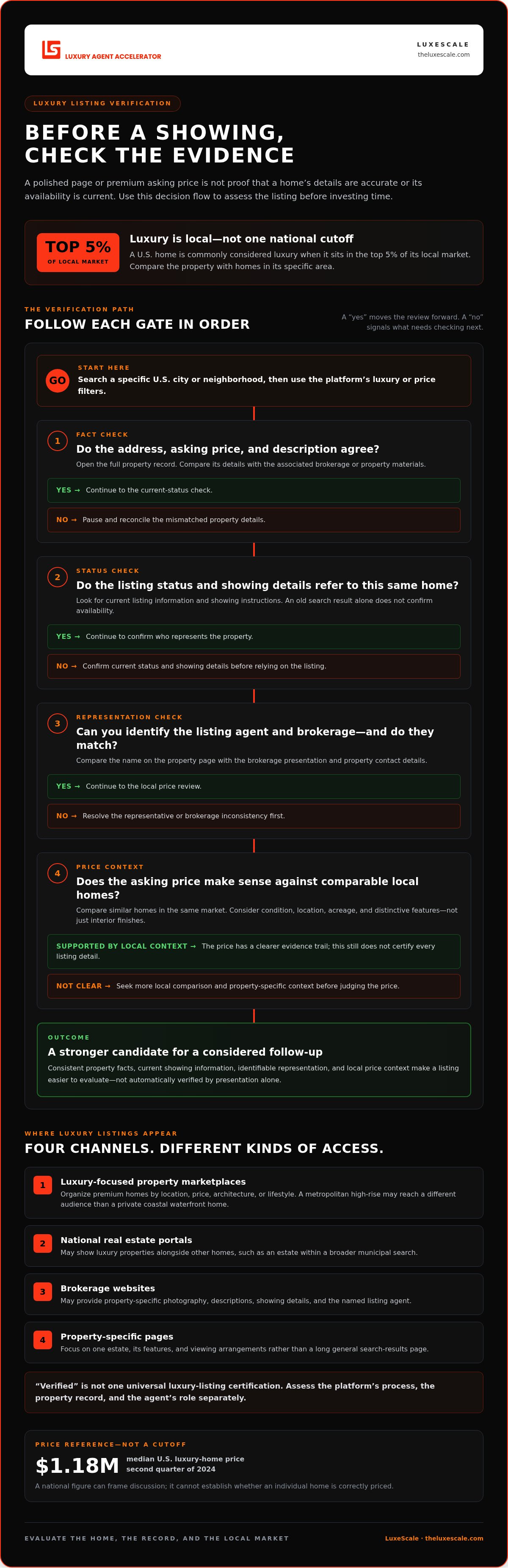
In the United States, “verified” does not refer to one universal luxury-listing platform or shared certification. Buyers encounter high-end properties through multiple channels, each with different listing details and access. Before treating a property as a genuine opportunity, review the platform’s verification process, the listing’s current status, and the agent’s role.
Start with these four platform types:
- Luxury-focused property marketplaces: These organize premium homes by location, price, architecture, or lifestyle. A listing for a metropolitan high-rise residence may reach a different audience than a private coastal waterfront home.
- National real estate portals: Broad search sites can display luxury properties alongside other homes. A suburban estate listing, for example, may appear in a broader municipal search rather than an exclusive luxury-only collection.
- Brokerage websites: Agents and firms may present listings with property-specific photography, descriptions, and showing details. Review the named listing agent and the brokerage information shown.
- Property-specific pages: A dedicated landing page can focus on one estate, its features, and viewing arrangements. This format gives buyers a more concentrated presentation than a long, general search-results page.
Assess the property itself, not just its platform category. A high asking price signals a premium offering, but does not prove that the details or availability are current. Compare the address, images, description, and agent information across the listing and the associated brokerage presentation.
Local context matters, too. A home is commonly considered luxury when it falls within the top 5% of its local market. That means a platform’s luxury filters may surface different price levels depending on the specific municipal region. Don’t assume one national cutoff defines every market. Look for comparable properties and the home’s position within its specific area.
For more focused results, follow this sequence:
- Search a specific U.S. city or neighborhood, then apply the platform’s luxury or price filters.
- Open the full property record and compare its address, asking price, and description.
- Identify the listing agent and brokerage associated with the property.
- Confirm that the showing details refer to that same home, especially when a page links to a private viewing.
These steps help distinguish a polished marketing page from a useful, up-to-date listing. When exploring verified luxury listing opportunities through LuxeScale, always compare the platform’s information with the property’s location, agent, and viewing details. The next section explains how platforms and agents can validate those elements.
How do luxury listing platforms verify agents, properties, and asking prices?
Verification can mean different things on different luxury platforms. A badge may indicate that an agent’s profile was reviewed, while a property record may rely on information supplied by a brokerage. Evaluate each claim separately: a premium presentation alone does not establish that every detail has been checked.
Agent review and property review are separate processes. A platform may display an agent’s brokerage affiliation or professional profile, but that does not confirm the status of a specific home. Look for the agent’s name on the property page, then compare it with the brokerage’s presentation. If the platform and property materials name different representatives, resolve the inconsistency before relying on the contact details.
For the property record, examine details you can compare directly. Use this checklist:
- Address: Match the street address and location across the platform and property materials.
- Images: Check that interior and exterior photos depict the same home and align with its written description.
- Status: Look for current showing instructions and listing information, rather than assuming an old search result remains active.
- Representation: Compare the named agent and brokerage with the contact information provided for that property.
Asking-price review requires context, not just arithmetic. In the second quarter of 2024, the median U.S. luxury-home price was $1.18 million. That national figure can frame a market discussion, but it cannot establish whether a particular home’s price is well supported. Local comparable sales, property condition, location, acreage, and distinctive features shape the analysis. A 50.5-acre parcel, for example, calls for comparisons that reflect land and use, not merely interior finishes.
To assess price consistency, follow these steps:
- Record the displayed price, address, and listing date.
- Compare the price with similar homes in the same local market.
- Review whether the property’s features explain differences from those comparisons.
- Check the listing agent’s materials for consistent figures and property details.
A platform can organize information, but a buyer still needs a clear evidence trail. If an agent is building a luxury-market pipeline, a structured route to listing opportunities can support the step from market research to seller conversations.
Marketing materials can give buyers more ways to examine a property, but they should not replace confirmation of the listing record. An agent can create a dedicated microsite or landing page for that individual property instead of placing a lengthy list of properties on the brokerage website. Agents can also send prospective buyers a link or QR code to access a 3D walkthrough.
Agents can build an opt-in email list of current and previous clients to promote properties, and send follow-up emails with 3D walkthroughs of properties that may interest clients. These outreach methods distribute information, but do not independently confirm an asking price, property status, or agent’s authority. The average total real estate agent commission rate in the United States is 5-6%; treat that as broad context, not proof of the commission for an individual transaction.
What are the eligibility requirements for a verified luxury property listing?
There is no single national cutoff that makes a home eligible for every luxury platform. In the United States, a property is commonly considered luxury when it ranks in the top 5% of its local market. That local benchmark helps explain why a home’s eligibility can differ between Reno, Nevada, and Montecito, California. A platform can also apply its own submission and presentation standards.
Price is one screening signal, not the whole picture. A listing’s position among comparable homes matters more than any single nationwide price threshold. For example, assess a property in a high-priced neighborhood against relevant nearby homes, not listings in a less expensive market. Compare location, property type, land, condition, and distinctive features before deciding whether a luxury classification is appropriate.
Platforms and listing teams can assess several practical elements before accepting or promoting a property:
- Local-market fit: Compare the property with homes in its immediate market and assess whether it sits within the local luxury tier.
- Property identity: Provide a consistent address, description, and set of images so the listing clearly represents one home or parcel.
- Price rationale: Connect the asking price to relevant local comparisons and the property’s features, rather than relying on a luxury label alone.
- Listing authority: Ensure the marketing materials identify the responsible agent or brokerage and provide a clear path for inquiries.
- Buyer-ready presentation: Prepare accurate property details and showing information that support a serious buyer’s review.
A distinctive property illustrates why criteria extend beyond price. A 50.5-acre parcel in Reno presents different buyer considerations from a city residence. Land size, location, access, and the property’s intended use shape its positioning. A listing should make those distinctions clear instead of relying on generic language such as “exclusive estate.”
Before submitting a home, organize its details consistently. Match the address across the listing materials, confirm the photographs show the property, and ensure the asking price aligns with the stated details. Compare the home with local examples, then explain which features support its market position. This gives the platform clearer information to assess and helps create a credible first impression for affluent buyers.
For agents, a Luxury Listing Appointment creates a direct opportunity to discuss a seller’s property, goals, and market positioning. The conversation helps establish whether the home fits the target market and what information is needed to present it effectively.
How do verified luxury listings compare with MLS and off-market listings
These terms describe different aspects of property marketing. A verified luxury listing emphasizes how a platform presents or reviews a property. An MLS listing is entered into a multiple listing service used by real estate professionals. An off-market listing is marketed privately rather than broadly to the public. These categories can overlap: an agent may promote an MLS property through a luxury portal, while another property may be shared privately with selected buyers.
Think of the distinctions as three separate questions: where the property appears, who can access it, and what information has been reviewed. A “verified” label may describe the platform’s own review process. On its own, it does not say whether the property is on the MLS or available only through private introductions. Read the listing details and access instructions to understand what the label means in that context.
- Luxury platform listing: Focuses the presentation on high-end homes, lifestyle features, or a particular market. A property page might include detailed photography and information about private showings.
- MLS listing: Uses an industry listing database to share property information with participating real estate professionals. Its audience and display depend on the MLS and the listing’s distribution.
- Off-market listing: Relies on targeted, private communication instead of broad public advertising. A seller may prefer this approach for privacy or controlled access.
For buyers, each route creates a different search experience. An MLS search can provide structured property details across a defined market. A luxury portal can make it easier to explore high-end homes by location, style, or lifestyle. Off-market access may depend on an agent’s relationships and the buyer’s stated criteria. Someone seeking a secluded estate, for example, may value discreet introductions, while a buyer comparing Manhattan residences may prefer broad online visibility.
Sellers face a related trade-off. Wider distribution can reach more potential buyers, while private marketing can limit exposure and help manage attention. Neither approach automatically establishes a suitable price or produces a qualified buyer. Let the property’s audience, the seller’s privacy priorities, and marketing objectives guide the choice.
To compare a specific opportunity, use this sequence:
- Identify whether the listing is public, MLS-distributed, or privately shared.
- Clarify what “verified” means on the platform displaying it.
- Compare the property details and showing process across available materials.
- Decide whether the access and exposure match your buying or selling priorities.
This distinction helps buyers interpret verified luxury listing opportunities without confusing a platform’s presentation with access to a listing. It also helps sellers choose a marketing route based on reach, discretion, and the buyers they want to engage.
What are the risks of fake, outdated, or misleading luxury property listings
A luxury listing can look polished and still contain errors that disrupt a buyer’s next step. An outdated asking price can skew comparisons, and an unavailable home can waste time arranging travel or a private showing. A misleading description may overstate features, acreage, or location. Treat a platform page as a starting point, not a substitute for a consistent property record.
Consider the Reno property at 515 Rhodes Rd. It had been on Zillow for 88 days. That duration alone doesn’t prove the listing was stale or inaccurate. It does show why buyers should examine the listing date, current status, and showing details before making plans. A long-running page may still be valid, but old information deserves a fresh comparison with the agent’s current materials.
Common warning signs include mismatched addresses, reused images, conflicting prices, and contact details that differ from the named brokerage. Each can create a distinct problem. A wrong address can cause confusion about the property being marketed. A price discrepancy can undermine financial planning. Unclear representation can make it difficult to know who can answer questions or arrange access.
Review the listing carefully before booking a showing or sharing personal information:
- Compare the address, price, and property description across the platform and brokerage materials.
- Check whether the images match the home’s stated features and location.
- Review the listing date and status, then confirm the showing instructions apply to that property.
- Match the named agent and brokerage with the contact information on the listing.
- Keep communications tied to the property and avoid sending sensitive financial details through an unverified channel.
Misleading information can affect sellers, too. An inaccurate feature description may attract poorly matched inquiries, while an outdated price can cause confusion during negotiations. For a high-end home, details such as acreage, views, architectural features, and access can strongly shape buyer interest. Clear, consistent marketing helps prospective buyers assess the property on its merits.
Don’t assume every discrepancy indicates a fake listing. A page may lag behind a price change or status update. Focus on resolving the specific inconsistency before committing time, money, or private information. If you’re an agent building a more reliable pipeline of luxury seller conversations, explore Luxury Listing Appointments as a next step.
These figures provide specific examples of prices shown for Reno properties, but they do not establish that a listing is current or that the homes are directly comparable. Before relying on a price, confirm that it refers to the exact property and matches the agent’s current materials. Treat any discrepancy as a reason to ask for clarification, not as proof of deception. A verified price, address, status, and description together give buyers a firmer basis for deciding whether to pursue a showing or keep comparing options.
LuxeScale: Luxury Listing Appointments
LuxeScale helps real estate agents build a focused path into the luxury market through Luxury Listing Appointments. These appointments connect agents with affluent homeowners ready to discuss selling, creating a direct opportunity to understand the property, seller priorities, and possible next steps.
Turn to this approach when you’re ready to pursue luxury seller conversations but need qualified opportunities and structured support. LuxeScale also offers Affluent Buyer Leads, Affluent Seller Leads, and accompanying award-winning training, coaching, systems, and support. Together, these offerings help agents develop their market expertise while engaging with prospective luxury clients.
To explore whether this approach fits your business goals, visit LuxeScale and start a conversation.
Turn Market Insight Into Your Next Opportunity
The next step is to turn your understanding of affluent buyers into a focused business strategy. For agents, verified luxury listing opportunities matter most when they lead to substantive seller conversations and a clear path to serving the property’s market. That means developing the expertise and confidence to engage high-value prospects, not simply collecting listing links.
LuxeScale offers Luxury Listing Appointments and Affluent Buyer Leads, alongside accompanying award-winning training, coaching, systems, and support. These offerings can help agents pursuing luxury-market growth build momentum while developing the skills to work with affluent clients. Choose your starting point based on whether your priority is connecting with sellers or reaching qualified buyers.
Take the next step at a pace that fits your goals. Contact LuxeScale to discuss your listing and explore a focused path toward your next luxury-market opportunity.
Frequently Asked Questions
What does “verified luxury listing” mean in real estate?
A “verified luxury listing” is a high-end property listing where a platform has reviewed certain details under its own process. The term doesn’t represent one universal certification, so the review’s scope can vary. In the United States, a home is commonly considered luxury when it falls within the top 5% of its local market. Check what the platform’s verification label covers before relying on it for details such as property features or current availability.

Article by
Mark Coppens
Mark Coppens is the Founder and Chairman of LuxeScale and Co-Team Lead of Living Vogue | eXp Luxury. He is an active elite-level luxury agent and the author of the upcoming book, POWER POSITIONING: From Missiles to Mansions – Why People Really Buy, and is a nationally recognized speaker on luxury real estate, consumer psychology, marketing, and business growth.
A U.S. Army veteran with an MBA in Marketing, Mark has generated more than $1 billion in career sales and now leads one of the nation's fastest-growing luxury referral platforms, referring more than $2 billion in luxury real estate opportunities each month to partner agents across the United States. He specializes in helping real estate agents generate more listings, break into the luxury market, and build scalable businesses through qualified referrals, award-winning training, coaching, and proven systems. His practical, psychology-driven approach has helped agents across the country increase their income while attracting more affluent clients and building lasting, referral-driven businesses.